Businesses can no longer afford disjointed systems or delayed information in today’s customer-driven, fast-paced economy. Faster orders are anticipated, real-time inventory accuracy is required, and operations must grow without disruption. However, a lot of businesses continue to use ineffective enterprise resource planning platforms and isolated warehouse management systems. At this point, WMS ERP Integration stops being a technical improvement and instead becomes a strategic requirement.
Businesses gain visibility, control, and agility throughout the whole supply chain when warehouse operations and enterprise systems operate as a single, interconnected ecosystem. Integration removes uncertainty and human intervention in everything from order fulfilment and financial reporting to procurement and inventory planning.
What is WMS ERP Integration?
Comprehending the Idea
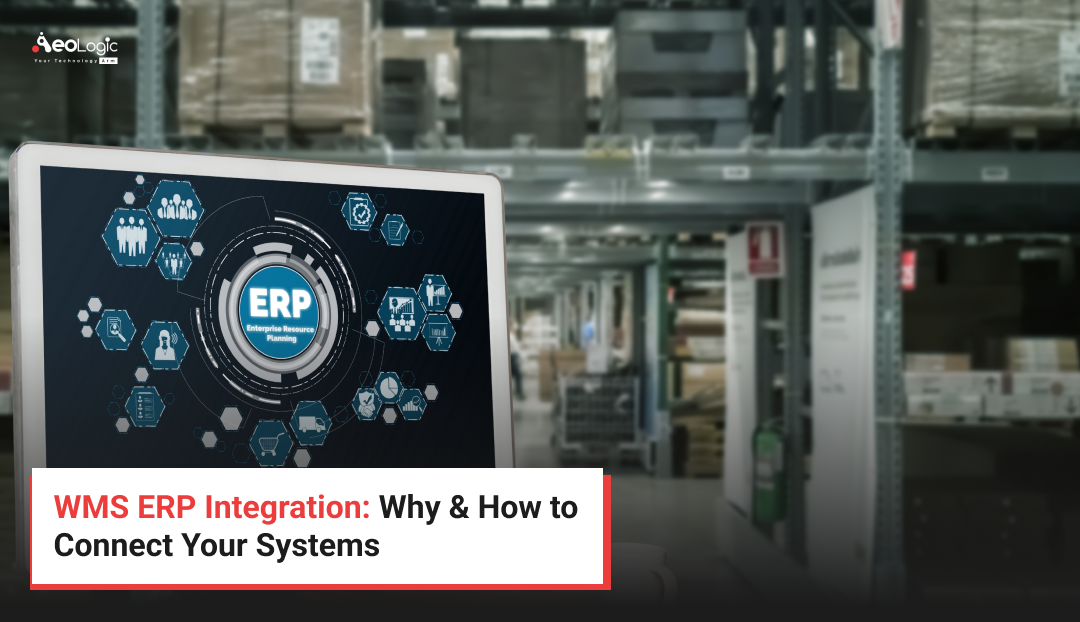
This smooth connection between a Warehouse Management System (WMS) and an Enterprise Resource Planning (ERP) system allows data to move automatically, precisely, and in real time across both platforms.
Warehouse-level execution is the main focus of a WMS, including:
- Monitoring inventory
- Shipping, packing, and picking
- Optimising space and slotting
- Management of labour
Enterprise-wide procedures are managed by an ERP system, such as:
- Accounting and finance
- Acquisition and Purchasing
- Management of sales orders
- Planning for demand
- Human resources
Data silos arise when these systems function independently. By ensuring that both systems operate from a single source of truth, integration closes the gap.
Why WMS and ERP Systems Work Better Together?
Teams frequently rely on spreadsheets, batch uploads, manual data entry, and delayed reports in the absence of integration. These workarounds introduce errors, slow down decisions, and limit scalability.
When WMS and ERP systems are properly integrated:
- Inventory levels are instantly updated.
- Orders automatically move from ERP to WMS.
- Confirmations of shipments are synchronised with ERP
- Maintaining accurate and audit-ready financial records
An operation that operates more quickly, intelligently, and with fewer surprises is the outcome.
 The Increasing Significance of WMS ERP Integration in the Modern Era
Growing Expectations from Customers
Consumers now anticipate:
- Delivery the same day or the following day
- Precise order fulfilment
- Tracking in real time
- Easy returns
It is almost impossible to consistently meet these expectations when systems are disconnected. Integration guarantees that warehouses respond to sales data instantly and without delay.
Complexity of the Supply Chain
Supply chains are now more complicated than before due to global sourcing, omnichannel sales, and shifting demand. Only integrated systems can give businesses the real-time visibility they require across partners, locations, and channels.
Making Decisions Based on Data
Forecasting and analytics are essential to modern businesses. Poor planning decisions result when warehouse data lags behind financial or sales data without proper system integration.
Systems that are integrated allow:
- Precise demand projections
- More intelligent replenishment
- Improved financial planning
Digital Transformation and Scalability
Manual processes break down as businesses expand. Without adding more employees, integration enables automation, AI-driven insights, and scalable operations.
Key advantages of WMS ERP Integration
Inventory Visibility in Real Time
Accurate stock levels are provided by integrated systems in all warehouses and sales channels. This stops:
- Stockouts
- Excess inventory
- Decreased sales
- Restocking in an emergency
Quicker Order Processing
Orders are automatically transferred from ERP to WMS, initiating picking and shipping without the need for human intervention. This increases customer satisfaction and shortens order cycle times.
Decreased Operational Mistakes
One of the main causes of errors is manual data entry. Removing redundant inputs through system synchronization guarantees consistency.
Enhanced Accuracy in Finance
Accurate invoicing, accounting, and compliance are made possible by the direct syncing of shipping confirmations, inventory valuations, and cost updates with ERP.
Improved Planning of Resources
ERP provides insight into labour consumption, warehouse capacity, and throughput, enabling more intelligent forecasting and planning.
Improved Client Experience
Real-time updates, quicker delivery, and accurate orders foster loyalty and trust.
How WMS ERP Integration Works in Practice
Data Transmission Between Systems
In a setting that is integrated:
- WMS receives purchase orders, sales orders, and master data from ERP.
- WMS carries out warehouse operations.
- ERP receives inventory updates, shipment confirmations, and exceptions from WMS.
Every stage of alignment is guaranteed by this bidirectional flow.
Typical Flow of Business Use
In ERP, a sales order is generated.
The order shows up in WMS automatically.
Teams in the warehouse pick, pack, and ship; shipping information is automatically generated and synced with ERP.
Delays and manual oversight are decreased by this smooth procedure.
Integration Models Employed by Companies
Depending on volume and complexity, some organisations use scheduled updates, while others prefer real-time synchronisation between warehouse and enterprise platforms.
Industry Applications of WMS ERP Integration
E-commerce and Retail
To effectively handle omnichannel fulfilment, store replenishment, and returns, retailers rely on WMS and ERP Integration.
Production
In order to coordinate production scheduling with the availability of raw materials and the distribution of completed goods, manufacturers integrate systems.
Third-party warehousing and logistics
In order to handle numerous clients, accurate billing, and service quality, 3PL providers rely on integration.Improving visibility, scalability, contract management, reporting accuracy, profitability, and customer trust.
Medicines and Healthcare
For regulated goods, integrated systems guarantee traceability, compliance, and precise inventory control. Supporting patient safety, regulatory reporting, cold-chain monitoring, recalls, audits, and transparency.
Food and Drinks
Demand variations, batch tracking, and shelf life are all managed with the use of real-time data. minimizing waste, guaranteeing freshness, maximizing output, adhering to regulations, making accurate forecasts, and being responsive.
WMS ERP Integration Technologies and Techniques
Integration Based on APIs
APIs provide flexibility, scalability, and quicker implementation by enabling real-time system communication. such as instantaneous app communication, which minimizes delays, manual labor, mistakes, rework, and frustration.
Platforms for Integration and Middleware
Cloud platforms facilitate remote access, lower infrastructure costs, and simplify connectivity. facilitating communication between various programs without the need for continuous human intervention.
Cloud-Based Integration
Cloud platforms facilitate remote operations, lower infrastructure costs, and simplify connectivity. ensuring that systems are secure, scalable, maintainable, and accessible from any location.
Architecture Driven by Events
Automated workflows across systems are started by triggers like the creation of an order or the completion of a shipment. When something changes, automatic actions take place, saving time and preventing follow-ups.
Challenges in Integrating WMS with ERP Systems
Inconsistencies in Data
Errors can arise from different definitions and data formats. Confusion, rework, and reporting errors can be avoided by maintaining a single version of the truth.
Limitations of Legacy Systems
Modern integration capabilities may not be present in older systems. Middleware or phased modernization helps bridge gaps. Modern layers help old systems connect without breaking critical processes.
Disruption to Operations
Poorly planned integrations can disrupt daily operations. Phased rollouts and testing minimize risk. Gradual rollouts protect teams from downtime, surprises, stress, and impact.
Security Issues
Integrated systems increase data exposure. Monitoring, encryption, and strict access controls are crucial. Strong safeguards keep shared data safe from misuse, leaks, breaches.
Best Ways to Integrate WMS ERP Successfully
Align Integration with Organizational Objectives
Integration should solve real business problems, not just technical ones. Ensures technology investments directly support efficiency, growth, customer satisfaction, measurable outcomes, and long-term strategic success.
Engage Operations Early
Warehouse teams offer vital information about exceptions and workflows. Early involvement reduces rework, enhances adoption, avoids gaps, and captures actual operational realities across daily processes.
Begin with the Fundamental Procedures
Before extending functionality, start with inventory and order synchronization. Prioritizing creates a solid foundation, produces rapid results, and makes future business system integrations easier.
Do a lot of testing
Before going live, simulate failure scenarios, edge cases, and peak volumes. Extensive testing prevents surprises, safeguards consumers, and guarantees dependability in real-world situations and high-load failure stress scenarios.
Continue to Monitor and Optimize
Integration is a continuous process. Regular reviews ensure performance and scalability. Continuous monitoring identifies bottlenecks, facilitates scaling, enhances performance, and proactively promotes continuous improvement over time.
Future Trends of WMS ERP Integration
Optimization Driven by AI
Using integrated data, artificial intelligence will improve labor planning, forecasting, and exception handling. enhancing sustainability, accuracy, scalability, responsiveness, visibility, cooperation, cost, and compliance.
Self-sufficient Warehouses
Real-time ERP connectivity will be crucial for robotics and automation systems. facilitating safer operations, reduced errors, continuous operations, scalability, and quicker fulfillment.
Hyper-Networked Supply Chains
Integration will extend beyond internal systems to suppliers, carriers, and customers. Supporting end-to-end visibility, predictive analytics, planning, risk mitigation, customer satisfaction.
Platforms for Low-Code Integration
These tools will reduce implementation time and dependency on custom development. Empowering users, accelerating innovation, lowering costs, simplifying maintenance, improving governance.
Conclusion
Businesses looking to remain competitive in a fast-paced, digital-first economy must now integrate their warehouse and enterprise systems. It lowers errors and expenses while enabling scalable growth, operational efficiency, and real-time visibility. Businesses that make careful, well-executed integration investments gain a strong basis for automation, analytics, and future innovation.
Businesses like Aeologic Technologies have personally witnessed how well-integrated systems turn warehouse operations from operational bottlenecks into strategic business assets.
Organizations can fully utilize their warehouse and enterprise systems by matching technology with business goals and adhering to tried-and-true best practices.
Frequently Asked Questions
Q1. What is WMS ERP Integration?
It is the seamless connection between a Warehouse Management System and an ERP system to enable real-time data sharing. Ensuring synchronized inventory, orders, financials, and operational data accuracy across platforms.
Q2. What makes WMS and ERP Integration crucial?
It facilitates better decision-making, increases visibility, lowers errors, and expedites order fulfilment. assisting companies in responding more quickly, maximising resources, raising customer satisfaction, and increasing profitability.
Q3. Is WMS and ERP Integration Beneficial for Small Businesses?
Indeed. Integrated systems improve accuracy, scalability, and efficiency for even small operations. permitting expansion without excessive operational overhead, manual labour, or complexity.
Q4. What is the duration of WMS and ERP Integration?
Phased implementations lower risk and disruption, but timelines vary based on system complexity. Stakeholder alignment, testing, and proper planning all have a big impact on how long an implementation takes.
Q5. Is on-premises integration inferior to cloud integration?
Increased flexibility, scalability, and reduced infrastructure costs are all provided by cloud integration. facilitating easier system scalability, quicker updates, less maintenance, and remote access.
Q6. What dangers come with inadequate integration?
Missed business opportunities, operational disruptions, data errors, and security problems. resulting in financial losses, reputational harm, customer dissatisfaction, and compliance risks.
Q7. How can I pick the best integration strategy?
Evaluate your long-term growth plans, data volume, system capabilities, and business objectives. ensuring that future scalability, operational requirements, and technology investments are all in line.

With a strong foundation in software and a growing expertise in AI, I specialize in building smart, scalable solutions that drive digital transformation