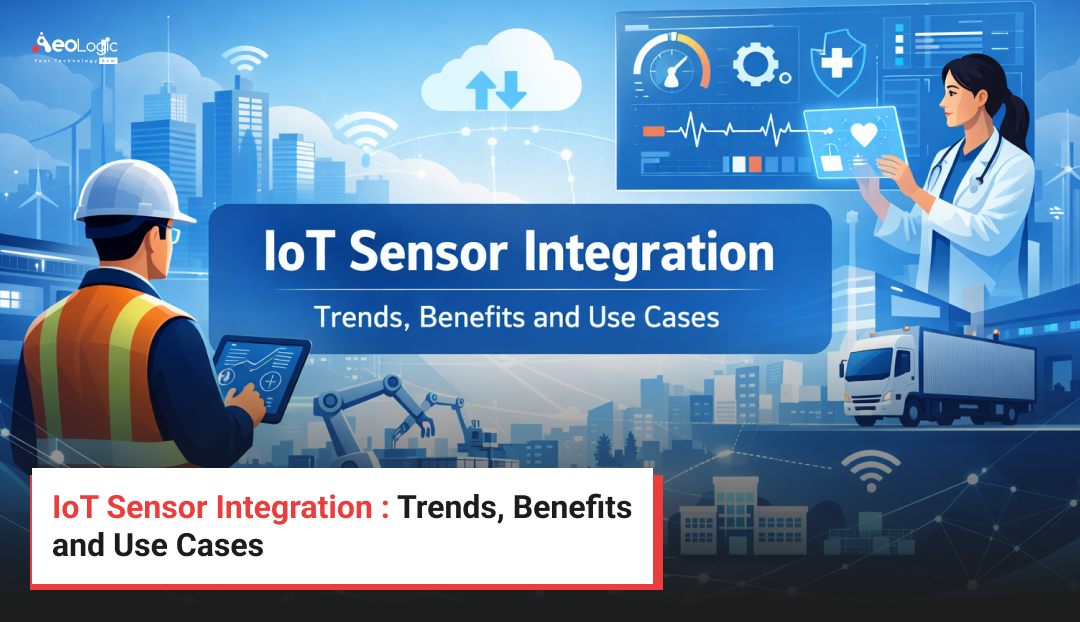
IoT sensor integration, which enables businesses to gather real-time data from the physical world and turn it into actionable intelligence, is quickly emerging as a fundamental component of contemporary digital ecosystems. In 2026, integrated sensor networks will be essential for seamlessly integrating assets, systems, and processes as businesses move towards automation, predictive operations, and AI-driven decision-making. Businesses are depending more and more on integrated IoT sensors to improve visibility, agility, and operational resilience, from manufacturing floors to smart infrastructure.
IoT Sensor Integration is now a strategic capability for professionals and businesses rather than merely a technical improvement. Organisations can increase productivity, lower risks, and develop data-driven business models by integrating sensors with cloud platforms, analytics tools, and enterprise applications. This makes IoT Sensor Integration a key enabler of scalable digital transformation across industries.
This blog explores IoT Sensor Integration, explaining how it connects physical sensors with digital systems to enable real-time data collection, intelligent analytics, and automated decision-making. It covers the core concepts, business relevance, and practical value of integrating IoT sensors across modern enterprises.
What Is IoT Sensor Integration?
The process of integrating physical sensors with software programs, networks, and cloud platforms in order to gather, send, process, and act upon data in real time is known as Internet of Things Sensor Integration. It guarantees data loss and latency-free transmission of sensor-generated data from edge devices to enterprise applications. To provide useful insights, this integration integrates middleware, hardware, connectivity, and analytics layers. To put it simply, it creates a safe and scalable bridge between the real and virtual worlds.
Why IoT Sensor Integration Matters for Enterprises?
In today’s data-driven economy, raw data alone has little value without integration. Businesses can use IoT Sensor Integration to convert sensor data into insightful knowledge that enables quicker and more intelligent decision-making. It facilitates predictive and autonomous processes, lowers downtime, and increases operational transparency. Integrated sensor ecosystems have a direct impact on customer satisfaction, productivity, and compliance for businesses handling complicated assets or supply chains.
Highlights of the Business Impact
- Permits monitoring and control in real time.
- Promotes risk mitigation and predictive maintenance
- Enhances cost optimisation and operational efficiency
- Enhances decision-making based on data
 Core Components of IoT Sensor Integration
Multiple interconnected layers must cooperate seamlessly for IoT sensor to be successful. Every component is essential to guaranteeing performance, scalability, and dependability.
Edge Hardware and Sensor Devices
Physical characteristics like temperature, pressure, motion, and location are recorded by sensors. This data is preprocessed by edge devices to lower latency and bandwidth consumption. Reliable data collection depends on the selection of robust and accurate sensors.
Protocols for Communication and Connectivity
This layer uses protocols like MQTT, CoAP, HTTP, LoRaWAN, NB-IoT, or 5G to guarantee data transmission between sensors and systems. The ideal protocol strikes a balance between coverage, power consumption, and speed.
IoT Integration Layer and Middleware
Middleware serves as a link between enterprise apps and devices. Device authentication, data normalisation, routing, and API integration are all handled by it. Scalable IoT sensor integration relies heavily on this layer.
Analytics, Data Processing, and Visualisation
Collected data is processed using analytics engines, AI models, and dashboards. This makes it possible for business intelligence, predictive insights, and real-time alerts across departments.
Step-by-Step Approach to IoT Sensor Integration
A methodical approach to IoT sensor is advantageous to organisations. Using a phased approach lowers risks and increases return on investment.
Step 1: Establish Use Cases and Business Objectives
Start by identifying the problems to solve—cost reduction, asset tracking, energy optimisation, or safety compliance. Decisions about architecture and technology are guided by specific goals.
Step 2: Choose Connectivity and Sensors
Choose sensors based on accuracy, durability, and environmental conditions. Match connectivity choices to requirements for data frequency, coverage, and power.
Step 3: Design the Integration Architecture
Plan the flow of sensor data through enterprise systems, cloud platforms, and middleware. Assure data security, scalability, and interoperability right away.
Step 4: Implement Analytics and Automation
To extract insights and initiate automated actions, integrate analytics tools and AI models. This step turns raw data into measurable business value.
Step 5: Monitor, Optimize, and Scale
Continue to keep an eye on system health, data quality, and performance. As business requirements expand, scale deployments and optimise configurations.
Key Benefits of IoT Sensor Integration
When properly implemented, IoT sensor offers real benefits across industries.
- Real-time visibility into environments, operations, and assets
- Predictive maintenance to lower repair costs and downtime
- Automation and process optimisation for increased operational efficiency
- Enhanced security and adherence to ongoing surveillance
- Scalability and flexibility for evolving business requirements
Real-World Use Cases and Examples
IoT sensor integration is already changing industry operations in quantifiable, useful ways.
Smart Manufacturing
Temperature, vibration, and machine health are all tracked by integrated sensors. This information is used by manufacturers to forecast malfunctions, cut downtime, and enhance production quality.
Logistics and Supply Chain
Sensors monitor the movement, location, and state of goods in real time. This increases delivery dependability, lowers losses, and improves inventory accuracy.
Medical Care and Remote Surveillance
Continuous patient monitoring is made possible by the integration of medical sensors with digital platforms. Healthcare providers benefit from better patient outcomes and early alerts.
Energy Management and Smart Buildings
Sensors track occupancy, energy use, and environmental factors. Integrated systems optimize energy consumption and reduce operational costs.
Technologies and Platforms Enabling IoT Sensor Integration
To manage scale and complexity, modern IoT sensor ecosystems rely on cutting-edge technologies.
- Cloud-based analytics and data storage platforms
- Edge computing for processing with minimal latency
- Predictive insights using AI and machine learning
- Microservices and APIs for system interoperability
- Digital twins for optimization and simulation
Common Challenges and Best Practices
IoT Sensor Integration has advantages, but it also has drawbacks that call for careful preparation.
Common Challenges
- Lack of standardization and data silos
- Device management problems and security flaws
- Scalability limitations in legacy systems
- Expensive integration and upkeep
Top Strategies for Achievement
- Make use of open architectures and standardized protocols
- Put robust security and device lifecycle management into practice.
- Pilot projects should come before full-scale implementation.
- Align business and IT stakeholders from the start.
Future Trends in IoT Sensor Integration
The future of IoT Sensor is being shaped by advancements in edge computing, AI, and next-generation connectivity. By bringing more intelligence closer to the edge in 2026, sensors and gateways will be able to process data locally, lower latency, and enable real-time automation. This change reduces reliance on centralized cloud infrastructure and facilitates quicker decision-making.
Digital twins, self-optimizing systems, and AI-driven analytics are all becoming commonplace at the same time. Predictive models that predict failures, optimize energy use, and mimic real-world situations are now fed by integrated sensors. With the expansion of 5G, LPWAN, and sustainable IoT deployments, IoT Sensor Integration is evolving into a smarter, more autonomous, and environmentally responsible ecosystem.
Conclusion
In 2026, IoT sensor has become a key factor in operational intelligence, automation, and company expansion. Organizations can gain real-time insights, increase productivity, and create digital infrastructures that are ready for the future by seamlessly integrating sensors with enterprise systems. The value is found in the intelligent integration of data across platforms and procedures, not just in its collection.
To stay competitive in an increasingly connected world, enterprises must adopt a strategic approach to IoT Sensor Integration—one that prioritizes scalability, security, and analytics-driven outcomes.
Now is the time to invest in IoT Sensor Integration—start building scalable, secure, and insight-driven systems that drive growth, efficiency, and innovation.
People Also Ask (FAQs)
Q1. What is IoT Sensor Integration and how does it work?
The process of linking hardware sensors with software systems to gather and process data in real time is known as IoT sensor integration. Sensors record operational or environmental data, which is then sent to middleware and cloud platforms via communication protocols. This integration ensures seamless data flow across devices, applications, and enterprise systems, enabling informed decision-making and automation.
Q2. Why is IoT Sensor Integration important for businesses?
Because it converts unprocessed data into useful insights, IoT sensor integration is essential. Companies benefit from increased operational efficiency, predictive capabilities, and real-time visibility. Integrated systems facilitate data-driven strategies, minimize downtime, and maximize resource utilization. This capability has a direct impact on long-term scalability, customer satisfaction, and profitability in competitive markets.
Q3. Which sectors gain the most from the integration of IoT sensors?
IoT sensor integration greatly benefits a number of industries, including manufacturing, logistics, healthcare, energy, agriculture, and smart infrastructure. Integrated sensors can be used to increase productivity, safety, and compliance in any industry that depends on asset monitoring, environmental data, or real-time decision-making.
Q4. What are the main components of an IoT Sensor Integration system?
Sensors, edge devices, connectivity protocols, middleware, cloud platforms, analytics tools, and user interfaces are all part of an IoT Sensor Integration system. Accurate data collection, safe transmission, processing, and visualization are all guaranteed by each component. When combined, they produce an IoT ecosystem that is dependable and scalable.
Q5. What challenges should organizations expect during IoT Sensor Integration?
Data interoperability problems, security threats, scalability limitations, and integration complexity with legacy systems are typical obstacles. Addressing these challenges requires standardized protocols, robust security frameworks, and a phased implementation strategy aligned with business goals.
Q6. How does IoT Sensor Integration support digital transformation?
Digital transformation is made possible by IoT Sensor Integration, which links digital platforms and physical operations. It provides real-time data, supports automation, and enables advanced analytics and AI. Faster innovation, process optimization, and the creation of intelligent, networked businesses are all made possible by this foundation.

With a strong foundation in software and a growing expertise in AI, I specialize in building smart, scalable solutions that drive digital transformation