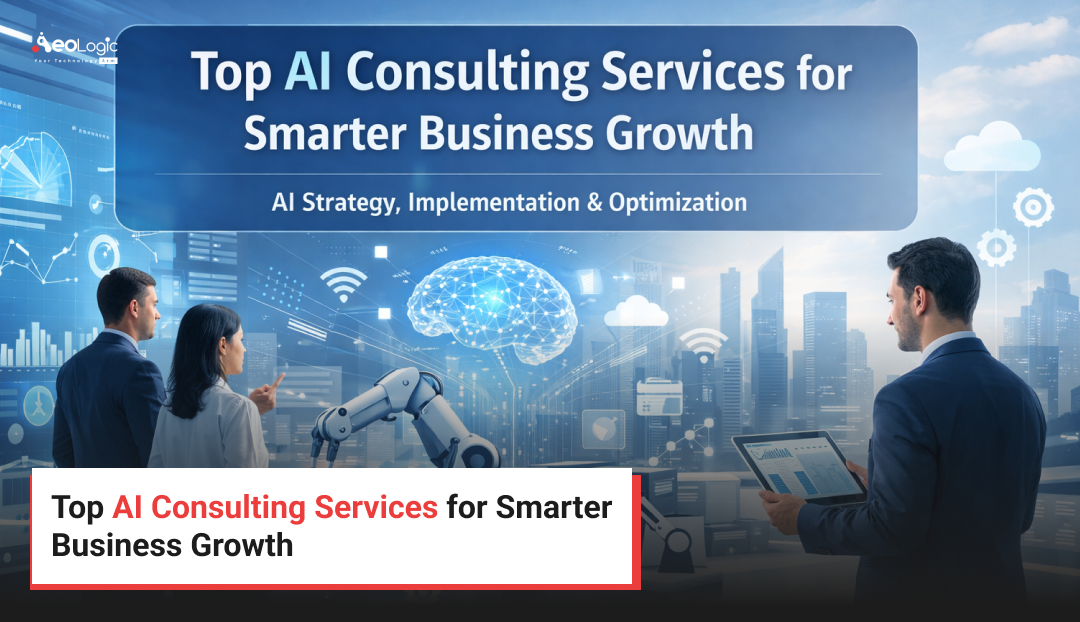
The development of artificial intelligence has progressed from experimentation to implementation. AI is currently being actively used by businesses in a variety of sectors to enhance operations, enhance decision-making, and open up new revenue streams. The true difficulty, though, is not in implementing AI tools but rather in strategically using them to address actual business issues. In this dynamic environment, AI consulting services are essential for assisting businesses in locating high-impact AI prospects, creating scalable solutions, and guaranteeing quantifiable results.
These services, which span from strategy development to implementation and optimisation, help close the gap between cutting-edge technology and business value, facilitating the more intelligent, rapid, and sustainable adoption of AI.
This blog explores how AI consulting services help organizations define strategy, implement scalable AI solutions, overcome adoption challenges, and drive measurable business growth through intelligent, future-ready technologies.
What Are AI Consulting Services?
Professional advisory and implementation services that assist businesses in planning, developing, implementing, and overseeing AI solutions in line with their objectives are referred to as AI consulting services. These services blend in-depth business knowledge with technical proficiency in automation, data science, and machine learning.
In order to determine readiness, establish use cases, choose the best technologies, and incorporate AI into current systems, an AI consulting partner usually collaborates with stakeholders. The goal is to develop useful, scalable, and moral AI systems that provide long-term benefits, not just algorithms.
Why AI Consulting Services Matter for Modern Businesses
Accelerating AI Adoption with Reduced Risk
Skill gaps, unclear AI road maps, and fragmented data are problems for many organisations. By offering organised frameworks, tried-and-true techniques, and skilled teams, AI consulting services aid in the removal of these obstacles. This expedites time-to-value and drastically lowers trial-and-error expenses.
Businesses can steer clear of overengineering and concentrate on use cases that have a direct impact on revenue, efficiency, and customer experience by coordinating AI initiatives with strategic goals.
Creating Measurable Business Results
AI projects are only successful when they produce measurable outcomes. Every model, workflow, or automation is linked to KPIs like cost reduction, productivity enhancement, or customer satisfaction thanks to consulting-led approaches. AI is no longer a technical experiment but rather a business enabler due to its outcome-driven mindset.
 Core Components of Effective AI Consulting Services
AI Strategy and Roadmap Development
Clarity is the first step in a successful AI journey. Consultants assist in prioritising use cases, developing phased roadmaps, and defining an enterprise-wide AI vision. To guarantee scalability and compliance, this includes governance planning, ROI modelling, and data readiness assessments.
Data Engineering and Intelligence Foundation
AI is only as good as the data that supports it. Consulting teams create analytics frameworks, guarantee data quality, and build strong data pipelines. Consistent decision-making throughout the company, real-time insights, and dependable model training are made possible by this foundation.
Model Development, Deployment, and Optimization
Consultants create and implement models based on business requirements, ranging from generative AI to predictive analytics. In order to preserve accuracy and relevance, they also concentrate on MLOps procedures, performance monitoring, drift management, and ongoing model optimisation.
Step-by-Step Approach to Implementing AI Successfully
Identification of Business Problems
Begin by identifying specific issues, like demand forecasting or fraud detection, where AI can be useful.
Evaluation and Preparation of Data
To guarantee viability, assess data security, quality, and availability.
Designing Solutions and Choosing Technologies
Select the right cloud infrastructure, platforms, and algorithms.
Validation and Pilot
Create proof-of-concepts to measure early impact and validate assumptions.
Enterprise Deployment and Scaling
Workflows, systems, and decision-making processes should all incorporate AI.
Continuous Improvement and Governance
Implement monitoring, performance optimisation, and ethical AI practices.
Key Benefits of AI Consulting Services
- AI adoption that is quicker and more assured
- Enhanced operational effectiveness and cost reduction
- Large-scale data-driven decision-making
- Lower technical debt and implementation risks
- Improved communication between business strategy and technology
Real-World Use Cases and Examples
By evaluating sensor data, AI-powered predictive maintenance in manufacturing lowers unscheduled downtime. Demand forecasting models in retail enhance inventory management and cut down on waste. AI is used by financial institutions for risk assessment, fraud detection, and customer personalisation. Consulting-led AI deployments across industries guarantee that these solutions are secure, scalable, and ROI-oriented.
Technologies and Platforms Commonly Used
Instead of relying on discrete tools, successful AI initiatives depend on a well-coordinated technology stack. In order to guarantee scalability, security, and performance throughout the organization, AI consulting engagements usually combine data, AI, cloud, and integration platforms.
Platforms for Analytics and Data Management
Any AI solution must have a solid data foundation. In order to combine structured and unstructured data, consultants frequently use contemporary data warehouses, data lakes, and analytics platforms. These platforms guarantee compliance and data governance while facilitating real-time data processing, sophisticated analytics, and smooth data access for AI models.
Frameworks for AI and Machine Learning
Widely used machine learning frameworks are used to create, train, and implement AI models. These frameworks enable versatility across use cases, including recommendation, classification, and prediction systems, by supporting supervised, unsupervised, and deep learning models. Frameworks are chosen by consultants according to factors like performance, scalability, and compatibility with current systems.
AI and Cloud Platform Services
The adoption of AI in enterprises is significantly influenced by cloud-based AI platforms. They offer pre-built AI services, scalable computing power, and MLOps capabilities for managing the lifecycle and deploying models. Cloud environments also facilitate safe team collaboration, cost optimization, and quick experimentation.
Tools for Automation, Integration, and MLOps
AI is operationalized through the embedding of models into business workflows through automation and integration tools. MLOps platforms facilitate the management of model versioning, monitoring, retraining, and performance tracking. This ensures AI solutions remain reliable, explainable, and continuously optimized.
Common Challenges and Best Practices
Despite AI’s enormous business potential, organizations frequently encounter real-world obstacles when implementing it. Addressing these challenges early with proven best practices is key to long-term success.
Common Challenges in AI Implementation
Poor data quality or fragmented data sources are among the most common issues, and they have a direct effect on model accuracy. Uncertain goals are another issue that many organizations face, which results in AI initiatives with no quantifiable results. Adoption is further slowed by a lack of skills, the difficulty of integrating with legacy systems, and worries about data privacy and compliance.
Over engineering, or the use of sophisticated AI solutions without a clear business rationale, is another significant problem. High expenses, poor adoption, and a small return on investment are the outcomes of this.
Best Practices for Sustainable AI Success
Starting with clearly defined, high-impact use cases that complement business priorities is the most efficient strategy. Early implementation of robust data governance frameworks guarantees data security, dependability, and regulatory compliance. To make sure AI solutions are useful and embraced throughout the company, cross-functional cooperation between data scientists, IT teams, and business executives is crucial.
Explainable and moral AI practices should also be given top priority by organizations. Transparent models lower regulatory risks and increase stakeholder trust. Lastly, organizations can adjust models as data, markets, and business requirements change by embracing AI as a continuous improvement project rather than a one-time implementation.
Future Trends in AI Consulting Services
Project-based implementation of AI consulting is quickly giving way to long-term, value-driven collaborations. The emergence of industry-specific AI solutions, where consultants provide pre-built models and frameworks suited to industries like manufacturing, healthcare, finance, and logistics, is one of the most important trends. As global AI regulations develop, there is a growing emphasis on transparency, bias mitigation, data governance, and regulatory compliance, making responsible and explainable AI a fundamental requirement.
The increasing use of generative AI, AI agents, and autonomous decision systems in businesses is another significant change. Using automation, MLOps, and AI-as-a-service models to integrate these capabilities into fundamental business processes is the growing focus of AI consulting services. AI is becoming a key element of long-term digital and enterprise transformation as organizations shift away from one-time deployments and toward continuous optimization, where AI systems learn, adapt, and scale alongside business needs.
Conclusion
AI is now a strategic necessity rather than an option. But how well it is embraced and scaled will determine its success. The knowledge, framework, and execution skills required to turn AI from a concept into a competitive advantage are offered by AI consulting services.
Working with seasoned companies like Aeologic Technologies can assist you in designing, implementing, and scaling AI solutions that promote more intelligent growth and long-term value if you’re hoping to go beyond experimentation and achieve genuine business impact.
People Also Ask (FAQs)
Q1. What is included in AI consulting services?
Strategy development, data analysis, model design, implementation, integration, and continuous optimization are all common components of AI consulting services. To guarantee the long-term adoption of AI, they also address governance, security, and ethical issues.
Q2. How do businesses benefit from AI consulting?
Companies benefit from measurable results, accelerated time-to-value, lower implementation risk, and structured guidance. Instead of being isolated technical experiments, consulting helps align AI initiatives with actual business goals.
Q3. Are AI consulting services suitable for small and mid-sized enterprises?
Indeed. Organizations of all sizes can begin with specific use cases and progressively increase their AI capabilities thanks to the modularity and scalability of many consulting approaches.
Q4. What is the typical duration of an AI consulting engagement?
The complexity determines the timeline. Depending on data readiness and integration requirements, the strategy and assessment stages could take a few weeks, while the full implementation and scaling could take several months.
Q5. What industries commonly use AI consulting?
AI consulting is widely used by sectors like manufacturing, healthcare, finance, retail, logistics, and energy to increase productivity, forecast accuracy, and customer satisfaction.
Q6. How do AI consultants ensure ROI?
To make sure AI projects provide real business value, consultants set KPIs up front, rank high-impact use cases, and track results over time.

I’m a Software Developer with 9 years of experience building scalable web and mobile applications. Currently focused on React.js and React Native, I specialize in creating high-performance, user-friendly interfaces that drive business outcomes.
My background spans cross-platform development using Flutter, and native Android development, giving me a strong understanding of the entire mobile ecosystem. I’ve contributed to products in EdTech, Healthcare, and Enterprise SaaS—helping scale apps to 100K+ users and improving performance, reliability, and user engagement.
I’m passionate about clean architecture, modular design, and seamless user experiences. Whether it’s setting up robust state management with Redux Toolkit, optimizing API integrations with GraphQL/REST, or automating workflows with CI/CD pipelines (GitHub Actions)—I focus on writing maintainable code and delivering value to both users and stakeholders.