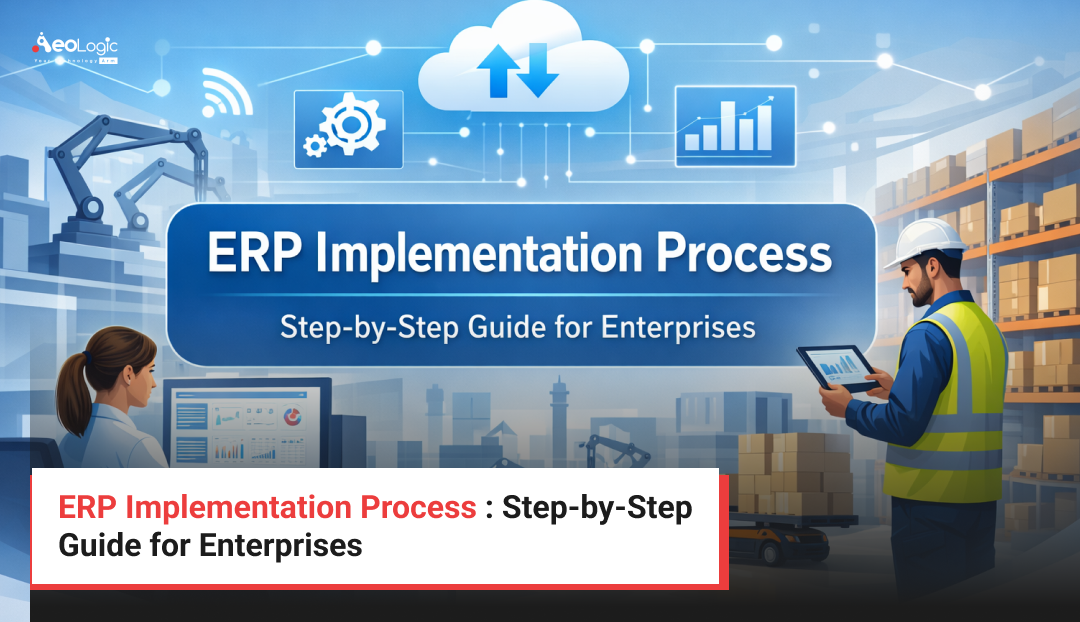
In order to achieve operational efficiency, data transparency, and strategic agility, modern organizations now rely heavily on enterprise resource planning systems. In order for businesses to successfully move from legacy systems to integrated, scalable platforms that foster innovation and growth, the ERP Implementation Process is essential.
ERP implementation is a strategic transformation endeavor for businesses, not merely a technical improvement. When done correctly, the ERP Implementation Process unifies departments under a single system, optimizes workflows, and enhances decision-making using real-time data. But in the absence of a systematic approach, it may result in delays, user resistance, and cost overruns.
What Is the ERP Implementation Process?
The methodical approach used to organize, set up, launch, and enhance an enterprise resource planning system inside a company is known as the ERP Implementation Process. To ensure seamless adoption, it entails rethinking workflows, moving data, training users, and matching business objectives with system capabilities.
Fundamentally, ERP implementation creates a centralized system that links departments like supply chain, manufacturing, sales, finance, HR, and procurement. The goal is to replace fragmented applications with a single source of truth that facilitates strategic planning and operational excellence.
Why the ERP Implementation Process Matters for Enterprises
Whether a business experiences disruption or a quantifiable return on investment depends on how well the ERP implementation process is carried out. Implementing ERP systems has an impact on people, processes, and performance at the same time because they affect almost every department.
Business Impact and Real-World Relevance
- Enhanced departmental operational visibility
- Real-time dashboards and data-driven decision-making
- Automation of processes to reduce costs
- Standardized reporting in accordance with regulations
- Improved scalability to accommodate growth
ERP implementation, for instance, can streamline procurement, inventory tracking, and production planning in a manufacturing company, lowering stock disparities and speeding up delivery. To enhance profitability analysis, service-based businesses can also centralize their HR, project management, and billing processes.
 Core Components of a Successful ERP Implementation Process
Success in the ERP journey is determined by a number of fundamental pillars.
Strategic Planning and Requirement Analysis
Businesses need to establish specific business goals before choosing software. This entails prioritizing functional requirements, recording workflows, and locating operational gaps. Involving stakeholders at this point guarantees that the operational and leadership teams are in agreement.
ERP System Selection
Industry requirements, scalability, customization potential, and integration potential all play a role in selecting the best platform, whether it be SAP, Oracle, Microsoft Dynamics, or another enterprise-grade system. Because of their flexibility and reduced infrastructure costs, cloud-based ERP solutions are becoming more and more popular.
Process Redesign and Customization
ERP works best when businesses modify their procedures to follow best practices instead of heavily altering the program. Prior to system configuration, business process reengineering, or BPR, aids in streamlining workflows.
Data Migration and Integration
Structured migration, validation, and data cleansing are essential. Continuity across operations is ensured through integration with third-party platforms, legacy databases, IoT devices, and CRM systems.
Testing and Quality Assurance
Before going live, thorough testing—including unit, integration, and user acceptance testing—makes sure the system works as planned.
Training and Transformation Management
The largest challenge is frequently employee adoption. Clear communication techniques and organized training programs lower resistance and boost output after launch.
Step-by-Step ERP Implementation Process for Enterprises
Below is a practical, structured approach enterprises can follow:
Define Objectives & Scope
Identify the objectives, difficulties, and KPIs of the business. Clearly state the project’s goals, budget, schedule, and scope.
Form Implementation Team
To guarantee cross-functional coordination, designate an ERP consultant, executive sponsor, project manager, and representatives from important departments.
Requirement Analysis & Process Mapping
Record current procedures, find any gaps, and match procedures to ERP best practices.
ERP System Selection
Based on integration requirements, industry fit, and scalability, select the best ERP platform (SAP, Oracle, Microsoft Dynamics, etc.).
System Configuration & Customization
Set up modules, roles, dashboards, and workflows. If necessary, carry out some limited customization.
Data Migration
To guarantee accuracy, clean, verify, and transfer legacy data into the new system while testing.
Testing & User Acceptance
Prior to deployment, carry out user acceptance testing (UAT), integration testing, and functional testing.
Training & Change Management
Employee training, clear communication of changes, and team preparation for system adoption are all important.
Go-Live Deployment
Start the ERP system (either fully or in phases) and keep a careful eye on its performance.
Post-Implementation Support & Optimization
Continued support, KPI measurement, problem solving, and system performance enhancement are all important.
Key Benefits of a Structured ERP Implementation Process
Measurable business benefits are offered by a methodical approach:
- Enhanced cooperation across functional boundaries
- Accurate and centralized reporting
- quicker cycles for financial closures
- Improved supply chain and inventory management
- Decreased manual mistakes and repetition
- Improved client satisfaction
- Enhanced readiness for audits and compliance
Common Challenges and Mistakes in ERP Implementation
ERP initiatives are intricate programs that transform an entire organization. Despite meticulous preparation, businesses frequently encounter obstacles that can affect budgets, schedules, and adoption rates. Execution success is greatly increased when these risks are known ahead of time.
Lack of Clear Business Objectives
Treating ERP as an IT upgrade rather than a business transformation project is one of the most frequent errors. Projects lose focus if their objectives are not well defined, such as cutting operational expenses, increasing supply chain visibility, or improving reporting accuracy.
Impact:
- Scope creep
- Unmatched expectations
- ROI measurement challenges
Before implementation starts, businesses should establish quantifiable KPIs.
Poor Involvement of Stakeholders
ERP has an impact on manufacturing, sales, HR, finance, and procurement, among other areas. Resistance and misalignment may occur if department leaders and end users are not consulted early on.
Typical problems include:
- Absence of cooperation across functional boundaries
- Inadequate collection of requirements
- Low post-go-live user adoption
Department-level champions and strong executive sponsorship are essential.
Over-Customization of the System
ERP can be customized to fit specific workflows, but making too many changes raises the complexity, cost, and difficulty of upgrades. Instead of implementing ERP best practices, businesses frequently try to duplicate legacy processes.
Over-customization risks include:
- Increased implementation expenses
- Extended deployment cycles
- Complex upgrades in the future
- A greater reliance on suppliers
Long-term technical debt is decreased by prioritizing best practices.
Poor Data Migration Strategy
ERP systems depend on precise, well-organized data. Reporting and decision-making may be jeopardized if old or inconsistent data from legacy systems is migrated without being cleaned.
Typical errors in data migration:
- Ignoring data validation
- The master data mapping is incomplete.
- Absence of trial migrations
- Disregarding data governance
To guarantee integrity and compliance, businesses should set up a specialized data team.
Weak Change Management and Training
Employee daily operations are altered by ERP implementation. Even technically successful deployments can go wrong if there is inadequate training and communication.
Among the difficulties are:
- Resistance from users
- After going live, productivity declines
- Inappropriate use of the system
Adoption is sped up and friction is decreased through organized training sessions, workshops, and post-launch assistance.
Unrealistic Timelines and Budget Underestimation
Due to underestimated complexity, integration needs, and change management initiatives, ERP projects frequently go over their original budgets.
Factors that contribute:
- Not enough preparation for emergencies
- Expansion of the scope during implementation
- Integration efforts were underestimated.
A phased implementation strategy with milestone reviews improves predictability.
Lack of Post-Go-Live Optimization
After deployment, many businesses view ERP implementation as complete. Ongoing needs, however, include system upgrades, performance monitoring, and optimization.
Constant improvement guarantees:
- Improvement of the process
- Improved use of analytics
- Improved automation
- Better return on investment
ERP should evolve alongside business growth.
Technologies and Platforms Involved in ERP Implementation
Modern ERP ecosystems go beyond traditional back-office automation. They incorporate cutting-edge technologies that improve connectivity, scalability, and intelligence.
Leading ERP Platforms
Platforms are usually assessed by businesses according to their scalability, industry fit, and integration potential.
Well-known business ERP options consist of:
- SAP S/4HANA (on-premises and cloud)
- Cloud ERP for Oracle Fusion
- Dynamics 365 by Microsoft
- CloudSuite by Infor
- NetSuite (for businesses in the mid-market)
Finance, supply chain, human resources, manufacturing, procurement, and analytics are all covered by the modular functionality available on each platform.
Artificial Intelligence and Advanced Analytics
ERP systems are being transformed by AI from transactional instruments to predictive engines.
Among the AI-powered capabilities are:
- Predictive upkeep
- Processing invoices intelligently
- Identification of fraud
- Financial reconciliation that is automated
Dashboards for advanced analytics offer real-time insight into performance metrics and KPIs.
Robotic Process Automation (RPA)
By automating repetitive rule-based tasks like these, RPA improves ERP systems.
By automating repetitive rule-based tasks like these, RPA improves ERP systems.
- Entering data
- Processing invoices
- Payroll computations
- Reporting on compliance
RPA integration speeds up operations and lowers human error.
Integration Technologies and APIs
The following must be seamlessly integrated with modern ERP systems:
- CRM systems
- Systems for eCommerce
- Tools for supply chain management
- IoT gadgets
- Providers of third-party logistics
- Gateways for payments
Integration frameworks, middleware platforms, and APIs guarantee seamless data transfer between systems.
IoT and Industry 4.0 Integration
ERP connects with IoT sensors in the manufacturing and logistics industries to allow:
- Monitoring of equipment in real time
- Inventory tracking that is automated
- Alerts for predictive maintenance
- Intelligent warehouse operations
An interconnected enterprise ecosystem is produced as a result.
Cybersecurity and Compliance Technologies
Because ERP systems contain sensitive financial and operational data, businesses need to put in place:
- Access controls based on roles
- Authentication with multiple factors
- Encrypting data
- Tools for ongoing monitoring
- Frameworks for regulatory compliance (GDPR, ISO, etc.)
Security is now fundamental, not optional.
Emerging Technologies Shaping ERP
The following are part of the future of ERP implementation:
- Blockchain technology for open supply chain monitoring
- Platforms with low code for quicker customization
- Workflows with embedded analytics
- ERP apps that prioritize mobile
- AI generative assistants for business insights
Businesses that use these technologies benefit from increased strategic vision and competitive agility.
Future Trends in ERP Implementation
The ERP environment is changing quickly:
- Automation powered by AI for smart workflows
- Low-code/no-code personalization
- ERP solutions tailored to certain industries
- Integrating blockchain technology for safe transactions
- Using predictive analytics to make proactive decisions
Instead of considering ERP as a stand-alone system, forward-thinking businesses are emphasizing agility, scalability, and digital transformation integration.
Conclusion
By integrating systems, increasing visibility, and facilitating data-driven growth, a carefully thought-out ERP implementation process revolutionizes business operations. Stakeholder participation, strategic alignment, careful planning, and ongoing optimization are essential for success.
ERP implementation should not be viewed as a one-time IT project but rather as a long-term transformation initiative by businesses seeking to modernize their operations. Businesses may fully utilize ERP systems and gain a sustainable competitive edge with the correct knowledge, governance, and execution framework, aided by seasoned technology partners like Aeologic Technologies.
Now is the ideal moment to create a well-organized plan that guarantees quantifiable success if your company is thinking about implementing ERP or updating its systems.
People Also Ask (FAQs)
Q1. What is the ERP Implementation Process?
An organized method for implementing an enterprise resource planning system throughout a company is the ERP Implementation Process. Planning, system selection, configuration, data migration, testing, training, and go-live are all included. Integrating essential business operations into a single platform with increased efficiency and data accuracy is the goal. A successful deployment guarantees seamless user adoption and harmonizes technology with business strategy.
Q2. How long does an ERP implementation take?
The size, complexity, and customization needs of the organization all affect how long it takes to implement ERP. Deployment can be finished in 4–8 months for small to mid-sized businesses and 12–24 months for large businesses. Duration is greatly impacted by elements like change management planning, integration requirements, and the complexity of data migration.
Q3. What are the major phases of ERP implementation?
Planning, requirement analysis, system design, configuration, data migration, testing, training, deployment, and post-go-live support are some of the key stages. To guarantee organized progress and risk reduction, each phase builds on the one before it.
Q4. What are common ERP implementation risks?
Budget overruns, low user adoption, insufficient testing, incomplete data migration, and a mismatch between system configuration and business processes are typical risks. These risks are decreased by executive sponsorship, organized change management, and efficient governance.
Q5. How much does ERP implementation cost?
Software licensing, customization, integration, infrastructure, training, and consulting services all affect costs. Although they may use subscription-based pricing structures, cloud ERP solutions usually require less initial infrastructure investment. Depending on the size and complexity of the business, total costs can vary significantly.
Q6. Why do ERP implementations fail?
Failures often stem from unclear objectives, lack of leadership involvement, resistance to change, insufficient planning, or over-customization. A disciplined, phased strategy with stakeholder engagement significantly increases success rates.

With a strong foundation in software and a growing expertise in AI, I specialize in building smart, scalable solutions that drive digital transformation