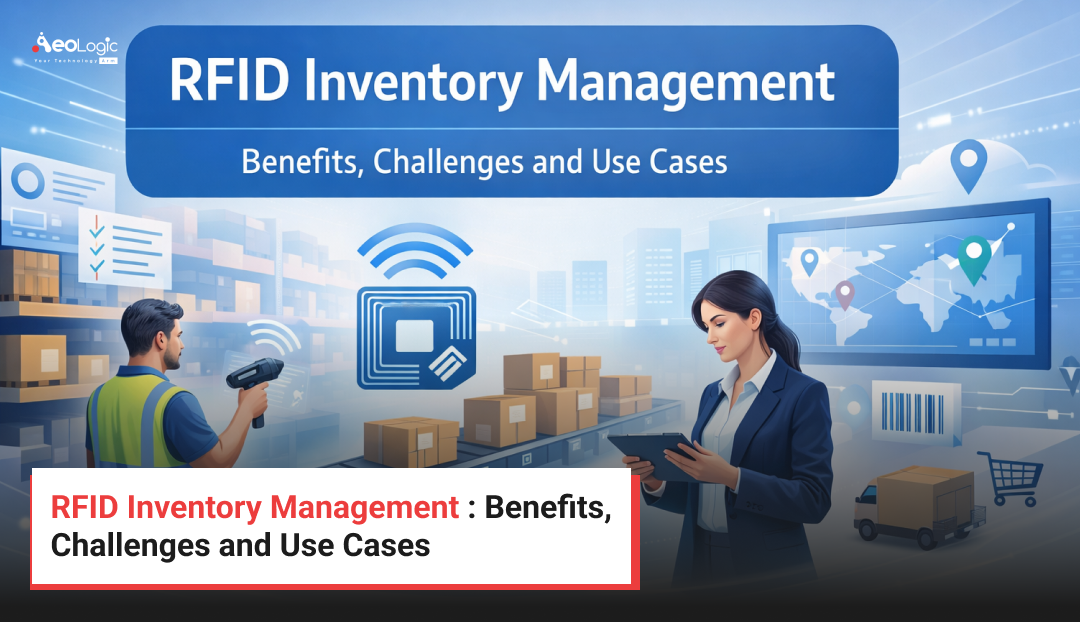
Businesses can no longer depend on manual stock counts and barcode-only systems to maintain inventory accuracy in the fast-paced, data-driven economy of today. Real-time visibility, automation, and operational control across warehouses, retail locations, manufacturing facilities, and supply chains are made possible by RFID inventory management, which has become a game-changing solution.
In order to lower losses, avoid stockouts, and boost customer satisfaction, businesses are increasingly investing in this technology in search of greater accuracy, quicker operations, and better traceability. The use of RFID-driven systems is revolutionizing the tracking, monitoring, and optimization of inventory in both large and mid-sized businesses.
What is RFID Inventory Management?
RFID Inventory Management is a technologically advanced system that tracks inventory automatically and in real time using Radio Frequency Identification (RFID) tags, readers, and software. Since RFID doesn’t require line-of-sight scanning like barcodes do, it can read multiple items at once in bulk.
Fundamentally, the system consists of:
- Passive, active, or semi-passive RFID tags
- RFID antennas and readers
- Software for integration and middleware
- Dashboards for inventory analytics
Businesses can continuously monitor the movement, location, and status of their stock throughout the supply chain by affixing RFID tags to goods, pallets, or other assets.
Why RFID Inventory Management Matters for Modern Enterprises
Accurate inventory has a direct impact on revenue, operational effectiveness, and customer trust in markets with intense competition. Reducing shrinkage, increasing fulfillment speed, and facilitating data-driven decision-making are all made possible by RFID inventory management.
It matters because it helps businesses:
- Minimize human error in inventory counting
- Boost order fulfillment rates and accuracy
- Allow for cross-location real-time stock visibility
- Reduce the amount of money lost to theft or loss
-
Strengthen supply chain transparency
The ability to track items automatically can result in significant cost savings and improved compliance for industries like manufacturing, logistics, retail, and healthcare.
 Core Components of RFID Inventory Management Systems
A well-executed system is composed of several interrelated parts. Successful deployment is ensured by comprehension of these pillars.
RFID Tags
Product-specific data is stored on RFID tags. They may be:
- Passive (without an internal power source)
- Active (longer range due to battery power)
- hybrid functionality, or semi-passive
The operational environment, cost limitations, and range requirements all influence the decision.
RFID Readers and Antennas
Radio waves released by readers activate tags and collect data. While handheld readers help with audits and cycle counts, fixed readers are frequently used at warehouse gates.
Middleware and Integration Layer
Before transferring raw tag data to inventory management, WMS, or ERP systems, this layer filters and processes it. Across enterprise platforms, integration guarantees smooth data flow.
Data Analytics and Reporting
Predictive inventory planning is made possible by modern solutions that offer dashboards that provide information on stock levels, movement patterns, and replenishment requirements.
Key Benefits of RFID Inventory Management
The main reasons why organizations use this technology are quantifiable increases in visibility and efficiency.
Improved Inventory Accuracy
- 99% accuracy is attained.
- Removes errors in manual counting
- Minimizes inconsistencies in stock records
Real-Time Visibility
- Instantly tracks the movement of inventory
- Facilitates proactive restocking
- Facilitates omnichannel operations
Faster Operations
- Scanning several items in bulk
- Shorter time spent on checkout and dispatch
- Accelerated counts of warehouse cycles
Reduced Shrinkage and Loss
- Improved detection of theft
- Enhanced traceability
- Improved control over audits
Enhanced Customer Experience
- Precise stock availability
- Quicker order fulfillment
- Decreased stockouts
Step-by-Step Approach to Implement RFID Inventory Management
Structured planning and execution are necessary for a successful deployment.
Step 1: Define Business Goals
Determine the main issues, such as slow order processing, shrinkage, or inaccurate stock. Set quantifiable KPIs.
Step 2: Perform a Process Evaluation
Evaluate the system’s capabilities and current inventory workflows. Determine the needs for ERP or WMS integration.
Step 3: Select Appropriate RFID Hardware
Depending on the environment and operational requirements, select the tag type, reader range, and frequency.
Step 4: Integrate with Enterprise Systems
Utilize supply chain software, reporting dashboards, and inventory platforms to guarantee smooth data flow.
Step 5: Pilot and Optimize
Before expanding enterprise-wide, conduct a controlled pilot in a particular department or warehouse.
Step 6: Develop Teams
Teach managers and employees in the warehouse how to analyze and respond to real-time inventory data.
Real-World Use Cases Across Industries
Retail
RFID is used by retailers to enable precise omnichannel fulfillment, minimize shrinkage, and preserve shelf-level visibility. It lowers lost sales and increases inventory accuracy.
Manufacturing
To ensure a more efficient production flow and less downtime, manufacturers keep track of raw materials, work-in-progress items, and completed products. Companies like RFID Manufacturers in India help enable real-time tracking and improved inventory visibility across the production lifecycle.
Healthcare
RFID is used by hospitals to keep an eye on medications, medical equipment, and supplies, enhancing patient safety and legal compliance.
Logistics & Storage
RFID gates are used by warehouses to automate inbound and outbound tracking, which speeds up dispatch procedures and reduces errors.
Common Challenges and Mistakes
Adoption has obvious advantages, but there are obstacles that organizations must successfully overcome.
High Initial Investment
Upfront funding may be necessary for RFID hardware and system integration. Long-term ROI, however, frequently outweighs expenses.
Integration Complexity
Value realization may be limited by inadequate ERP or WMS system integration.
Environmental Interference
Signal interference from metal surfaces and liquids necessitates careful infrastructure planning.
Lack of Change Management
Adoption may be delayed by staff resistance. Stakeholder alignment and training are crucial.
Best Practices for Successful Implementation
To optimize return on investment:
- Begin with a test project.
- Before installation, survey the site.
- Select solutions that are scalable.
- Match business objectives with RFID strategy.
- Continue to track performance indicators.
Future Trends in RFID-Based Inventory Systems
Initiatives for digital transformation and Industry 4.0 are intimately related to the development of RFID.
Integration with IoT and AI
Predictive inventory optimization is made possible by combining RFID with IoT sensors and AI-driven analytics.
Cloud-Based RFID Platforms
Cloud deployment ensures scalability, centralized data access, and easier system updates.
Advanced Analytics and Automation
Machine learning models are enhancing demand forecasting and automated replenishment.
Sustainability Tracking
RFID enhances reverse logistics management and product lifecycle tracking, which helps with circular economy initiatives.
Conclusion
RFID inventory management has evolved from a futuristic idea to a strategic requirement for businesses looking to gain a competitive edge, operational efficiency, and real-time visibility. It turns traditional inventory control into an intelligent, data-driven function by increasing accuracy, lowering losses, and facilitating automation.
Businesses wishing to update their inventory systems should assess their operational requirements, strategically pilot the technology, and collaborate with an experienced RFID Solutions Company in India.
Companies like Aeologic Technologies help enterprises design and deploy scalable RFID solutions tailored to specific industry requirements.
People Also Ask (FAQs)
Q1. What is RFID Inventory Management and how does it work?
RFID Inventory Management tracks inventory items automatically using embedded tags and readers that use radio frequency technology. It can read multiple items at once because it doesn’t require line-of-sight scanning like barcode systems do. This increases supply chain visibility, decreases manual labor, and improves stock accuracy.
Q2. What are the main benefits of RFID Inventory Management?
Improved inventory accuracy, quicker stock counts, less shrinkage, real-time visibility, and increased operational efficiency are the primary advantages. Companies can automate warehouse procedures and drastically cut down on human error. Accurate stock availability guarantees increased customer satisfaction and facilitates better demand forecasting.
Q3. Is RFID better than barcode systems for inventory tracking?
Compared to barcode systems, RFID has a number of benefits. It increases speed, lessens reliance on labor, and permits bulk scanning without direct visibility. Barcode systems, on the other hand, are less expensive and might work for smaller companies. RFID-based systems are generally more advantageous for businesses that handle high volumes.
Q4. What industries benefit the most from RFID-based inventory systems?
The manufacturing, logistics, retail, and healthcare sectors all gain a great deal. These industries demand real-time tracking, compliance, and high inventory accuracy. RFID facilitates operational workflows, improves traceability, and lowers losses.
Q5. What are the challenges of implementing RFID Inventory Management?
Common challenges include high initial setup costs, integration complexities, environmental interference, and employee resistance to new systems. Proper planning, pilot testing, and training programs can mitigate these risks and ensure smooth deployment.
Q6. How much does it cost to implement RFID systems?
Tag type, reader infrastructure, integration complexity, and deployment scale all affect costs. Even though the initial investment might seem high, it is usually justified by the long-term operational savings and increased efficiency.

Currently, as a Senior Manager of Technology, I oversee a dynamic team, ensuring the delivery of high-quality software solutions that meet the evolving needs of our clients. A seasoned technology leader with over a decade of experience in the software development industry, I have been instrumental in driving the end-to-end software development lifecycle since my career inception in 2011.