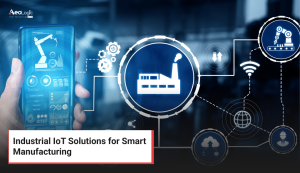

Modern warehouse operations are being revolutionized by IoT in smart warehouse management, which allows companies to switch from reactive procedures to data-driven, real-time decision-making. Organizations are under pressure to increase operational efficiency, visibility, and accuracy as supply chains become more complex and customer expectations demand faster delivery.
Warehouses can become intelligent ecosystems with seamless communication between sensors, devices, and systems thanks to the integration of Internet of Things (IoT) technologies. This improves productivity, safety, and scalability throughout operations in addition to lowering manual intervention. Adopting smart warehouse solutions is now a strategic requirement for businesses looking to maintain their competitiveness.
What is IoT in Smart Warehouse Management?
The term “IoT” in Smart Warehouse Management refers to the real-time monitoring, management, and optimization of warehouse operations through the use of sensors, RFID systems, software platforms, and interconnected devices. Better control over inventory, assets, personnel, and environmental conditions is made possible by these networked technologies’ constant data collection and transmission.
IoT-enabled warehouses use real-time insights rather than manual tracking or delayed reporting. This results in increased precision, lower operating expenses, and faster response times across the supply chain.
 Why IoT in Smart Warehouse Management Matters
The ability of IoT to connect digital intelligence and physical operations is what makes it so important for smart warehouse management. Traditional warehouse systems frequently fail to provide the agility, transparency, and speed that businesses today demand.
By facilitating predictive decision-making, cutting down on inefficiencies, and guaranteeing smooth process coordination, IoT has a quantifiable impact. It has a direct impact on important business outcomes like supply chain resilience, operational cost reduction, and customer satisfaction.
Core Components of IoT-Enabled Warehousing
A smart warehouse ecosystem is made up of a number of interrelated parts that cooperate to provide visibility and efficiency.
Real-time data from inventory, equipment, and environmental conditions is gathered by sensors and Internet of Things devices. Smooth communication between devices is ensured by connectivity technologies like Wi-Fi, LPWAN, or 5G. Analytics tools transform this data into useful insights, while cloud platforms handle and store it. Automation and optimization of operations based on real-time intelligence are guaranteed through integration with warehouse management systems (WMS).
Top 7 Key Applications of IoT in Smart Warehouse Management
1. Real-Time Inventory Tracking
Using RFID tags and smart sensors, IoT makes it possible to continuously track inventory. This greatly lowers errors and does away with manual counting. Real-time stock level monitoring by businesses ensures precise demand forecasting and helps avoid stockouts and overstocking.
2. Smart Asset Tracking and Management
IoT devices can be used to track warehouse assets like pallets, containers, and forklifts. This minimizes time spent looking for equipment and guarantees optimal utilization. It also reduces losses and enhances asset lifecycle management.
3. Automated Warehouse Operations
Picking, packing, and sorting procedures are made more efficient by IoT integration with robotics and automation systems. Automated workflows maintain high levels of accuracy while decreasing reliance on humans and increasing operational speed.
4. Predictive Maintenance of Equipment
IoT sensors continuously track the functionality and condition of machinery. Businesses can minimize downtime and repair expenses by performing maintenance prior to failures by examining usage patterns and identifying irregularities.
5. Environmental Monitoring
Temperature, humidity, and air quality can be monitored continuously using IoT sensors. This is especially critical for industries like pharmaceuticals and food storage, where environmental conditions directly impact product quality.
6. Workforce Safety and Productivity
Wearable IoT devices can track worker movement, monitor fatigue levels, and ensure compliance with safety protocols. This helps in reducing workplace accidents while also improving workforce efficiency.
7. Data-Driven Decision Making
IoT systems generate vast amounts of data that can be analyzed to optimize warehouse layouts, workflows, and resource allocation. This enables managers to make informed decisions that improve overall operational performance.
Step-by-Step Strategy to Implement IoT in Warehousing
Step 1: Assess Business Requirements
Organizations must first determine their main goals, operational difficulties, and inefficiencies. This aids in establishing precise use cases for the deployment of IoT.
Step 2: Select the Right Technology Stack
Selecting the right platforms, connectivity options, and sensors is essential. The technology should be in line with the integration requirements and scale of the business.
Step 3: Integrate with Existing Systems
IoT solutions should seamlessly integrate with current WMS and ERP systems to ensure smooth data flow and operational continuity.
Step 4: Pilot Implementation
Before a full-scale rollout, begin with a small-scale deployment to test performance, find any gaps, and improve the system.
Step 5: Scale and Optimize
Once validated, expand the implementation across the warehouse and continuously optimize using analytics and insights.
Key Benefits for Enterprises
IoT-driven warehouse systems provide enhanced operational visibility, allowing businesses to track every asset and process in real time. They lower manual errors and greatly increase inventory management accuracy. Automation reduces redundancies and delays, increasing operational efficiency.
Predictive maintenance, optimized resource use, and decreased labor dependency all contribute to cost savings. Additionally, enhanced safety protocols and adherence guarantee a better workplace for workers.
Real-World Use Cases
International e-commerce businesses use IoT to precisely manage large quantities of inventory, guaranteeing quicker order fulfillment. IoT-enabled warehouses help manufacturing companies reduce delays by coordinating production and storage. Environmental monitoring systems are essential for cold storage providers to uphold compliance standards and product integrity.
These illustrations show how IoT turns conventional warehouses into responsive, intelligent ecosystems.
Technologies Powering Smart Warehouses
Technologies such as RFID, Bluetooth Low Energy (BLE), cloud computing, artificial intelligence, and edge computing play a crucial role in enabling IoT-driven warehouses. Advanced analytics platforms process real-time data, while automation systems execute tasks with minimal human intervention.
The combination of these technologies creates a highly efficient and scalable warehouse environment.
Challenges in IoT-Enabled Smart Warehousing
Organizations must carefully address the operational and technical challenges that come with implementing IoT in warehouse environments. The substantial upfront costs associated with devices, infrastructure, and system integration are among the main issues.
System integration is another major obstacle. It can be challenging to integrate IoT devices with enterprise platforms and current warehouse management systems, particularly in legacy settings. Since connected devices raise the possibility of cyberattacks and illegal access, data security is also a top concern.
Best Practices for Successful IoT Implementation
Businesses should take a methodical and strategic approach to guarantee the successful implementation of IoT in warehouses. In addition to lowering risks, a phased implementation approach enables businesses to test and refine solutions before expanding. Selecting interoperable and scalable technologies is crucial for sustained success. Systems ought to be adaptable enough to work with current platforms and change with the times. robust cybersecurity protocols, such as encryption and frequent audits, are critical to protect sensitive data and maintain system integrity.
Future Trends in Smart Warehousing
AI, digital twins, and 5G connectivity are the main drivers of the IoT’s future in smart warehouse management. With systems that can self-optimize and make predictions, warehouses will become increasingly independent.
Edge computing will enable faster data processing, while AI-powered analytics will provide deeper insights into operations. As technology evolves, smart warehouses will play a critical role in building resilient and agile supply chains.
Conclusion
IoT in Smart Warehouse Management is redefining how warehouses operate by enabling real-time visibility, automation, and intelligent decision-making. From inventory tracking to predictive maintenance, its applications are driving efficiency, accuracy, and scalability across industries.
Businesses that embrace this transformation position themselves for long-term success in an increasingly competitive and fast-paced market. Partnering with experienced providers like Aeologic Technologies can help organizations implement tailored IoT solutions that deliver measurable value and future-ready warehouse operations.
People Also Ask (FAQs)
Q1. What is IoT in Smart Warehouse Management?
IoT in Smart Warehouse Management uses connected devices, sensors, and systems to automate and monitor warehouse operations in real time. It improves inventory tracking, visibility, and efficiency while reducing manual errors and enabling faster, data-driven decision-making.
Q2. How does IoT improve warehouse efficiency?
Through process automation, real-time inventory tracking, and predictive maintenance, IoT increases productivity. It speeds up order fulfillment and maximizes resource use by cutting down on delays, minimizing errors, and increasing productivity.
Q3. What industries benefit most from IoT-enabled warehouses?
The sectors that gain the most are manufacturing, logistics, e-commerce, retail, and pharmaceuticals. Through automation and real-time monitoring, IoT solutions help these industries meet their high standards for accuracy, speed, and compliance.
Q4. Is IoT implementation expensive for warehouses?
Implementing IoT results in long-term savings, but it does require an initial investment in systems and devices. Over time, businesses become more cost-effective by lowering labor costs, preventing mistakes, and increasing efficiency.
Q5. What are the security concerns in IoT-based warehouses?
Security risks include data breaches and unauthorized access. These can be managed with encryption, secure networks, regular monitoring, and strong cybersecurity practices to protect systems and data.
Q6. Can small warehouses adopt IoT solutions?
Yes, scalable IoT solutions can be implemented in small warehouses. Modular technologies and cloud-based systems enable gradual deployment, which makes it flexible and affordable as the company expands.