

Walk into the back office of almost any bank and you will still find teams keying in the same customer details twice, copying numbers between spreadsheets, and chasing approvals over email. These repetitive, rules-based tasks eat up hours every week, slow down customer service, and leave more room for human error. That is exactly the problem that Banking Task Automation was built to solve.
Banking Task Automation is the practice of using software, robotic process automation (RPA), artificial intelligence, and workflow tools to handle the routine, high-volume work that banks perform every day — from onboarding a new customer to reconciling thousands of transactions overnight. Done well, it frees skilled staff from manual data entry so they can focus on advising customers, managing risk, and growing the business.
In this guide, we will walk through what Banking Task Automation actually means, which processes are the best candidates for automation, the technology that powers it, and a practical, step-by-step approach your institution can follow to get started — without the jargon and without needing a massive IT overhaul on day one.
 What is Banking Task Automation?
At its core, Banking Task Automation refers to using technology to perform repetitive, predictable banking operations with little or no human intervention. Instead of an employee manually copying data from a loan application into three different systems, an automated workflow does it in seconds, consistently and accurately, every single time.
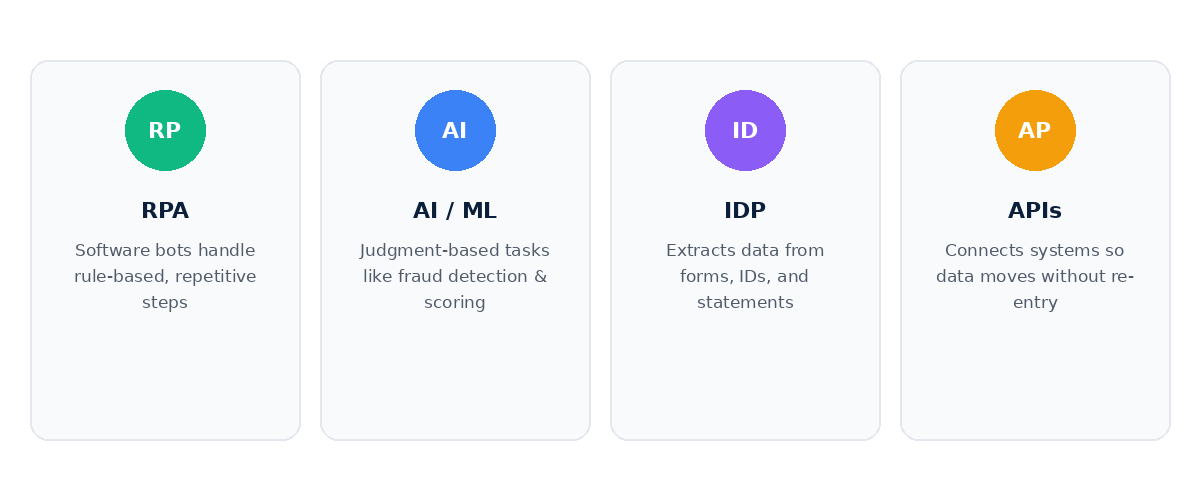
Banking Task Automation typically combines a few building blocks:
- Robotic Process Automation (RPA) — software “bots” that mimic how a human clicks, types, and navigates through applications.
- Artificial intelligence and machine learning — used for tasks that require judgment, such as detecting unusual transactions or reading unstructured documents.
- Workflow and business process management (BPM) tools — which route approvals, tasks, and notifications between departments automatically.
- APIs and system integrations — which let different banking platforms exchange data without manual re-entry.
Put together, these tools turn a slow, paper-heavy or email-heavy process into a fast, digital one. This is why so many retail banks, credit unions, and NBFCs are prioritizing automation in banking as part of their broader digital transformation strategy.
 Why Repetitive Tasks Slow Down Banks
Before looking at solutions, it helps to understand why manual processes are such a drag on banking operations in the first place:
- High transaction volumes. Banks process enormous numbers of transactions, applications, and service requests daily, and manual handling simply cannot scale.
- Multiple legacy systems. Many banks still run core banking platforms that do not talk to each other, forcing staff to copy data back and forth.
- Strict compliance requirements. Regulatory checks like KYC and AML require repetitive verification steps that are easy to delay or get wrong when done by hand.
- Human error. Manual data entry is one of the leading causes of reconciliation mismatches and compliance gaps.
- Staffing pressure. Skilled employees spend valuable hours on low-value, repetitive work instead of relationship-building or risk analysis.
These pain points are precisely why Banking Task Automation has moved from a “nice to have” to a competitive necessity for financial institutions of every size.
Key Benefits of Banking Task Automation
When implemented thoughtfully, Banking Task Automation delivers benefits that go well beyond simple time savings.
| Benefit | What It Means in Practice |
| Faster turnaround times | Loan approvals, account openings, and service requests move from days to minutes or hours |
| Lower operational costs | Fewer manual hours spent on data entry, reconciliation, and follow-ups |
| Improved accuracy | Bots don’t get tired or make typos, reducing reconciliation errors |
| Stronger compliance | Automated audit trails make it easier to demonstrate regulatory adherence |
| Better customer experience | Faster response times and fewer errors translate into higher satisfaction |
| Scalability | Automated workflows handle volume spikes without hiring additional staff |
| Employee satisfaction | Staff are freed from monotonous work to focus on higher-value tasks |
It’s worth noting that Banking Task Automation is not just about replacing people — it’s about reallocating human effort toward the work that actually needs judgment, empathy, and expertise.
Which Banking Tasks Can Be Automated?
Not every process is a good candidate for automation, but a surprising number of day-to-day banking operations are. Here are the areas where Banking Task Automation tends to deliver the fastest return on investment.
Customer Onboarding and KYC Verification
Opening a new account typically involves identity verification, document checks, and data entry across multiple systems. Automated KYC tools can scan ID documents, cross-check details against watchlists, and populate core banking systems automatically, cutting onboarding time dramatically.
Loan Origination and Processing
From initial application to credit checks, document verification, and approval routing, loan processing is full of repetitive steps. Automation can pull data from pay slips and bank statements, run eligibility checks, and route exceptions to a human underwriter only when something truly needs a judgment call.
Transaction Monitoring and Fraud Detection
AI-powered systems can continuously scan transactions for unusual patterns, flagging suspicious activity in real time rather than relying on periodic manual reviews. This is one of the highest-value applications of automation in banking because speed directly affects fraud losses.
Compliance and Regulatory Reporting
Preparing regulatory reports often means pulling data from several systems and formatting it to meet a specific regulator’s requirements. Automated reporting tools can assemble this data on a schedule, reducing the risk of missed deadlines or reporting errors.
Data Entry, Reconciliation, and Back-Office Processing
Matching transactions between internal ledgers and external statements is one of the most common repetitive tasks in any bank. Automation tools can reconcile thousands of line items far faster and more accurately than a manual team.
Customer Service and Query Handling
Chatbots and automated ticketing systems can resolve routine customer queries — balance checks, statement requests, card blocking — without involving a live agent, freeing human staff for more complex conversations.
Technologies Behind Banking Task Automation
Understanding the technology stack helps banks choose the right tools for each use case.
- Robotic Process Automation (RPA): Best for rule-based, repetitive tasks across existing systems, such as copying data between applications or generating standard reports.
- Intelligent Document Processing (IDP): Uses optical character recognition (OCR) and machine learning to extract data from forms, ID documents, and statements, even when formats vary.
- Artificial Intelligence and Machine Learning: Powers fraud detection, credit scoring, and chatbots that need to make judgment-based decisions rather than follow fixed rules.
- Workflow Automation / BPM Platforms: Manage multi-step approval processes, ensuring tasks move automatically between departments with full visibility.
- APIs and Core Banking Integrations: Allow different systems — CRM, core banking, payment gateways — to share data instantly instead of relying on manual exports and imports.
Most successful automation programs combine several of these technologies rather than relying on just one, which is sometimes referred to as “intelligent automation” or “hyperautomation.”
Step-by-Step: How to Implement Banking Task Automation
Getting started with Banking Task Automation does not require a complete technology overhaul. A phased, practical approach works best.
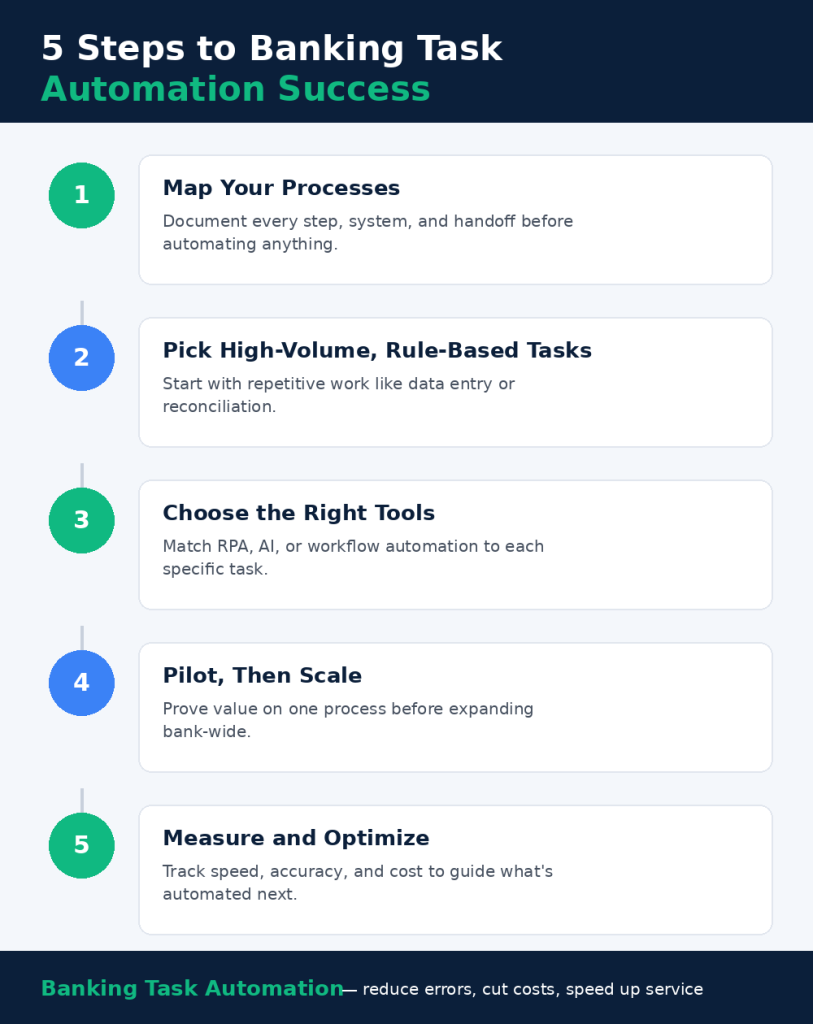
- Map your existing processes. Document each step of a workflow — who does what, in which system, and how long it takes.
- Identify high-volume, rule-based tasks first. Look for processes that are repetitive and based on clear rules rather than subjective judgment.
- Set clear goals and success metrics. Decide upfront what you want to improve — turnaround time, error rate, cost per transaction.
- Choose the right tools for each task. A simple data-entry task may only need RPA, while document-heavy workflows benefit from IDP.
- Start with a pilot project. Automate one process end-to-end before scaling across the organization.
- Involve compliance and risk teams early. Regulatory requirements must be built into the automation design from day one.
- Train staff and manage change. Employees need to understand how automation changes their role for the better.
- Monitor, measure, and optimize. Automation is not “set and forget” — review performance regularly.
- Scale gradually. Once a pilot proves successful, expand automation to adjacent processes.
Challenges in Banking Task Automation and How to Overcome Them
| Challenge | Practical Solution |
| Legacy core banking systems | Use APIs or RPA as a bridge layer instead of a full system replacement |
| Data security and privacy concerns | Apply strict access controls, encryption, and audit logging |
| Resistance to change among staff | Communicate early and reframe automation as support, not replacement |
| Regulatory uncertainty | Work closely with compliance teams and build flexible workflows |
| Choosing the wrong processes | Start with a thorough process assessment before automating |
| Integration complexity | Prioritize vendors with strong banking-specific integration experience |
Best Practices for Successful Banking Automation
- Start small with a single, well-understood process rather than an enterprise-wide rollout.
- Keep a human in the loop for any decision that carries legal, financial, or reputational risk.
- Document every automated workflow clearly so it can be audited and maintained.
- Build in exception handling so unusual cases are routed to a human.
- Revisit automated processes periodically as regulations and customer needs change.
- Treat Banking Task Automation as an ongoing program, not a one-time project.
Banking Task Automation vs Traditional Manual Processes
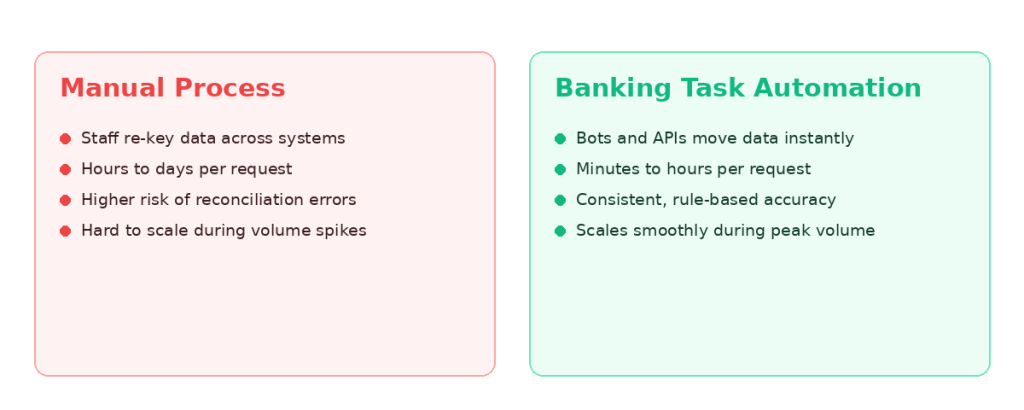
| Factor | Manual Process | Banking Task Automation |
| Speed | Hours to days | Minutes to hours |
| Accuracy | Prone to human error | Consistent, rule-based accuracy |
| Scalability | Needs more staff for more volume | Scales without proportional headcount |
| Compliance tracking | Manual logs, easy to miss steps | Automatic audit trails |
| Cost over time | Rises with volume | Decreases per-transaction cost at scale |
 Real-World Use Cases of Banking Task Automation
While every institution’s journey looks different, common real-world applications include automating account-opening document checks so new customers are verified in minutes rather than days, using bots to reconcile daily transactions between core banking systems and payment gateways overnight, deploying AI-based monitoring to flag potentially fraudulent transactions as they happen, and routing loan applications automatically to the right underwriter based on loan type and risk profile. Many institutions start with one of these use cases, measure the results, and then expand automation across adjacent departments.
How to Measure the ROI of Banking Task Automation
Leadership teams rightly want to know whether an automation investment is paying off. Rather than guessing, track a small set of clear metrics before and after rollout:
- Processing time per task — compare how long a process took manually versus after automation.
- Error and rework rate — fewer corrections and reconciliation mismatches is a direct sign of success.
- Cost per transaction — factor in software, maintenance, and reduced manual hours.
- Compliance exceptions — track how often missed deadlines or audit findings occur.
- Employee time reallocated — measure how many hours staff now spend on advisory work.
- Customer satisfaction or turnaround feedback — faster service often improves satisfaction scores.
Reviewing these metrics every quarter helps banks decide where to expand Banking Task Automation next and whether existing workflows need adjustment as transaction volumes or regulations change.
The Future of Banking Task Automation
Banking Task Automation is evolving quickly. The next wave includes AI “agents” capable of handling multi-step processes end-to-end, more natural conversational banking through advanced chatbots, and predictive automation that anticipates customer needs before a request is even made. As regulations evolve and customer expectations for instant service grow, banks that invest early in a solid automation foundation will be better positioned to adopt these next-generation capabilities without starting from scratch.
Conclusion
Repetitive, manual work no longer has to be the default way banks operate. Banking Task Automation gives financial institutions a practical path to faster processing, stronger compliance, lower costs, and happier employees and customers alike. The key is to start small — map your processes, pick a high-volume rule-based task, and build from there rather than attempting to automate everything at once.
If your institution is ready to reduce manual workload and improve operational efficiency, Aeologic Technologies can help you identify where Banking Task Automation can make the biggest difference in your organization. Reach out to your technology or operations team to identify your first automation pilot and start building momentum today.
Frequently Asked Questions
Q1. What is Banking Task Automation and why does it matter?
Banking Task Automation refers to using technology such as RPA, AI, and workflow tools to handle repetitive banking processes automatically. It matters because it reduces errors, speeds up operations, lowers costs, and frees staff to focus on customer relationships and complex decision-making.
Q2. Which banking processes are easiest to automate?
Rule-based, high-volume tasks like data entry, transaction reconciliation, document verification, and standard report generation are typically the easiest and safest processes to automate first.
Q3. Does Banking Task Automation replace bank employees?
Not usually. Most institutions use automation to remove repetitive manual work, allowing employees to shift toward advisory, relationship, and risk-management roles rather than being replaced outright.
Q4. How long does it take to implement banking automation?
Timelines vary by complexity, but a well-scoped pilot project for a single process can often be implemented within a few weeks to a couple of months, with broader rollouts taking longer.
Q5. Is RPA the same as Banking Task Automation?
RPA is one technology within the broader umbrella of Banking Task Automation. Automation also includes AI, machine learning, intelligent document processing, and workflow management tools working together.
Q6. What are the risks of automating banking tasks?
Risks include data security gaps, over-automating processes that need human judgment, and poor exception handling. These can be managed with strong governance, compliance involvement, and phased rollouts.
Q7. How does automation improve regulatory compliance in banking?
Automated workflows create consistent, timestamped audit trails and reduce the chance of missed steps, making it easier for banks to demonstrate compliance during regulatory reviews.

Project Lead with 9+ years of experience in Web Technologies and AI. Expert in leading end-to-end development of scalable, AI-driven solutions. Driving innovation through smart architecture, agile execution, and team leadership.