Three years ago, “AI in Enterprise Solutions” mostly meant a chatbot bolted onto a help desk. Today it means autonomous agents that close invoices, flag fraudulent claims before a human ever sees them, and rewrite how entire departments work. The distance between those two pictures is the real story of enterprise AI — and it’s accelerating faster than most roadmaps accounted for.
This guide breaks down where AI in Enterprise Solutions stands today, where it’s headed, and what separates organizations that turn AI into durable advantage from those still stuck running pilots. Whether you’re an IT leader building a 2026 roadmap or a business leader trying to separate hype from genuine opportunity, this is a practical, no-fluff look at the landscape.
What is AI in Enterprise Solutions?
AI in Enterprise Solutions refers to the use of artificial intelligence — including machine learning, generative AI, and autonomous agents — embedded directly into core business software and workflows (ERP, CRM, supply chain, HR, finance) to automate tasks, surface insights, and support decisions at organizational scale, rather than as a standalone consumer tool.
Unlike consumer AI tools that live in a browser tab, AI in Enterprise Solutions is built to operate inside the systems that already run a business. It connects to proprietary data, respects access controls and compliance requirements, and is accountable to audit trails that a general-purpose chatbot was never designed to meet. That distinction — purpose-built versus bolted-on — is what separates enterprise-grade AI from a novelty integration.
Why AI in Enterprise Solutions Matters Right Now
A few years ago, the conversation inside most boardrooms was whether to invest in AI at all. That debate is largely over. Surveys from firms like McKinsey and Gartner consistently show that the majority of large organizations now use AI in at least one business function, and a growing share report that AI is scaling across multiple departments rather than staying confined to a single pilot. Analysts also project that a substantial share of new enterprise applications will ship with AI agents built in by the end of this year, up sharply from a couple of years ago.
What’s changed isn’t just adoption — it’s ambition. Early enterprise AI projects optimized for cost savings on narrow tasks: summarizing documents, drafting emails, answering FAQs. The current wave of AI in Enterprise Solutions is aimed at something bigger: reshaping how work gets planned, executed, and improved across the organization. That shift explains why so many companies are moving budget from “experiment with AI” line items into core technology spend.
Three forces are driving the urgency:
- Competitive pressure. When a competitor automates claims processing or customer onboarding and cuts turnaround time dramatically, standing still becomes a competitive liability, not a neutral choice.
- Data readiness. A decade of cloud migration and data-platform investment means most enterprises finally have the clean, connected data that AI systems need to be useful rather than unreliable.
- Talent and cost pressure. Skilled labor is expensive and hard to hire at scale, and AI in Enterprise Solutions offers a way to extend the output of existing teams without a proportional headcount increase.
Key Trends Shaping AI in Enterprise Solutions
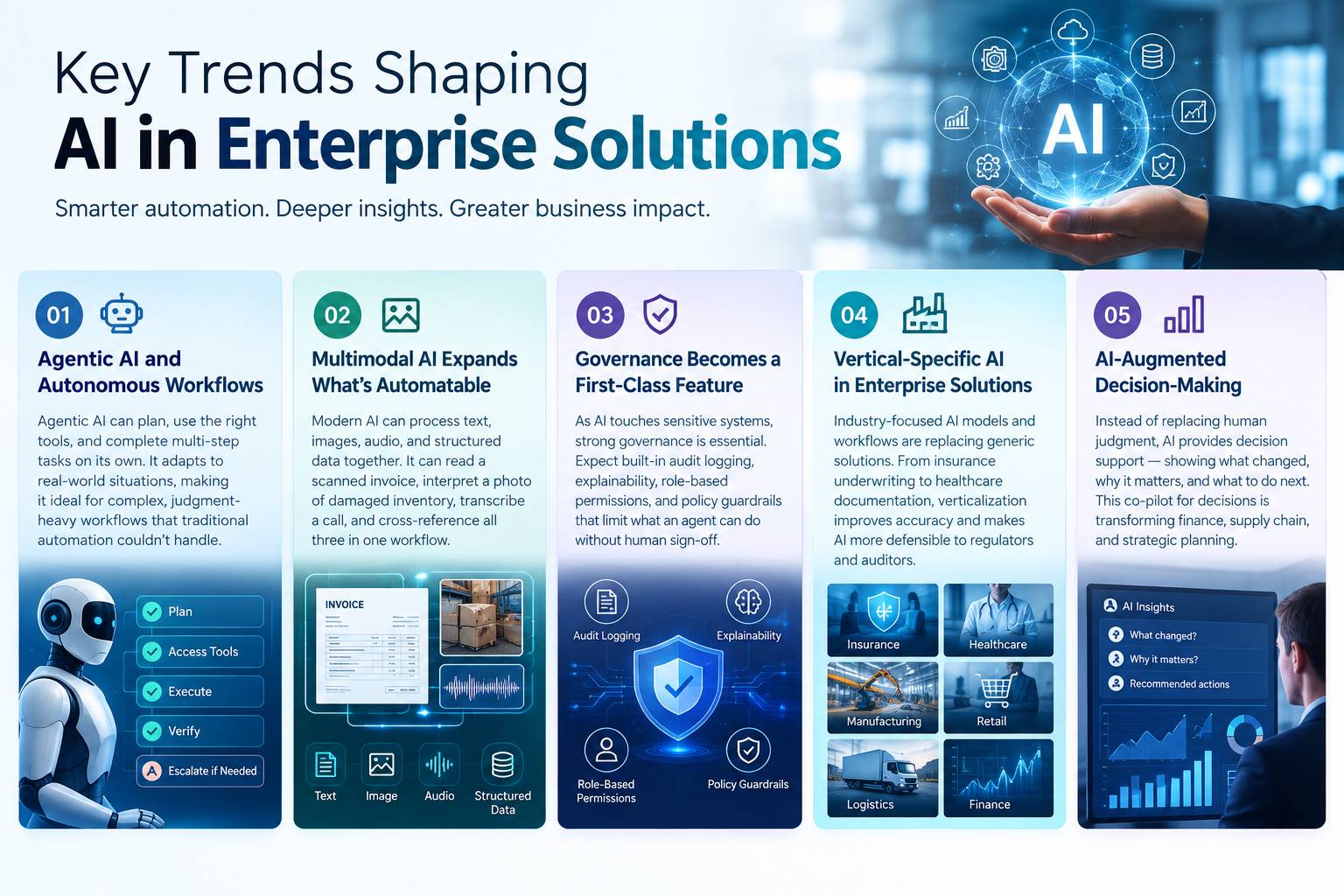
Agentic AI and Autonomous Workflows
The biggest shift in AI in Enterprise Solutions is the move from AI that answers questions to AI that completes tasks. Agentic AI systems can plan a multi-step process, call the right internal tools or APIs, check their own work, and only escalate to a human when something falls outside their confidence threshold. Instead of a support agent copy-pasting information between five systems, an AI agent can pull the customer record, check the order status, issue the refund, and log the resolution — end to end.
This matters because it changes the unit of automation. Traditional automation (think: RPA bots) could only follow rigid, pre-scripted steps. Agentic AI in Enterprise Solutions can adapt the sequence of steps based on what it finds along the way, which makes it viable for the messier, judgment-heavy workflows that resisted automation for the last two decades.
Multimodal AI Expands What’s Automatable
Modern enterprise AI models can process text, images, audio, and structured data together. That means AI in Enterprise Solutions is no longer limited to text-based tasks — it can read a scanned invoice, interpret a photo of damaged inventory, transcribe a call center conversation, and cross-reference all three against a database in a single workflow. Insurance, logistics, manufacturing, and healthcare are seeing some of the fastest gains here, precisely because so much of their real-world data isn’t neatly typed into a form.
Governance Becomes a First-Class Feature, Not an Afterthought
As AI touches more sensitive systems — payroll, contracts, customer PII — governance has moved from a compliance checkbox to a core design requirement. Expect AI in Enterprise Solutions to increasingly ship with built-in audit logging, explainability features, role-based permissions, and policy guardrails that limit what an agent can do without human sign-off. Enterprises that treat governance as an add-on tend to stall at the pilot stage; the ones that engineer it in from day one are the ones scaling successfully.
Vertical-Specific AI in Enterprise Solutions
Generic, one-size-fits-all AI tools are giving way to models and workflows fine-tuned for specific industries — underwriting models for insurance, clinical documentation assistants for healthcare, demand-forecasting agents for retail. This verticalization makes AI in Enterprise Solutions more accurate and more defensible to regulators and auditors, because the system is trained and evaluated against the specific risks and terminology of that industry rather than general-purpose internet text.
AI-Augmented Decision-Making
Rather than replacing human judgment, a large share of enterprise AI investment is going toward decision support: dashboards that don’t just show data but explain what changed, why, and what to do about it. This “co-pilot for decisions” pattern is becoming a defining feature of AI in Enterprise Solutions in finance, supply chain planning, and strategic forecasting, where the cost of a wrong decision is high enough that full autonomy isn’t yet acceptable — but faster, better-informed human decisions are extremely valuable.
 Benefits of AI in Enterprise Solutions
| Benefit | What It Looks Like in Practice |
| Operational efficiency | Routine tasks (data entry, reconciliation, ticket triage) handled automatically, freeing staff for higher-value work |
| Faster decision-making | Real-time dashboards and forecasts replace weekly or monthly reporting cycles |
| Cost reduction | Lower per-transaction processing costs as agents handle higher volumes without added headcount |
| Improved customer experience | 24/7 AI-assisted support that resolves routine requests instantly and routes complex ones intelligently |
| Risk and fraud detection | Pattern recognition flags anomalies in transactions, claims, or access logs far earlier than manual review |
| Talent leverage | Existing teams can take on more scope because AI handles the repetitive layer of the work |
| Scalability | AI systems absorb volume spikes (seasonal demand, promotions, incident surges) without proportional hiring |
These benefits compound. A company that reduces manual processing time can reinvest that capacity into the kind of judgment-heavy, relationship-driven work that AI still can’t do well — which is usually where the real competitive differentiation lives.
Real-World Use Cases of AI in Enterprise Solutions
- Finance: Automated invoice matching, anomaly detection in expense reports, AI-assisted forecasting for cash flow and budgeting.
- Human Resources: Resume screening support, onboarding assistants, AI-drafted job descriptions and policy summaries (with human review).
- Customer Service: AI agents that resolve tier-1 tickets autonomously and hand off complex cases with full context attached.
- Supply Chain and Logistics: Demand forecasting, dynamic route optimization, and automated reordering triggered by real-time inventory signals.
- Sales and Marketing: AI-generated first-draft content, lead scoring, and conversational assistants that qualify inbound interest before a rep gets involved.
- IT Operations: Anomaly detection across logs, AI-assisted incident triage, and automated ticket routing based on historical resolution patterns.
- Legal and Compliance: Contract review assistants that flag non-standard clauses for attorney review, and policy-monitoring agents that track regulatory changes.
Across all of these, the common pattern is the same: AI in Enterprise Solutions works best when it handles the repetitive 80% of a workflow and routes the ambiguous 20% to a person — not when it’s asked to replace judgment wholesale.
 Challenges of Implementing AI in Enterprise Solutions
No honest look at this topic skips the hard parts. The organizations getting real value are the ones that plan for these challenges up front rather than discovering them mid-rollout.
- Data quality and fragmentation. AI is only as good as the data behind it. Siloed systems, inconsistent formats, and incomplete records are still the single biggest blocker to scaling AI in Enterprise Solutions beyond a pilot.
- Integration complexity. Enterprise environments are rarely clean. Connecting AI to legacy ERPs, mainframes, and custom-built internal tools takes real engineering effort, not just an API key.
- Governance and compliance risk. Industries like finance, healthcare, and insurance carry regulatory obligations that AI deployments must be designed around from the start, not patched in afterward.
- Change management. Employees who fear being replaced — or who simply don’t trust an unfamiliar system — will quietly route around it. Adoption is a people problem as much as a technology one.
- Measuring ROI. Many organizations still struggle to attribute business outcomes cleanly to AI versus other process changes happening at the same time, which makes it hard to justify continued investment.
- Talent gaps. Few organizations have enough in-house expertise to design, evaluate, and maintain AI systems responsibly, which has created real demand for both hiring and upskilling.
Best Practices for Adopting AI in Enterprise Solutions
- Start with a well-defined, high-friction workflow — not a flashy but low-impact demo. Pick a process with clear volume, clear cost, and a measurable before/after.
- Fix the data foundation first. Time spent cleaning, connecting, and governing data pays off across every future AI initiative, not just the first one.
- Build governance in from day one. Define what an AI agent is allowed to do autonomously, what requires human approval, and how every action is logged.
- Treat pilots as learning exercises, not pass/fail tests. The goal of a first deployment is to learn what breaks, not to prove AI works in general.
- Involve the people whose workflow is changing. Early, honest involvement from frontline staff reduces the “shadow resistance” that quietly kills AI rollouts.
- Measure outcomes, not activity. Track cycle time, error rate, and cost per transaction — not just how many people logged into the new tool.
- Plan for iteration. The best AI in Enterprise Solutions deployments are tuned continuously based on real usage, not configured once and left alone.
- Choose vendors and architectures that avoid lock-in. Enterprise AI is moving fast; flexibility to swap models or providers protects you against being stuck with yesterday’s technology.
AI in Enterprise Solutions vs. Traditional Enterprise Software
| Dimension | Traditional Enterprise Software | AI in Enterprise Solutions |
| How it handles tasks | Follows fixed, pre-programmed rules | Learns patterns and adapts to new situations |
| Data handling | Structured data only, manually entered | Structured and unstructured data (text, images, audio) |
| Decision support | Static reports and dashboards | Dynamic insights, forecasts, and recommended actions |
| Maintenance model | Periodic manual updates and configuration | Continuous learning and model refinement |
| Scalability | Scales by adding more licenses/users | Scales by extending automation across more workflows |
| Typical ROI driver | Efficiency from digitization | Efficiency plus judgment-level automation |
This isn’t a case of one replacing the other overnight. Most enterprises run AI in Enterprise Solutions alongside traditional systems for years, gradually shifting more decision-making and task execution to AI as trust, governance, and data quality mature.
How to Choose the Right AI in Enterprise Solutions Strategy
There’s no universal playbook, but three questions consistently separate successful strategies from stalled ones:
- What’s the cost of being wrong? Low-stakes, high-volume tasks (routing a ticket, drafting a first version of a document) are ideal early candidates for more autonomous AI. High-stakes decisions (credit approvals, medical guidance) call for AI-assisted human decision-making rather than full autonomy, at least initially.
- Do you control the data the AI needs? If the relevant data lives in three disconnected systems and nobody owns the integration, that’s the first project — not the AI rollout itself.
- Who owns the outcome if the AI gets it wrong? Clear accountability, before deployment, is what keeps a promising pilot from becoming a liability.
Organizations that answer these honestly tend to build a phased roadmap: assist (AI suggests, human decides) → augment (AI handles routine cases, human handles exceptions) → autonomous (AI handles the full workflow within defined guardrails). Rushing straight to the third stage is where most high-profile AI failures come from.
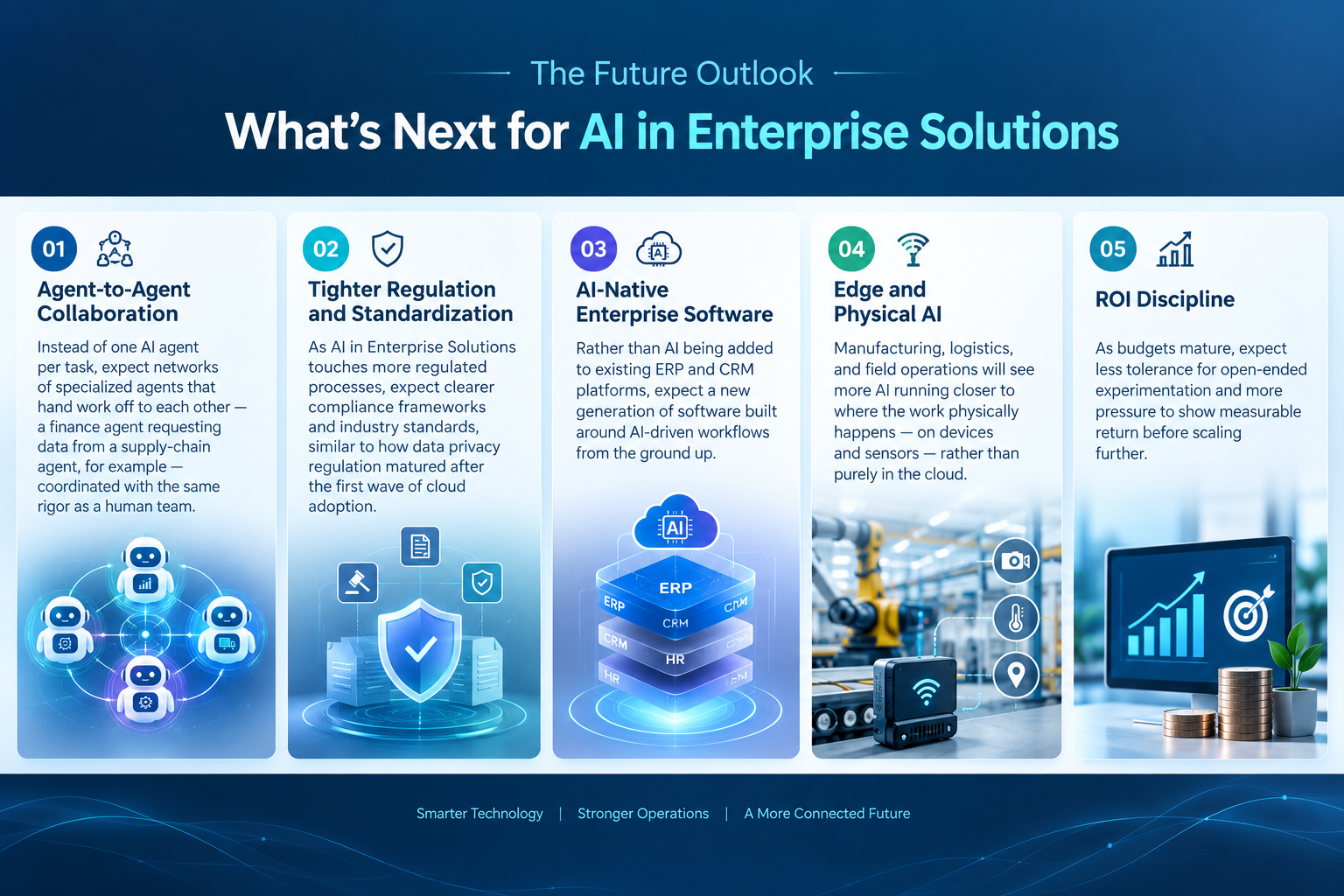
The Future Outlook: What’s Next for AI in Enterprise Solutions
Looking ahead, a few directions are already visible on the horizon:
- Agent-to-agent collaboration. Instead of one AI agent per task, expect networks of specialized agents that hand work off to each other — a finance agent requesting data from a supply-chain agent, for example — coordinated with the same rigor as a human team.
- Tighter regulation and standardization. As AI in Enterprise Solutions touches more regulated processes, expect clearer compliance frameworks and industry standards, similar to how data privacy regulation matured after the first wave of cloud adoption.
- AI-native enterprise software. Rather than AI being added to existing ERP and CRM platforms, expect a new generation of software built around AI-driven workflows from the ground up.
- Edge and physical AI. Manufacturing, logistics, and field operations will see more AI running closer to where the work physically happens — on devices and sensors — rather than purely in the cloud.
- ROI discipline. As budgets mature, expect less tolerance for open-ended experimentation and more pressure to show measurable return before scaling further.
None of this suggests AI in Enterprise Solutions is a finished category — it’s still early. But the direction is consistent: deeper integration, more autonomy within clearer guardrails, and a shift from “AI as a feature” to “AI as the operating layer” of enterprise software.
 Key Takeaways
- AI in Enterprise Solutions means AI embedded directly into core business systems — not a standalone chatbot.
- Agentic AI, multimodal capabilities, and built-in governance are the trends defining the current wave of adoption.
- The biggest blockers are data quality, integration complexity, and change management — not the AI models themselves.
- A phased approach (assist → augment → autonomous) consistently outperforms rushing straight to full automation.
- Clear accountability and measurable outcomes separate scaled AI programs from stalled pilots.
Conclusion
AI in Enterprise Solutions has moved past the hype-cycle stage of “should we adopt this?” into the harder, more valuable question of “how do we scale this responsibly?” The organizations pulling ahead aren’t necessarily the ones with the flashiest AI demo — they’re the ones with clean data, clear governance, and a phased rollout that builds trust before expanding autonomy. Agentic AI, multimodal capabilities, and embedded governance are turning AI in Enterprise Solutions from a bolt-on feature into the operating layer of enterprise software itself.
If your organization is still treating AI in Enterprise Solutions as a side experiment, the gap between you and competitors that have moved toward scaled deployment will only widen. At Aeologic Technologies, we help businesses move beyond pilots by identifying high-friction workflows, strengthening the data behind them, and building the governance needed to scale what works. The next step isn’t another pilot—it’s turning AI in Enterprise Solutions into measurable business value. Ready to put AI in Enterprise Solutions to work for your business?
FAQs
Q1. What does AI in Enterprise Solutions actually mean?
It refers to artificial intelligence capabilities — including machine learning, generative AI, and autonomous agents — built directly into enterprise software like ERP, CRM, HR, and finance systems. Rather than a separate tool, it operates inside existing workflows, connected to company data and subject to the organization’s access controls and compliance requirements.
Q2. Is AI in Enterprise Solutions only for large companies?
No. While large enterprises were early adopters due to bigger budgets and more complex workflows, mid-sized and even smaller organizations increasingly use AI-powered tools for customer service, finance automation, and operations, often through cloud-based platforms that require minimal upfront infrastructure.
Q3. How long does it take to implement AI in Enterprise Solutions?
Timelines vary widely by scope. A focused pilot on a single workflow can launch in weeks, while an enterprise-wide rollout with deep legacy-system integration and governance requirements can take many months to over a year, depending on data readiness and organizational complexity.
Q4. What’s the difference between AI agents and traditional automation (RPA)?
Traditional RPA follows fixed, pre-scripted steps and breaks when conditions change. AI agents can interpret context, adapt their approach, and handle exceptions dynamically, which makes them suitable for more complex, judgment-involving workflows that rigid automation couldn’t handle.
Q5. How do companies measure ROI from AI in Enterprise Solutions?
Common metrics include reduced cycle time, lower cost per transaction, error-rate reduction, faster decision cycles, and capacity freed up for higher-value work. The most reliable programs define these metrics before deployment, not after, so impact can be isolated from other changes.
Q6. What are the biggest risks of adopting AI in Enterprise Solutions?
Key risks include poor data governance leading to inaccurate outputs, compliance exposure in regulated industries, over-automating high-stakes decisions too early, and employee resistance if change management is neglected. Strong guardrails and phased rollout reduce most of these risks significantly.
Q7. Do employees need to learn to code to work with enterprise AI tools?
Generally, no. Most AI in Enterprise Solutions is designed with natural-language interfaces so business users can interact with it directly. Technical teams remain essential for integration, governance, and model oversight, but day-to-day use doesn’t require programming skills.