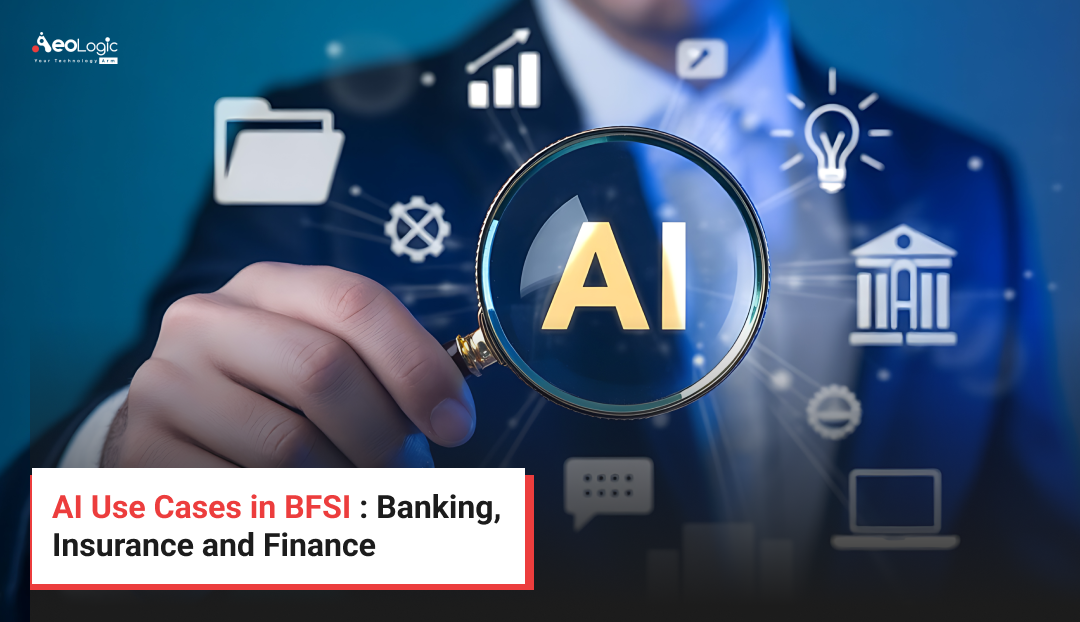
In today’s fast-evolving digital economy, AI Use Cases in BFSI are redefining how financial institutions operate, compete, and deliver value. Artificial Intelligence is no longer just a futuristic idea; it is a business necessity. It can improve customer experiences, lower risks, and make sure that rules are followed. Banks, insurance companies, and other financial services companies are using AI to automate tasks, get predictive insights, and find new ways to make money.
Every day, the BFSI sector deals with huge amounts of sensitive data and complicated transactions. This is a great place for AI-driven innovation to happen. AI is helping businesses become more flexible, data-driven, and focused on the customer, whether it’s for fraud detection, credit scoring, or personalized financial advice.
What is AI in BFSI?
Artificial Intelligence in BFSI is the use of advanced technologies like machine learning, natural language processing, computer vision, and predictive analytics to make financial institutions run more smoothly and make better decisions. These technologies let systems learn from past data, find patterns, and make smart guesses without needing people to be there all the time.
AI Use Cases in BFSI are transforming how banking, insurance, and financial institutions operate by making repetitive tasks easier, identifying risks and anomalies, personalizing services, and improving overall efficiency. They turn traditional workflows into intelligent ecosystems that can adapt dynamically to changing market conditions and evolving customer needs.
Why AI Use Cases in BFSI Matter for Modern Enterprises?
The BFSI sector is using more and more AI Use Cases because customers expect more, regulations are getting stricter, and businesses need to be more efficient. Banks and other financial institutions are always under pressure to provide services that are faster, safer, and more tailored to each customer while also managing risks well.
AI helps solve these problems by making decisions smarter, lowering the chance of human error, and making things easier to scale. It helps organizations go from being reactive to proactive, which lets them see what customers want and what the market is doing.
AI gives established companies the tools they need to innovate and stay relevant in a competitive market where fintech startups are changing the way things are done. It also builds trust by making financial operations more open, accurate, and compliant.
Key AI Use Cases in BFSI Across Banking, Insurance, and Finance
AI solutions for BFSI sector have effects in many areas, and each one helps make things run more smoothly and make customers happier.
Fraud Detection and Prevention
AI systems look at a lot of transaction data in real time to find strange patterns and possible fraud. Machine learning models get better over time by learning from new data all the time. This lets banks and other financial institutions stop fraud before it happens instead of dealing with it after it happens.
Credit Scoring and Risk Assessment
Traditional credit scoring models use only a few data points. AI, on the other hand, uses more data points, such as transaction behavior and digital footprints. This helps institutions make better lending decisions and assess risk more accurately.
Customer Service and Chatbots
AI-powered chatbots and virtual assistants are always available to help customers with their questions, fix problems, and walk them through financial processes. These systems use natural language processing to understand what customers want and give them what they need.
Algorithmic Trading
AI algorithms, as part of AI Use Cases in BFSI, analyze market trends, historical data, and real-time signals to identify the most optimal trading opportunities. This significantly reduces human bias and enhances the accuracy of investment decisions, ultimately leading to improved financial outcomes.
Claims Processing in Insurance
AI speeds up and makes the claims process more accurate by looking at documents, pictures, and data. This speeds up processing and makes customers happier.
Personalized Financial Services
AI lets banks and other financial institutions give personalized advice based on each customer’s habits, likes, and financial goals. This gets people more involved and helps them build long-term relationships.
 Core Components and Technologies Behind AI in BFSI
To successfully use AI Use Cases in BFSI, you need to know how the technologies that power them work. These parts work together to make smart systems that can change how businesses handle money.
Machine Learning
Machine learning models look at past data to find patterns and make predictions. People use these models a lot to find fraud, score credit, and group customers.
Natural Language Processing
NLP lets computers understand and work with human language. It is used for chatbots, analyzing people’s feelings, and processing documents automatically.
Robotic Process Automation
RPA takes care of tasks that need to be done over and over again, like entering data, checking for compliance, and making reports. When you add AI to it, it makes smart automation systems.
Predictive Analytics
Predictive analytics uses data to make predictions about what will happen in the future. It helps businesses predict market trends, customer behavior, and risks.
Computer Vision
Computer vision is used to look at pictures and documents, especially when checking someone’s identity or making an insurance claim.
Step-by-Step Strategy to Implement AI Use Cases in BFSI
To make sure that AI works and can grow, it needs to be implemented in a structured way. Companies need to make sure that their technology is in line with their business goals and the rules they have to follow.
Step 1: Define Business Objectives
Find specific problems or chances where AI can help. This could mean better customer service, less fraud, or making operations run more smoothly.
Step 2: Data Collection and Preparation
Get the right information from a variety of sources and make sure it is safe, structured, and clean. For AI to work correctly, the data must be of high quality.
Step 3: Choose the Right Technology Stack
Choose the right AI tools, platforms, and frameworks for your business needs. Think about how easy it is to scale, how well it works with other systems, and what the rules are for compliance.
Step 4: Develop and Train Models
Use old data to make machine learning models. Teach these models to find patterns and make guesses.
Step 5: Integration with Existing Systems
Integrate AI Use Cases in BFSI with existing banking or insurance systems to achieve smooth functioning, improved efficiency and uniform performance for all processes.
Step 6: Testing and Validation
Check the models for accuracy, dependability, and compliance. Check the results before putting them into use on a large scale.
Step 7: Deployment and Continuous Improvement
Put AI solutions into action and keep an eye on how well they work. Update models often so they can keep up with new data and changes in the market.
Advantages and Benefits of AI in BFSI
Using AI Use Cases in BFSI has a lot of benefits for banks and other financial institutions. These benefits apply to better risk management, better operational efficiency, and better customer service.
AI helps people make better decisions by giving them information-based insights. By automating repetitive tasks and cutting down on the need for human intervention, it lowers operational costs. Personalized services and faster response times make customers happier. Real-time monitoring and predictive analytics make risk management work better.
AI also helps with regulatory compliance by making sure that financial transactions are accurate and automating reporting. It also lets institutions grow, so they can handle more data and transactions without slowing down.
Real-World Examples and Mini Case Studies
Banks and other financial institutions all over the world are already using AI to improve efficiency and drive innovation.
A major international bank put in place AI-based fraud detection systems that cut down on fake transactions by a large amount and increased customer trust. The system looked at millions of transactions in real time and found suspicious patterns with a high degree of accuracy.
One insurance firm cut the claims process from days to minutes using AI Use Cases in BFSI. The system was able to analyze images and documents to assess claims quickly and accurately which led to a substantial increase in customer satisfaction.
A fintech company used AI to give customers personalized financial advice, which helped them make better investment choices. The system looked at how users behaved and what was happening in the market to give them personalized advice.
Tools, Platforms, and Technologies Used in AI Use Cases in BFSI
There are a number of tools and platforms that can help put AI to use in the financial services industry. Some of these are cloud-based AI platforms, machine learning frameworks, and tools for analyzing data.
Cloud platforms are flexible and scalable, which helps organizations handle large amounts of data quickly and easily. Machine learning frameworks come with ready-made models and tools for making AI apps. Tools for data analysis make insights easier to see and help people make decisions.
Integration platforms ensure seamless connectivity between AI systems and existing infrastructure, while cybersecurity tools protect sensitive financial data.
Challenges in Implementing Artificial Intelligence Applications in BFSI
When discussing AI Use Cases in BFSI, there are significant concerns around data privacy and security because these institutions handle highly sensitive financial information. Ensuring compliance with strict regulatory frameworks becomes even more challenging, especially when organizations must navigate varying laws and standards across different regions.
Another big problem is making AI work with old systems that are often inflexible and out of date. Also, there aren’t enough skilled AI workers, which makes it hard for companies to build, deploy, and maintain advanced AI-driven solutions well.
Best Practices for Implementing AI Use Cases in BFSI
Finally, for AI to deliver consistent and reliable results, businesses need to have strong data governance processes in place that ensure security, accuracy and regulatory compliance. This means having clear policies around data collection, storage and use, including regular audits and monitoring. Investing in scalable cloud infrastructure and choosing the right AI technologies can help organizations build a flexible, future-ready ecosystem that can evolve with business needs.
Business leaders and technology teams need to collaborate closely to ensure AI initiatives are aligned to strategic business objectives. Open communication, alignment on goals, and joint planning across functions ensure AI solutions solve real problems and provide tangible value. This alignment not only improves efficiency, but also accelerates innovation and enhances decision making across the organization.
Sustained success with AI depends on continuous monitoring, model training, and performance optimization. Organizations must regularly evaluate outcomes, update models with new data, and adapt to changing market conditions and regulatory requirements. This ongoing improvement cycle ensures that AI systems remain accurate, relevant, and capable of supporting long-term business growth.
Future Trends: The Evolution of AI in BFSI
Continuous innovation and technological progress are what will shape the future of AI use cases in BFSI. People think that AI will become more independent, which will lead to self-learning systems that don’t need much help from people.
Hyper-personalization will be a big deal, and AI will make financial experiences that are very unique to each person. Explainable AI will become more important because it will make decisions more clear.
Combining AI with blockchain and the Internet of Things (IoT) will open up new ways to make financial systems safe and work well. Regulatory technologies will also change to help AI-driven environments stay in line with the law.
Conclusion
The increasing use of AI Use Cases in BFSI is changing the way money works, making institutions smarter, more efficient, and more focused on customers. AI is pushing innovation and opening up new ways to grow, from finding fraud to offering personalized services. Companies that use AI now will be better able to deal with problems in the future and stay ahead of the competition.
Now is the time for businesses that want to use AI in banking, insurance, and finance to do so. Work with experts in the field, like Aeologic Technologies, to create and put into place AI solutions that can grow with your business and bring in real value.
People Also Ask (FAQs)
Q1. What are AI Use Cases in BFSI?
AI solutions for BFSI sector is the implementation of artificial intelligence technologies in banking, financial services, and insurance to increase efficiency, improve customer experience, and reduce risks. These use cases include fraud detection, credit scoring, customer service automation and personalized financial services. Institutions can use AI to analyze vast amounts of data, identify patterns and make informed decisions. This helps to lower operational costs, increase accuracy, offer better services to customers and ensure compliance with regulations.
Q2. How is AI transforming the banking sector?
AI is transforming banking through automation, enhanced customer engagement and increased security. Banks use AI to detect fraud, evaluate risk and offer personalized services. Chatbots offer instant customer service, and predictive analytics assists in decision making. AI also helps banks approve loans faster by analyzing customer data in real time. This transformation leads to improved efficiency, reduced costs, and better customer experiences. As a result, banks can stay competitive in a rapidly evolving digital landscape.
Q3. What role does AI play in insurance?
AI is crucial for insurance, automating claims, refining underwriting, and improving customer service. It leverages data analytics to enhance risk assessments and detect fraudulent claims. AI-driven tools can analyze documents and images, helping to accelerate the claims process. It also allows for tailored insurance products based on customer behavior and preferences. This leads to better risk management, faster delivery of service and more customer satisfaction.
Q4. What are the benefits of AI in financial services?
The advantages of AI for financial services are manifold, including improved efficiency, better decision-making, and a superior customer experience. Automates repetitive tasks , reducing operational costs and human errors . AI also offers real-time insights that help institutions manage risks effectively. Personalized services enhance customer engagement and advanced analytics assist in strategic planning. Overall, AI enables financial institutions to operate more efficiently and deliver value to customers.
Q5. What challenges do organizations face when implementing AI in BFSI?
Organizations face challenges like data privacy concerns, regulatory compliance, and integration with legacy systems. Financial data is highly sensitive and protecting data is critical. Rules and regulations can be complex and differ from location to location. There is also a shortage of skilled professionals who can develop and manage AI systems. To meet these challenges, organizations need to build strong data governance, deploy robust security and continuously invest in talent and technology.
Q6. How can companies successfully adopt AI in BFSI?
To successfully adopt AI, you need a clear strategy, quality data and the right technology stack. First, companies should identify use cases and business objectives where AI can deliver value. Data needs to be clean, structured, and secure. It is important to choose scalable platforms and integrate them with the existing systems. “Constantly testing, testing, and testing again for top performance.” Collaboration between business and technology teams also plays a key role in successful implementation.