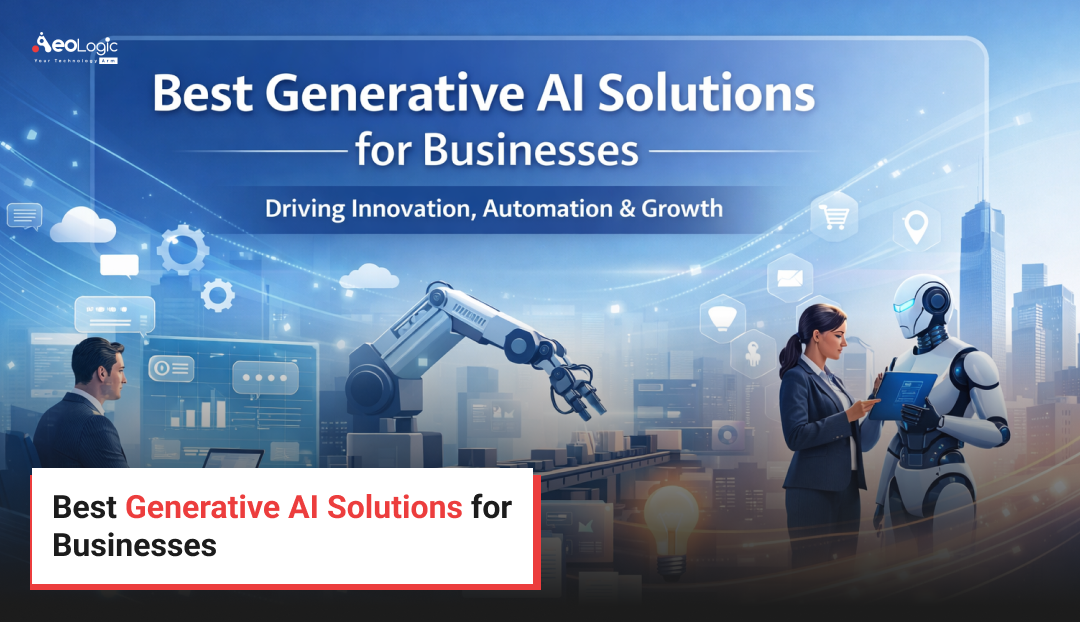
Generative artificial intelligence has rapidly evolved from an emerging concept into a powerful driver of enterprise innovation. Across industries, organizations are rethinking how they automate processes, create digital assets, and extract insights from complex data. By adopting Generative AI Solutions, businesses in 2026 are enabling smarter
Enterprises, startups, and technology leaders are increasingly exploring how these solutions can improve efficiency, reduce costs, and create scalable, future-ready business models without compromising governance or security.
What Are Generative AI Solutions?
Generative AI refers to a class of artificial intelligence systems capable of creating new content rather than just analyzing existing data. These systems use advanced machine learning models trained on large datasets to generate text, code, images, audio, designs, and even business insights.
From a business perspective, Generative AI solutions are deployed as platforms, tools, or integrated services that support automation, creativity, analytics, and decision-making. They are designed to work alongside human teams, enhancing productivity while maintaining accuracy, compliance, and contextual relevance.
Why Generative AI Matters for Businesses in 2026
The business landscape in 2026 demands speed, personalization, and intelligent automation at scale. Traditional automation tools struggle to adapt to unstructured data and complex workflows, whereas AI-powered systems excel in these areas.
Key reasons why this technology matters include:
-
Rising operational complexity across global enterprises
-
Growing demand for personalized digital experiences
-
Pressure to reduce costs while improving output quality
-
The need for faster insights from vast data ecosystems
By adopting Generative AI Solutions, organizations can shift from reactive operations to proactive, insight-driven decision-making.
Core Pillars of Enterprise-Grade Generative AI Solutions
Data Foundation and Model Architecture
A strong data strategy is the backbone of any AI initiative. High-quality, domain-specific datasets combined with robust model architectures ensure reliable and context-aware outputs.
Key considerations include:
-
Secure data pipelines and governance
-
Fine-tuning models for industry-specific use cases
-
Continuous learning and performance monitoring
Integration, Security, and Governance
For enterprise adoption, AI systems must integrate seamlessly with existing IT ecosystems. Security, compliance, and explainability are critical factors influencing trust and scalability.
Best practices involve:
-
API-based integration with ERP, CRM, and analytics platforms
-
Role-based access control and audit trails
-
Compliance with data protection and AI governance standards
Step-by-Step Strategy to Implement Generative AI in Business
Step 1: Identify High-Impact Use Cases
Start by mapping business challenges where automation or content generation can deliver measurable value. Focus on repetitive, data-heavy, or insight-driven processes.
Step 2: Select the Right Tools and Platforms
Evaluate AI platforms based on scalability, customization, security, and integration capabilities. Avoid one-size-fits-all approaches.
Step 3: Pilot, Measure, and Optimize
Run controlled pilots to measure ROI, accuracy, and adoption. Use feedback loops to refine models and workflows before enterprise-wide rollout.
Key Benefits and Business Advantages
Organizations adopting advanced AI solutions experience tangible outcomes, including:
-
Faster content and code generation
-
Improved customer engagement through personalization
-
Reduced operational costs and manual effort
-
Enhanced decision-making with AI-driven insights
-
Greater innovation velocity across teams
These benefits position businesses to respond quickly to market changes.
Real-World Use Cases and Industry Applications
In manufacturing, AI-generated predictive maintenance reports reduce downtime. In BFSI, automated document generation accelerates compliance and onboarding. Retailers use AI-driven personalization engines to boost conversions, while software firms rely on AI-assisted coding to shorten development cycles.
These examples highlight how AI moves beyond experimentation into measurable business value.
Technologies and Platforms Powering Generative AI
Modern AI ecosystems are built on:
-
Large language models (LLMs) and multimodal AI
-
Cloud-native AI platforms and MLOps frameworks
-
APIs for text, image, and code generation
-
Edge AI for real-time enterprise applications
Choosing the right mix of technologies is critical for long-term scalability.
Common Challenges and Best Practices of Generative AI Solutions
As adoption accelerates, businesses are realizing that implementing generative AI is not purely a technology decision—it is an organizational transformation. Many initiatives fail to scale because foundational challenges are underestimated during early stages.
One of the most common challenges is data quality and context alignment. Generative models rely heavily on training data, and poor, outdated, or biased datasets can lead to inaccurate or misleading outputs. Without domain-specific fine-tuning, AI-generated content may lack business relevance or regulatory accuracy, especially in industries like finance, healthcare, or manufacturing.
Another major concern is security, compliance, and intellectual property risk. Enterprises must ensure sensitive data is not exposed through AI prompts, outputs, or third-party model training. This includes compliance with data protection laws, internal security policies, and audit requirements. Lack of transparency in AI decision-making can also create trust gaps among stakeholders.
Change management and workforce adoption is another overlooked challenge. Employees may resist AI adoption due to fear of job displacement or lack of understanding. Without proper training and role clarity, AI tools remain underutilized or misused.
Best Practices for Successful Adoption
To overcome these challenges, organizations should follow structured best practices:
-
Establish strong AI governance frameworks covering data usage, ethics, and accountability
-
Use human-in-the-loop validation to review critical AI-generated outputs
-
Fine-tune models with domain-specific and organization-owned data
-
Implement role-based access control and prompt management
-
Align AI initiatives with measurable business KPIs rather than experimentation alone
Enterprises that treat AI as a long-term capability—not a quick deployment—are far more likely to see sustainable ROI.
Future Trends: How Generative AI Is Evolving
By 2026, generative AI is evolving from task-based assistance to autonomous, decision-support systems deeply embedded into enterprise workflows. The next phase is not about generating content faster, but about enabling smarter, context-aware business execution.
One key trend is the rise of AI agents capable of managing end-to-end workflows. These agents can plan tasks, interact with multiple systems, make decisions based on real-time data, and continuously optimize outcomes with minimal human intervention. This marks a shift from AI tools to AI collaborators.
Another major evolution is industry-specific AI models. Instead of generic models, businesses are adopting domain-trained systems for sectors such as logistics, BFSI, manufacturing, retail, and government. These models offer higher accuracy, regulatory alignment, and faster deployment compared to generalized AI platforms.
Explainable and ethical AI is also becoming a priority. Organizations are demanding transparency into how AI systems generate outputs, especially for risk-sensitive decisions. Explainability, bias monitoring, and compliance reporting are now core enterprise requirements rather than optional features.
Conclusion
In 2026, Generative AI Solutions are no longer optional—they are a strategic necessity for organizations aiming to scale, innovate, and stay competitive. By adopting the right frameworks, tools, and governance models, businesses can unlock sustainable value and transform operations end to end. To successfully navigate this AI-driven future, partnering with experienced technology leaders such as Aeologic Technologies can help organizations design, implement, and scale enterprise-ready AI solutions with confidence.
People Also Ask (FAQs)
Q1. What are Generative AI Solutions and how do they work?
Generative AI Solutions use advanced machine learning models trained on large datasets to create new content such as text, code, images, or insights. Unlike traditional AI, which focuses on prediction or classification, these systems generate original outputs based on patterns learned from data. In business environments, they are integrated into workflows to automate tasks, enhance creativity, and support decision-making while maintaining governance and security.
Q2. How can businesses benefit from Generative AI in 2026?
Businesses benefit through increased efficiency, faster innovation cycles, and improved customer experiences. AI-driven automation reduces manual workloads, while intelligent content generation supports marketing, development, and analytics teams. In 2026, enterprises also gain competitive advantages by leveraging AI for predictive insights, personalization, and scalable digital operations.
Q3. Are Generative AI Solutions suitable for enterprises and regulated industries?
Yes, enterprise-grade solutions are designed with security, compliance, and governance in mind. With features like data encryption, access control, audit logs, and explainability, they can be safely deployed in regulated sectors such as finance, healthcare, and manufacturing. Custom model training further ensures industry relevance.
Q4. What are common use cases of Generative AI in business?
Common use cases include automated report generation, AI-powered customer support, software code assistance, marketing content creation, predictive maintenance insights, and knowledge management. These applications help organizations reduce costs while improving accuracy and speed across departments.
Q5. What challenges should organizations consider before adoption?
Organizations must address data quality, model bias, integration complexity, and user adoption. Without proper governance, AI outputs may be inaccurate or non-compliant. A structured implementation strategy and ongoing monitoring are essential for sustainable success.
Q6. How do Generative AI Solutions differ from traditional automation tools?
Traditional automation follows predefined rules, while AI-driven systems learn from data and adapt to new contexts. This allows them to handle unstructured information, generate insights, and support complex decision-making processes that rule-based tools cannot manage effectively.