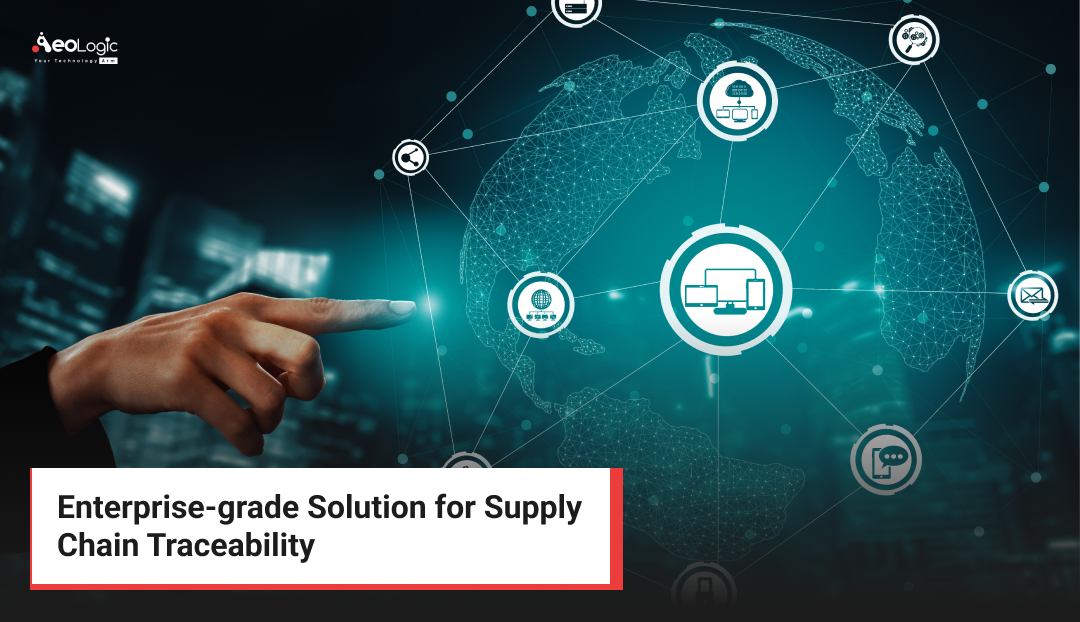
Contemporary supply chains have developed into intricately linked ecosystems spanning partners, continents, and legal frameworks. Supply chain traceability systems is now crucial for businesses that require total visibility, accountability, and control over the flow of goods from the point of origin to the final consumer. Businesses are more vulnerable to compliance issues, disruptions, poor quality, and a decline in customer confidence in the absence of a trustworthy traceability framework.
Here, enterprise supply chain traceability has become more of a strategic requirement than a technical advancement. Today’s businesses are expected to be aware of the origins, manufacturing processes, transportation methods, and conditions of their products at every stage of the supply chain. More crucially, they need to be able to demonstrate it to authorities. An enterprise-grade solution for supply chain traceability goes beyond basic tracking. It integrates data, processes, and technologies across the entire value chain to deliver real-time visibility, accountability, and control at scale.
What is Enterprise Supply Chain Traceability?
The ability of an organisation to use scalable and secure systems to track, record, and validate the movement, transformation, and status of goods, materials, and information throughout the whole supply chain—from raw materials to the final consumer—is known as enterprise supply chain traceability.
Supply chain traceability systems links each node in the network, in contrast to simple tracking systems that concentrate on discrete phases like shipping or warehousing. It creates a continuous and auditable digital history of the product lifecycle by collecting data at every handoff and process stage.
Traceability at the corporate level comprises:
- Complete visibility across distributors, retailers, manufacturers, and suppliers
- Decision-makers’ access to real-time or nearly real-time data
- Integration with partner systems, WMS, TMS, and ERP
-
Standardized data models and governance across geographies
-
Scalability to support high volumes and complex operations
The Current Significance of End-to-End traceability
The global business landscape has undergone significant transformation. Rising customer expectations, regulations, and volatility all put constant pressure on supply chains. Enterprise supply chain traceability systems has emerged as a crucial facilitator of growth and resilience in this setting.
Growing Complexity of the Supply Chain
Supply chains are now more difficult to manage due to global sourcing, multi-tier supplier networks, and outsourced manufacturing. Dozens of suppliers from several nations may be involved in a single product.
Organisations can find dependencies, bottlenecks, and risks that would otherwise go unnoticed thanks to Supply chain traceability systems, which offers a unified view across this complexity.
Demand for Openness and Confidence
Transparency is becoming more and more expected by partners, investors, and customers. They want to know how sustainable products are, where they come from, and if they are sourced ethically.
Traceability is now more than just a tool for internal operations. It now serves as a mechanism for fostering trust that promotes long-term consumer loyalty and brand credibility.
Continuity of Business and Risk Management
The significance of visibility has been brought to light by disruptions like pandemics, geopolitical conflicts, natural disasters, and supplier failures. Strong enterprise supply chain traceability enables businesses to minimise operational impact, reroute supplies, and react more quickly.
 Key Benefits of Enterprise Supply Chain Traceability
Supply chain traceability systems implementation offers benefits in terms of operations, finances, and strategy. The advantages go far beyond tracking and compliance.
Complete Visibility
Real-time visibility into inventory, shipments, production status, and supplier performance throughout the whole supply chain is made possible by a single traceability platform. Faster decision-making and more precise forecasting are made possible by this visibility.
Quicker and More Precise Recalls
Traceability can mean the difference between a focused response and an expensive, brand-damaging crisis in industries where recalls are a reality.
Enhanced Efficiency in Operations
Organisations can find inefficiencies, delays, and process gaps by monitoring materials and products at every stage. Better production planning, less waste, and improved logistics result from this.
End-to-End traceability: How Companies Use It
Enterprise supply chain traceability systems is not a single system or process. It is a framework that supports multiple business use cases across departments and functions.
Purchasing and Managing Suppliers
Traceability is used by procurement teams to monitor sourcing risks, confirm supplier compliance, and guarantee supply continuity. Organisations can avoid becoming overly dependent on specific suppliers or geographical areas by having visibility into upstream tiers.
By recording the origins of materials and supplier practices, traceability data also helps sustainability reporting and ethical sourcing.
Production Control and Manufacturing
Traceability connects raw materials, components, and completed goods in manufacturing settings. Process validation, lot tracking, and accurate quality control are made possible by this.
When problems occur, manufacturers can link defects to particular materials, equipment, or shifts, cutting down on investigation time and averting recurrence.
Distribution and Logistics
Traceability is used by logistics teams to manage handoffs between carriers and warehouses, optimise routes, and track the status of shipments. On-time delivery performance is enhanced and delays are decreased with real-time tracking.
Additionally, traceability facilitates condition tracking, exception management for sensitive goods, and cold chain monitoring.
Customer service, sales, and brand defence
Accurate product histories and delivery data are beneficial to teams that interact with customers. Teams are able to react confidently and openly when clients have enquiries or grievances.
Applications of Enterprise Supply Chain Traceability in Industry
While the principles of end-to-end traceability are consistent, its application varies by industry. Each sector faces unique risks, regulations, and operational challenges.
Food and Drinks
Traceability is crucial for quality, safety, and compliance in food supply chains. Enterprise solutions allow for quick reaction to contamination incidents by tracking ingredients from farms to processing plants to retailers.
By recording sourcing procedures and lowering food waste through improved inventory control, they also support sustainability initiatives.
Medicines and Healthcare
Strict documentation and control are necessary for pharmaceutical supply chains. Supply chain visibility guarantees adherence to temperature monitoring requirements, anti-counterfeiting laws, and serialization.
By guaranteeing product integrity throughout the distribution process, it also improves patient safety.
Production and Industrial Products
Traceability helps manufacturers handle complicated bills of materials, guarantee quality, and satisfy legal and customer requirements. High-volume, multi-plant operations with uniform data standards are supported by enterprise-level systems.
Consumer goods and retail
Retailers use end-to-end traceability to increase omnichannel fulfillment, decrease shrinkage, and improve inventory accuracy. Faster replenishment and improved customer experiences are supported by visibility across suppliers and distribution centers.
Methods and Technology Driving Enterprise Supply Chain Traceability
Enterprise traceability solutions relies on a combination of physical identification technologies, digital platforms, and intelligent data processing systems. Together, they create a connected ecosystem that captures, validates, and analyzes supply chain events at scale.
Technologies for Identification and Data Capture
Reliable data collection is the first step towards accurate traceability. Depending on the product type, environment, and level of granularity needed, enterprises usually employ a combination of technologies.
Pallets, containers, and other items are still frequently tracked in manufacturing and logistics operations using RFID tags and barcode systems. High-volume environments can benefit from RFID’s non-line-of-sight scanning and bulk reading capabilities.
IoT sensors are becoming more and more important for end-to-end traceability because they can record real-time data like temperature, humidity, shock, and location. This is especially critical for pharmaceuticals, food, and high-value goods.
Connectivity to Enterprise Systems
Only when traceability data is integrated with essential business systems does it provide value. ERP, WMS, TMS, MES, and supplier platforms are all easily integrated with enterprise-grade solutions.
Traceability events are guaranteed to be in line with financial transactions, production records, shipment documents, and procurement orders thanks to this integration. It makes end-to-end process visibility possible and removes data silos.
Scalability and interoperability are supported by standardizing data exchange between internal systems and external partners through the use of middleware layers and APIs.
Analytics and Data Platforms
Centralized or hybrid data platforms that compile data from various sources are the foundation of contemporary end-to-end traceability solutions.
AI models and advanced analytics turn unprocessed traceability data into useful insights. Predictive analytics can spot possible problems with quality, compliance, or disruptions before they escalate.
Dashboards and visualization tools present real-time and historical data in a format that supports fast decision-making by operations teams and leadership.
Technologies for Security, Governance, and Trust
Security and governance are crucial as traceability data becomes more important. Access controls, encryption, and audit trails protect sensitive information and ensure data integrity.
In order to build trust among supply chain partners and produce tamper-resistant records, some organizations are also investigating distributed ledger or blockchain technologies. Although not necessary for every use case, these technologies can be useful in high-risk, multi-party settings.
Implementing Supply Chain Traceability: Challenges and Solutions
Despite its benefits, implementing end-to-end traceability is not without challenges. Understanding these obstacles helps organizations plan more effectively and avoid common pitfalls.
Disjointed Ecosystems of Suppliers
Numerous businesses collaborate with hundreds or thousands of suppliers who have varying degrees of digital maturity. It can be challenging to achieve consistent traceability throughout such a network.
Prioritizing essential suppliers and products first, then progressively broadening coverage, is a sensible strategy. Providing standardized tools, templates, and onboarding support helps bring partners into the traceability ecosystem.
Problems with Data Quality and Standardization
Systems for traceability rely on reliable and consistent data. Variations in data formats, naming conventions, and processes can undermine visibility.
It is crucial to establish precise data standards, governance guidelines, and validation procedures. Automation minimizes errors at the source and decreases manual data entry.
Complexity of Integration
It can be difficult and resource-intensive to integrate traceability solutions with legacy systems.
By utilizing modular architectures, APIs, and integration platforms that enable incremental deployment without interfering with core operations, businesses can lessen this.
Adoption and Change Management
Technology alone does not guarantee success. Employees and partners must adopt new processes and workflows.
Training, clear benefit communication, and alignment with corporate goals are all components of effective change management. When groups realize how traceability facilitates and improves their work, adoption improves.
Cost and ROI Issues
Investments in technology, integration, and process redesign are necessary for supply chain visibility. Without precise ROI measurements, organizations may find it difficult to defend expenditures.
Building a solid business case requires defining quantifiable results like fewer recalls, lower inventory costs, better compliance, and quicker decision-making.
Enterprise Supply Chain Traceability Best Practices
Successful traceability initiatives share common principles that guide design, implementation, and long-term management.
Align Business Objectives with Traceability
Traceability should support clear business objectives, whether they relate to compliance, efficiency, sustainability, or customer experience.
Defining use cases upfront ensures that the solution delivers tangible value rather than becoming a purely technical project.
Begin with an Architecture That Is Scalable
Traceability of the enterprise supply chain must expand along with the company. Organizations can scale across regions, products, and partners without requiring significant redesigns by selecting adaptable, cloud-enabled platforms.
Prioritise End-to-End Visibility Over Isolated Tracking
True enterprise traceability connects upstream and downstream processes. Steer clear of putting isolated solutions in place that only deal with one aspect of the supply chain.
An end-to-end perspective enables better risk management and strategic planning.
Invest in the Quality and Governance of Data
Robust governance guarantees the accuracy, consistency, and reliability of traceability data over time.
Clear ownership, validation rules, and audit processes prevent data degradation as systems and partners evolve.
Make Use of Insights, Not Just Data
Traceability data should drive action. Teams can respond swiftly and maximise performance with the aid of analytics, alerts, and decision-support tools.
Organizations that embed traceability insights into daily operations and strategic planning realize the greatest value.
Future Trends of Supply Chain Traceability
Enterprise supply chain traceability continues to evolve as technology, regulation, and market expectations change.
Predictive Traceability Powered by AI
Predicting disruptions, quality problems, and compliance risks will be more heavily reliant on artificial intelligence. Businesses will anticipate and prevent events rather than responding to them.
AI models trained on traceability data will support scenario planning and automated decision-making.
Enhanced Harmonisation of Regulations
Businesses will require traceability systems that facilitate cross-border compliance and reporting as international regulations become more uniform.
Digital documentation and standardised data models will become commonplace.
Increased Attention to ESG and Sustainability
Initiatives related to the environment, society, and governance will all depend heavily on traceability. Businesses will use it to confidently report sustainability performance, measure carbon footprints, and confirm ethical sourcing.
Traceability will become a strategic ESG enabler as a result of this change from an operational tool.
Increased Cooperation Between Ecosystems
Partners will be able to collaborate more successfully while preserving data security thanks to shared platforms and data exchanges. Transparency and trust will become advantages in the marketplace.
Conclusion
For businesses functioning in an increasingly intricate and transparent global marketplace, enterprise supply chain traceability has emerged as a critical capability. It makes it possible for companies to take control of their supply networks and go beyond reactive management.
Supply chain visibility promotes resilience, efficiency, and sustainable growth by providing end-to-end visibility, enhancing compliance, lowering risk, and facilitating data-driven decision-making.
As digital transformation accelerates, solution providers such as Aeologic Technologies are helping enterprises design and implement scalable traceability frameworks that align technology with real-world business outcomes, ensuring traceability becomes a competitive advantage rather than a compliance burden.
Frequently Asked Questions
Q1. What makes Supply chain traceability systems different from basic tracking?
Supply chain traceability systems provides end-to-end visibility, system integration, scalability, and governance across the entire supply chain, rather than isolated tracking of shipments or inventory.
Q2. Does Supply chain traceability systems only apply to big businesses?
Large corporations gain a lot, but mid-sized businesses with intricate supply chains also benefit. Businesses can begin small and expand over time with scalable solutions.
Q3. How much time does it take to put Supply chain traceability systems into practice?
Timelines for implementation differ according to integration requirements, complexity, and scope. Many businesses take a phased approach, adding value little by little.
Q4. Is it necessary to replace current ERP systems in order to achieve traceability?
No, Supply chain traceability systems solutions are typically designed to integrate with existing ERP and operational systems, extending their capabilities rather than replacing them.
Q5. In what ways does traceability aid in compliance and recalls?
Traceability lowers expenses, risk, and reputational harm by facilitating quick identification of impacted products, precise reporting, and focused recalls.
Q6. Which sectors stand to gain the most from Supply chain traceability systems?
Regulatory, quality, and complexity challenges greatly benefit industries like food, pharmaceuticals, manufacturing, retail, automotive, and electronics.
Q7. Is it possible for Supply chain traceability systems to increase customer confidence?
Indeed. Transparency, authenticity verification, and reliable delivery information enhance customer confidence and brand credibility.

With a strong foundation in software and a growing expertise in AI, I specialize in building smart, scalable solutions that drive digital transformation