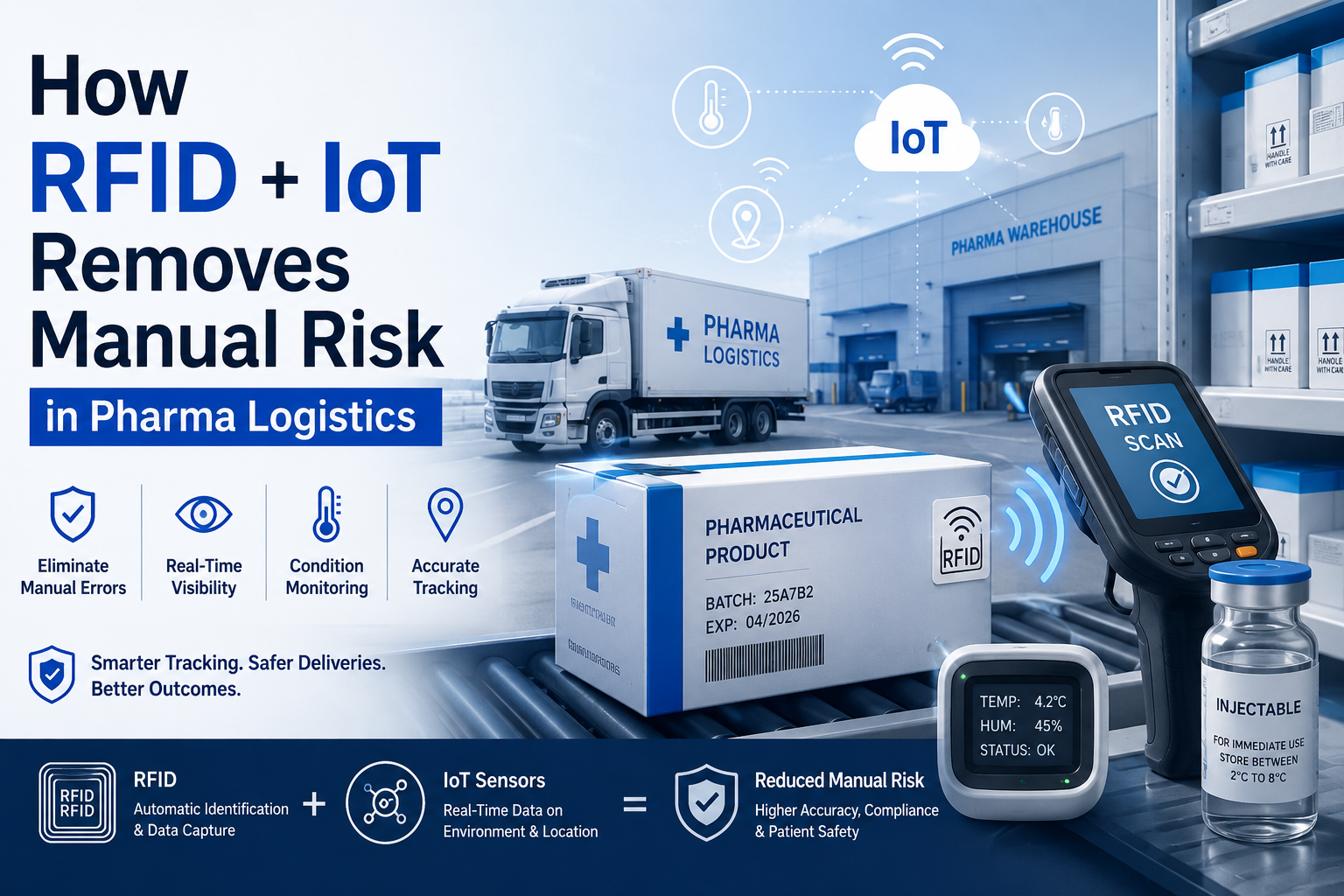
Pharmaceutical Supply Chains are one of the most vulnerable and tightly regulated business settings in the world. Medicines, vaccines, biologics and health products travel from manufacturing sites, through warehouses, transportation systems, and ultimately to patients. A tiny error in running the operation can impact on product quality, compliance with regulations and patient safety. With this background, RFID in Pharma Logistics has emerged as a crucial technology solution that can alleviate manual reliance and enhance supply chain transparency.
When combined with the Internet of Things, Radio Frequency Identification provides an integrated ecosystem of products constantly communicating with each other. Organizations have access to real-time visibility, automated monitoring and predictive intelligence, eliminating the need for human intervention at each step. Digital transformation in pharmaceutical logistics is becoming more than just a matter of efficiency – it’s about minimizing risks and preserving trust throughout the healthcare value chain.
What is RFID and IoT in Pharmaceutical Logistics?
RFID is radio wave identification and tracking without human intervention by applying tags to assets such as products, packages or containers. These tags can be scanned without having to look the reader in the eye and data captured.
With IoT technology, devices, sensors, and systems are connected to networks that are constantly gathering and sharing information. In RFID in Pharma Logistics, environmental conditions such as temperature, humidity, location, vibration, and handling conditions can be continuously measured and monitored by sensors, ensuring better visibility, compliance, and product safety throughout the supply chain.
In combination, both technologies enable pharmaceutical companies to provide intelligent logistics environments, enabling shipments and inventory to be digitally visible along the entire transport process. Organizations are not reliant on manual checks for periodic updates on product movement and conditions.
Why RFID in Pharma Logistics Matters for Modern Businesses
Pharmaceutical companies produce products which are extremely affected by environment and regulatory requirements. Vaccines, specialty medicines, biologics and temperature sensitive drugs all depend on specific conditions during transport and storage.
Manual processes can cause data silos. Organizations can only find issues when products arrive when employees forget to scan inventory, enter wrong shipment information or forget about a temperature change.
These scenarios can pose substantial business dangers. Product recall, stock shortages, non-compliance, late deliveries, and the distribution of counterfeit drugs can impact profitability and reputation.
Applications are therefore moving towards a smart logistics system, as they make the entire lifecycle transparent. Human reporting is not the sole source of information for decision makers, as it provides accurate and continuous information.
The effects on the business aren’t just operational. The increased speed in shipment validation, the decrease in wastage, better stock optimization and improved customer trust all directly impact the organization’s performance.
Understanding Manual Risks in Pharmaceutical Supply Chains
Several vulnerabilities arise in operations when using manual processes, which can become difficult to manage at scale. Implementing RFID in Pharma Logistics helps reduce these risks by enabling real-time visibility, minimizing human errors, and improving operational efficiency across the supply chain.
Counting inventory is still a frequent problem due to human error. Staff working with thousands of pharmaceutical products can make mistakes when counting products or inputting data into systems.
Documentation mis-entries can also cause compliance issues. Pharmaceutical movement and handling needs detailed records in regulatory environments. Auditing issues can arise due to missing or incorrect records.
Another challenge is for temperature-sensitive goods. The traditional methods of monitoring have been based on periodic manual checking. Temperature excursions that happen between monitoring periods can potentially result in organizations not being able to detect issues promptly.
There are shipment visibility limitations which impact operations as well. If businesses cannot determine the exact location and condition of products during transit, they tend to have problems.If they are unable to track the products in real time, they have difficulties in finding out just where the products are and how they’re doing during their transport.
The issues of counterfeit products are another problem. Patient safety and brand credibility can be compromised when medicines are unauthorized by entering the supply chain.
As supply chains reach out to various geographical regions and distribution partners, these risks grow substantially.
 How RFID in Pharma Logistics Helps Remove Manual Risks
By combining RFID and IoT technology, automation is achieved, reducing reliance on repetitive human tasks.
When products move through checkpoints, the tags automatically identify the product. Employees don’t have to scan individual items and transfer the information to another computer since the reader automatically captures the information.
Internet of Things (IoT) sensors continuously monitor the environment and send data in real-time. When temperature or humidity levels are above or below thresholds, systems provide immediate alerts.
The real-time visibility enables logistics teams to detect problems in advance before they are big operational issues. Stakeholders log in to live dashboards with shipment and inventory data, rather than waiting for reports and manual updates.
Manual data entry is also minimised, which also enhances the accuracy of data.
The result is a logistics ecosystem where human effort shifts from repetitive tracking activities toward strategic decision-making.
Core Technology Components Behind Smart Pharmaceutical Logistics
There are multiple interrelated technologies that support intelligent pharmaceutical operations, with RFID in Pharma Logistics playing a key role in improving visibility, traceability, and operational efficiency across the supply chain.
RFID tags are Logistics Identification. Depending on the application cost-effectiveness is important, and while passive tags can be used for inventory tracking, active tags offer more in terms of functionality and real-time monitoring needs.
Environmental information is continuously collected by the IoT sensors. Temperature sensors are particularly vital since many pharmaceutical products have a need for cold chain integrity.
Cloud platforms are centralized places that store and analyze operational data.
Analytics engines convert the enormous amount of logistical data that can be transformed into actionable insights.
AI solutions are increasingly helping to identify patterns linked to operational risks, which helps to facilitate predictive analysis.
These technologies form an intelligent network that can better and more efficiently control pharmaceutical logistics activities.
Step-by-Step Strategy for Implementing Smart Pharma Logistics
Step 1: Identify Existing Manual Risks
The first step for organizations is to assess the current logistics workflows. Teams should establish areas that slow or cause errors or compliance issues for human intervention.
This should include inventory process, shipment handling activities, warehouse operations, and monitoring.
Step 2: Define Business Objectives
The effectiveness of the implementation depends on having clear goals.
There are organizations that have their interest at the level of inventory accuracy, others that are interested in cold-chain monitoring, product authentication or regulatory compliance.
Measurable objectives support technology investments in a manner that is consistent with business priorities.
Step 3: Select Appropriate Hardware and Infrastructure
For RFID in Pharma Logistics, RFID tags, sensors, readers, and networks need to be tested according to the specific operational requirements to ensure accuracy, compliance, and seamless tracking throughout the supply chain.
Medications that are sensitive to temperature may need special sensor technologies to continuously monitor the environment.
Step 4: Integrate Systems Across Operations
Data from connected devices should be connected with warehouse management systems and ERP platforms, as well as logistics applications.
Integration makes sure that stakeholders are able to get info via unified dashboards.
Step 5: Train Teams and Monitor Performance
Successfully adopting a new system relies on staff being aware of the ways in which new technology will help them with their everyday tasks.
System performance should be monitored on an ongoing basis and opportunities for improvements should be identified.
Business Advantages of Intelligent Logistics Systems
Automated logistics environments offer a range of benefits, from operational to strategic.
Organizations will get better visibility as inventory and shipments will be traceable on the way. Automated identification also decreases inventory mistakes as companies lower the risk of worker errors.
Staff members are more efficient because they don’t have to do repetitive tracking work.
Real-time monitoring of the environment results in better product quality as storage and transport conditions are controlled.
Digital records automatically capture the movement and handling information, making compliance management easier.
Businesses that deliver accurate information about their orders and ensure that products are reliable are more likely to have their customers satisfied.
The reduction of waste, loss, and better resource allocation also make cost optimization possible.
Real-World Use Cases and Industry Examples
Giant pharmaceutical companies often have products which must be kept at a specific temperature throughout the world’s transportation system.
Think about a vaccine company that is manufacturing and supplying products in a number of countries. The condition of the shipment might need to be inspected by the employee during transit using traditional monitoring methods.
Sensors measure conditions in the environment all the time with connected technologies. Alerts are sent to stakeholders immediately if temperatures change outside of approved ranges.
Counting products manually can be challenging for a pharmaceutical distribution center with thousands of products.
RFID readers automatically identify products entering and leaving storage areas. An instant update of inventory information in management systems.
Intelligent tracking is also another advantage for hospital pharmacies.
Healthcare organizations that store drugs with unique properties can track inventory levels and minimize drug shortages and expiration losses.
These case studies highlight the benefits of digital logistics systems and their positive impact on operational transparency and decision-making.
Technologies and Platforms Supporting Digital Transformation
There are a number of technology platforms integral to modern pharmaceutical logistics environments that are part of a suite of integrated solutions, with RFID in Pharma Logistics playing a critical role in improving visibility, tracking accuracy, and operational efficiency.
Cloud Computing Solutions offer scalable infrastructure to store the data of operations.
Edge computing technologies aim to accelerate processing of sensor information nearer to operational environments.
There are many examples of how blockchain solutions are being used to enhance transparency and verification of product authenticity for supply chains. Blockchain solutions are being investigated to enhance transparency and verification of product authenticity in supply chain.
Mobile Applications also provide field visibility as they enable stakeholders to access information remotely.
The logistics process becomes more intelligent and responsive with the use of integrated technology ecosystems in the organizations.
Common Challenges During Implementation
While there are definite benefits, there are implementation challenges as well.
However, often large-scale deployment efforts are sidetracked because of initial investment costs.
Integrating infrastructure can also get complicated if businesses are running legacy systems that are incompatible with current technologies.
However, connected environments produce vast amounts of data that can present data management issues.
However, there may be employee resistance when implementing that is related to lack of knowledge of new systems among employee teams.
With growing connectivity comes new digital exposure, so cybersecurity has to be taken into account.
Structured planning and phased implementation approaches are likely to yield better results on organizations that tackle these issues.
Best Practices for Successful Adoption
Pilot projects for RFID in Pharma Logistics should be implemented and evaluated before rolling out the solution on a larger operational scale.
However, cross-functional cooperation is equally important as the supply chain teams, tech teams, compliance teams, and leadership teams must all have a shared goal.
When it comes to technology selection, a key consideration for businesses is scalability.
By continuously monitoring and measuring performance, organisations can discover opportunities for optimising.
The cybersecurity framework needs to be robust enough to support connected environments and to ensure protection of operational information.
Training programs are still relevant as staff are an integral part of technology uptake.
Future Trends: How Smart Pharma Logistics Is Evolving
Pharmaceutical logistics is continually evolving and innovative digitalisation is increasingly advanced.
AI will play an increasingly important role in predictive risk identification, processing historical and real-time data patterns.
The digital twin can be used to develop virtual logistics environments that simulate operational situations before the actual deployment.
Strategies could further be shaped by sustainability efforts, which might explore avenues for waste reduction and energy efficiency.
As personalization and biologics enter into the treatment landscape, spending on connected logistics systems is expected to increase.
Organizations will need more visibility and intelligence in their operations as the pharmaceutical supply chain becomes more complex.
Conclusion
The pharmaceutical industry cannot completely depend on traditional manual workflows in the ever more complex worldwide supply chain. Connected technologies make for smarter operating environments, with them, visibility, monitoring and decision making become more accurate and proactive. The RFID in Pharma Logistics solution, along with IoT features, offers a way to manage operational risks while simultaneously enhancing product integrity, compliance, and efficiency.
To modernize pharmaceutical logistics operations, businesses should invest in technologies that ensure long-term scalability and intelligent automation. Companies like Aeologic Technologies empower businesses to create sophisticated logistics ecosystems, enhance their operational efficiency, and assist in digital transformation efforts.
People Also Ask
Q1. How does RFID in Pharma Logistics improve supply chain visibility?
The use of RFID in Pharma Logistics enhances the visibility of the supply chain, allowing for automatic identification and tracking of pharmaceutical products during transportation and storage. In contrast to manual systems that require scanning of barcodes or manual reporting, RFID systems automatically record product movement information via readers and linked infrastructure. Real-time visibility of stock levels, shipment movements and product locations are provided to organisations. Having greater visibility will help businesses minimize delays, better manage stock and detect any disruptions to operations before they impact the product quality or customer experience.
Q2. What role does IoT play in pharmaceutical transportation?
IoT technology creates connected environments where devices and sensors exchange information continuously. In pharmaceutical transportation, sensors monitor factors such as temperature, humidity, movement, and geographic location. This information allows logistics teams to understand shipment conditions throughout the transportation process. If environmental changes occur outside acceptable ranges, alerts can be generated immediately. Such capabilities help organizations protect sensitive products and improve operational decision-making.
Q3. Can RFID and IoT reduce pharmaceutical product wastage?
Yes. Intelligent monitoring capabilities help reduce wastage by identifying risks before products become unusable. Continuous monitoring of storage and transportation conditions allows organizations to detect temperature excursions, handling issues, and inventory irregularities quickly. Improved visibility also reduces overstocking and expiration-related losses. Businesses can make more informed decisions regarding inventory movement and resource allocation.
Q4. Is smart pharmaceutical logistics suitable for small and medium businesses?
Small and medium businesses can also benefit from digital logistics technologies. While implementation requirements may vary depending on operational complexity, scalable solutions allow organizations to begin with targeted deployments and expand over time. Businesses often start with inventory tracking or cold-chain monitoring projects before integrating additional capabilities. The long-term operational benefits frequently justify investment decisions.
Q5. What industries benefit from connected logistics systems besides pharmaceuticals?
Connected logistics technologies provide value across several industries. Healthcare, food distribution, manufacturing, retail, automotive operations, and chemical supply chains frequently use intelligent tracking systems. Any industry requiring visibility, compliance management, and condition monitoring can benefit from digital logistics approaches. The specific implementation strategy usually depends on operational objectives and product sensitivity.

I’m a Software Developer with 9 years of experience building scalable web and mobile applications. Currently focused on React.js and React Native, I specialize in creating high-performance, user-friendly interfaces that drive business outcomes.
My background spans cross-platform development using Flutter, and native Android development, giving me a strong understanding of the entire mobile ecosystem. I’ve contributed to products in EdTech, Healthcare, and Enterprise SaaS—helping scale apps to 100K+ users and improving performance, reliability, and user engagement.
I’m passionate about clean architecture, modular design, and seamless user experiences. Whether it’s setting up robust state management with Redux Toolkit, optimizing API integrations with GraphQL/REST, or automating workflows with CI/CD pipelines (GitHub Actions)—I focus on writing maintainable code and delivering value to both users and stakeholders.