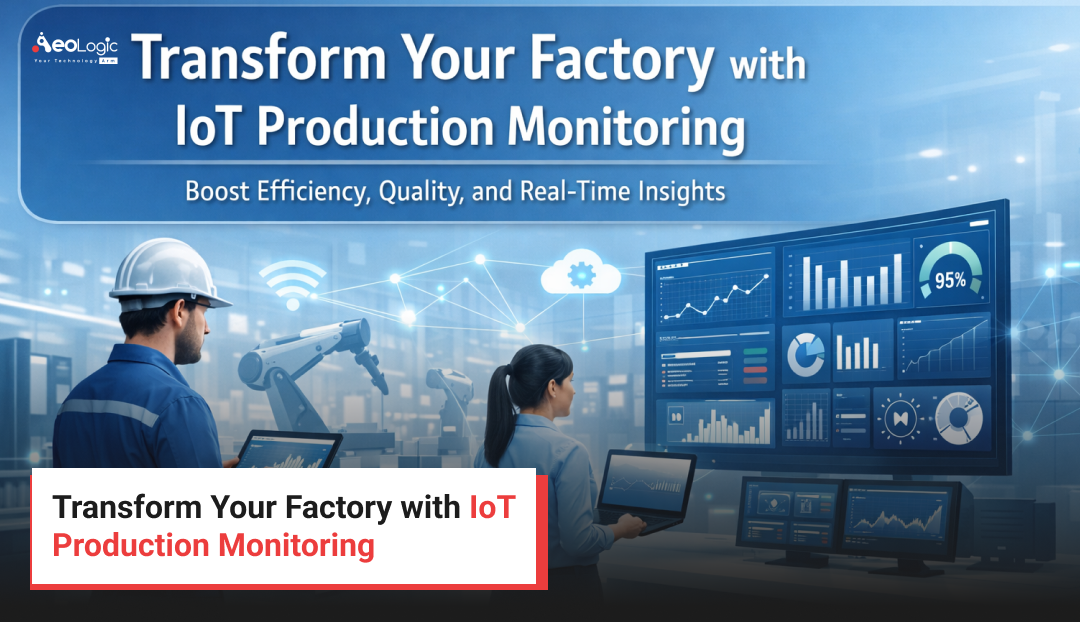
Intuition and delayed reports are no longer the driving forces behind manufacturing. Real-time production data collection, instantaneous machine performance analysis, and proactive decision-making that directly affects output, quality, and profitability are all made possible by IoT Production Monitoring. Connected production environments have evolved from a technological advancement to a strategic necessity in a time when supply chains require accuracy and downtime costs thousands of dollars per hour.
To increase operational transparency, businesses in the automotive, pharmaceutical, electronics, and process sectors are implementing connected monitoring frameworks. Manufacturers can increase productivity, lower losses, and maintain uniform production standards across single or multi-plant operations by turning raw machine data into actionable insights.
What Is IoT Production Monitoring?
IoT Production Monitoring refers to a connected system that uses industrial sensors, devices, and analytics platforms to track manufacturing performance in real time. It collects data directly from machines, production lines, and operational processes, then converts that data into meaningful dashboards, alerts, and predictive insights.
Fundamentally, this system connects digital intelligence and tangible production assets. Information like cycle time, downtime, vibration levels, temperature, output volume, rejection rates, and energy consumption are all transmitted by machines. Instead of relying on reports from the past, this constant flow of information allows executives and plant managers to make well-informed decisions based on real-time operational visibility.
 Why IoT-Based Production Monitoring Matters for Modern Enterprises
These days, manufacturing competitiveness is based on speed, efficiency, and flexibility. Manual logs, disjointed spreadsheets, and delayed reporting are examples of traditional monitoring techniques that produce blind spots that result in inefficiencies and unscheduled downtime.
By providing real-time production intelligence, IoT Production Monitoring removes those blind spots. Anomalies are quickly identified when machines are continuously monitored, which shortens the time between an issue occurring and its resolution. This reduces productivity losses and greatly increases Overall Equipment Effectiveness (OEE).
Connected monitoring improves strategic planning in addition to operational control. Leadership teams can more precisely estimate production capacity, compare plant performance, locate bottlenecks, and assess resource usage. Centralized visibility guarantees uniform operational benchmarks and standardized performance metrics for businesses with several locations.
Core Components of an Effective IoT Production Monitoring System
Three interrelated layers form the foundation of a strong monitoring ecosystem.
Data acquisition is the first layer. Performance metrics are directly collected from production lines and machines by edge devices, PLC integrations, and industrial sensors. Since decision-making solely relies on trustworthy data inputs, accuracy at this level is crucial.
Processing and connectivity make up the second layer. Data is sent to centralized platforms via secure communication protocols like MQTT and OPC-UA. Here, edge computing is crucial because it allows for immediate alerts, lowers latency, and processes time-sensitive data locally.
Analytics and visualization make up the third layer. Advanced dashboards convert unstructured data into organized insights, such as performance trends, OEE metrics, predictive maintenance indicators, and downtime analysis. By spotting patterns that human analysis might miss, machine learning models improve the system even more.
These layers work together to form a closed-loop intelligence system that continuously assesses, evaluates, and enhances production performance.
Step-by-Step Strategy to Implement Industrial IoT-Based Production Monitoring
Step 1: Define Clear Business Goals
Start by identifying measurable goals such as:
- 20% less downtime
- Increase OEE by 15%
- Defect rate reduction of 10%
Clearly defined KPIs guarantee ROI tracking and direct system design.
Step 2: Examine Current Infrastructure
Assess system integration capabilities, network preparedness, and machine compatibility to ensure seamless IoT Production Monitoring implementation. Evaluate the need for modernization or retrofitting to support real-time data visibility and analytics.
Step 3: Deploy Sensors and Edge Devices
Put sensors in place to record production data. For important alerts, edge computing guarantees quicker processing and lower latency.
Step 4: Integrate with Business Systems
To guarantee departmental data synchronization, integrate ERP, MES, and maintenance systems with production monitoring platforms.
Step 5: Train Teams and Optimize
Adoption is essential. Teach managers, supervisors, and operators how to read dashboards and take preventative action.
Key Business of IoT Production Monitoring in Smart Factories
Measurable improvements are regularly reported by factories that use connected production monitoring frameworks. Because maintenance crews can spot warning signs before failures happen, equipment downtime is reduced. As bottlenecks are identified and promptly fixed, production throughput rises. Regular monitoring of process parameters raises quality levels.
It is possible to optimize energy use, reduce waste, and get rid of needless machine idle time. These small improvements add up to significant financial gains over time.
Most significantly, data-driven visibility improves decision-making. Based on real-time performance intelligence rather than conjecture, leadership teams acquire the confidence to make investments, grow, or improve operations.
Real-World Applications Across Industries
Real-time machine monitoring has assisted assembly plants in the automotive industry in identifying previously undetected micro-stoppages. Businesses have raised line productivity by fixing these inefficiencies without having to make additional capital investments.
Facilities that process food use connected monitoring to keep an eye on crucial parameters like temperature and hygiene. Prompt notifications guarantee regulatory compliance and stop spoiling.
These illustrations show how IoT Production Monitoring systems go beyond gathering data to produce noticeable changes in operations.
Challenges for IoT-Based Production Monitoring
Best Practices for IoT Production Monitoring
Prior to expanding the monitoring system throughout the entire factory environment, begin with a targeted pilot project that focuses on high-impact production lines. Measure specific KPIs and confirm ROI.
The Future of Connected Production Intelligence
The evolution of IoT Production Monitoring is closely tied to Industry 4.0 advancements. Integration with AI-driven predictive analytics, digital twins, robotics, and 5G connectivity is shaping autonomous and self-optimizing factories.
Monitoring systems will advance from predictive alerts to prescriptive recommendations in the upcoming years, automatically modifying machine parameters to preserve peak performance. Sustainability metrics, energy intelligence, and carbon tracking will also become embedded within production dashboards as manufacturers align with ESG goals.
Conclusion
Manufacturers can transition from reactive to proactive, data-driven production management with the help of IoT Production Monitoring. It serves as the foundation for contemporary smart factories by providing real-time visibility, predictive insights, and quantifiable efficiency gains.
Organizations ready to modernize their operations and unlock scalable performance improvements should invest in IoT-Based Production Monitoring with a strategic implementation roadmap. Partnering with experienced digital transformation providers like Aeologic Technologies can accelerate deployment, ensure seamless integration, and maximize long-term ROI.
People Also Ask (FAQs)
Q1. What is IoT Production Monitoring in manufacturing?
IoT-Based Production Monitoring is a connected digital framework that tracks machine performance and production metrics in real time using sensors and analytics platforms. It enables manufacturers to monitor downtime, output, quality, and equipment health continuously. By transforming machine data into actionable insights, it helps factories improve efficiency, reduce waste, and make proactive operational decisions aligned with business objectives.
Q2. How does IoT-Based Production Monitoring improve operational efficiency?
By giving immediate insight into machine status and production flow, it increases efficiency. Managers can quickly identify bottlenecks, pinpoint the reasons behind downtime, and streamline processes. By lowering unplanned equipment failures, predictive maintenance features increase machine availability and guarantee steady output. This eventually results in lower operating costs and better OEE.
Q3. What industries benefit most from Manufacturing IoT Monitoring?
Heavy manufacturing, electronics, food processing, pharmaceuticals, and the automotive industry all gain a great deal. Connected monitoring can improve performance and compliance in any industry that depends on machinery, continuous production lines, or stringent quality control standards.
Q4. Is IoT-Based Production Monitoring expensive to implement?
Scale and infrastructure complexity have an impact on costs. On crucial production lines, however, a lot of manufacturers begin with pilot projects. The ROI frequently uses decreased maintenance costs, increased productivity, and decreased downtime to justify the investment.
Q5. How secure is IoT-based production monitoring?
Modern systems use encrypted communication protocols, secure gateways, and access control mechanisms to protect production data. With proper cybersecurity frameworks and regular audits, risks can be effectively managed, ensuring safe and reliable operations.
Q6. How long does it take to see ROI from Manufacturing IoT Monitoring?
Depending on deployment size and operational complexity, the majority of manufacturers see quantifiable improvements in six to eighteen months. Predictive maintenance savings, decreased downtime, and increased production efficiency are usually the sources of gains.