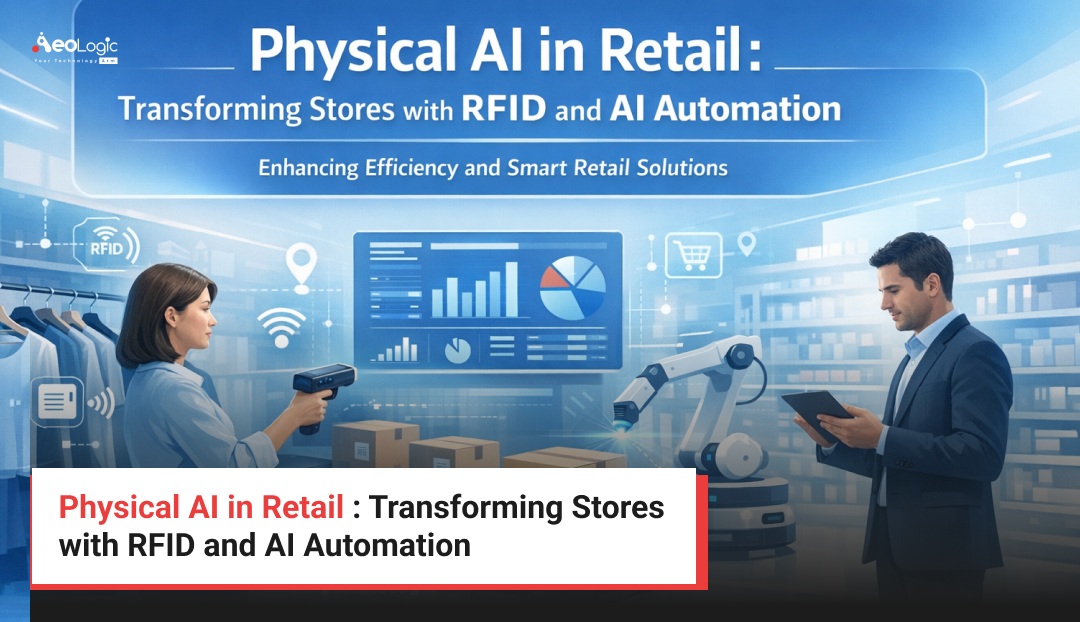
As companies work to close the gap between digital intelligence and physical store operations, retail is rapidly changing. Physical AI in Retail is becoming a potent strategy in this changing environment, combining connected infrastructure, intelligent automation, and real-time data to create smarter, more responsive store environments. Retailers must reconsider how their physical spaces function and adapt as consumer expectations change toward quicker service, precise product availability, and seamless shopping experiences.
By directly integrating intelligence into store operations, this change goes beyond conventional digitization. Retailers are able to improve decision-making at every level, automate repetitive tasks, and obtain real-time visibility thanks to technologies like RFID, AI-driven analytics, and computer vision. Consequently, companies can decrease inefficiencies, enhance operational precision, and deliver a more personalized and frictionless in-store experience.
What is Physical AI in Retail?
The integration of artificial intelligence with physical retail infrastructure, which allows machines and systems to perceive, analyze, and act within actual store environments, is known as “physical AI in retail.” This method links physical assets like shelves, products, and customer movement with intelligent algorithms, in contrast to conventional AI systems that work mainly on digital data.
Fundamentally, this idea automates and improves store operations by combining technologies like RFID sensors, edge computing, computer vision, and machine learning. Retailers can keep an eye on inventory, comprehend consumer behavior, and react quickly to operational changes thanks to these systems’ constant collection and processing of real-time data.
Retailers can create smart environments where tasks like tracking products, managing queues, and replenishing shelves happen automatically by integrating intelligence into physical processes. This level of automation enhances both operational efficiency and customer satisfaction while minimizing manual intervention.
 Why AI-powered retail environments Matters for Modern Businesses?
Retailers can make quicker and more accurate decisions by using intelligent automation to obtain real-time insights into store operations. In high-volume settings, where even minor inefficiencies can cause large financial losses, this capability is especially helpful.
Additionally, physical stores must change to provide comparable levels of efficiency and intelligence as e-commerce continues to set new benchmarks for convenience and customization. By providing data-driven insights and automation right within the store, AI-powered retail environments aid in closing this gap. This not only improves operational performance but also enhances the overall shopping experience.
Core Components of Physical AI in Retail Systems
The smooth integration of several cutting-edge technologies working together is essential for the successful deployment of AI-powered retail environments. These elements enable real-time automation and decision-making and serve as the cornerstone of intelligent retail ecosystems.
RFID technology is essential because it allows for precise, real-time product tracking across the entire store. Retailers are able to track inventory movement without the need for manual scanning because each item is tagged with a unique identifier. This guarantees high levels of inventory accuracy and gets rid of human error.
Data gathered from multiple sources, such as cameras and RFID systems, is analyzed by artificial intelligence and machine learning algorithms. These algorithms recognize trends, forecast demand, and automate choices like product placement and restocking. As the system gains knowledge from both historical and current data, it eventually becomes more effective.
By making it possible to visually monitor shelves, customer interactions, and store layouts, computer vision systems improve store intelligence. These systems can track foot traffic, identify out-of-stock merchandise, and even examine customer behavior to improve store layout.
By ensuring that data processing takes place near the source, edge computing lowers latency and permits real-time responses. This is especially crucial in retail settings where prompt actions—like setting off alerts or updating inventory systems—are essential.
Retailers can combine several locations into a single system thanks to cloud platforms’ scalability and centralized data management. This facilitates enterprise-wide insights for strategic decision-making and guarantees consistent operations.
Step-by-Step Strategy to Implement AI-powered retail environments
Physical AI implementation in retail necessitates a methodical strategy that synchronizes technology adoption with business goals.
Key Benefits of Physical AI in Retail
Businesses wishing to modernize their operations can benefit greatly from implementing intelligent retail systems.
Because automated tracking removes inconsistencies and guarantees real-time visibility into stock levels, retailers benefit from increased inventory accuracy. This improves demand fulfillment by lowering the possibility of stockouts and overstocking.
When automated workflows take the place of manual processes, operational efficiency rises. Inventory counting, shelf monitoring, and checkout procedures all become quicker and more dependable.
Personalized interactions and shorter wait times improve the customer experience. Technologies such as cashier-less checkout and smart recommendations create a seamless shopping journey.
Data-driven decision-making turns into a fundamental skill that helps retailers react swiftly to shifts in the market and consumer preferences. In the fiercely competitive retail industry, this flexibility is crucial.
Reduced labor needs, fewer mistakes, and better use of resources all contribute to cost savings. These efficiencies eventually lead to increased profitability and long-term growth.
Real-World Use Cases and Applications
Retailers across the globe are leveraging Physical AI in Retail to transform their store operations and customer experiences.
Automated inventory management, where RFID and AI systems track products in real time, is one well-known use case. This lowers the possibility of lost sales as a result of unavailable items and guarantees that shelves are always stocked.
Another use is in cashierless stores, where customers can pick up their purchases and depart without going through the usual checkout procedures thanks to computer vision and artificial intelligence. A seamless shopping experience is produced by the automatic recording of transactions.
Additionally, smart shelf technology is becoming more popular because it enables retailers to keep an eye on product placement and identify when items need to be restocked. Both shelf availability and store presentation are improved as a result.
Another potent application is customer behavior analytics, where AI systems examine shopping habits and foot traffic patterns. These insights can be used by retailers to improve marketing plans, product placement, and store layouts.
Technologies Powering Physical AI in Retail
The evolution of AI-powered retail environments is driven by a combination of advanced technologies that work together to create intelligent store environments.
Real-time inventory tracking is made possible by RFID systems, which enable precise and automated product monitoring.
Large amounts of data are processed by machine learning and artificial intelligence algorithms to produce insights and automate decision-making procedures.
Retailers can monitor shelves, identify irregularities, and comprehend customer behavior by using computer vision technology to visually analyze store environments.
Internet of Things (IoT) devices connect physical assets and sensors, creating a network of interconnected systems that share data in real time.
Because cloud computing platforms guarantee scalability and centralized data management, retailers are free to grow their businesses.
Challenges in Physical AI in Retail Implementation
Compatibility problems frequently arise when integrating cutting-edge technologies like RFID, AI, and current legacy systems. Data silos are a problem for many retailers, which makes it challenging to guarantee real-time visibility throughout operations and accomplish smooth platform communication.
Concerns about data security and privacy pose another significant obstacle. Retailers must maintain regulatory compliance while safeguarding sensitive customer and operational data from potential breaches due to the growing use of sensors, cameras, and tracking systems.
Setting up infrastructure, training employees, and transforming processes all require organizational alignment and financial commitment, which can be challenging without a clear implementation roadmap and ROI visibility.
Best Practices for Smart Retail Automation and AI-Driven Store Systems
In high-impact areas like inventory management or checkout automation, start with a pilot project. Before expanding to several locations, this enables companies to evaluate system performance, calculate return on investment, and improve implementation techniques. Select compatible and scalable platforms to guarantee smooth system integration. To facilitate seamless data flow and centralized control, retailers should give top priority to solutions that are simple to integrate with current ERP, POS, and supply chain systems.
Invest in employee training and continuous optimization. Empowering staff to work alongside AI systems improves adoption, while ongoing performance monitoring and data analysis help refine processes, enhance accuracy, and maximize long-term operational efficiency.
Future Trends in Physical AI in Retail
The future of Intelligent retail systems is poised for rapid growth as technologies continue to evolve and become more accessible.
The growing use of edge AI, where data processing takes place right inside the store, is one new trend.
The combination of virtual assistants and augmented reality, which improves consumer interaction and offers interactive shopping experiences, is another trend. With AI systems optimizing energy use and cutting waste in retail operations, sustainability is also emerging as a major priority.
Retail environments will become more intelligent, flexible, and customer-focused as these innovations advance, establishing new benchmarks for the sector.
Conclusion
By fusing intelligent systems with physical environments to provide real-time insights, automation, and improved customer experiences, physical AI in retail is completely changing how stores run. As retailers continue to embrace digital transformation, the adoption of AI-driven technologies such as RFID and computer vision will play a critical role in shaping the future of retail.
Businesses looking to stay ahead must invest in scalable, data-driven solutions that enable smarter operations and seamless customer journeys. Partnering with experienced technology providers like Aeologic Technologies can help organizations successfully implement and scale intelligent retail systems, ensuring long-term growth and competitive advantage.
People Also Ask (FAQs)
Q1. What is Physical AI in Retail and how does it work?
In order to enable real-time monitoring, analysis, and automation of retail operations, Intelligent retail systems integrates artificial intelligence with physical store infrastructure. It gathers information from the store environment by combining technologies like RFID, computer vision, and Internet of Things sensors. AI algorithms then process this data to produce insights and initiate automated processes, like replenishing shelves or improving store layouts. The end product is an extremely responsive and effective retail system that enhances customer satisfaction and operational performance.
Q2. How does RFID support AI-driven retail systems?
RFID technology plays a critical role in enabling AI-driven retail systems by providing accurate and real-time data on inventory movement. This data is essential for AI algorithms to analyze stock levels, predict demand, and automate inventory management. By ensuring high data accuracy, RFID enhances the effectiveness of AI systems and supports seamless retail operations.
Q3. What are the benefits of implementing AI in physical retail stores?
Implementing AI in physical retail stores offers numerous benefits, including improved inventory accuracy, enhanced operational efficiency, and better customer experiences. AI systems enable real-time monitoring and automation, reducing manual effort and minimizing errors. Retailers can also gain valuable insights into customer behavior, allowing them to personalize interactions and optimize store layouts. These advantages contribute to increased sales, reduced costs, and stronger competitiveness in the market.
Q4. Is Intelligent retail systems suitable for small businesses?
While large enterprises are leading the adoption, Intelligent retail systems is increasingly becoming accessible to small and medium-sized businesses. Scalable cloud platforms and cost-effective RFID solutions allow smaller retailers to implement intelligent systems without significant upfront investment. By adopting a phased approach, small businesses can gradually integrate AI technologies into their operations and benefit from improved efficiency and customer engagement.
Q5. What challenges do retailers face when adopting AI and RFID?
Retailers often face challenges such as integrating new technologies with existing systems, managing data privacy concerns, and handling the initial investment required for deployment. Additionally, ensuring employee readiness and adapting to new workflows can be complex.
Q6. How will AI transform the future of retail stores?
AI is expected to transform retail stores by making them more intelligent, automated, and customer-centric. Future stores will leverage advanced technologies to provide personalized experiences, optimize operations, and reduce costs. Innovations such as cashier-less checkout, smart shelves, and real-time analytics will become standard, enabling retailers to meet evolving consumer expectations and stay competitive in a dynamic market.

Currently, as a Senior Manager of Technology, I oversee a dynamic team, ensuring the delivery of high-quality software solutions that meet the evolving needs of our clients. A seasoned technology leader with over a decade of experience in the software development industry, I have been instrumental in driving the end-to-end software development lifecycle since my career inception in 2011.