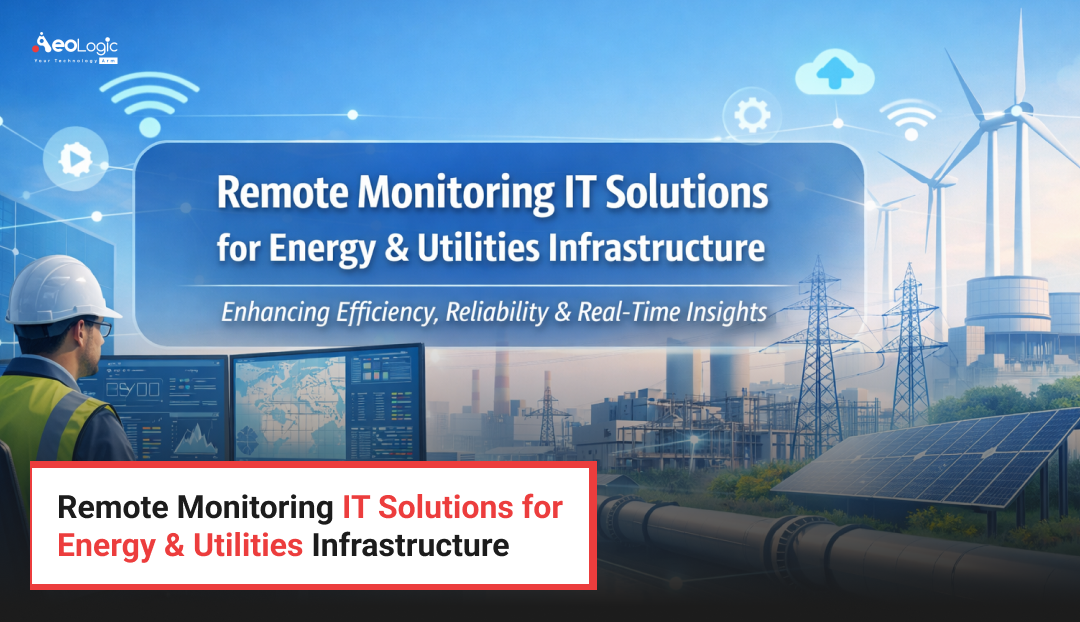
Power plants, substations, pipelines, water networks, and renewable resources are examples of the complex, geographically dispersed infrastructure that modern energy and utility companies manage. IT solutions for energy and utilities have become essential to monitor these assets in real time, ensure uninterrupted service, and maintain regulatory compliance.
Utilities can reduce downtime, increase safety, and optimise performance by gathering, analysing, and acting upon operational data without being physically present thanks to Remote Monitoring IT Solutions. These solutions are now essential to resilience, efficiency, and long-term sustainability for businesses and decision-makers.
What Are Remote Monitoring IT Solutions for Energy & Utilities?
Remote Monitoring IT Solutions are integrated digital systems that use sensors, networks, software platforms, and analytics to enable energy and utility providers to remotely monitor, manage, and control infrastructure assets.
Operational technology (OT) and information technology (IT) are combined in these energy and utility IT solutions to provide real-time visibility into environmental conditions, performance metrics, and asset health. Instead of reactive maintenance, proactive management is the outcome.
Why Remote Monitoring IT Solutions Matter?
Infrastructure related to energy and utilities is both mission-critical and capital-intensive. Customers, earnings, and public trust are all directly impacted by any disruption.
By facilitating ongoing supervision, quicker decision-making, and predictive maintenance, remote monitoring tackles these issues. This results in reduced operational risk, enhanced service dependability, and better asset utilisation throughout the whole value chain for businesses.
 Core Components of Remote Monitoring IT Solutions
IoT Edge Devices and Sensors
Temperature, pressure, voltage, vibration, and flow rates are among the real-time data that sensors gather from assets. To cut down on latency, edge devices preprocess data locally.
These elements serve as the cornerstone of IT solutions for utilities and energy, guaranteeing timely and accurate data collection even in remote areas.
Networks for Communication and Connectivity
Cellular (4G/5G), LPWAN, satellite, fibre, or private networks enable dependable data transmission. Uninterrupted data flow across various terrains and crucial infrastructure environments is ensured by the appropriate connectivity strategy.
Platforms for Centralised Monitoring
Platforms that are hybrid or cloud-based combine data from various sources into single dashboards. These platforms facilitate the management of complex infrastructure at scale by offering visualisation, alerts, and control capabilities.
AI, predictive intelligence, and analytics
AI models and advanced analytics find anomalies, predict failures, and improve operations. This layer elevates energy and utility IT solutions from monitoring to intelligence-driven operations by converting raw data into actionable insights.
Step-by-Step Strategy to Implement Remote Monitoring
Step 1: Evaluate Business Goals and Infrastructure
Determine operational risks, performance objectives, and critical assets. Align monitoring goals with compliance requirements and business KPIs. IT solutions for energy and utilities are guaranteed to provide quantifiable value when a clear roadmap is in place.
Step 2: Choose Data Sources and Sensors
Select sensors according to data requirements, asset type, and environmental conditions. Long-term scalability and dependable monitoring depend on accurate instrumentation.
Step 3: Create an Architecture for Secure Connectivity
Analyse cybersecurity needs and network options. Put redundancy, authentication, and encryption into practice. Critical infrastructure is shielded from cyber threats by security-first design.
Step 4: Implement Analytics and Monitoring Platforms
Incorporate data into centralised platforms that have alerting systems and real-time dashboards. Predictive maintenance and operational optimisation are made possible by analytics capabilities.
Step 5: Develop Teams and Continue to Improve
Provide workflows and training to IT and operations teams so they can respond to insights. Constant optimisation guarantees that the system adapts to changing operational requirements.
Key Benefits of Remote Monitoring IT Solutions
- Decreased downtime via predictive maintenance and early fault detection
- Longer asset life and reduced maintenance expenses
- Reduced on-site inspections for increased safety
- Operational visibility in real time across dispersed assets
- Automated reporting and audit trails for regulatory compliance
- Scalable operations to facilitate the growth of smart grids and renewable energy
These advantages demonstrate the importance of IT solutions for utilities and energy in digital transformation plans.
Real-World Applications and Use Cases
Monitoring of the Power Grid and Substation
Utilities monitor transformer health, load conditions, and fault indicators remotely. Faster outage response and increased grid reliability are made possible by this.
Monitoring of Oil and Gas Pipelines
In pipelines that span thousands of kilometres, sensors identify corrosion, leaks, and changes in pressure. Remote monitoring guarantees regulatory compliance and lowers environmental risk.
Management of Water and Wastewater
Water utilities use remote monitoring to keep an eye on pump performance, flow rates, and quality parameters. This helps reduce water loss, improve service delivery, and optimize energy usage.
Asset Management for Renewable Energy
Weather, energy output, and equipment performance are all monitored by solar and wind operators. Return on investment and generation efficiency are maximized through remote monitoring.
Technologies Driving Solutions for Remote Monitoring
- Platforms for the Internet of Things
- Industrial control systems and SCADA
- Hybrid and cloud-based infrastructure
- Predictive analytics powered by AI and ML
- Digital twins for simulating assets
- Critical infrastructure cybersecurity frameworks
When combined, these technologies provide reliable IT solutions for utilities and energy that promote resilience and modernization.
Common Challenges and Best Practices
Challenges
-
Integrating legacy systems with modern IT platforms
-
Managing data volume and quality
-
Ensuring cybersecurity across distributed assets
-
Achieving interoperability between vendors
Best Practices
- Start with assets that have a big impact and work your way up.
- Make use of interoperable platforms and open standards.
- Integrate cybersecurity from the outset of design
-
Align IT and OT teams for unified governance
For implementation to be successful, these issues must be resolved.
Future Developments in Energy and Utility Remote Monitoring
Remote monitoring is evolving toward autonomous operations powered by AI and edge intelligence. These technologies enable real-time data processing closer to assets, reducing latency, improving response times, and minimizing operational risks across complex energy networks.
Self-healing grids that automatically identify and fix problems, sophisticated digital twins that mimic asset performance, 5G-enabled monitoring for fast connectivity, and sustainability-driven analytics that promote energy efficiency and emissions reduction are some of the emerging trends.
IT solutions for energy and utilities will be essential to enabling smart, resilient, and low-carbon infrastructure as energy systems decentralize and the use of renewable energy sources increases. These solutions will enhance predictive maintenance, grid reliability, cybersecurity, and long-term operational sustainability.
Conclusion
IT solutions for remote monitoring are revolutionizing the way utilities and energy companies handle vital infrastructure. These solutions offer more insight into asset performance and system health by utilizing real-time data, sophisticated analytics, and safe digital platforms.
IT solutions for energy and utilities enable increased resilience, operational efficiency, and quicker response to possible disruptions through automated alerts and predictive insights. In order to support scalable, secure, and future-ready operations—ensuring long-term sustainability and more intelligent infrastructure management—remote monitoring will be essential as the sector shifts toward decentralized and low-carbon energy systems.
Now is the time to invest in scalable remote monitoring strategies to reduce risk, improve performance, and lead the transition toward smarter, more sustainable energy and utility ecosystems.
People Also Ask (FAQs)
Q1. What are IT solutions for energy and utilities?
Digital systems that facilitate the monitoring, management, and optimisation of infrastructure like water networks, pipelines, and power grids are known as IT solutions for energy and utilities. To increase operational effectiveness, these solutions combine software platforms, data analytics, cloud infrastructure, and cybersecurity tools. They support digital transformation initiatives while assisting organisations with downtime reduction, proactive asset management, and regulatory compliance by providing real-time visibility and predictive insights.
Q2. How does remote monitoring improve utility operations?
By offering constant, real-time insights into asset performance without requiring on-site presence, remote monitoring enhances utility operations. This enables operators to proactively plan maintenance, identify problems early, and react to faults more quickly. Remote monitoring lowers operating costs, improves safety, and guarantees dependable energy and utility IT solutions.
Q3. Is remote monitoring secure for critical infrastructure?
Indeed, remote monitoring can be extremely secure when properly designed. Network segmentation, role-based access control, encryption, and ongoing threat monitoring are all features of contemporary energy and utility IT solutions. Systems are shielded from cyberattacks and illegal access by cybersecurity frameworks designed for critical infrastructure.
Q4. Which sectors gain the most from IT solutions for remote monitoring?
The industries that gain the most are those that oversee dispersed and vital assets. These include operators of renewable energy, water and wastewater utilities, oil and gas, and power generation and distribution. Energy and utility IT solutions allow these industries to optimise asset performance in geographically dispersed environments, enhance safety, and maintain operational continuity.
Q5. In what ways does AI improve systems for remote monitoring?
By evaluating vast amounts of operational data to spot trends, forecast failures, and suggest courses of action, artificial intelligence (AI) improves remote monitoring. Machine learning models can automate alerts, optimise energy output, and predict equipment deterioration. AI transforms operations in energy and utility IT solutions from reactive to predictive, allowing for more intelligent and effective infrastructure management.
Q6. What are the implementation costs of remote monitoring solutions?
Asset size, sensor specifications, connectivity choices, and analytics capabilities all affect implementation costs. IT solutions for energy and utilities frequently provide a strong return on investment (ROI) through decreased downtime, lower maintenance costs, and longer asset lifespans, even though the initial investment may be substantial.