In today’s business world, where data is king, keeping track of physical assets accurately is no longer a choice; it’s a strategic must. Companies depend on efficient asset tracking systems to keep their operations visible, cut down on losses, and make better decisions. These systems are used in everything from manufacturing plants and warehouses to healthcare facilities and logistics networks. This is where RFID vs Barcode vs NFC Asset Tracking becomes a critical comparison for enterprises evaluating the right technology.
RFID, barcode, and NFC are all different technologies that have their own strengths, weaknesses, and costs. But picking the right one depends on a number of things, such as how well it can grow, how much automation it needs, the conditions of the environment, and how well it can work with other systems. This article gives businesses a full, professional, and SEO-friendly comparison to help them make smart choices.
What is RFID vs Barcode vs NFC Asset Tracking?
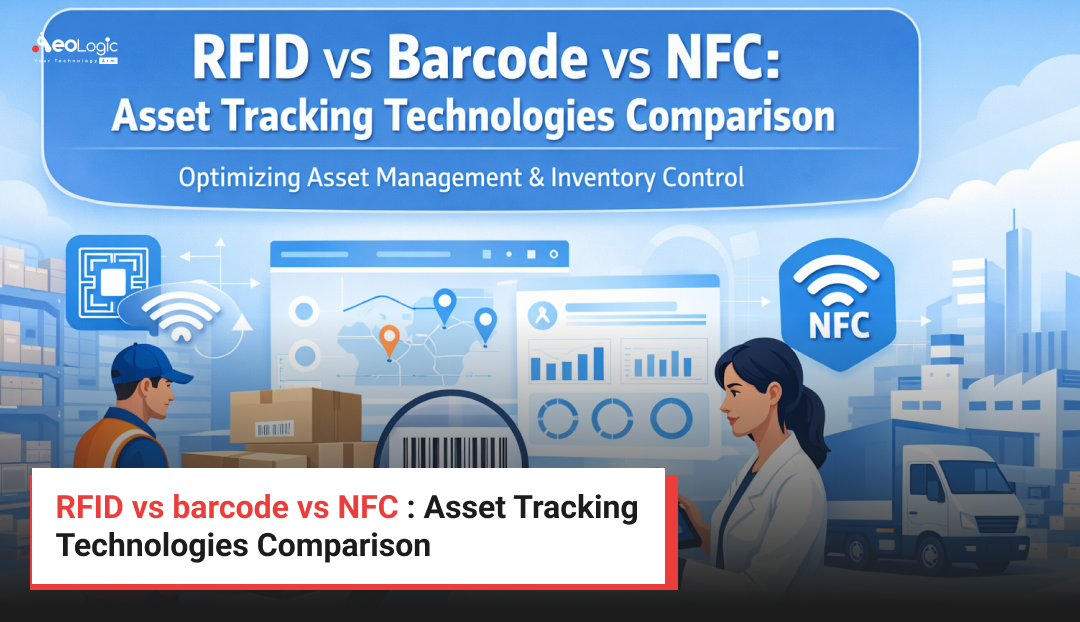
RFID vs Barcode vs NFC Asset Tracking refers to the comparative analysis of three widely used technologies for identifying, monitoring, and managing physical assets across industries. These technologies enable businesses to capture data about assets, track their movement, and optimize workflows.
Barcode technology is one of the easiest and cheapest ways to do things because it uses printed labels that are scanned by optical readers. RFID (Radio Frequency Identification) uses radio waves to automatically find tagged items without needing to see them. NFC (Near Field Communication), which is a part of RFID, lets you talk to someone over a short distance. It’s often used in mobile interactions.
All three technologies have the same main goal: to find and track assets. However, they all work differently, are more or less scalable, and are more or less efficient. To choose the best solution, you need to know what these differences are.
Why RFID vs Barcode vs NFC Asset Tracking Matters for Businesses
The right asset tracking technology has a direct effect on how well your business runs, how much it costs, and how easily it can grow. Companies that deal with valuable assets or large inventories can’t afford to waste time and money on tracking methods that are old or don’t work.
For instance, a warehouse that uses barcode systems may have trouble with delays when scanning items by hand, but an RFID-enabled facility can track hundreds of items at once in real time. In the same way, NFC might be great for apps that customers use, but not for tracking large amounts of industrial data.
This comparison matters because it helps businesses:
- Cut down on human errors to make asset management more accurate.
- Increase the speed of operations by using automation and tracking in real time.
- Make it easier to follow the rules and be ready for an audit.
- Lower the risk of losing, stealing, or misplacing assets
- Use technologies that can grow to help digital transformation projects.
Knowing these things helps businesses buy technology that helps them reach their operational goals.
 RFID vs Barcode vs NFC Asset Tracking: Core Technology Comparison
Barcode Technology Overview
Printed labels with encoded data that can be read by optical scanners are what barcode systems use. These labels are cheap and easy to use, which is why they are so popular in retail, logistics, and inventory management.
But barcode systems need to be scanned in line of sight and require human help. This makes them less useful in places where a lot of work is done or where machines do most of the work. Also, barcode labels can get damaged or worn out over time, making them harder to read.
RFID Technology Overview
RFID technology automatically finds and keeps track of tags on things by using electromagnetic fields. It can scan more than one item at a time and doesn’t need a direct line of sight like barcodes do.
Tags, readers, and software platforms make up RFID systems that let you capture data in real time. These systems can be easily expanded and are great for places that need automation, like big warehouses and factories.
NFC Technology Overview
NFC works by sending and receiving short-range wireless signals, usually within a few centimeters. People often use it in mobile devices for payments that don’t require a card, access control, and smart interactions.
NFC is very secure and easy to use, but it doesn’t work well for tracking a lot of assets at once because it has a short range. But it works best when close interaction and authentication are needed.
RFID vs Barcode vs NFC Asset Tracking: Key Differences
The main differences between these technologies are how they work, how much they cost, how big they can get, and how they can be used.
Barcode systems are cheap, but they need to be scanned by hand and seen directly. RFID is great for businesses because it can automate tasks, scan over long distances, and read a lot of data at once. NFC, on the other hand, is better for interactive apps because it lets you talk to each other securely over short distances.
RFID tags can hold more data than barcodes, and NFC lets two devices talk to each other. RFID works better in bad weather than barcode labels, so they are also different in how well they adapt to different environments.
These differences are very important for figuring out which technology is best for a certain business need.
Step-by-Step Approach to Choosing the Right Asset Tracking Technology
Step 1: Define Business Requirements
Organizations must first identify their tracking needs, including asset volume, movement frequency, and operational complexity. This step ensures clarity on whether automation or manual tracking is sufficient.
Step 2: Evaluate Operational Environment
The performance of technology can be affected by things like temperature, humidity, and interference. RFID works better in tough situations, while barcodes may not work as well over time.
Step 3: Assess Budget and ROI
Cost is an important thing to think about when making a decision. Barcode systems cost less to set up, but RFID systems cost more up front but save money in the long run by making things more efficient.
Step 4: Consider Integration Capabilities
The technology you choose should work well with your current ERP, WMS, or IoT platforms. Compared to older barcode systems, RFID and NFC systems often work better with other systems.
Step 5: Analyze Scalability Needs
Companies that want to grow should put scalable solutions at the top of their list. RFID systems can grow with your business, so they are great for businesses that want to grow.
Step 6: Test and Pilot Implementation
Before full-scale deployment, pilot tests help find possible problems and make sure the process goes smoothly.
Benefits of RFID vs Barcode vs NFC Asset Tracking
RFID technology makes things easier to see in real time, cuts down on manual work, and makes operations run more smoothly. It is especially useful for fields that need automation and high accuracy.
Barcode systems are easy to use and cheap, which makes them perfect for small to medium-sized businesses with tight budgets.
NFC technology makes it easier for users to interact with each other, improves security, and makes things more convenient, especially when it comes to authentication and mobile integration.
Each technology has its own strengths and weaknesses when it comes to tracking assets, so the best one for you will depend on your needs and business goals.
Real-World Use Cases and Examples
RFID is commonly used in manufacturing to keep track of raw materials and finished goods as they move between production lines. It lets you check things in real time and cuts down on delays caused by scanning by hand.
Barcode systems are popular for managing inventory in retail stores because they are cheap and easy to set up.
NFC is used in healthcare to identify patients, control access, and keep track of equipment. This keeps things safe and follows the rules.
Logistics companies use RFID to keep an eye on shipments in real time, which makes deliveries more accurate and keeps customers happy.
Technologies and Tools Involved
Modern asset tracking systems work with cutting-edge technologies like AI analytics, cloud computing, and the Internet of Things. RFID systems often work with IoT platforms to give you real-time information.
Most of the time, barcode systems work with inventory management software and handheld scanners. NFC solutions are commonly embedded in mobile applications and smart devices.
With these technologies, businesses can do more than just track things; they can also do predictive analytics, automation, and smart decision-making.
Common Challenges and Mistakes
One of the most common problems is picking a technology without fully understanding what the business needs. This often makes things less efficient and costs more.
Another mistake is not realizing how hard it is to integrate. Even cutting-edge technologies like RFID may not work as expected if they are not properly integrated into the system.
The environment can also affect how well someone does. For example, RFID signals can be blocked by metal surfaces and liquids, and barcode labels can wear out in bad conditions.
To get past these problems, you need to plan ahead, test things out, and talk to experts.
Best Practices for Successful Implementation
To reduce risks and make sure that deployment goes smoothly, organizations should use a phased implementation approach. Businesses can test performance and make changes as needed by starting with a pilot project.
It’s just as important to train employees on how to use the chosen technology correctly. Also, regular updates and maintenance help keep the system running smoothly.
Working with experienced technology providers can greatly improve the chances of a successful implementation and a good return on investment.
Future Trends in Asset Tracking Technologies
Improvements in IoT, AI, and automation are what will shape the future of asset tracking. RFID technology is getting better all the time, with more accurate readings, lower costs, and better ways to work together.
NFC is becoming more popular in smart apps, especially for interacting with customers and making secure payments. Digital and mobile scanning solutions are making barcode technology better all the time.
The combination of these technologies with AI-driven analytics is making it possible to do predictive maintenance, make decisions in real time, and improve operational intelligence.
Companies that use these new ideas early will have an edge over their competitors in their fields.
Conclusion
In conclusion, RFID vs Barcode vs NFC Asset Tracking is not about choosing the best technology universally, but about selecting the most suitable solution for specific business needs. Each technology has its own benefits. For example, barcodes are cheap, RFID can automate tasks, and NFC lets people interact safely.
Organizations need to think about their operational needs, budget limits, and long-term goals before making a choice. Businesses can become more efficient, accurate, and scalable by using the right technology to track their assets.
For enterprises looking to implement advanced and scalable asset tracking solutions, partnering with experts like Aeologic Technologies can provide the strategic guidance and technical expertise needed to drive successful digital transformation.
People Also Ask (FAQs)
Q1. What is the difference between RFID, barcode, and NFC in asset tracking?
The main difference between RFID, barcode, and NFC is how they collect and send data. Barcode systems need to be scanned by hand and seen, which makes them good for simple tasks. RFID uses radio waves to automatically keep track of many assets without being able to see them directly. This makes operations faster and more efficient. NFC works over short distances and is often used for secure communication and tracking on mobile devices. Businesses can choose the best asset tracking solution for their needs and growth by knowing the differences between RFID, barcode, and NFC.
Q2. Which asset tracking technology is most cost-effective?
Barcode technology is usually the best choice because it doesn’t cost much to start and is easy to set up. But RFID systems usually have higher initial costs, they often give a better return on investment over time because they automate and make things more efficient. NFC is in the middle, depending on what you want to do with it.
Q3. Is RFID better than barcode for inventory management?
Many people think that RFID is better for managing inventory in large businesses because it can scan many items at once and give real-time data. But barcode systems are still a good choice for small businesses that don’t have a lot of money. The choice should be based on what the business needs, not a one-size-fits-all approach.
Q4. Where is NFC commonly used in asset tracking?
NFC is a common technology for secure, short-range interactions in applications like authentication systems, mobile payments, and access control. When tracking assets, it is often used for expensive items or situations where the user needs to interact with the system. Because it doesn’t work well over long distances, it’s not good for tracking large groups of people.
Q5. Can these technologies be integrated with existing systems?
Yes, all three technologies can work with current business systems like ERP and inventory management platforms. RFID and NFC are better at integrating with IoT and cloud-based solutions than other technologies. Proper integration makes sure that data flows smoothly and operations run more smoothly.
Q6. What industries benefit most from asset tracking technologies?
Asset tracking technologies are very useful for industries like healthcare, manufacturing, logistics, retail, and construction. These industries need precise and quick tracking to make their operations better, cut down on losses, and make better decisions. The choice of technology depends on industry-specific requirements.

I’m a Software Developer with 9 years of experience building scalable web and mobile applications. Currently focused on React.js and React Native, I specialize in creating high-performance, user-friendly interfaces that drive business outcomes.
My background spans cross-platform development using Flutter, and native Android development, giving me a strong understanding of the entire mobile ecosystem. I’ve contributed to products in EdTech, Healthcare, and Enterprise SaaS—helping scale apps to 100K+ users and improving performance, reliability, and user engagement.
I’m passionate about clean architecture, modular design, and seamless user experiences. Whether it’s setting up robust state management with Redux Toolkit, optimizing API integrations with GraphQL/REST, or automating workflows with CI/CD pipelines (GitHub Actions)—I focus on writing maintainable code and delivering value to both users and stakeholders.