Physical keys and door locks are no longer the only aspects of security. Conventional access control techniques find it difficult to meet the demands of contemporary security as organisations expand, diversify, and become more digital. Businesses are vulnerable to operational risks and compliance gaps due to lost keys, shared access cards, lack of visibility, and manual tracking. Here, RFID Access Control shows up as a dependable, scalable, and clever solution.
RFID-based systems are revolutionising the way businesses secure buildings, assets, and sensitive areas by enabling contactless, automated, and traceable access management. RFID Access Control is evolving into a fundamental security layer in everything from corporate offices and warehouses to hospitals, data centres, and manufacturing facilities.
RFID Access Control: What Is It? Definition and Fundamental Idea
RFID Access Control refers to a security system that uses Radio Frequency Identification technology to grant or restrict access to physical locations, assets, or systems based on authorized RFID credentials.
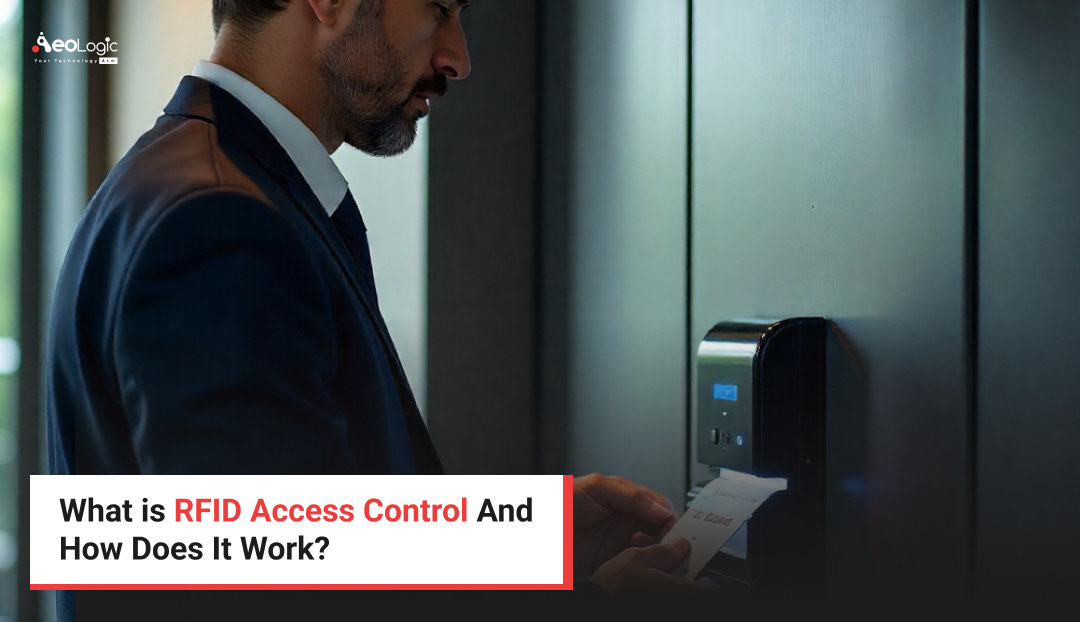
Fundamentally, RFID Access Control uses RFID-enabled tags, cards, or wearables to supplement or replace conventional access methods like keys, PIN codes, or magnetic stripe cards. These credentials use wireless communication with RFID readers to instantly confirm identity and authorisation.
RFID Access Control functions without physical contact or line-of-sight scanning, in contrast to manual systems. As a result, it is quicker, safer, and simpler to administer across various locations and access points.
A Basic Understanding of RFID Technology
RFID technology operates by sending data between two main components via radio waves:
- A person or asset’s RFID tag or credential
- Access points have an RFID reader installed.
The system automatically checks access rights and initiates the proper action—such as unlocking a door, recording entry, or denying access—when an authorised RFID tag approaches a reader.
RFID Access Control is perfect for settings that need speed, accuracy, and audit-ready security because of this smooth interaction.
The Significance of RFID Access Control in the Modern World
The industrial environment and modern workplace confront a distinct set of difficulties.
Growing Security Concerns and Complicated Access Requirements
Today’s organisations deal with:
- Greater facilities and dispersed locations
- High contractor access and staff turnover
-
Sensitive data, assets, and intellectual property
-
Regulatory requirements and audit obligations
Conventional access control systems are not scalable, traceable, or flexible. By providing centralised control and real-time visibility, RFID Access Control fills these gaps.
Transition to Smart and Contactless Systems
The adoption of RFID Access Control has accelerated due to the global push towards contactless operations. Touch-free authentication increases user convenience, lessens wear and tear, and improves hygiene.
Businesses also want more intelligent systems that work with analytics tools, security platforms, and enterprise software.
Data-Based Security and Responsibility
RFID Access Control systems produce actionable data, in contrast to mechanical locks. This information benefits organisations:
- Examine incidents
- Boost adherence
- Maximise the use of the facilities
- Boost responsibility
In today’s risk-aware business environment, this level of visibility is no longer optional.
 Principal Advantages of RFID Access Control
RFID Access Control offers benefits that go beyond simple security. It promotes risk mitigation, digital maturity, and operational efficiency across industries.
Strengthened Security and Restricted Entry
RFID access control makes sure that only people with permission can enter particular locations. Access rules can be customized based on roles, shifts, departments, or clearance levels.
If a credential is lost or stolen, it can be deactivated instantly—eliminating the need to rekey locks or replace hardware.
A quicker and more seamless user experience
Employees and visitors no longer need to remember PINs or carry physical keys. Even in busy areas, quick and easy access is possible with a basic RFID card, badge, or wearable.
This enhances user satisfaction while upholding robust security measures.
Scalability and Centralised Management
RFID Access Control systems can be managed from a central dashboard. Administrators can:
-
Add or remove users remotely
- Instantly change access permissions
- Track access from various locations.
The system expands with businesses without interfering with ongoing operations.
Monitoring and Audit Trails in Real Time
Whether an access attempt is granted or denied, it is automatically recorded. These electronic documents aid in:
- Reporting on compliance
- Audits of security
- Investigations into incidents
In regulated industries, this degree of traceability is particularly beneficial.
Connectivity to Other Systems
Contemporary RFID access control systems easily interface with:
- Surveillance and CCTV systems
- Platforms for time and attendance
- Systems for managing visitors
- HR and ERP software
How RFID Access Control Operates in Practical Situations
Businesses can see the benefits of RFID access control by comprehending how it operates.
Issuing Credentials and Enrolling Users
An RFID credential is given to each authorized user. This could be:
- An RFID key fob or card
- An RFID chip embedded in a badge
- An RFID-capable wearable or wristband
The system database safely stores user information and access permissions.
Request for Access and Verification
When a user gets close to an access point:
-
The RFID reader detects the credential
-
The system verifies identity and access rights
Milliseconds pass during this whole process.
Decision-Making and Action Access
Using predetermined guidelines, the system:
- Permits entry and opens the door.
- Prevents access and sets off alerts
- Records the occurrence for auditing purposes.
Ongoing Observation and Reporting
Real-time access event monitoring is possible for administrators. Dashboards and reports provide insights into:
- Patterns of entry and departure
- Unauthorized attempts to gain access
- Trends in system usage
How Companies Strategically Use RFID Access Control
RFID Access Control is a strategic enabler as well as a security tool.
Management of Workforce Access
RFID access control is used by organizations to control employee access according to:
- Roles in jobs
- Shifts at work
- Assignments for projects
This guarantees that workers only have access to what they require at the appropriate time.
Control of Visitors and Contractors
Temporary RFID credentials can be issued to visitors and contractors with time-bound permissions. Once the access period expires, credentials are automatically deactivated.
This lessens the need for escorts and manual visitor logs.
RFID Access Control Applications in Industry
RFID Access Control is one of the most adaptable security technologies on the market today because it can be tailored to a variety of industry demands.
Commercial buildings and corporate offices
RFID Access Control supports flexible work models and enhances security in office settings. Authorized floors, meeting spaces, and facilities are easily accessible to staff members.
Facilities for Manufacturing and Industry
RFID Access Control is used in manufacturing facilities to:
- Limit entry to dangerous areas
- Defend intellectual property
- Enforce adherence to safety regulations
Logistics hubs and warehouses
By regulating access to inventory areas, docks, and storage zones, RFID Access Control improves warehouse security. It enhances overall operational visibility when paired with RFID tracking.
Hospitals and Healthcare
RFID Access Control is used by hospitals to protect:
- Medication storage and patient records
- Rooms for equipment
Contactless access upholds stringent security while promoting hygienic standards.
Campuses and Institutions of Higher Learning
RFID access control is used by colleges and universities for:
- Access to the dorms and campus
- Security of labs and libraries
- Identity management and attendance
This makes the classroom a safer place to learn.
RFID Access Control Technology and Techniques
Investigating the underlying technologies and techniques that make RFID Access Control dependable, secure, and industry-neutral is crucial to comprehending its full potential.
Credentials and RFID Tags
RFID tags, which hold distinctive identifying information, are essential to RFID Access Control systems. These tags can be embedded in:
- Access cards made of plastic
- Key fobs
- ID badges
- Wearables or wristbands
Generally, tags can be classified as semi-passive, active, or passive.
Antennas and RFID Readers
Access points like doors, gates, elevators, and turnstiles have RFID readers installed. These readers send out radio signals that trigger RFID tags in the vicinity and record their identification information.
Antennas determine the read range and accuracy of the system. Proper antenna placement ensures fast and reliable credential detection without false reads.
Software for Access Control
Any RFID Access Control system’s software layer is its brain. It oversees:
- Credentials and user identities
- Schedules and regulations for access
- Monitoring and notifications in real time
-
Reporting and analytics
These days, cloud-based or hybrid platforms allow for easy scalability and remote management.
Connectivity to Security Infrastructure
RFID Access Control frequently works with:
- Cameras for surveillance
- Systems of alarms
- Biometric verification
- Software for managing visitors
This multi-layered security strategy lowers single points of failure and increases resilience.
Problems with RFID Access Control and Workable Solutions
RFID access control has many benefits, but in order to be as effective as possible, organizations need to overcome some obstacles.
Unauthorized Sharing of Credentials
Employee credential sharing is one prevalent issue. Accountability deteriorates when access cards are transferred between people.
Solution:
In high-security areas, combine RFID access control with identity verification techniques like photo ID validation, recurring audits, or integration with biometric systems.
Read Accuracy and Signal Interference
RFID systems may be interfered with by liquids, metal objects, or electromagnetic noise.
Solution:
Make use of professional system design, industrial-grade readers, and suitable RFID frequencies. Antenna configuration and reader placement are optimised with the aid of site surveys.
Privacy and Data Security
Sensitive information about people and their movement patterns can be found in access data.
Solution:
Encryption, role-based system access, and safe data storage are the solutions. Compliance with data protection laws and frequent security updates are crucial.
Costs of Initial Deployment
While RFID access control offers long-term benefits, some organisations may be concerned about the initial cost.
Solution:
Use a phased implementation strategy. As value is realised, start with the most important access points and progressively expand.
The Best Ways to Put RFID Access Control in Place
Planning, governance, and ongoing optimisation are essential for the successful implementation of RFID Access Control.
Perform a Comprehensive Access Risk Assessment
Prior to implementation, determine:
- Crucial areas and resources
- Roles of users
-
Regulatory or compliance requirements
Establish Explicit Access Policies
Role-based, time-bound, and routinely reviewed access rules are ideal. Refrain from providing unrestricted access that raises exposure.
Invest in User Education and Awareness
Workers should be aware of how RFID Access Control operates, why it is important, and how to handle credentials appropriately.
Regularly Audit and Monitor
Utilise system reports for:
- Determine odd access patterns
- Examine credentials that are expired or inactive.
- Verify adherence to security guidelines
Frequent audits maintain the system’s efficacy over time.
Make an Integration and Scalability Plan
Select RFID access control systems that can accommodate expansion, new locations, and system integrations without requiring significant reconfiguration.
RFID Access Control’s Future Trends
RFID Access Control continues to evolve as technology and business needs change.
Systems for Cloud-Based Access Control
RFID Access Control is increasingly integrated with IoT sensors and smart building systems. They provide:
- Management of remote access
- Automatic modifications
- Reduced overhead for infrastructure
This is particularly useful for organisations with multiple locations.
IoT and Smart Building Integration
IoT sensors and smart building systems are becoming more and more integrated with RFID access control. This makes it possible:
- HVAC and lighting systems that adjust according to occupancy
- Real-time insights into space use
- An increase in energy efficiency
Wearable and Mobile Credentials
In certain settings, wearables and smartphones are taking the place of actual RFID cards. Mobile credentials lower card management expenses and increase convenience.
Security Analytics Powered by AI
By spotting irregularities, anticipating dangers, and enhancing decision-making based on access behaviour patterns, artificial intelligence is improving RFID access control.
Increased Attention to Privacy and Compliance
As data protection regulations evolve, RFID Access Control systems are being designed with stronger privacy controls and compliance reporting features.
Conclusion
RFID access control has developed into a strategic security and operations tool from a basic access mechanism. It increases efficiency and visibility while enabling organisations to safeguard personnel, resources, and data.
RFID Access Control complies with contemporary security standards and the objectives of digital transformation by providing contactless access, real-time monitoring, and centralised control. Companies that carefully implement it benefit from improved governance and operational intelligence in addition to increased protection.
Working with seasoned solution providers like Aeologic Technologies can help guarantee that RFID Access Control systems are developed, deployed, and scaled for long-term success as businesses continue to modernise their infrastructure.
Frequently Asked Questions
Q1. What is the purpose of RFID access control?
RFID Access Control is used to manage and monitor access to buildings, rooms, and restricted areas using RFID-enabled credentials. It enhances operational effectiveness, accountability, and security.
Q2. Is it safe to use RFID access control?
Indeed, when used properly, RFID access control is extremely secure. Encrypted communication, centralized management, and real-time monitoring significantly reduce unauthorized access risks.
Q3. Is it possible to integrate RFID Access Control with current systems?
The majority of contemporary RFID access control systems easily interface with time-tracking, visitor management, CCTV, and HR systems.
Q4. Which sectors gain the most from RFID access control?
RFID access control is very beneficial for industries like manufacturing, healthcare, logistics, education, corporate offices, and data centres.
Q5. To what extent is RFID Access Control scalable?
The scalability of RFID Access Control is very high. Without interfering with business operations, organisations can begin small and grow across locations and access points.
Q6. What occurs if you misplace an RFID card?
Lost RFID credentials can be instantly deactivated in the system, preventing unauthorized use without changing physical locks.
Q7. Does RFID Access Control support compliance requirements?
Yes, detailed access logs and audit trails support compliance with security, safety, and regulatory standards.

Currently, as a Senior Manager of Technology, I oversee a dynamic team, ensuring the delivery of high-quality software solutions that meet the evolving needs of our clients. A seasoned technology leader with over a decade of experience in the software development industry, I have been instrumental in driving the end-to-end software development lifecycle since my career inception in 2011.