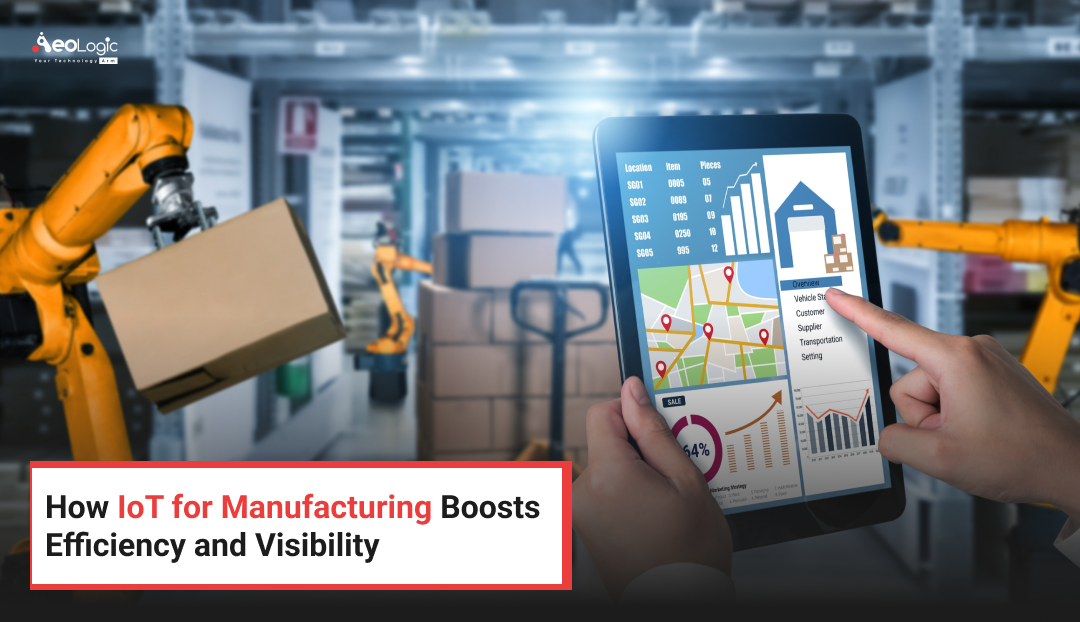
The manufacturing industry is evolving more quickly than before. Connected, intelligent systems are being adopted by industries that previously relied solely on manual monitoring, routine inspections, and conventional machinery. IoT for manufacturing, a potent technological framework that links devices, sensors, tools, systems, and people via real-time data, is at the center of this revolution.
IoT is helping manufacturers operate more accurately and efficiently by strengthening quality control, decreasing downtime, and increasing visibility across production lines. Companies like Aeologic Technologies are crucial to the smooth integration of these capabilities in factories.
Businesses that use IoT have a major advantage as global manufacturing becomes more competitive, not only in terms of performance but also in terms of innovation and scalability. This article provides useful insights for businesses looking to modernize operations by examining the meaning, advantages, applications, difficulties, and future of IoT for manufacturing.
What IoT Actually Means for Manufacturing
IoT for manufacturing, also known as the Industrial Internet of Things (IIoT), is the monitoring, analysis, and optimization of manufacturing processes through the use of internet-connected sensors, devices, and software.
These interconnected parts continuously record information like:
- Performance of the machine
- Use of energy
- Pressure, vibration, or temperature
- Movement of materials
- Activity of the operator
- Production results
- Equipment condition
This data enters a central system, which is typically an on-premises or cloud platform, where AI engines, automation tools, and analytics produce insights that can be put to use.
To put it another way, IoT turns regular factories into smart factories where everything is connected, tracked, and optimized in real time.
Why IoT Is Important for Manufacturing Today
There are several factors putting pressure on modern manufacturing:
- Growing rivalry
- The need for quicker production
- Growing labor shortages
- Increased demands from customers
- Disruptions to the global supply chain
- The requirement for constant quality
IoT makes it possible to address each of these issues with data-driven accuracy.
It has become crucial for a number of important reasons, including:
Making Decisions in Real Time
Manufacturers no longer have to wait for monthly reviews or end-of-shift reports. Decisions based on real-time operational data are made possible by IoT.
Predictable and Avoidable Downtime
Downtime that isn’t planned can cost thousands or even millions of dollars. IoT aids in anticipating equipment problems before they arise.
Improved Quality Control
Sensors reduce defects by early detection of variations in production parameters.
Enhanced Synchronization of the Supply Chain
Materials, logistics, warehouse operations, and outgoing shipments can all be seen thanks to IoT.
Energy Efficiency and Sustainability
Manufacturers can meet sustainability goals and cut costs by using real-time energy and waste tracking.
IoT has become so important that businesses without digital transformation run the risk of falling behind. Even conventional factories can embrace IoT with little disruption thanks to cutting-edge services and customized solutions from companies like Aeologic Technologies.
IoT’s Main Advantages for Manufacturing
IoT benefits extend well beyond simple automation. These are the main advantages that smart manufacturing facilities enjoy.
Increased Effectiveness of Operations
Manufacturers can identify bottlenecks, delays, idle machinery, and workflow inefficiencies with the help of connected sensors and automated data collection. This enables them to:
- Make production schedules more efficient.
- Workloads should be balanced.
- Reduce the number of manual inspections
- Increase throughput
Smoother operations with less waste and downtime are the outcome.
Visibility in Real Time Throughout Production
One of the main issues with traditional manufacturing is visibility. IoT removes blind spots by offering:
- Real-time machine dashboards
- Information about the movement of products
- Anomaly alerts
- Perspectives on operator behavior
When something goes wrong, managers can take immediate action thanks to this degree of transparency.
Predictive Equipment Maintenance
IoT sensors record information about load, temperature, vibration, and noise. With this information, the system can forecast:
- When a machine is most likely to malfunction
- Which elements need to be attended to
- Ideal schedules for maintenance
Predictive maintenance extends the life of assets while drastically lowering repair costs and downtime.
Better Quality and Fewer Flaws
IoT tracks the following to help guarantee consistent production quality:
- Condition of raw materials
- Environmental elements (temperature, humidity)
- Calibration of machines
- Variations in the process
The system either automatically fixes the problem or sends alerts when something deviates from tolerance.
Increased Safety for Workers
Wearables, tracking devices, and environment-monitoring sensors are used in IoT-enabled workplaces to identify:
- Unsafe circumstances
- Risks associated with machinery
- Levels of toxic gases
- Indicators of fatigue
Safety systems have the ability to sound an alarm, turn off machinery, or alert managers.
Improved Supply Chain and Inventory Management
Using IoT:
- Inventory levels are automatically updated.
- Shortages of materials are anticipated.
- Timelines for shipments are monitored in real time.
- RFID systems and smart shelves are used in warehouses.
This synchronization enhances delivery performance while reducing stockouts and excess inventory.
Enhanced Flexibility in Production
Connecting systems makes it easier to manage demand fluctuations. IoT uses data-driven insights to help factories change production modes effectively.
Cost Reduction and Energy Savings
Smart energy meters show which devices use the most electricity and when. Manufacturers can schedule off-peak operations, modify usage patterns, and cut down on needless energy waste.
How IoT Is Used in Manufacturing
IoT is a simple concept despite its apparent complexity. This is how it works in a manufacturing setting.
Devices and Sensors Collect Data
Tools, machinery, and production lines are equipped with:
- Temperature sensors
- Vibration sensors
- RFID labels
- Smart meters
- Camera and computer vision tools
- Sensors for pressure and humidity
These devices are constantly transmitting data about operations.
Transmission of Data through Connectivity
IoT relies on reliable, quick communication technologies such as:
- Wi-Fi
- 4G and 5G
- LoRaWAN
- Bluetooth
- Ethernet
- Edge Gateways
These networks connect the factory floor to local servers or the cloud.
Data processing and analytics
Data analysis is carried out using:
- Cloud-based systems
- Devices for edge computing
- Algorithms for machine learning
- Dashboards for IoT
This facilitates the identification of patterns, trends, and potential issues.
Automation and Insights Spur Action
According to the analysis, IoT systems:
- Activate alerts
- Change the machine’s configuration
- Automate repetitive tasks
- Schedule upkeep
- Make performance reports.
Supervisors and managers have access to all insights through dashboards.
Integration of Systems
IoT works best when connected to:
- ERP programs
- Manufacturing Execution Systems, or MES
- SCM (Supply Chain Management) tools
- Systems for managing quality
This leads to the creation of a coherent digital ecosystem that enhances decision-making overall.
Industry Applications for IoT in Manufacturing
IoT is adaptable, supporting numerous use cases in various manufacturing sectors. Some important application areas are listed below.
Automobile Production
- Monitoring the production line in real time
- Robotic control with high precision
- Automated tracking of parts
- Assembling machine predictive maintenance
Manufacturing of Electronics and Semiconductors
- Environmental management for hygienic spaces
- Accurate observation of micro-assembly procedures
- Product testing that is automated
Manufacturing of Textiles and Clothing
- Intelligent fabric flaw identification
- Automated inventory control
- Monitoring of machine health
Food and Drink Production
- Monitoring of contamination, temperature, and hygiene
- Ingredient traceability
- Automation of compliance
Life Sciences and Pharmaceuticals
- Process monitoring that is strictly regulated
- Management of the cold chain
- Traceability of quality
Heavy Machinery and Industrial Equipment
- Predictive upkeep
- Monitoring equipment remotely
- Optimization of energy
Businesses like Aeologic Technologies are experts at creating IoT solutions tailored to each industry’s particular needs.
IoT-Powered Manufacturing Technologies
Contemporary IoT ecosystems depend on a combination of cutting-edge technologies:
The Edge of Computing
Reduces latency and makes decisions more quickly by processing data close to the source.
Cloud Computing
Stores and evaluates massive amounts of data.
5G Networking
Allows for fast, low-latency data transfer over large networks of devices.
Machine Learning and AI
Evaluates intricate datasets to forecast errors, maximize output, and improve quality.
Digital Equivalents
Builds virtual copies of systems or machines for performance monitoring and simulations.
Cybersecurity Tools
Defend IoT networks against threats and illegal access.
RFID and sophisticated sensors
Establish the physical framework for keeping an eye on resources, equipment, and supplies.
Together, these technologies form an intelligent manufacturing system that is fully connected.
IoT Adoption Challenges in Manufacturing
IoT has many advantages for manufacturing, but it can be difficult to implement throughout a factory. Businesses can better plan and steer clear of common pitfalls by being aware of these challenges.
High initial outlay of funds
The initial expense of sensors, communication infrastructure, cloud systems, and software integration causes many manufacturers to hesitate. IoT offers a rapid return on investment, but the initial outlay may seem high, particularly for small and mid-sized businesses.
Connectivity with Outdated Equipment
IoT capability is frequently absent from older equipment. Technical planning and expert knowledge are necessary for retrofitting machines or integrating new sensors. By facilitating seamless IoT enablement for legacy lines, service providers like Aeologic Technologies help close the gap.
Data Management and Overload
Every day, factories produce enormous volumes of data. Manufacturers find it difficult to extract valuable insights in the absence of appropriate data management tools. Dashboards, storage systems, and analytics are crucial.
Risks to Cybersecurity
The risk of cyberattacks is increased by connected devices. Attackers may target production systems, steal data, or interfere with operations if security measures are inadequate.
Workforce Skill Gaps
Upskilling is necessary to manage digital workflows, handle IoT platforms, and comprehend analytics. Employees need to learn how to operate connected systems and interpret IoT insights.
Scalability Issues
Due to infrastructure or financial constraints, some manufacturers find it difficult to expand their initial IoT initiatives across several production lines or facilities.
Opposition to Change
Some employees might be hesitant to use digital systems. For IoT transformation to be successful, managing acceptance and change is essential.
Ways to Get Past IoT Adoption Obstacles
By strategically simplifying adoption, forward-thinking manufacturers are successfully implementing IoT.
Phased Execution
Businesses can start with high-impact areas like energy monitoring or predictive maintenance rather than implementing IoT throughout the entire factory at once. This lowers risk and boosts self-assurance.
Making Use of Scalable Platforms
Manufacturers can expand their digital capabilities without significant disruptions by selecting scalable cloud and IoT platforms.
Repurposing Outdated Equipment
Without having to be replaced, outdated machinery can be turned into intelligent, networked assets using contemporary sensors, edge devices, and IoT gateways.
Robust Cybersecurity Structures
Data and systems are protected through the use of firewalls, encryption, device authentication, and network segmentation.
Workforce Upskilling and Training
People are key to the success of IoT. Offering training courses guarantees that technicians, operators, and managers know how to use new tools efficiently.
Collaborating with Technology Professionals
Businesses such as Aeologic Technologies assist manufacturers in creating tailored IoT roadmaps, implementing solutions, and guaranteeing smooth integration with current systems.
The Best Ways to Use IoT in Manufacturing
Manufacturers should adhere to tried-and-true best practices that guarantee long-term success in order to fully realize the potential of IoT.
Establish a Clear Goal First
Prior to installing any sensors or devices, manufacturers need to establish clear objectives like:
- Minimizing downtime
- Increasing the rate of production
- Increasing the consistency of quality
- Increasing the visibility of the supply chain
The IoT strategy is guided by well-defined objectives.
Select the Appropriate Sensors and Equipment
There are many different types of factory environments. Choosing industrial-grade sensors guarantees dependable performance, long lifespan, and accurate data.
Give High-Value Use Cases Priority
IoT is not necessary for every process. Start with use cases that have the best return on investment, such as energy optimization or predictive maintenance.
Assure Smooth System Integration
IoT functions best when combined with:
- ERP
- MES
- WMS
- Software for quality control
An end-to-end connected manufacturing environment is produced as a result.
Get Faster Insights by Using Edge Computing
Edge computing provides quicker response times than cloud-only systems for time-sensitive applications, like machine failure prediction.
Pay Attention to Data Quality
Bad decisions are the result of poor data. Perform routine device health inspections and calibration checks.
Make security a top priority right away
Manufacturers ought to put strong security measures in place, such as encrypted communication, access control, and device authentication.
Continue to Monitor and Optimize
IoT is a continuous endeavor. The system is kept accurate, current, and prepared for the future through regular upgrades and ongoing improvements.
IoT for Manufacturing: Upcoming Trends
Automation, intelligent decision-making, and digital transformation are all critical to the future of manufacturing. In the upcoming years, IoT for manufacturing will be redefined by these new trends.
Manufacturing Driven by AI (AIoT)
IoT and AI combine to create smarter factories that can make their own decisions. Production planning, quality analysis, and predictive maintenance are all improved by AI.
The Adoption of Digital Twins
Manufacturers can use digital twins to remotely manage equipment, find inefficiencies, and simulate machine performance.
Smart Factories Driven by 5G
Factory floors will be transformed by 5G with:
- Quicker transmission of data
- Extremely low latency
- Large-scale device connectivity
This creates opportunities for real-time simulation, automated guided vehicles, robotics, and augmented reality.
Autonomous Systems and Robotics
IoT-powered robots will perform dangerous operations, precise assembly, and repetitive tasks with little human oversight.
Superior Predictive Maintenance
Predictive systems of the future will order replacement parts, schedule repairs, and modify machine settings without human intervention.
Growing Uptake of Green Manufacturing
IoT will help with sustainability by monitoring:
- Use of water
- Production of waste
- Use of energy
- CO2 emissions
Manufacturers can more readily achieve environmental objectives.
Increased Connectivity in Supply Chains
IoT will provide end-to-end visibility across raw materials, production, logistics, and customer delivery by integrating with blockchain, RFID, and AI.
Human-Machine Cooperation
Smart workstations, wearables, and AR glasses will increase worker safety and productivity.
To assist businesses in embracing these game-changing innovations, companies such as Aeologic Technologies are already developing smart factory solutions.
Conclusion
IoT for manufacturing is a revolutionary change that redefines how factories function, compete, and expand. It is not merely a technological advancement. Manufacturers can eliminate inefficiencies, minimize downtime, enhance quality, and achieve unprecedented production performance with connected sensors, intelligent analytics, and real-time data visibility.
IoT implementation is now necessary for long-term growth as the demand for quicker, smarter, and more sustainable manufacturing grows worldwide. Businesses can adopt best-in-class IoT solutions, accelerate their digital transformation, and create manufacturing ecosystems that are ready for the future with knowledgeable partners like Aeologic Technologies.
The companies that adopt IoT now will be at the forefront of the industrial revolution of the future.
FAQs
Q1. What does IoT mean for manufacturing?
It describes the real-time monitoring and optimization of manufacturing processes through the use of internet-connected sensors, devices, and software.
Q2. How does IoT increase the productivity of manufacturing?
IoT increases productivity by lowering downtime, streamlining processes, enhancing quality assurance, and offering real-time production line monitoring.
Q3. Which manufacturing sectors stand to gain the most from IoT?
The automotive, electronics, food and beverage, pharmaceutical, textile, and heavy machinery industries all gain a lot.
Q4. Does IoT lower the cost of manufacturing?
Indeed, IoT lowers costs through improved resource management, reduced waste, energy savings, predictive maintenance, and optimized production.
Q5. Is IoT appropriate for older factories with outdated machinery?
Of course. Sensors and Internet of Things gateways can be added to legacy machines to make them intelligent and networked.
Q6. How does AI fit into the manufacturing IoT?
AI evaluates IoT data, forecasts malfunctions, automates procedures, finds irregularities, and improves production and quality planning.
Q7. What role can Aeologic Technologies play in IoT adoption?
Aeologic Technologies provides manufacturing-specific end-to-end digital transformation services, predictive maintenance platforms, system integration, and customized IoT solutions.

Manoj Kumar is a seasoned Digital Marketing Manager and passionate Tech Blogger with deep expertise in SEO, AI trends, and emerging digital technologies. He writes about innovative solutions that drive growth and transformation across industry.
Featured on – YOURSTORY | TECHSLING | ELEARNINGINDUSTRY | DATASCIENCECENTRAL | TIMESOFINDIA | MEDIUM | DATAFLOQ