In order to maintain product quality in today’s cutthroat business environment, brands can no longer rely on guesswork, manual checks, and fragmented data. Consumers anticipate faultless goods, quicker delivery, and total transparency regarding the production process. Here, IoT Traceability Systems are revolutionising how businesses handle operational effectiveness, quality, and compliance.
Real-time tracking of goods, operations, resources, and materials from the point of origin to the final consumer has emerged as a competitive advantage. Businesses can guarantee that every product produced satisfies the highest quality standards by utilising IoT-powered sensors, connected devices, cloud platforms, and sophisticated analytics.
Businesses like Aeologic Technologies are assisting enterprises in the smooth implementation of IoT-enabled traceability solutions that improve supply chain visibility, lower errors, and raise quality.
Comprehending IoT Traceability Systems
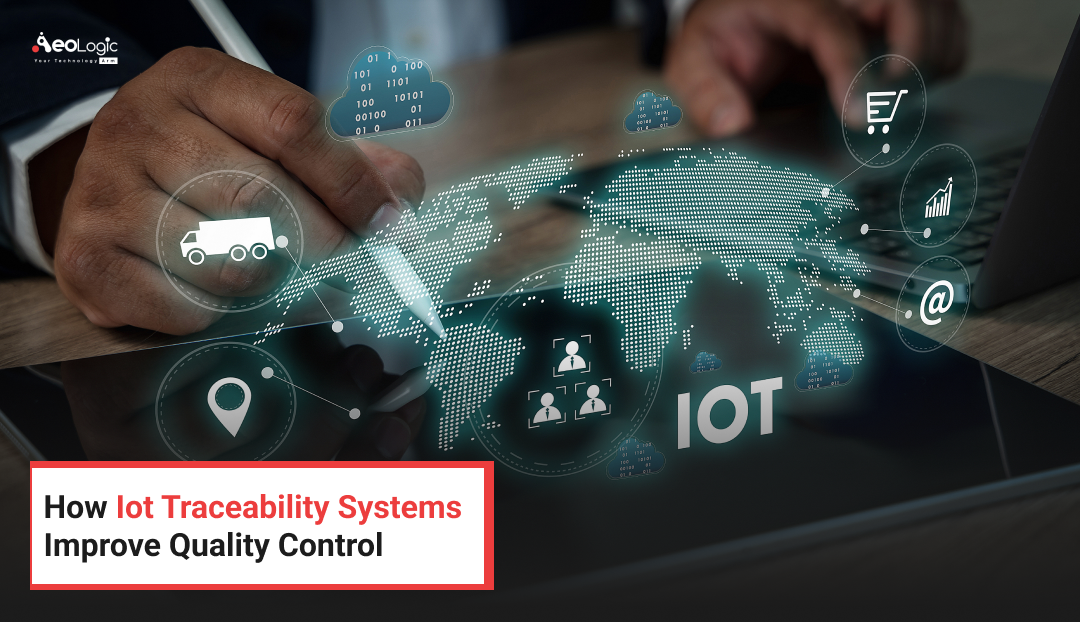
IoT Traceability Systems track the movement, state, and lifecycle of products or components by combining sensors, RFID tags, linked devices, cloud platforms, and analytics tools.
Fundamentally, an IoT traceability setup provides real-time answers to five important questions:
- What is it?
- Where is it at the moment?
- What state is it in?
- Who took care of it?
- What environment or process did it go through?
Businesses can obtain a complete digital footprint of their operations, from sourcing raw materials to final delivery, by continuously collecting and analysing this data. This degree of traceability guarantees that goods fulfil safety, quality, and compliance requirements at every stage.
Why IoT Traceability Systems Are Important Now
The modern world moves fast. Global supply chains are more complex, regulatory requirements are stricter, and customer expectations are higher than ever. This makes traditional paper-based tracking and manual inspections outdated and unreliable.
Businesses today cannot afford to ignore IoT traceability for the following reasons:
- It makes the whole product journey transparent.
- It facilitates data-driven decision-making and lessens human error.
- By providing real-time insights, it improves quality control.
- It aids in avoiding expensive recalls and poor quality.
- It guarantees adherence to rules unique to the industry.
Consistent quality is crucial to a number of industries, including manufacturing, automotive, food processing, healthcare, and electronics. IoT Traceability Systems provide these industries with the visibility they require to create products that are safer, better, and more dependable.
 IoT Traceability Systems’ Principal Advantages for Quality Control
The many advantages of IoT traceability are among its greatest advantages. Businesses that implement these systems see quantifiable gains in operational performance and quality.
Real-time visibility at every level
IoT devices capture continuous data on products and processes, allowing quality teams to monitor performance instantly rather than relying on post-production checks.
Early identification of flaws
Sensors detect variations in temperature, vibration, pressure, or environmental conditions the moment they occur. This helps teams take corrective actions before defects escalate.
Improved audit readiness and compliance
Strict documentation is necessary in sectors like aerospace, food safety, and pharmaceuticals. Digital audit trails that adhere to international standards are automatically produced by IoT traceability.
Complete material tracking
Materials, components, and finished goods can be tracked in real time across production, storage, shipping, and final delivery.
Decreased waste and financial savings
Early deviation detection saves time and money by reducing scrap and preventing product rework.
Increased responsibility
Accountability is simple to uphold because each item or process is connected to a timestamp, operator ID, machine ID, and environmental conditions.
Making decisions more quickly and intelligently
Continuous data flow allows managers to identify patterns, close process gaps, and precisely optimise future workflows.
How IoT Traceability Systems Operate in Actual Business Situations
It is helpful to see how companies use these systems in their daily operations in order to comprehend the impact of IoT traceability.
Monitoring raw materials as soon as they arrive
Incoming materials have QR codes or RFID tags attached to them. Sensors monitor their movements, storage conditions, and compliance with specifications like humidity and temperature.
Real-time production process monitoring
Machine-installed IoT devices gather information like:
- Duration of a cycle
- Pressure
- Speed
- Temperature of operation
- Levels of vibration
- Usage of energy
Quality teams may receive immediate alerts for any deviation.
Sensitive product condition monitoring
Strict environmental conditions are necessary for food products, medications, chemicals, and electronics. Sensors make sure that storage conditions, airflow, moisture, and temperature all remain within reasonable bounds.
Monitoring the transfer of assets between facilities
Pallets, trolleys, forklifts, and tools are all under observation to guarantee that operations remain effective and well-organised.
Digital traceability in labelling and packaging
Every item is given a digital identity that allows for immediate verification, which lowers the possibility of incorrect labelling or packaging.
Transparency in the supply chain
During shipping and delivery, product movement is monitored by GPS, cellular IoT devices, and gateways. Alerts are automatically sent in the event of a delay or deviation.
Dashboards in real time for quality teams
Cloud dashboards enable prompt decision-making and quality event investigation by combining all data into a single view.
Organisations can easily incorporate these traceability workflows into their digital ecosystem with the assistance of companies like Aeologic Technologies.
IoT Traceability System Applications in Industry
IoT traceability systems are useful and adaptable in a variety of industries. Key industries that profit from them are as follows:
Manufacturing
Manufacturers are able to see production parameters, output quality, machine performance, and raw material quality. Traceability increases first-pass yield and lowers defects.
Automobile
From supplier to assembly line, every component—from bolts to intricate assemblies—can be tracked. This significantly reduces the possibility of non-compliance and recalls.
Food and Drinks
Throughout processing, packaging, and distribution, sensors make sure that food safety parameters like temperature, cleanliness, and freshness are tracked.
Medicines
IoT traceability facilitates adherence to international regulations, including FDA, GMP, and WHO standards. It improves cold chain compliance, batch visibility, and drug authenticity.
Semiconductors and Electronics
Components are highly susceptible to static, moisture, and heat. IoT sensors ensure accuracy and safety during the assembly process.
E-commerce and retail
IoT traceability is used by retailers to control inventory accuracy, minimise shrinkage, and guarantee prompt order fulfilment.
Transportation & Logistics
IoT-powered traceability is advantageous for cold-chain monitoring, fleet tracking, route optimisation, and shipment status visibility.
IoT Traceability Technology and Techniques
A combination of communication, software, and hardware technologies are used in an IoT traceability system. Among the most significant are:
RFID Readers and Tags
Facilitate movement tracking, automated identification, and fast scanning.
Internet of Things Sensors
Keep an eye on the product’s condition, machine performance, and surroundings.
Cellular IoT Modules and GPS
Keep track of product locations around the world.
Beacons with Bluetooth Low Energy (BLE)
In indoor spaces like factories or warehouses, offer proximity-based tracking.
Data Lakes and Cloud Platforms
Collect, store, and evaluate real-time traceability data.
The Edge of Computing
Allows for quicker action by processing important data at the source.
Predictive analytics and artificial intelligence
Identifies quality risks, finds patterns, and suggests preventative measures.
Blockchain
Enhances the authenticity of the product and stops data manipulation.
Businesses like Aeologic Technologies integrate these technologies to provide comprehensive traceability solutions that are prepared for the future.
IoT Traceability System Adoption Obstacles and Their Solutions
IoT traceability systems have many advantages, but adoption can be difficult for some businesses. Fortunately, there is a workable and efficient solution for every problem.
High initial outlay of funds
For some businesses, setting up software platforms, sensors, and connectivity infrastructure can seem expensive.
Solution: Start with the most important tasks first. Scale progressively. Initial costs are offset by the return on investment from quality improvements.
Overload of data
Teams may become overwhelmed by constant IoT data streams.
Solution: Simplify data with dashboards, AI analytics, and automated alerts.
Connectivity to legacy systems
IoT connectivity may not be supported by older equipment.
Solution: IoT gateways and connectors can be used to retrofit old machines.
Cybersecurity issues
Systems that are connected may be vulnerable to security breaches.
Solution: Use secure cloud environments, role-based access, and encrypted networks.
Workforce adjustment
Workers might be resistant to new technology.
Solution: Involve staff early in the process, show benefits, and offer training.
Businesses can also benefit from end-to-end implementation from firms like Aeologic Technologies, which reduces obstacles and speeds up adoption.
The Best Ways to Effectively Use IoT Traceability Systems
Businesses should adhere to a set of tried-and-true best practices in order to optimize results:
- Gradually implement traceability throughout the phases.
- Make use of standardized labeling and tagging procedures.
- Connect IoT traceability to CRM, MES, and ERP systems.
- Give real-time data monitoring precedence over manual audits.
- Automate quality notifications and alerts.
- To stop future flaws, use predictive analytics.
- Audit sensors, gateways, and devices on a regular basis.
- Prior to selecting solutions, assess the capabilities of the vendor.
These procedures guarantee accuracy, dependability, and quality enhancements over time.
IoT Traceability System Trends for the Future
IoT traceability systems have a bright future because substantial innovation is already taking place:
AI-driven quality forecasts
Risks will be identified by machine learning models before they materialize.
Digital twins
Quality testing and simulations will be strengthened by virtual copies of actual goods and procedures.
Blockchain integration
Blockchain integration will improve compliance and trust by producing unchangeable traceability records.
Real-time monitoring enabled by 5G
Instantaneous responsiveness across industries will be made possible by ultra-low latency.
Self-sufficient quality systems
Workflows that are automated will self-diagnose, self-correct, and maximize quality.
Excessive customization in consumer products
Based on traceability insights, brands will provide personalized products.
Conclusion
Quality control is now more than just a checklist; it is a strategic requirement that influences customer satisfaction, brand reputation, and operational excellence. IoT Traceability Systems give modern businesses the transparency, intelligence, and real-time visibility they require to maintain constant quality throughout all phases of their operations.
Businesses like Aeologic Technologies are setting the standard by assisting businesses in a variety of sectors in putting strong IoT traceability solutions into place that improve quality assurance and future-proof operations.
Businesses that embrace digital visibility, intelligent data, and proactive quality management will win the future, and IoT traceability is the cornerstone that makes this possible.
FAQs
Q1. What are traceability systems for the Internet of Things?
These are technological systems that track the movement, state, and history of goods or materials in real time using sensors, Internet of Things devices, and digital platforms.
Q2. How can IoT traceability systems enhance quality assurance?
They guarantee that every product satisfies quality standards, offer real-time monitoring, identify deviations early, and minimize human error.
Q3. Which sectors stand to gain the most from IoT traceability?
Manufacturing, electronics, pharmaceuticals, food and beverage, automotive, logistics, and retail.
Q4. Can product recalls be decreased by IoT traceability?
Indeed. Companies reduce recall risks by precisely tracking components and detecting defects early.
Q5. Which technologies are used in IoT traceability?
RFID, sensors, blockchain (optional), cloud platforms, AI, GPS, BLE, and predictive analytics.
Q6. For IoT traceability solutions, why pick Aeologic Technologies?
With a focus on automation, integration, and digital transformation, Aeologic provides enterprise-grade, scalable, and customized IoT solutions.

Manoj Kumar is a seasoned Digital Marketing Manager and passionate Tech Blogger with deep expertise in SEO, AI trends, and emerging digital technologies. He writes about innovative solutions that drive growth and transformation across industry.
Featured on – YOURSTORY | TECHSLING | ELEARNINGINDUSTRY | DATASCIENCECENTRAL | TIMESOFINDIA | MEDIUM | DATAFLOQ