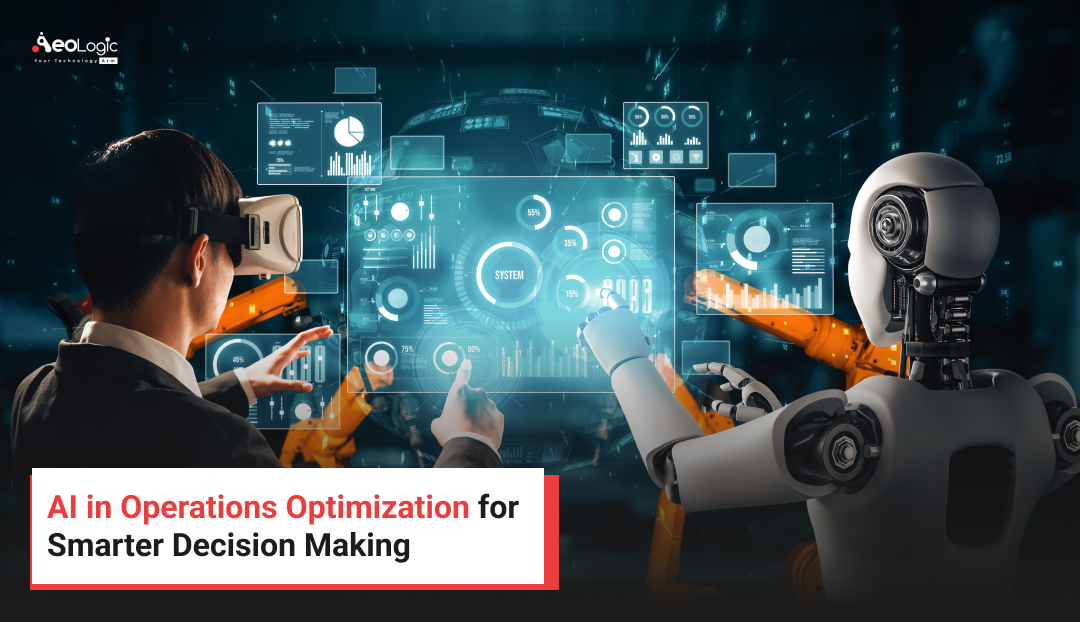
Businesses are constantly under pressure to operate more quickly, intelligently, and economically in the rapidly evolving digital landscape of today. Consumers anticipate prompt responses. Accurate forecasting is expected by leaders. Rapid innovation is expected by markets. This push toward efficiency and smarter decision-making has given rise to one of the most powerful technological shifts of our time—AI in Operations Optimization.
Businesses are utilising AI not only to automate tasks but also to intelligently streamline operations, cut waste, and enhance decision-making at every level across a variety of industries, including manufacturing, logistics, healthcare, and retail. Businesses now have access to sophisticated algorithms that analyse patterns, forecast outcomes, and suggest the best course of action rather than depending on guesswork, manual workflows, or siloed data.
Comprehending AI’s Significance in Operations Optimisation
At its core, AI in Operations Optimization helps organizations modernize processes with smart automation and real-time intelligence. Artificial intelligence (AI) in operations optimisation is the application of AI technologies, including computer vision, machine learning, predictive analytics, and intelligent automation, to increase business operations’ speed, accuracy, and efficiency.
AI analyses vast amounts of operational data in real time and provides insights that assist businesses, rather than just automating repetitive tasks.
- Minimise bottlenecks
- Boost the effectiveness of your workflow
- Estimate the risks associated with operations
- Improve quality assurance
- Maximise the use of resources
- Make quicker, more informed decisions
Consider it a shift from reactive to intelligent, proactive operations.
Conventional operations rely on human judgement and historical data. AI-driven operations make use of intelligent suggestions, algorithm-based forecasts, and real-time insights.
The Significance of AI in Operations Optimisation in the Modern World
The need for efficiency, accuracy, and agility is at an all-time high as industries become more competitive. These days, AI is essential to helping businesses thrive in this environment.
Here’s why it’s more important than ever:
Data volume is skyrocketing
Production lines, consumer behaviour, supply chain movements, financial transactions, IoT devices, and more are just a few of the massive datasets that businesses produce every second. At this scale, human analysis is no longer feasible. AI instantly interprets this data.
The expectations of customers have evolved
Consumers want consistent quality, personalised experiences, real-time updates, and quicker deliveries. AI enables companies to meet rising demands with precision.
Supply chains are growing increasingly erratic
Global disruptions, such as pandemics or geopolitical events, can have an immediate effect on supply chains. This is one of the major reasons companies are embracing AI in Operations Optimization today.
Errors and delays are caused by manual processes
Operations are slowed down by paperwork, repetitive decision-making, and error-prone tasks. AI increases accuracy and eliminates inefficiencies.
Companies want to cut expenses without sacrificing quality
AI helps businesses save a lot of money by preventing waste, cutting downtime, and making efficient use of their resources.
Businesses can operate more intelligently, quickly, and effectively than ever before by implementing AI in operations optimisation.
 AI’s Principal Advantages for Operations Optimisation
AI presents numerous opportunities for transformation in a variety of operational domains. Among the most significant advantages are:
Making decisions in real time
AI systems enable leaders to make quick, well-informed decisions by analysing data as it is generated. Businesses can now react to operational changes immediately rather than waiting for daily, weekly, or monthly reports.
Predictive upkeep
AI finds abnormalities in machines before they cause problems. This prolongs asset life, lowers maintenance costs, and decreases downtime.
Increased productivity and lower operating expenses
AI helps businesses drastically cut expenses by automating repetitive tasks, streamlining workflows, and identifying pointless procedures.
Increased output
While intelligent systems handle routine or analytical tasks, AI helps workers concentrate on high-value tasks.
Enhanced visibility of the supply chain
AI improves supply chain transparency by forecasting delays, streamlining routes, and balancing supply and demand.
The Workings of AI in Operations Optimisation
The mechanics of AI-optimized operations can be divided into easy-to-understand steps, despite the concept’s apparent complexity.
Data gathering
AI starts by gathering information from:
- Internet of Things sensors
- Equipment
- ERP programs
- CRM instruments
- databases of inventory
- Production lines
- Procedures in the supply chain
- Interactions with customers
AI gets smarter and more accurate the more data it has.
Machine learning-based data analysis
Machine learning models examine patterns, anomalies, and trends after data is gathered. AI determines what is effective, ineffective, and in need of improvement.
Producing predictions and insights
AI forecasts:
- Demand in the future
- Risks of machine failure
- Shortages of inventory
- Delays in production
- Consumer behaviour
- Disruptions in the supply chain
Making better decisions is guided by these insights.
Automation with intelligence
AI takes action in addition to analysis.
Examples consist of:
- Automatically modifying the rate of production
- When inventory levels decline, reordering
- Shipments being redirected
- assigning employees to high-demand jobs
- Preventive maintenance scheduling
Businesses can operate with confidence and agility by implementing these AI-driven models with the assistance of companies such as Aeologic Technologies.
AI Applications in Industry for Operations Optimisation
AI is changing operations in almost every industry. The following sectors are where the effects are most noticeable:
Manufacturing
Manufacturing is one of the sectors that benefits most from AI in Operations Optimization, especially when improving production efficiency and quality control. AI is used by manufacturers to automate quality checks, minimise downtime, optimise production lines, and anticipate equipment failures. With unparalleled precision, computer vision finds flaws in products. AI and robotics work together to increase productivity and lessen reliance on humans for repetitive tasks.
Logistics and Supply Chain
Demand forecasting, fleet management, real-time tracking, warehouse automation, and route optimisation are all improved by AI. AI is crucial to preserving speed and cost effectiveness for everything from delivery services to international shipping behemoths.
E-commerce and retail
AI is used by retailers to automate reordering, enhance customer service, optimise inventory, and personalise recommendations. AI uses precise demand forecasting to guarantee that the right product is available at the right time.
Medical care
AI is used by hospitals to streamline patient flow management, maximise staffing, enhance diagnostic precision, and minimise operational delays. AI also aids in resource distribution, scheduling, and documentation automation.
Financial Services and Banking
AI is used by banks for risk management, automated compliance, fraud detection, automated customer service, and predictive analytics for investment choices.
Building
Through intelligent monitoring systems, AI assists in tracking project progress, anticipating delays, optimising material usage, and enhancing worker safety.
Mobility and Transportation
AI facilitates efficient fleet operations, autonomous logistics, traffic forecasting, and route optimisation.
By providing AI-powered solutions for practical operational challenges, Aeologic Technologies has made a substantial contribution to industries like manufacturing, energy, and logistics.
AI-Driven Operations Optimisation Technologies and Techniques
AI in operations optimisation incorporates a number of fundamental technologies, each of which contributes in a different way to increasing productivity.
Machine Learning (ML)
In order to spot trends and generate predictions, machine learning algorithms learn from both historical and current data. Workflow optimisation, predictive maintenance, and demand forecasting are all powered by it.
Deep Learning
Complex tasks like image recognition, anomaly detection, and natural language understanding are handled by this sophisticated type of machine learning.
Vision in Computers
Utilized for jobs like these in manufacturing, retail, and logistics
- Inspection of quality
- Scanning barcodes
- Counting inventory
- Monitoring of workplace safety
Natural Language Processing (NLP)
AI systems can comprehend and produce human language thanks to NLP. Beneficial for:
- Chatbots
- Automated documentation
- Voice-activated decision-making
Analytical Predictive
This technology helps businesses reduce risks and make better plans by predicting future events based on data patterns.
Automation with Intelligence
Systems can act on insights without human input when AI and automation are combined, leading to quicker workflows.
Integration of IoT and AI
IoT sensors collect data from machinery and devices in real time. This results in extremely responsive and optimized operational environments when paired with AI.
Implementing AI in Operations Optimization: Obstacles and Solutions
One reason organizations hesitate to adopt AI in Operations Optimization is the presence of implementation challenges. AI in operations optimization has many advantages, but putting it into practice is not always simple. Adoption can be difficult for many organizations, particularly if they are moving away from manual workflows or legacy systems. Fortunately, there is a workable solution for every problem.
Problems with data quality
The availability and quality of data are critical components of AI solutions. Data that is inconsistent, erroneous, or lacking can make insights less accurate.
Solution:
Companies need to make investments in real-time data collection systems, data governance tools, and appropriate data-cleaning procedures. Collaborating with technology partners such as Aeologic Technologies guarantees that AI systems get high-quality, structured data right away.
Absence of expertise
Analytics, machine learning, and artificial intelligence all require specific expertise. Many businesses find it difficult to hire or develop employees who can oversee AI projects.
Solution:
Businesses can work with knowledgeable AI solution providers who offer pre-made tools, implementation strategies, and expertise. Long-term capability can also be developed by upskilling internal teams through training initiatives.
Connectivity to legacy systems
AI platforms might not work with current ERP, CRM, or on-premise systems.
Solution:
Cloud-based AI systems, middleware, and APIs are used to close the gap. Integration frameworks can be tailored by technology partners to guarantee seamless system interoperability.
High initial investment concerns
Some businesses are hesitant because they believe implementing AI will be expensive.
Solution:
Adoption of AI can start with modest pilot projects that concentrate on the most important operational problems. Organizations can expand once ROI becomes apparent. The majority of contemporary AI tools are also offered in cloud-based or subscription-based models, which lower initial expenses.
Risks to data security and privacy
Strict security controls are necessary when handling sensitive operational data.
Solution:
Safe AI operations are ensured by using encryption, secure data pipelines, role-based access, and adherence to international standards (ISO, GDPR). Businesses such as Aeologic Technologies create AI architectures that prioritize security.
The Best Ways to Optimize Operations with AI
Businesses should adhere to tried-and-true best practices in order to fully benefit from AI-driven operational improvements:
Establish a clear goal first
Select a particular operational challenge, such as decreasing downtime, enhancing forecasting, or optimizing resource allocation, rather than implementing AI everywhere at once.
Establish a solid data foundation
Data ought to be real-time, reliable, and consistent. AI performance is enhanced by the use of IoT sensors, data lakes, and analytics dashboards.
Select AI solutions that are scalable
Choose AI systems that can expand with your company’s needs, whether they span several departments, locations, or functions, but start small.
Make employee participation a top priority
Your employees should be knowledgeable about and at ease with AI-powered procedures. Adoption goes more smoothly when staff members are aware of AI tools.
Track and improve AI models
AI is not a “deploy and forget” technology. Maintaining alignment with changing business needs necessitates constant monitoring, feedback, and optimization.
Assure cybersecurity preparedness
To foster trust and prevent vulnerabilities, incorporate strong data protection and compliance strategies.
Organizations can maximize the benefits of AI-based operational optimization by adhering to these best practices.
AI’s Prospects for Operations Optimization
AI’s use in operational management is only getting started. Businesses will see increasingly sophisticated, user-friendly, and networked AI systems driving their operations in the upcoming years. Here are some significant upcoming trends:
Excessive automation
To completely automate complicated workflows from beginning to end, AI will work in tandem with RPA (Robotic Process Automation), BPM (Business Process Management), and analytics.
Autonomous operations powered by AI
Supply chains, warehouses, and manufacturing lines will run with little human intervention thanks to computer vision and real-time intelligence.
Operational generative AI
Schedules will be optimized, strategies will be created, operational scenarios will be simulated, and intelligent suggestions will be provided for each workflow by generative AI.
Digital twins
AI-powered digital twins will virtually replicate real operations in supply chains and factories, assisting companies in performance analysis and outcome prediction prior to decision-making.
Predictive and prescriptive decision-making
AI will automatically suggest the best course of action in addition to predicting future events.
AI systems that collaborate
Instead of taking the place of human roles in decision-making, AI will collaborate seamlessly with human teams.
AI will undoubtedly become the foundation of any successful, adaptable, and productive company in the future.
Conclusion
AI in operations optimization has emerged as a game-changer for companies seeking to attain cost effectiveness, operational excellence, and more intelligent decision-making. AI is assisting businesses in removing bottlenecks, cutting downtime, and increasing forecasting accuracy in everything from manufacturing floors to logistics networks and healthcare systems.
When used properly, artificial intelligence (AI) adds intelligence to all phases of business operations, going far beyond simple automation. Real-time visibility, predictive insights, and extremely effective workflows give businesses a competitive edge.
Aeologic Technologies is still assisting businesses in implementing scalable, secure, and industry-specific AI-powered operational solutions.
FAQs
Q1. What does artificial intelligence mean for operations optimisation?
It refers to the application of AI technologies, such as automation, machine learning, and predictive analytics, to increase operational effectiveness, lower expenses, and facilitate more intelligent decision-making.
Q2. In what ways does AI enhance operational decision-making?
AI evaluates real-time data, forecasts patterns, detects hazards, and suggests the best course of action. This enables leaders to make data-driven decisions more quickly and accurately.
Q3. Which sectors stand to gain the most from operations optimisation using AI?
Although almost every industry can use AI to enhance operations, manufacturing, retail, logistics, healthcare, banking, energy, and construction stand to gain the most.
Q4. Does implementing AI cost a lot of money?
Although the costs of implementing AI vary, companies can begin with modest pilot projects. AI tools that are cloud-based or subscription-based significantly lower initial expenses.
Q5. What part does data play in operations powered by AI?
Real-time, accurate data boosts automation capabilities, streamlines processes, and improves forecasts.
Q6. Are AI systems safe to use in commercial settings?
Indeed. AI systems can be extremely secure with the right encryption, safe pipelines, and compliance requirements.
Q7. In what ways can Aeologic Technologies facilitate the adoption of AI?
Aeologic Technologies offers complete AI solutions, ranging from system integration and data strategy to specialised AI models that enhance practical operations.

Manoj Kumar is a seasoned Digital Marketing Manager and passionate Tech Blogger with deep expertise in SEO, AI trends, and emerging digital technologies. He writes about innovative solutions that drive growth and transformation across industry.
Featured on – YOURSTORY | TECHSLING | ELEARNINGINDUSTRY | DATASCIENCECENTRAL | TIMESOFINDIA | MEDIUM | DATAFLOQ