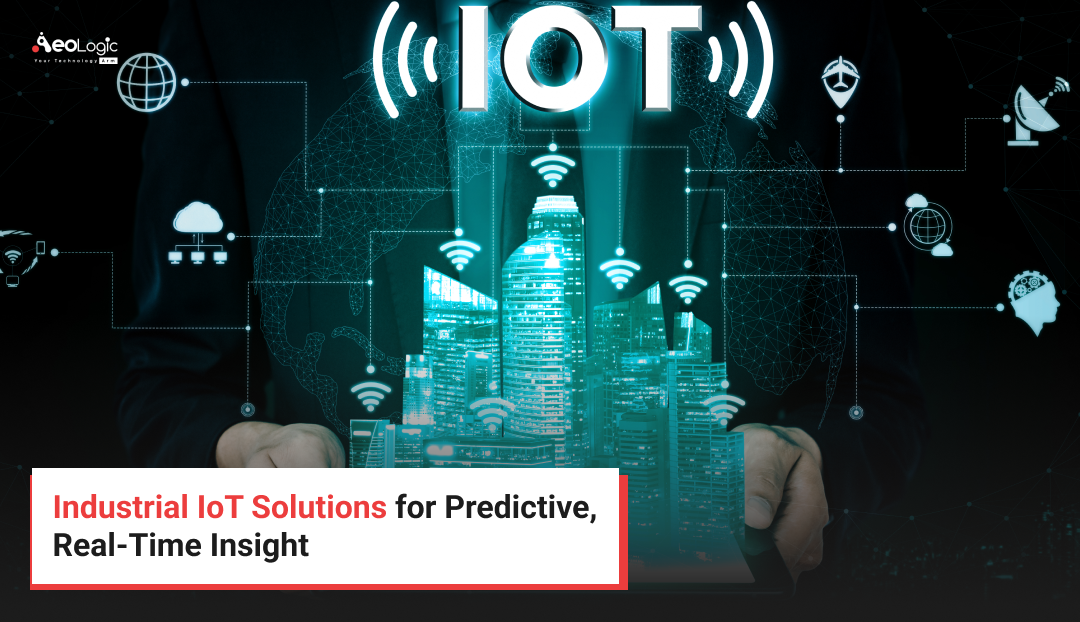
Data is now the most valuable resource in a time when businesses are constantly under pressure to increase productivity, decrease downtime, and make decisions more quickly. Raw data, however, is insufficient on its own. Companies require actionable visibility across operations, predictive insights, and real-time intelligence. Here, Industrial IoT solutions are revolutionising the way contemporary businesses function.
Industrial IoT solutions link machines, sensors, systems, and people into a single digital ecosystem that spans from manufacturing facilities and warehouses to energy grids and logistics networks. Predictive maintenance, real-time monitoring, and continuous optimisation are made possible by their transformation of physical operations into intelligent, data-driven environments.
Businesses that use IoT Solutions have a major advantage as global competition heats up and profit margins narrow. They transition from making reactive decisions to making proactive and predictive ones, opening up higher productivity, lower costs, and better customer outcomes.
What Industrial IoT Solutions Mean in the Current Environment
The term “industrial IoT solutions” refers to the real-time collection, processing, and analysis of operational data in industrial settings through the use of interconnected sensors, devices, machines, software platforms, and analytics tools.
IoT solutions are designed for mission-critical environments, in contrast to consumer IoT, which concentrates on convenience and lifestyle applications. They are made to manage large amounts of data, challenging environments, intricate processes, and stringent reliability standards.
Fundamentally, IoT solutions serve as a link between digital intelligence and physical operations. These days, machines don’t work alone. Every asset becomes a source of ongoing insight, whether it’s a temperature-controlled warehouse, a conveyor belt, or a production line motor.
This connected intelligence allows businesses to monitor equipment health, detect anomalies, predict failures, optimize processes, and make data-backed decisions instantly rather than after problems occur.
 The Importance of Industrial IoT Solutions in the Modern World
The complexity of industrial environments is increasing. Smarter operations are required due to global supply chains, growing energy costs, labour shortages, and rising customer expectations.
Conventional systems mainly rely on historical reporting, routine inspections, and manual checks. These techniques are reactive, slow, and prone to mistakes.
IoT solutions assist businesses in anticipating problems rather than reacting to them after harm has been done by providing real-time data and predictive intelligence. This ability is turning into a need rather than a competitive advantage.
Additionally, industries are dealing with more stringent safety requirements, sustainability objectives, and regulatory compliance. Industrial IoT solutions enhance operational accountability and support compliance by offering transparent, auditable data trails.
In a world driven by speed and precision, Industrial IoT Solutions empower businesses to act faster, smarter, and with greater confidence.
Industrial IoT Solutions’ Principal Advantages
Decreased Downtime and Predictive Maintenance
Predictive maintenance is one of the most important advantages of IoT solutions. Sensors continuously monitor vibration, temperature, pressure, and performance patterns rather than waiting for machines to break down or adhering to set maintenance schedules.
By identifying early warning indicators of equipment failure, advanced analytics enable maintenance teams to take action prior to malfunctions. This lowers maintenance costs, prolongs asset life, and drastically reduces unscheduled downtime.
Operational Visibility in Real Time
IoT Solutions provide real-time visibility across operations, from factory floors to remote facilities. Real-time monitoring of production output, energy consumption, machine status, and performance metrics is available to decision-makers.
This visibility eliminates blind spots and enables faster responses to operational issues. Managers no longer rely on delayed reports—they see what’s happening as it happens.
Enhanced Productivity and Efficiency
Businesses can find previously undetectable inefficiencies with real-time insights. Process deviations, idle time, bottlenecks, and energy waste are all readily apparent.
By modifying workflows, machine settings, and resource allocation in response to real-time data, industrial IoT solutions allow for continuous optimisation.
Improved Compliance and Safety
In industrial settings, safety is a major concern. Real-time monitoring of worker safety parameters, equipment stress, and dangerous conditions is provided by industrial IoT solutions.
Data-driven safety procedures and automated alerts help lower risk, avoid mishaps, and guarantee adherence to industry rules.
Making Decisions Based on Data
IoT solutions use evidence instead of conjecture. Instead of relying on conjecture or out-of-date information, executives and operational teams can make well-informed decisions supported by precise, up-to-date data.
The Operation of Industrial IoT Solutions in Actual Business Settings
An organised flow of information, intelligence, and action powers industrial IoT solutions.
Sensors and connected devices collect real-time data from machines, assets, and environments. This data is transmitted through secure industrial networks to centralized or edge-based platforms.
Once collected, data is processed using analytics engines that apply rules, machine learning models, and predictive algorithms. These insights are then visualized through dashboards, alerts, and automated workflows.
For example, in a manufacturing plant, IoT Solutions can detect abnormal vibration in a motor, predict a bearing failure, trigger a maintenance work order, and notify technicians—all before production is disrupted.
The power of Industrial IoT Solutions lies in the smooth integration of sensing, analytics, and action.
Industrial IoT Solutions’ Industrial Applications
Production and Intelligent Factories
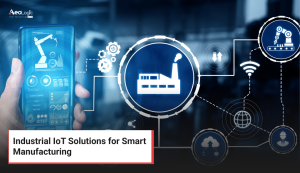
Manufacturing is one of the biggest adopters of Industrial IoT Solutions. Smart factories use connected machines, robotics, and analytics to monitor production lines, improve quality, and reduce waste.
Manufacturers can lower scrap rates, increase overall equipment effectiveness, and maintain consistent output with the aid of predictive insights.
Logistics and Supply Chain
Industrial IoT Solutions enable real-time tracking of goods, vehicles, and inventory across supply chains. Companies get insight into warehouse operations, transit delays, and shipment conditions.
This information guarantees on-time delivery, lowers losses, and enhances demand forecasting.
Utilities and Energy
Energy providers use Industrial IoT Solutions to monitor grid performance, equipment health, and energy consumption. Predictive analytics aids in sustainability objectives, energy distribution optimization, and outage prevention.
Heavy Industries, Gas, and Oil
Industrial IoT solutions enhance worker safety, asset dependability, and regulatory compliance in high-risk settings. Real-time monitoring boosts productivity while lowering operational risk.
Medicines and Healthcare
In pharmaceutical manufacturing and healthcare logistics, industrial IoT solutions facilitate cold-chain monitoring, equipment dependability, and regulatory compliance.
Make the switch to cutting-edge technologies
As industrial IoT develop, they incorporate more cutting-edge technologies like cloud platforms, edge computing, and artificial intelligence. These technologies enable quicker, more precise forecasts and increase the value of real-time data.
Industrial IoT Solutions Driven by Technologies
Industrial IoT depend on a seamless integration of intelligent analytics, software, and hardware.
Smart devices and sensors
Important information like temperature, vibration, humidity, pressure, and motion are all recorded by sensors. These devices act as the foundation of IoT Solutions, turning physical processes into digital signals.
The Edge of Computing
Instead of sending all data to centralized servers, edge computing processes it closer to its source. This lowers latency and makes it possible to make decisions in real time, particularly in settings where milliseconds count.
Platforms for the Cloud
Cloud-based Industrial IoT provide scalability, centralized data management, and advanced analytics. They enable organizations to analyze historical and real-time data across multiple locations.
Machine Learning and Artificial Intelligence
Analytics powered by AI find trends, abnormalities, and forecasts that conventional systems are unable to identify. As more data is gathered, machine learning models keep getting more accurate.
Protocols and Secure Connectivity
Industrial IoT use secure communication protocols to ensure data integrity, system reliability, and protection against cyber threats.
Implementing Industrial IoT Solutions: Obstacles and Solutions
Privacy and Data Security
Connected systems increase the attack surface for cyber threats. Implementing strong encryption, access controls, and network segmentation is essential.
Connectivity to Legacy Systems
Many industrial environments rely on legacy equipment. Successful Industrial IoT are designed to integrate with existing systems without disrupting operations.
Overload of Data
Teams may become overwhelmed by gathering enormous amounts of data. The answer is to prioritize actionable insights over unprocessed data.
Change Management and Skill Gaps
To guarantee that teams can use Industrial IoT efficiently, organizations must make investments in change management and training.
Best Practices for Industrial IoT Adoption Success
Clear business objectives should guide every Industrial IoT. Businesses should begin with high-impact use cases, like energy optimization or predictive maintenance.
Scalability must be built into the architecture from the beginning. Pilot projects should be designed with long-term expansion in mind.
Cross-functional collaboration between IT, operations, and leadership ensures alignment and smoother implementation.
Future Trends Shaping Industrial IoT Solutions
IoT solutions for industry are developing quickly. With self-optimizing systems, predictive analytics will become increasingly independent.
Digital twins will simulate physical assets in real time, enabling advanced scenario planning.
IoT solutions powered by sustainability will be crucial in cutting emissions and energy use.
As AI advances, IoT Solutions will shift from insight generation to intelligent automation.
Conclusion
Industrial IoT solutions are now necessary tools for creating robust, effective, and future-ready operations; they are no longer optional innovations. They enable businesses to minimize downtime, maximize performance, improve safety, and make better decisions at every level by providing predictive, real-time insight.
Businesses that invest in IoT Solutions today position themselves for long-term success in an increasingly connected and competitive world. IoT can become a potent engine for long-term growth with the correct approach, technology, and implementation partner.
Aeologic Technologies assists businesses in creating and deploying intelligent industrial IoT solutions that provide predictive intelligence, scalable industry transformation, and actual operational value.
Frequently Asked Questions
Q1. What is the purpose of industrial IoT solutions?
Real-time monitoring, predictive maintenance, process optimisation, safety enhancement, and data-driven decision-making are all made possible by industrial IoT solutions.
Q2. How do Industrial IoT Solutions enable predictive maintenance?
They continuously gather machine data and employ analytics to identify early indicators of failure, enabling maintenance prior to malfunctions.
Q3. Are small and mid-sized businesses a good fit for industrial IoT solutions?
Indeed, companies of all sizes and budgets can benefit from scalable industrial solutions, as they help improve efficiency, reduce operational costs, and allow businesses to grow gradually without heavy upfront investments.
Q4. How safe are IoT solutions for industries?
Industrial IoT solutions can be extremely secure, shielding systems from cyber threats and guaranteeing safe, dependable industrial operations with appropriate cybersecurity practices like encryption, access control, frequent updates, and continuous monitoring.
Q5. Which sectors stand to gain the most from industrial IoT solutions?
Industrial IoT adoption greatly benefits manufacturing, logistics, energy, oil and gas, healthcare, and utilities by increasing operational efficiency, enabling real-time monitoring, decreasing downtime, optimising resources, and facilitating more intelligent, data-driven decision-making.
Q6. How much time does it take to put industrial IoT solutions into practice?
Although implementation schedules differ depending on the size and complexity of the project, pilot deployments and rapid improvements in operational efficiency often show quantifiable benefits in a matter of months for many organisations.
Q7. How will Industrial IoT Solutions develop in the future?
Future industrial ecosystems will be smarter, greener, and more resilient thanks to autonomous operations, AI-driven optimisation, digital twins, and sustainability-focused innovation.

Manoj Kumar is a seasoned Digital Marketing Manager and passionate Tech Blogger with deep expertise in SEO, AI trends, and emerging digital technologies. He writes about innovative solutions that drive growth and transformation across industry.
Featured on – YOURSTORY | TECHSLING | ELEARNINGINDUSTRY | DATASCIENCECENTRAL | TIMESOFINDIA | MEDIUM | DATAFLOQ