Modern enterprises are increasingly dependent on a complex ecosystem of digital systems that must work together seamlessly to ensure operational efficiency, customer satisfaction, and real-time decision-making. Organizations today use multiple platforms such as ERP systems, CRM tools, HRMS applications, cloud-native SaaS platforms, IoT devices, and AI-powered analytics engines. However, the true challenge is not the adoption of these systems individually but their integration into a unified and intelligent ecosystem.
For decades, businesses have relied on traditional systems integration methods that involve custom coding, middleware platforms, and tightly coupled architectures. These methods were effective in an era when enterprise systems were limited in number and changes were infrequent. However, in today’s fast-paced digital environment, where agility, scalability, and real-time data flow are essential, traditional integration is increasingly becoming inefficient.
In contrast, a modern approach known as RaaS (Robotic Automation as a Service / Integration-as-a-Service model) is transforming how enterprises design and manage system connectivity. RaaS introduces cloud-native architecture, API-first design, prebuilt connectors, and AI-driven automation that significantly reduce complexity and accelerate integration processes.
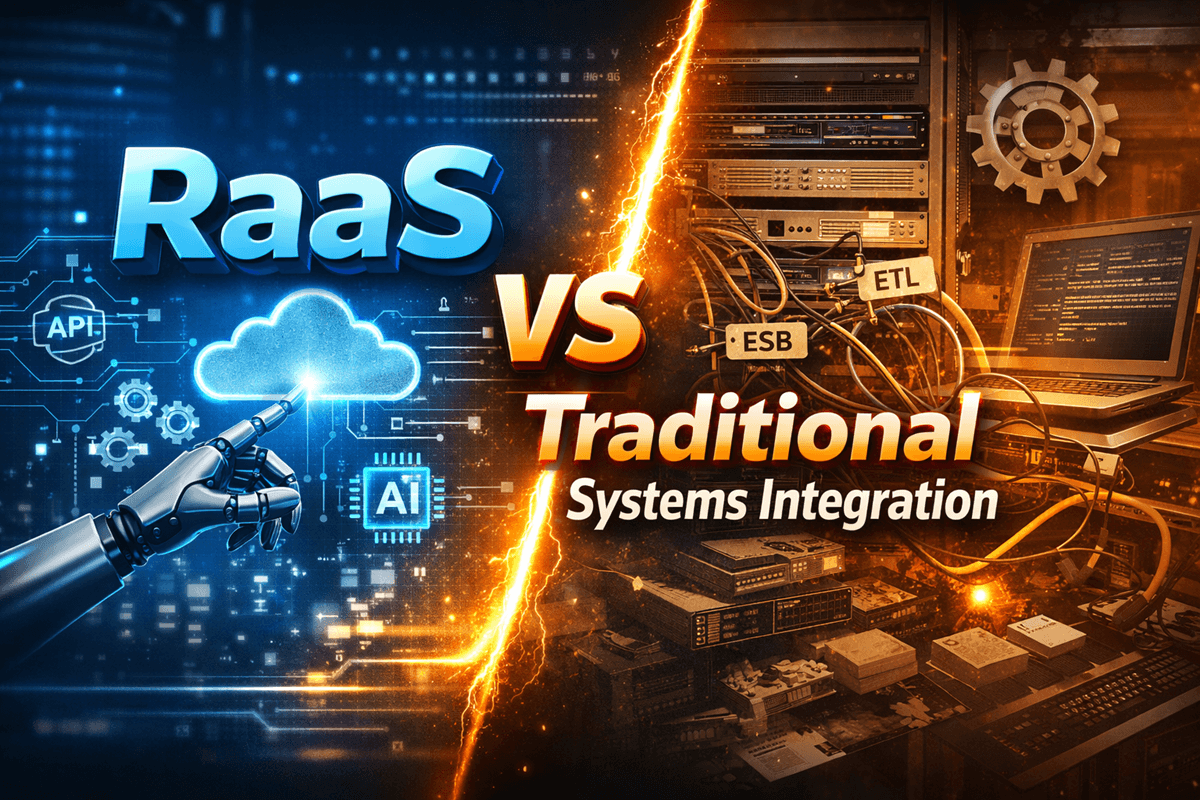
This blog explores a detailed comparison of RaaS vs Traditional Systems Integration, highlighting differences, benefits, and enterprise impact.
Understanding Traditional Systems Integration
Traditional systems integration refers to the conventional approach of connecting enterprise applications through manually developed code, middleware solutions, and point-to-point integrations. This approach has been the backbone of enterprise IT for many years and is still used in organizations with legacy infrastructure.
In traditional integration, systems communicate through custom-built APIs, enterprise service buses (ESB), ETL pipelines, and middleware platforms. These integrations are usually deployed on-premise or within controlled enterprise environments.
The primary objective of traditional integration is to ensure data exchange between different systems. However, the method used to achieve this is often complex, rigid, and resource-intensive.
How Traditional Integration Works
The traditional integration lifecycle typically involves multiple stages:
First, business requirements are gathered from stakeholders to understand what systems need to be connected. Next, solution architects design an integration architecture that defines how data will flow between systems. After that, developers write custom code to build connectors and transformation logic. Once development is completed, the system goes through rigorous testing. Finally, the integration is deployed into production environments and continuously maintained by IT teams.
Each integration is treated as a separate project, which adds complexity as the number of systems increases.
Technologies Used in Traditional Integration
Traditional systems integration relies on several core technologies, including:
- Enterprise Service Bus (ESB) platforms
- REST and SOAP APIs
- ETL (Extract, Transform, Load) pipelines
- Message queues such as JMS or Kafka (in older implementations)
- Custom middleware applications
- On-premise integration servers
These technologies were designed for stable and predictable environments rather than dynamic cloud ecosystems.
Advantages of Traditional Systems Integration
Despite its limitations, traditional integration offers several advantages that have kept it relevant for many years.
One of the most important advantages is control. Enterprises have full control over how data is processed, transformed, and transmitted between systems. This level of control is critical in industries such as banking and government where security and compliance are top priorities.
Another advantage is deep customization. Traditional integration allows organizations to build highly tailored workflows that match specific business requirements. It is also well-suited for legacy systems that cannot easily adapt to modern integration platforms.
Additionally, traditional systems are known for their stability. Once properly implemented, they can operate reliably for long periods without major changes.
Limitations of Traditional Systems Integration
However, as enterprise environments become more complex, the limitations of traditional integration become more apparent.
One major limitation is slow development speed. Building integrations manually requires significant time and effort, often taking weeks or even months for a single system connection.
Another limitation is high cost. Organizations must invest in skilled developers, infrastructure, and ongoing maintenance, which increases total cost of ownership significantly.
Scalability is also a challenge. As the number of systems increases, integration complexity grows exponentially, making it difficult to manage and expand.
Traditional integration also lacks flexibility. In today’s fast-changing business environment, organizations need to adapt quickly, but traditional systems require extensive effort to modify or update.
Finally, maintenance becomes increasingly difficult over time as integrations become tightly coupled and dependent on each other.
Understanding RaaS (Integration-as-a-Service Model)
RaaS represents a modern evolution of enterprise integration that leverages cloud computing, automation, and artificial intelligence to simplify connectivity between systems. Instead of manually building integrations, RaaS provides prebuilt connectors and workflow automation tools that can be configured with minimal coding effort.
RaaS is often associated with Integration-as-a-Service platforms, robotic process automation ecosystems, and AI-driven orchestration layers that enable real-time data flow between enterprise systems.
Key Characteristics of RaaS
RaaS is defined by several important characteristics that differentiate it from traditional integration models.
It is cloud-native, meaning it does not require on-premise infrastructure. It is also API-first, allowing systems to communicate through standardized interfaces. Most RaaS platforms offer prebuilt connectors for popular enterprise applications, reducing development effort significantly.
Another key feature is low-code or no-code workflow creation, which allows both technical and non-technical users to design integrations. Additionally, RaaS supports real-time data synchronization and event-driven architecture, ensuring instant communication between systems.
Artificial intelligence is also deeply integrated into RaaS platforms, enabling predictive analytics, anomaly detection, and workflow optimization.
How RaaS Works in Practice
RaaS simplifies integration into a structured but flexible process. Enterprises begin by selecting the applications they want to integrate. Next, they choose prebuilt connectors available within the platform. Then, they configure workflows using visual tools or low-code interfaces. After defining automation rules and triggers, the integration is deployed instantly in a cloud environment.
Once deployed, the system continuously monitors data flow, detects issues, and optimizes performance using AI-driven insights.
Example of RaaS in Action
Consider an enterprise that wants to integrate multiple systems such as Salesforce, SAP, Slack, and an inventory management system.
In a traditional setup, this would require custom APIs, middleware configuration, and months of development work.
In a RaaS environment, prebuilt connectors allow instant integration. When a customer places an order in Salesforce, inventory is automatically updated in SAP, warehouse teams are notified via Slack, and invoices are generated automatically. This entire workflow operates in real time without manual intervention.
RaaS vs Traditional Systems Integration: Detailed Comparison
The difference between RaaS and traditional systems integration becomes clear when analyzed across multiple dimensions.
In terms of architecture, traditional integration relies on monolithic middleware systems and point-to-point connections, while RaaS uses distributed, cloud-native, microservices-based architecture.
Deployment speed is another major difference. Traditional systems require long development cycles, whereas RaaS enables rapid deployment using preconfigured templates.
Cost structure also varies significantly. Traditional integration involves high upfront investment and ongoing maintenance costs, while RaaS follows a subscription-based model that reduces initial financial burden.
Scalability is limited in traditional systems due to rigid architecture, whereas RaaS provides elastic scalability through cloud infrastructure.
Flexibility is another key differentiator. Traditional systems are difficult to modify, while RaaS allows real-time configuration changes.
Maintenance in traditional systems is manual and resource-intensive, whereas RaaS platforms are managed and updated automatically by providers.
Finally, AI integration is minimal in traditional systems but deeply embedded in RaaS platforms, enabling intelligent automation and decision-making.
Why Enterprises Are Moving Toward RaaS
Several global trends are driving the adoption of RaaS across industries.
The rapid increase in SaaS applications has made traditional integration unsustainable. Enterprises now manage dozens or even hundreds of applications that need to communicate with each other in real time.
The shift toward cloud-first strategies has also accelerated the need for cloud-native integration platforms.
Additionally, businesses require real-time data access for faster decision-making, which traditional batch-based systems cannot provide.
The rise of artificial intelligence and automation further strengthens the case for RaaS, as modern enterprises need intelligent systems that can adapt and optimize workflows automatically.
Benefits of RaaS for Modern Enterprises
RaaS provides several significant benefits that make it highly attractive for organizations undergoing digital transformation.
It enables faster deployment of integrations, reducing time from months to hours. It reduces technical complexity through low-code platforms, allowing business users to participate in integration design.
RaaS also improves operational efficiency by automating repetitive tasks and ensuring real-time data synchronization across systems.
AI-powered optimization enhances workflows by detecting inefficiencies and improving performance over time.
Additionally, RaaS reduces total cost of ownership by minimizing infrastructure requirements and development overhead.
Challenges of RaaS
Despite its advantages, RaaS also presents certain challenges.
Vendor lock-in is a major concern, as enterprises may become dependent on specific platforms. Data security and compliance must also be carefully managed, especially in regulated industries such as finance and healthcare.
Another limitation is reduced customization for highly complex enterprise workflows that require deep system-level integration.
Finally, reliance on third-party connectors means performance and reliability depend on external providers.
Industry Use Cases of RaaS
RaaS is widely used across multiple industries.
In retail and e-commerce, it enables real-time inventory updates, order processing automation, and customer engagement workflows.
In healthcare, it supports patient data synchronization, appointment scheduling, and AI-driven diagnostics integration.
In manufacturing, RaaS enables IoT device connectivity, predictive maintenance, and supply chain optimization.
In finance, it is used for fraud detection, transaction monitoring, and compliance reporting.
In logistics, it powers shipment tracking, fleet management, and route optimization systems.
Future of Systems Integration
The future of enterprise integration is moving toward intelligent, autonomous, and AI-driven systems.
AI-native integration platforms will allow users to design workflows using natural language. Event-driven architectures will replace traditional batch processing systems.
Autonomous systems will self-heal, self-optimize, and self-scale without human intervention.
Eventually, integration will evolve into a unified platform layer where all enterprise systems communicate seamlessly through intelligent orchestration engines.
Conclusion
The comparison between RaaS and traditional systems integration highlights a major shift in enterprise IT architecture. Traditional integration, while reliable, is slow, expensive, and difficult to scale in modern digital ecosystems. RaaS introduces a faster, more flexible, and intelligent approach to system connectivity that aligns with the needs of modern enterprises.
As organizations continue their digital transformation journey, RaaS is becoming the preferred integration model due to its scalability, automation capabilities, and cost efficiency. It represents not just an alternative but the future of enterprise systems integration.
FAQs
What is RaaS in systems integration?
RaaS is a cloud-based integration model that connects enterprise systems using prebuilt connectors, APIs, and automation workflows with minimal coding.
How is RaaS different from traditional integration?
Traditional integration relies on manual coding and middleware, while RaaS uses cloud-based, automated, and AI-powered platforms.
Is RaaS replacing traditional systems integration?
Yes, especially in cloud-native environments. However, traditional systems are still used for legacy applications.
What are the benefits of RaaS?
Faster deployment, lower cost, real-time data sync, AI automation, and easy scalability.
Which industries benefit most from RaaS?
Retail, healthcare, finance, manufacturing, and logistics benefit the most due to high integration needs.
Is RaaS secure?
Yes, but security depends on implementation, encryption, and compliance standards of the provider.

Manoj Kumar is a seasoned Digital Marketing Manager and passionate Tech Blogger with deep expertise in SEO, AI trends, and emerging digital technologies. He writes about innovative solutions that drive growth and transformation across industry.
Featured on – YOURSTORY | TECHSLING | ELEARNINGINDUSTRY | DATASCIENCECENTRAL | TIMESOFINDIA | MEDIUM | DATAFLOQ