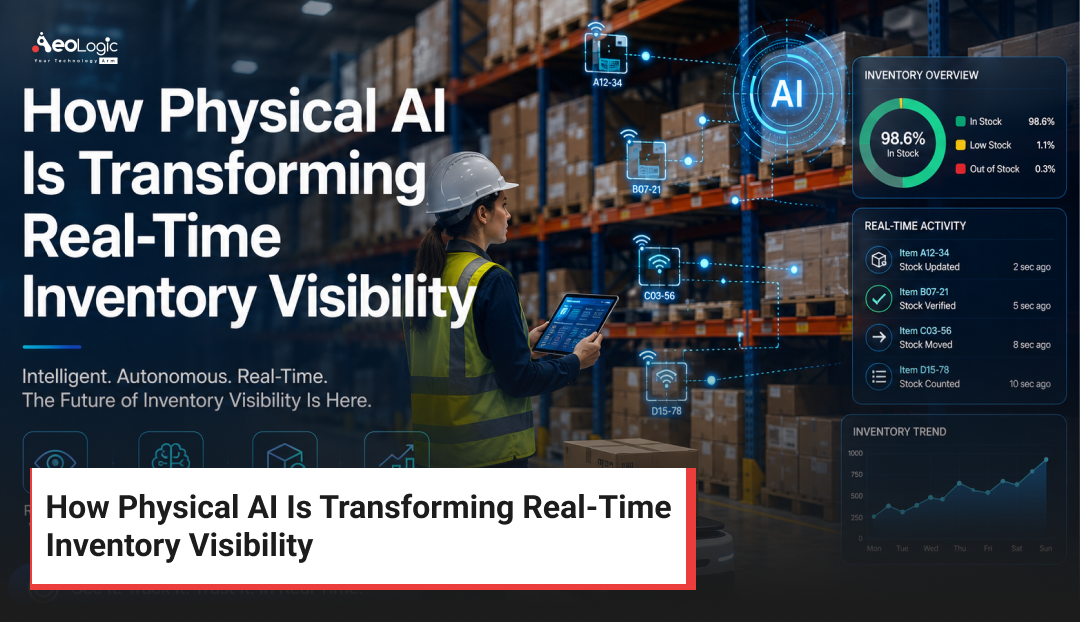
In the modern global, demand-led and connected supply chain landscape, businesses simply cannot afford to be dependent on late inventory updates, manual inventory counting or siloed tracking systems. Physical AI in Inventory Management is a promising solution that integrates artificial intelligence with the physical technologies like IoT sensors, robotics, RFID systems, computer vision, and autonomous systems to provide real-time inventory insights. Today, as the supply chain evolves in complexity and expectations from the customers grow rapidly, companies need smarter solutions to monitor the movement of inventory in real-time, anticipate disruptions, and enhance the process of making operational decisions. Real-time inventory tracking is no longer just a matter of efficiency; it’s a key factor in profitability, customer satisfaction, and business resilience.
Conventional inventory management processes can cause visibility issues, leading to stockout, overstock, late delivery, and higher operational expenses. The difficulties are even greater in industries that have a large number of inventories at several locations. AI-driven intelligent physical systems enable enterprises to shift from reactive to autonomous and predictive operations, with inventory management. With the ability to monitor, analyze, and react to real-world stock levels, companies can better manage warehouse operations, track assets, and enhance supply chain performance.
What is Physical AI and What Role Does It Play in Inventory Operations?
Physical AI is about AI that is integrated into machines, sensors, cameras, robotics, and connected infrastructure that can interact with and react to the physical world. Traditional AI processes digital data, whereas Physical AI monitors physical processes and takes intelligent action based on what it sees.
In inventory management, Physical AI in Inventory Management can transform inventory networks into intelligent ecosystems across warehouses, storage facilities, and distribution centers. Products moving across multiple locations can be tracked automatically in real time, improving operational visibility and reducing manual intervention. Any inventory discrepancies or irregularities can be detected instantly, enabling faster corrective actions. Sensitive products can be continuously monitored based on environmental conditions, ensuring compliance and quality standards are maintained.
For instance, if a warehouse has cameras that can detect product placement mistakes, RFID readers that can automatically monitor product movement and robots that can take inventory checks at the end of the day. These technologies are all combined to provide an up-to-date inventory environment. This enhances the accuracy of measurements, response times, and operational efficiency.
Why Real-Time Inventory Visibility Matters More Than Ever
Having visibility of your inventory has a direct impact on profitability, operational performance, and customer experience. When businesses are missing up-to-date information about their stocks, it can lead to unnecessary expenses and inefficiencies.
When the retailer does not have true inventory visibility, they can promote items they don’t have. Production delays may be experienced by manufacturers due to insufficient raw materials. Hospitals and other health care facilities face a risk of not having enough critical medical supplies. Logistics firms might have difficulties in ensuring shipment on time because of the inadequate inventory records.
To address these problems, real-time inventory visibility enabled by Physical AI in Inventory Management can provide organizations with instant access to accurate information on inventory levels, stock movement, and inventory conditions, helping businesses improve operational efficiency, reduce disruptions, and make faster, data-driven decisions.
With continuous visibility, businesses can:
Improve fulfillment accuracy.
Reduce excess inventory.
Prevent stock shortages.
Be quicker to respond to disturbances.
Optimize warehouse utilization.
Strengthen forecasting capabilities.
Increase customer satisfaction.
Today, inventory visibility is no longer a luxury but a necessity in today’s supply chain.
How Physical AI in Inventory Management Enables Real-Time Inventory Visibility
Intelligent inventory monitoring is made possible by combining multiple high-tech innovations. When combined, these technologies provide systems that can observe, analyze, predict and respond to operational changes.
Computer Vision for Automated Inventory Recognition
AI systems can process visual data collected by cameras in warehouses and workplaces through computer vision technology. These systems can also recognize products, track movement, and count items, and detect anomalies.
While manual inventory audits are limited to a certain time frame, computer vision works 24/7. The system can spot discrepancies at the instant products are misplaced or quantities are not balanced with the records.
AI-powered cameras are being adopted by big stores to automatically track stock levels. Similar solutions are utilized in warehouses to boost the level of accuracy in stock while lowering the amount of manpower needed.
Computer vision reduces the chances of errors and streamlines inventory tracking to a great degree.
IoT Sensors for Continuous Monitoring
The Internet of Things (IoT) is a key component of smart inventory systems. Real-time data on the location, environment, movement and storage status of products are gathered through connected sensors.
Sensor-based monitoring is particularly advantageous for industries with valuable sensitive stocks. Temperature monitoring is essential in pharmaceutical companies, for instance, to keep medicines good. Humidity and environmental tracking are needed to ensure food supply chains stay in compliance and products are safe to eat.
IoT systems offer constant operation awareness, enhancing inventory visibility and quality control.
 RFID Technology and Intelligent Tracking
Radio Frequency Identification (RFID) is a technology that enhances inventory management by allowing for the automatic identification of items without the need for manual scanning.
The traditional barcode system requires a direct line of sight and becomes highly time-consuming in large-scale inventory operations. In contrast, Physical AI in Inventory Management leverages RFID technology to detect tags remotely and simultaneously, enabling faster tracking, improved accuracy, and real-time inventory visibility.
With the incorporation of AI systems, RFID can be even more powerful. AI can measure the behavior of movement, forecast shortages, recognize unusual behavior, and suggest corrective measures.
Businesses that implement RFID-based inventory management can enjoy greater accuracy and stock discrepancies are minimized.
Autonomous Robots in Warehouses
AI-powered robots are increasingly being used in warehouses to move items around, scan items and automatically update warehouse systems.
AMRs minimize manual tasks, increase speed and efficiency.
These systems can:
Move around in industrial facilities without the aid of others.
Conduct inventory counts.
Transport products.
Identify misplaced items.
Keep stock records up-to-date.
Robotics and AI go hand-in-hand to help increase speed and visibility of the inventory.
Predictive Analytics for Smarter Inventory Decisions
The traditional inventory systems tend to concentrate on the past. Predictive analytics shifts this paradigm, forecasting future inventories needs.
Organizations can forecast:
Potential stock shortages.
Demand spikes.
Supply chain disruptions.
Inventory optimization opportunities.
Future purchasing requirements.
With predictive capabilities, companies can move from reactive management towards proactive planning.
Key Components Required for Successful Implementation
Implementing intelligent inventory systems isn’t as simple as buying the technology. Structured implementation strategies are crucial to successful transformation.
Step 1: Assess Existing Inventory Challenges
It is important to know the constraints of operations in an organisation before understanding the concept of a Virtual Coordinator. Issues like under-inventoried stock, tardy updates, manual reporting and ineffective warehouse functions are common.
Pain points can be used to set measurable goals, helping organizations implement Physical AI in Inventory Management more effectively to improve inventory visibility and operational efficiency.
Step 2: Determine High-Impact Use Cases
AI should be focused on areas where it can provide value quickly for businesses.
Examples include:
Warehouse automation.
Asset tracking.
Demand forecasting.
Cold chain monitoring.
Order fulfillment optimization.
Adoption outcomes are better when focused implementation is achieved.
Step 3: Integrate Existing Systems
There are a lot of organisations that have separate systems like ERP platform, warehouse management system, RFID system and logistics software.
Continuous data flow across operations with integration.
If not integrated, intelligent inventory systems could not really be effective.
Step 4: Deploy AI and Automation Solutions
It is important for the organizations to adopt technologies step by step and train the AI models with their past operations.
Implementation of pilot projects can help mitigate risks prior to wider deployment.
Step 5: Monitor Performance and Optimize Continuously
The implementation process should be ongoing.
Businesses must evaluate:
Inventory accuracy improvements.
Cost reduction.
Operational efficiency.
Forecast reliability.
Return on investment.
Business Benefits of Physical AI in Inventory Management for Real-Time Inventory Visibility
AI inventory systems can bring tangible benefits to organisations that adopt them.
The faster the warehouse is able to operate, the more productive it will be.
Manual involvement is reduced which reduces labor dependency.
The more efficiently resources are used, the more profitable it will be.
Operational resilience leads to better efforts in the event of disruption.
The synergy makes for better business results and competitive advantage.
Industry Applications and Real-World Use Cases
Retail
Smart inventory management enables retailers to keep a track of their stock availability and optimise their inventory levels.
AI visibility minimises lost sales due to out-of-stock products.
Manufacturing
Availability of raw material is crucial for manufacturers.
Real time inventory visibility for production avoid interruptions and increases planning accuracy.
Healthcare and Pharmaceuticals
Accurate inventory control is essential in hospitals and pharmaceutical companies, and Physical AI in Inventory Management is helping these sectors achieve real-time visibility, reduce errors, and ensure the availability of critical medical supplies.
Compliance, waste reduction and availability of critical supplies are made easier with AI-powered systems.
Logistics and Transportation
Smart tracking systems are employed by logistics companies to keep close track of shipments at all times.
Greater visibility helps ensure timely deliveries and good supply chain coordination.
E-commerce
E-commerce companies process many orders that are needed to be fulfilled quickly.
Customers have reduced dissatisfaction as they now know the status of their orders with real-time inventory updates.
Mini Case Study: Smart Warehouse Transformation
Think about a distribution company that manages multiple warehouses across different regions. This organization relied heavily on manual stock checks and routine audits, often leading to shipment delays and increased operational costs due to inventory discrepancies. After adopting Physical AI in Inventory Management, including AI-powered cameras, RFID systems, and predictive analytics tools, the company achieved continuous inventory monitoring, improved stock accuracy, faster order fulfillment, and significantly reduced operational inefficiencies.
Following the deployment of AI-powered cameras, RFID systems, and predictive analytics tools, inventory tracking shifted from periodic to continuous. The deployment of AI-powered cameras, RFID systems, and predictive analytics tools made inventory tracking continuous instead of periodic.
The organization was able to improve inventory accuracy, lower fulfillment errors, and reduce reliance on workforce within just a few months and made faster decisions.
Common Challenges During Adoption of Physical AI in Inventory Management
While there is much to be gained, there are some implementation issues.
Legacy systems may not integrate with current AI systems. Legacy systems may not be compatible with modern AI systems.
The poor quality of data can decrease the accuracy of the predictions.
The start-up expenses may seem high.
There can also be some resistance from employees that can delay adoption.
The more connected devices there are, the greater the cybersecurity risks also become.
These challenges will need to be tackled in a phased manner with robust organizational planning.
Best Practices for Long-Term Success
The key for businesses is on strategic deployment if they want to achieve sustainable outcomes.
Pilot projects help to reduce risk.
Good data governance makes data more reliable and strengthens the effectiveness of Physical AI in Inventory Management by ensuring accurate, consistent, and high-quality inventory insights.
Cybersecurity measures are still necessary.
Adopting technology is a key component to making a long-term impact, but it is just one piece of the puzzle; organizational readiness is the other.
Future Trends Shaping Inventory Visibility with Physical AI in Inventory Management
What will be seen in the future is more autonomous and more predictive in terms of inventory management.
Current advances include self-learning warehouses that can optimise warehouse layout automatically. The collaborative robots will work side-by-side with workers to boost productivity. Digital twins can be used to model inventory operations before changes are made to the physical inventory. Hyperautomation may seamlessly integrate procurement, logistics, and inventory management into intelligent ecosystems.
AI’s functions will further develop from observing operations to controlling them independently.
The sooner the changes are accepted by organisations the greater the competitive edge.
Why Businesses Should Invest Now?
Inventory visibility impacts almost every business function, such as customer experience, profitability, operational efficiency and risk management.
For organizations willing to wait for intelligent transformation, the challenges of growing supply chain size and complexity, coupled with the rising expectations of customers, can pose a hurdle.
Modern inventory technologies such as Physical AI in Inventory Management boost resiliency, improve operational agility, and contribute to building future-ready business operations.
The shift to AI-powered inventory management is no longer about innovation but about staying competitive in the long run.
Conclusion
The need for real-time inventory visibility is quickly evolving into a strategic imperative for businesses aiming for operational efficiency, resilience, and sustainable growth. The advent of smart systems that can monitor physical surroundings, anticipate disturbances, and execute automated responses is reshaping the way inventory is managed—from passive to responsive and data-driven. The shift towards intelligent systems that observe, predict, and automate physical environment responses is revolutionizing inventory management from passive to proactive and data-driven. In essence, Physical AI in Inventory Management is a significant advancement in the quest for smarter warehouses, integrated supply chains, and autonomous decision-making.
Companies that take proactive steps to optimize their inventory through intelligent transformation early on stand to gain greater accuracy, lower costs of operations, enhance customer satisfaction and create more resilient operations. Advanced inventory solutions can be curated with the help of the experienced technology partners like Aeologic Technologies who can assist the enterprise in designing scalable, AI-enabled systems that will meet the future supply chain needs.
People Also Ask (FAQs)
Q1. What is Physical AI in Inventory Management?
AI-driven inventory management refers to artificial intelligence integrated with physical technologies such as robotics, IoT sensors, RFID systems, cameras, and autonomous devices to monitor and optimize inventory operations. These systems continuously collect operational data, analyze patterns, and support automated decision-making. The objective is to improve visibility, increase inventory accuracy, and reduce dependency on manual processes.
Q2. How does AI improve inventory visibility?
AI improves inventory visibility by processing live data from multiple operational sources. Instead of relying on delayed updates, organizations gain continuous insight into stock movement, inventory levels, and potential disruptions. Predictive analytics also enables businesses to anticipate shortages before they affect operations.
Q3. Which industries benefit most from intelligent inventory systems?
Retail, manufacturing, healthcare, pharmaceuticals, logistics, automotive, and e-commerce industries benefit significantly because these sectors depend heavily on accurate inventory information and timely fulfillment.
Q4. Is implementing AI inventory technology expensive?
Implementation costs vary depending on scale and infrastructure requirements. However, many organizations achieve long-term savings through improved efficiency, reduced inventory losses, and better forecasting accuracy.
Q5. Can small businesses adopt AI-driven inventory systems?
Yes. Many solutions now offer scalable deployment options suitable for small and medium-sized businesses. Organizations can begin with limited implementations and expand gradually.
Q6. What technologies support intelligent inventory management?
Common technologies include IoT, RFID, robotics, computer vision, predictive analytics, machine learning, cloud platforms, digital twins, and edge computing.