Modern businesses generate enormous amounts of visual data every day—from CCTV footage and factory floor cameras to retail monitoring systems, medical imaging, logistics tracking, and quality inspection videos. The problem isn’t gathering this data, it’s getting it to a point where you can make better decisions in a timely fashion. That’s where Computer Vision Solutions for Businesses are now playing an essential role in digital transformation strategies.
Computer vision is leveraging in manufacturing, retail, healthcare, agriculture, logistics, construction and smart cities to automate tasks that previously relied on human observation. Companies are now able to analyze images and video in real time with minimal human oversight, decrease errors, increase efficiency and enhance operational visibility.
What is Computer Vision and Why Does It Matter for Enterprises?
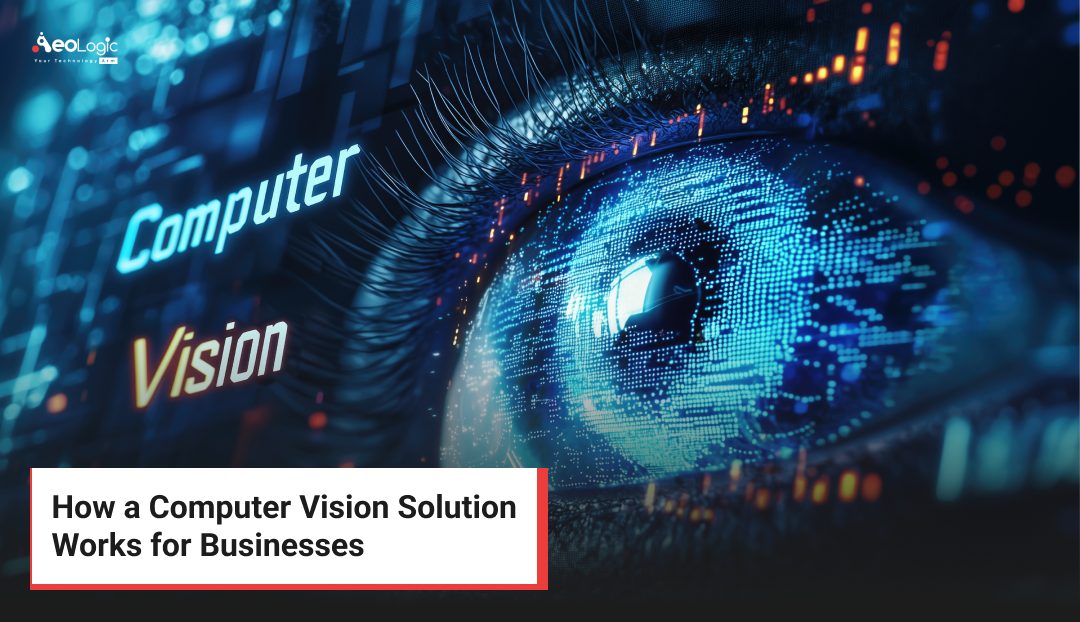
Computer vision is a field of AI that allows machines to decode, analyze, and make sense out of visual data, like images, videos, documents, objects and environments. In the same way that humans rely on sight and experience to detect patterns, AI algorithms and training data can be used to recognize objects, identify anomalies, track movement, and classify visual content.
Computer Vision Solutions for Businesses convert visual data into metrics for businesses. Organizations can now transform these vast resources of inactionable, meaningless footage and millions of product images into meaningful insights that increase operational efficiency, automate decision-making and inform better business decisions.
Think about a manufacturing plant where employees look at the items they make and find out if there are any issues. Errors can be overlooked by human inspection due to fatigue, speed constraints, and variations in the standards. With a computer vision system you can check products in real-time, identify defects in a few milliseconds, and ensure high accuracy during all operations.
Organizations are increasingly depending on speed, precision and automation to stay competitive, which is where computer vision comes in handy.
Why Computer Vision Solutions for Businesses Are Becoming Essential?
Companies are always pushing to get more efficiency out of their operations and to keep operational costs under control. Manual observation-based methods are often time-consuming, costly and prone to human error. Visual AI systems overcome these challenges.
CVC is gaining traction in businesses due to the following reasons: customers are looking for faster service, supply chains are asking for more transparency, and industries are setting higher standards of compliance.
Retail organizations leverage visual intelligence to understand how customers are moving around in their stores to enhance customer flows. Warehouse operations are automatically tracked by logistics firms. Medical scans are analysed quicker at hospital. Automated inspection is used by manufacturers to minimise defect rates.
As more and more organizations rely on digital data and images, those that don’t could find themselves being out-competed by competitors who are using digital capabilities.
How a Computer Vision System Works in Business Environments
Computer vision systems work by converting visual data, including images, videos, or real-time camera footage, into valuable information that a machine can process and respond to. The system not only interprets visual content but also detects patterns, identifies objects, detects anomalies, and understands the context behind the visuals, all to aid in business decisions.
Visual data is captured by cameras, sensors, drones, smartphones or industrial equipment and the process begins. This raw data is then filed, processed and analyzed to make it more consistent and of better quality so that the AI can accurately “read” what it is seeing. During processing, machine learning algorithms will be able to recognize patterns, identify relationships, and enhance the recognition process over time by analyzing large amounts of labeled visual data.
Following training, the system can recognize objects, track activities, detect defects, recognize faces or products and understand movement in the real world. The findings and analysis results are then combined with other business systems like ERP, inventory management software or operational dashboards. This enables organisations to automate actions, raise alerts, create reports and enable quick decision-making.
Computer Vision Solutions for Business are continuously improved by model updates and retraining as the environment evolves, whether it’s a change in products, lighting, customer behavior, or how they’re used at work. This continuous optimization ensures accuracy, improves performance, and keeps the technology relevant in ever-changing business scenarios with dynamic operational requirements.
Finally, a computer vision solution acts like an intelligent lens over visual data and business processes, turning the pictures and videos captured by the world into quantifiable gains in efficiency, automation, and strategic value for organizations.
Key Components Behind Computer Vision Solutions for Businesses
Implementation(s) are usually complex, incorporating several interrelated technologies.
The first component is visual hardware. Data is gathered using cameras, IoT sensors, drones and imaging devices.
The second part is cloud / edge compute infrastructure where the processing takes place.
The third part: machine learning models with specific goals.
The other key layer involves how the AI’s output can be integrated into business software.
When not connected between these elements, computer vision is an isolated experiment, not an enterprise capability.
 Major Business Applications Across Industries
Computer vision is becoming more than just a tech solution. Adoption cuts across various sectors.
Manufacturing
Visual AI is applied in factories for automated quality control, predictive maintenance, worker safety tracking and defect detection.
Production lines increase in speed and waste is minimized.
Retail
Retailers use the data to study their customers, place products at best positions on shelves, fight theft, and automate their check-out systems.
Custumer’s shopping experience becomes easy.
Healthcare
Imaging analysis is applied in hospitals for diagnostics, disease detection and clinical decision support.
Medical professionals gain faster insights.
Logistics and Warehousing
For businesses, Computer Vision Solutions streamline warehouse operations, boost accuracy, optimize processes, and enhance overall supply chain visibility, while for warehouses, Warehouse Operations benefit from Inventory tracking, Package identification, and Operational monitoring.
This helps to streamline the supply chain.
Agriculture
Farmers use drones to keep track of crops, and detect diseases early.
Yield prediction becomes more accurate.
Smart Cities
Visual Intelligence is increasingly vital to traffic monitoring, public safety systems and infrastructure management.
Benefits Businesses Gain From Computer Vision Adoption
By leveraging computer vision technology, organizations can boost their operational efficiency and minimize manual monitoring and repetitive inspection duties. Implementing computer vision systems in business allows them to handle an enormous amount of visual information more quickly, detect problems on the spot, and avoid mistakes that can happen with manual inspections. This results in higher productivity, faster response times and more uniform operating results in departments.
The one thing that makes Computer Vision Solutions for Businesses so great is that it is capable of automating complex processes without compromising the accuracy. These solutions can be used in a variety of industries, from manufacturing to retail, to improve operational efficiency and make data-driven decisions. These solutions can be used in a variety of industries, including manufacturing, retail, and warehouse management, to help organizations lower their operational costs and make data-driven decisions. As a result, businesses can have a better understanding of their operations and enhance overall performance.
In addition to efficiency and automation, computer vision also plays a role in ensuring customer safety, delighting customers, and scaling for future growth. Intelligent visual insights enable organizations to proactively detect risks, use resources judiciously, and adjust to market needs. As time passes, these features establish more competitive benefits and assist companies in speeding up their digital transformation efforts.
Implementing Computer Vision Solutions for Businesses: A Strategic Approach
Many companies fall short because they buy computers and think of it as a technology buying program instead of a business program.
Good success rate with structured implementation process.
Step 1: Define Business Objectives
It’s important that organizations create measurable objectives first.
This can be getting 30% fewer defects, being more accurate in the warehouse, or faster inspections, to name a few.
Technology should be used to achieve outcomes.
Step 2: Assess Existing Data Availability
Determine if adequate visual information is available.
Advanced AI systems fail when the data is not of high quality.
Step 3: Select Deployment Architecture
Businesses choose among:
Cloud deployment
Edge deployment
Hybrid infrastructure
This will depend on the latency, privacy, and the operational needs.
Step 4: Build or Train Models
The model can be custom-designed or modified from a pre-existing model.
Industry-specific requirements influence selection.
Step 5: Integrate With Business Systems
AI needs to fit into the current work processes.
Disconnected solutions rarely create sustained value.
Step 6: Measure ROI
Monitor progress on:
Operational savings
Error reduction
Processing speed
Revenue impact
Business outcomes justify continued investment.
Common Challenges in Implementing AI-Powered Visual Intelligence Solutions
While AI visual intelligence technologies have a lot to offer in terms of operational benefits, there are still a few challenges that may be encountered when implementing this technology in an organization. The availability of good and well-labeled visual data is one of the most challenging issues, and inaccurate or incomplete visual data can diminish model performance. Another challenge businesses face is integrating AI systems with their current software, infrastructure, or processes. Another hurdle is the integration of AI systems with the existing software, infrastructure, or workflow. Furthermore, privacy requirements, compliance needs and the need to keep the model up to date over time also makes deployment more complicated than initial implementation.
One of the other challenges in implementing Computer Vision Solutions in businesses is setting expectations with results. There is an expectation that AI systems will be accurate and automated instantaneously in many organizations, but successful implementation usually necessitates testing, optimizing, and continuous monitoring. Operating conditions, customer behavior, as well as changes in the environment and lighting conditions, can affect performance over time and therefore continuous improvement is necessary to ensure reliability and business value.
Best Practices for Successful Adoption of Computer Vision Solutions for Businesses
To be successful with AI-based visual technologies, organisations need to be focused on business goals before they implement them. Rather than putting new and sophisticated image recognition systems in place site-wide at once, companies should start with small-scale pilot projects for testing purposes to learn about performance in practice, any difficulties encountered and the ROI. By taking a phased approach, businesses minimize risk and gain insight into how intelligent vision platforms will fit into their business goals and digital transformation roadmap.
To ensure successful results with visual AI solutions, data quality is an important piece of the puzzle. It’s important for organisations to invest in the accurate, diverse and well-structured collection of data whilst also adhering to security and privacy laws. Furthermore, an IT team working closely with operational departments and decision makers increases successful deployment. The technical implementation of enterprise AI vision systems should complement existing real business workflows, not stand alone in innovation projects.
Continuous monitoring and optimization are equally important for long-term performance. Businesses change over time with changing products, lighting, customer behaviour, operational processes etc., which can impact the accuracy of the model. It’s essential for companies implementing machine vision solutions to continuously update their datasets, retrain their models, and track their performance metrics to ensure they remain efficient. Rather than conceiving computer vision as an end-to-end deployment, it can be embraced as an iterative process, resulting in more robust scale and business value.
Real-World Example: Manufacturing Quality Inspection
Now imagine that the electronics manufacturer is making thousands of components a day.
In the traditional inspection, multiple employees have to inspect the products manually.
Following AI implementation of visual inspection:
Defects are detected instantly
Waste decreases
Production speed improves
Customer complaints decline
The company benefits from increased efficiency and improved quality of products.
This is a clear example of how more and more visual intelligence is becoming a part of enterprise transformation strategies.
Future Trends Shaping Computer Vision Solutions for Businesses
The field of computer vision is ever expanding.
The trend of processing near devices as opposed to centralized servers is driving the growth of Edge AI. This decreases latency and enhances real-time analysis.
Multimodal AI, which integrates text, images, and video, will enhance the understanding of contextual information.
AI could lead to more adaptive visual systems with generative AI integration.
Specific models will increase accuracy for the healthcare, manufacturing and logistics industry sectors.
Visual intelligence will play a crucial role in autonomous systems, such as robotics and smart infrastructure.
The ability to understand the information presented visually is likely to be a key factor in the competitiveness of organizations in the future.
Conclusion
Visual data is one of the most important assets that businesses have and don’t realize they need. Smart interpretation of images and video helps organizations make quicker decisions, make operations more efficient, have higher quality control and greater customer experiences. Computer Vision Solutions for Businesses will become more of a must-have rather than an innovation as AI technologies advance.
Organizations looking to incorporate AI-powered automation, smart monitoring, or domain-specific visual systems will want to carefully consider their options and prioritize implementation to achieve tangible results. Aeologic Technologies are companies that are active in emerging technology areas that enable digital transformation efforts in other industries.
People Also Ask (FAQs)
Q1. What are Computer Vision Solutions for Businesses?
Computer Vision Solutions for Businesses are AI based computer vision solutions that analyze image and video content to automate tasks like inspection, monitoring, detection, recognition, and decision making. These technologies are leveraged by organizations to streamline their operations, minimize human error, enhance safety, and optimize processes. Visual AI is revolutionizing industries like manufacturing, healthcare, retail, and logistics, by converting vast visual data into tangible insights.
Q2. How does computer vision improve operational efficiency?
Computer vision reduces dependency on manual observation and repetitive inspection processes. AI systems can analyze visual information continuously and often faster than humans. Businesses improve accuracy, reduce delays, identify defects earlier, and automate routine monitoring tasks. The result is lower operational cost and increased productivity.
Q3. Which industries benefit most from computer vision?
Manufacturing, healthcare, retail, logistics, agriculture, construction, automotive, and smart city infrastructure frequently benefit from computer vision. Any industry generating visual data can potentially gain value from automated analysis and intelligent decision support.
Q4. Is computer vision expensive for small businesses?
Costs vary depending on project complexity, infrastructure, and deployment requirements. Cloud-based services and pre-trained AI models have reduced barriers to adoption. Small organizations often begin with focused pilot projects before expanding investments.
Q5. What is the difference between computer vision and image recognition?
Image recognition identifies objects or categories within images. Computer vision is broader and includes object detection, segmentation, tracking, activity recognition, anomaly detection, and contextual understanding.
Q6. How long does implementation usually take?
Timelines vary according to data availability, integration requirements, and project goals. Simple deployments may take weeks, while enterprise-scale implementations may require several months.

I’m a Software Developer with 9 years of experience building scalable web and mobile applications. Currently focused on React.js and React Native, I specialize in creating high-performance, user-friendly interfaces that drive business outcomes.
My background spans cross-platform development using Flutter, and native Android development, giving me a strong understanding of the entire mobile ecosystem. I’ve contributed to products in EdTech, Healthcare, and Enterprise SaaS—helping scale apps to 100K+ users and improving performance, reliability, and user engagement.
I’m passionate about clean architecture, modular design, and seamless user experiences. Whether it’s setting up robust state management with Redux Toolkit, optimizing API integrations with GraphQL/REST, or automating workflows with CI/CD pipelines (GitHub Actions)—I focus on writing maintainable code and delivering value to both users and stakeholders.