
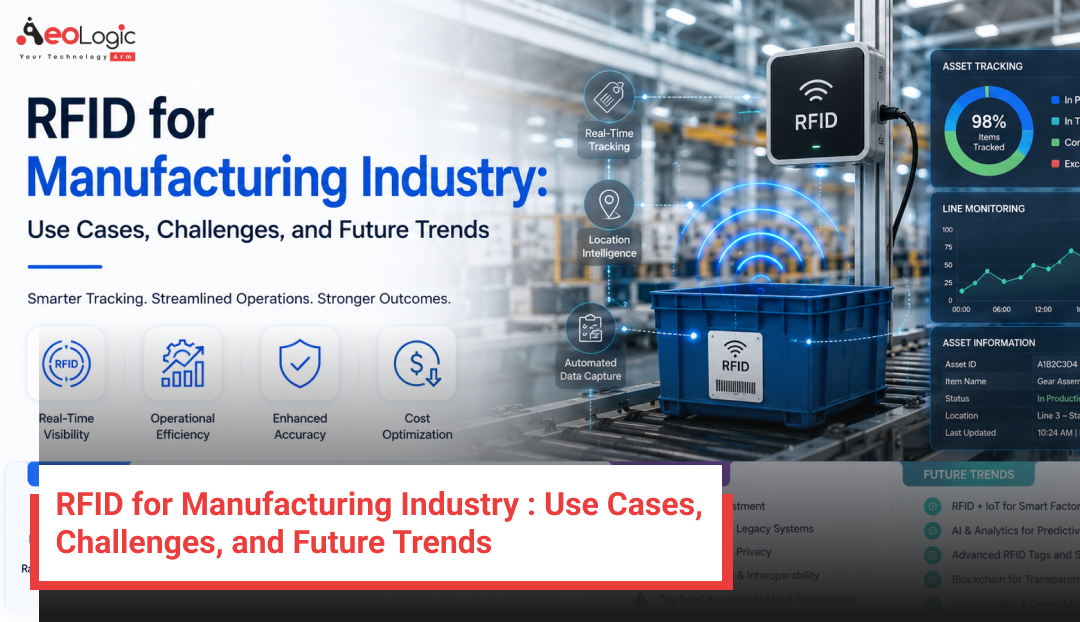
In the last ten years, manufacturing organizations have experienced a major shift in their processes, systems and technologies, primarily due to automation, digitalization and the demand for real-time process visibility. Manufacturers are no longer just looking to increase their output, but they are also looking to improve their inefficiencies, accuracy of inventory, product traceability, and resilience of their supply chains. However, in this ever-changing environment, RFID for Manufacturing Industry has become a potent tool that assists businesses to optimize their processes and make better decisions by automating tracking and data gathering.
The traditional production process requires manual records and barcode systems and is often disconnected. These techniques can cause delays, make human error more common and reduce the visibility throughout the production space. Competition is growing and customer demands are increasing, so manufacturers need intelligent systems that can provide information instantaneously on materials, products, assets and production stages. To overcome these issues, RFID technology is being developed to enable automatic identification and real-time tracking without the need for direct line of sight scanning.
This article explores how RFID works in manufacturing environments, its practical use cases, implementation strategies, challenges, business benefits, and future trends shaping industrial operations.
What is RFID in Manufacturing?
Radio Frequency Identification (RFID) is an automatic identification, monitoring and tracking technology employing radio waves. Typical components of a system are tags, readers, antennas, and software to gather and analyze data. While bar code systems need to be scanned directly, RFID can help locate multiple items at the same time and at a distance.
A tag is attached to raw materials, finished goods, machinery, pallets, containers, tools or equipment to provide for continuous tracking and identification in the RFID for Manufacturing Industry. These tags contain a digital information which is recorded by RFID readers deployed in manufacturing plants. The data gathered is then synced with enterprise software like ERP systems, Manufacturing Execution Systems (MES), or Warehouse Management Systems (WMS), and streamlines the efficiency, accuracy, and visibility of manufacturing processes.
This creates a unified system that provides manufacturers with immediate access to production processes, stock flow, machines and equipment usage, and operational efficiency. This ability facilitates quicker decision-making, minimises manual effort, and optimises production workflows.
Why Manufacturing Companies Need RFID Today?
Manufacturing companies are under greater pressure to increase their speed of operation, keep quality constant and keep costs low. Operational visibility is more crucial than ever before because of disruptions in the supply chain, changing demand, and labor issues.
Many factories continue to struggle with inaccurate inventory records, misplaced tools, delayed production schedules, and inefficient asset utilization. These problems can not only reduce productivity, but also the profitability and satisfaction of the customer. If tracking systems aren’t in place, bottlenecks are hard to detect and disruptions are hard to act upon.
RFID helps solve these problems by enabling continuous monitoring of products, materials, and assets throughout manufacturing operations. The solution to these problems is provided by the RFID, which allows to monitor the products, materials and assets during manufacturing operations.
Traceability needs are even greater in highly regulated sectors like food processing, aerospace, automotive manufacturing, and pharmaceuticals. The monitoring of products all the way from the start to the end of their lifecycle enables compliance and improves quality control procedures.
RFID for Manufacturing Industry: How the Technology Works
It is crucial to know how RFID works in order to successfully implement it. From an outside-in view, it might seem like a basic technology, but the effectiveness of the technology relies on the interaction between various components in manufacturing environments.
RFID tags are basically identification tags that are affixed to physical objects. These tags contain a microchip with information on products, serial numbers, batch information, location, maintenance information, or anything else. Organizations can employ passive, active, or semi-passive RFID.
The tags are activated by the radio signals sent by readers and then they retrieve information stored on the tag. This information is then collected and fed into software systems for analysis and incorporation into existing processes. RPD systems are increasingly integrated into modern manufacturing facilities, accessible via analytics platforms and cloud-based systems, allowing for enhanced reporting and predictive insights.
The continuous exchange of information creates transparency across operations. Production managers can know where materials are, how production goes, how equipment is used and identify abnormalities before they grow into real issues.
Types of RFID Systems Used in Manufacturing Operations
The complexity and environment of manufacturing operations, and the varying types of tracking required each call for a different type of RFID technology. Choosing the appropriate technology is crucial to successfully deploy RFID in the Manufacturing Industry due to the production workflow, tracking distance, environment and specific operational objectives.
Passive RFID systems are those that do not have internal batteries. The present “passive” tags require energy from the RFID reader to be activated and are popular due to their cost-effectiveness and applicability to inventory management systems. Passive tags are frequently used by manufacturers to monitor inventory in warehouses and for supply chain transparency.
Active RFID systems include a battery and continuously transmit signals over longer distances. In RFID for Manufacturing Industry, these systems are particularly useful for tracking high-value assets, large equipment, and containers across extensive industrial facilities, helping manufacturers improve visibility, asset utilization, and operational efficiency.
Semi-passive RFID features both passive and active RFID -based characteristics. These tags are engineered to provide enhanced performance in certain applications that demand extra reliability.
Choosing the right RFID system can impact the effectiveness of the implementation and its return on investment.
 RFID for Manufacturing Industry: Major Use Cases Across Production Environments
It is clear that RFID has real world applications in manufacturing operations for its practical value. Growing use of RFID for increased visibility and automating mundane functions.
Inventory Management and Stock Accuracy
One of the most frequent issues in manufacturing is inaccuracies in inventory. Manual counting methods are time consuming and can often result in inaccuracies between actual and recorded stock. The inaccuracy may lead to overstocking, stock shortages, delay in production or rising costs.
RFID revolutionizes inventory management, making it possible to automatically track raw materials, components and finished goods. Manufacturers have real-time insights into stock levels, without relying solely on manual checks. Stock is updated regularly, which contributes to better stock forecasting and minimizes delays in operating.
Better inventory accuracy helps maintain optimal production schedules and reduces waste due to over- or under-purchasing.
Production Tracking and Work-in-Progress Monitoring
It is difficult for manufacturers to follow a product from one stage of manufacturing to the next, particularly when they have partially completed products. Low visibility makes it difficult to identify bottlenecks, or to understand what is causing delays.
RFID technology allows monitoring products throughout production processes. Managers know at a glance where products are, which stage has been finalized and have an immediate insight into the inefficiencies.
Asset Tracking and Equipment Management
Expensive tools, mobile assets, and machinery are essential in factories to maintain smooth operations and production efficiency. In the context of the RFID for Manufacturing Industry, real-time asset tracking helps manufacturers monitor equipment movement, utilization, and availability across production facilities. Equipment failures, misplaced assets, and underutilized resources can significantly impact productivity, increase operational costs, and cause delays in manufacturing processes. By enabling continuous visibility into asset performance, RFID technology helps businesses improve maintenance planning, optimize resource allocation, and reduce unexpected downtime.
Using RFID, organizations can gain real-time visibility of the asset in the facility and gain insight into how assets are being used to prevent losses. Using monitoring to optimize maintenance schedules is also possible.
Supply Chain Visibility and Traceability
The modern manufacturing supply chain is complicated and interwoven. Reduces visibility which makes it more vulnerable to disruption and delay.
By tracking movements at the sourcing, manufacturing, storage, and distribution points, RFID helps to boost traceability. For manufacturers, recalls and compliance investigations can be done rapidly and easily with the ability to identify affected products.
Quality Assurance and Compliance Management
For manufacturers in regulated industries, it is imperative to maintain quality standards. Production errors can lead to losses of money, time and reputation.
Being able to quickly trace the defect allows for quicker corrective action.
Real-World Industry Examples of RFID Adoption
The automotive industry is one of the first industries to embrace RFID technology. Thousands of parts are passing along assembly lines in a vehicle manufacturing process. RFID can track with high accuracy, and minimize assembly errors.
Improved traceability is invaluable to product authenticity and patient safety. Greater clarity helps to minimize mistakes and ensure production planning is efficient.
The use of RFID for food contamination tracking, supply chain transparency and expiration monitoring is rampant among food processing companies. Traceability is crucial in a product recall scenario.
These are just a few examples of how RFID can provide measurable operational improvements in industry.
Step-by-Step Strategy for Implementing RFID in Manufacturing
Step 1: Define Clear Operational Objectives
The first step in successful implementation is to grasp business objectives. Manufacturing companies should pinpoint the areas that need enhancement, like inaccurate inventories, manufacturing delays, or ineffectiveness in asset tracking.
Organizations can clearly define objectives to prioritize the implementation, define expected outcomes, and assess the overall success of the implementation of RFID for Manufacturing Industry.
Step 2: Evaluate Existing Infrastructure
Manufacturers need to evaluate existing ERP solutions, warehouse operations, and workflows prior to deployment. One of the factors that can impact the success of an RFID project is the compatibility with existing infrastructure.
Infrastructure evaluations enable identification of integration needs early on.
Step 3: Select Suitable RFID Technology
Choosing appropriate tags, readers, and software platforms depends on tracking distance, environmental conditions, asset types, and budget considerations.
The choice of technology should be based on both the existing needs and future growth.
Step 4: Conduct Pilot Projects
Pilot testing can be used to test system performance in a controlled setting prior to enterprise-wide deployment.
Testing can help uncover operational problems and minimize implementation risk.
Step 5: Integrate RFID With Enterprise Systems
Seamless ERP integration, manufacturing execution system and analytics tools deliver maximum value generation.
Step 6: Train Employees and Optimize Processes
Workforce readiness is essential to the adoption of technology. Staff needs to be aware of new workflows and changes in operation.
Adoption increases and resistance decreases with training.
Business Benefits of RFID for Manufacturing Industry Adoption
Real-time visibility allows for quicker decision-making, as managers are able to access accurate information in real time.
Automation streamlines manual tasks, reduces the burden on administration and helps cut down on human error. Greater accuracy in inventory helps to ensure better procurement planning and lower inventory carrying costs.
Improved traceability increases the compliance management and quality assurance. The more efficient the business is, the easier it is to identify and fix production bottlenecks.
Manufacturers are able to maintain products to a higher standard, and react quicker to any disruptions, leading to increased customer satisfaction.
Gradually, these enhancements collectively result in higher competitiveness and profitability.
Common Challenges in RFID Implementation
Some manufacturers still have concerns about the initial investment costs. Costs can be for hardware, software, integration, infrastructure upgrades, and employee training.
Another obstacle is the complexity of the integration, especially for companies with older systems. Limited effectiveness due to poor compatibility of implementation.
In order to take information and convert it into insight, manufacturers need strong analytics tools.
Last, but not least, employee reluctance to change their operations can make the process of adoption slow. Addressing these concerns is through effective communication and training.
Best Practices for Successful RFID for Manufacturing Industry Implementation
Manufacturers achieve better outcomes when RFID implementation aligns with broader business strategies rather than isolated technology initiatives.
Beginning with pilot programs reduces deployment risk while supporting gradual optimization. Choosing scalable solutions ensures long-term flexibility as operational requirements evolve.
Cross-department collaboration improves adoption because production, logistics, IT, and management teams work toward shared objectives.
Continuous performance monitoring helps organizations refine processes and maximize return on investment after deployment.
Cybersecurity planning also becomes increasingly important as connected manufacturing ecosystems expand.
The Role of RFID in Industry 4.0 and Smart Manufacturing
Industry 4.0 represents a shift toward intelligent, connected manufacturing ecosystems powered by automation, IoT, artificial intelligence, and advanced analytics. In this transformation, RFID for Manufacturing Industry plays a crucial role by enabling real-time visibility, automated tracking, and seamless data exchange across production environments, helping manufacturers build smarter and more efficient operations.
RFID plays an important role within this transformation by generating real-time operational data. When integrated with AI systems, RFID information can support predictive maintenance and improve resource allocation.
IoT connectivity enables machines and systems to communicate automatically, while cloud platforms improve scalability and accessibility.
The combination of RFID, AI, and IoT creates manufacturing environments capable of autonomous monitoring and data-driven optimization.
Smart factories increasingly depend on these integrated technologies to remain competitive.
Future Trends Shaping RFID for Manufacturing Industry
The future of RFID in manufacturing is closely tied to broader digital transformation initiatives.
Artificial intelligence will continue improving how RFID-generated data is analyzed, enabling predictive insights and proactive decision-making. Manufacturers may increasingly identify disruptions before they affect operations.
Digital twin technology represents another emerging trend. Virtual representations of manufacturing environments become more accurate when supported by real-time RFID data.
Edge computing adoption may improve response speed by processing information closer to operational environments.
Sustainability goals will likely influence RFID implementation as manufacturers seek better resource utilization and waste reduction.
Conclusion
The manufacturing industry is steadily moving toward connected, intelligent, and data-driven operations where visibility and automation determine competitiveness. Technologies capable of improving traceability, reducing inefficiencies, and strengthening operational control are becoming essential rather than optional. RFID for Manufacturing Industry continues to play a crucial role in this transformation by enabling real-time tracking, improved inventory accuracy, stronger compliance management, and smarter production environments.
As manufacturing ecosystems evolve alongside Industry 4.0, AI, and Industrial IoT, RFID adoption is expected to accelerate further. Organizations seeking long-term operational efficiency should evaluate RFID implementation as part of broader digital transformation initiatives. Choosing the right RFID Solutions Company in India can help manufacturers improve asset visibility, inventory accuracy, and operational control. Aeologic Technologies provides advanced automation and tracking solutions designed to support smarter and more efficient industrial operations.
People Also Ask (FAQs)
Q1. What is RFID technology in manufacturing?
RFID technology in manufacturing refers to the use of radio frequency identification systems to track products, materials, equipment, and inventory automatically. The technology allows manufacturers to collect real-time information without manual scanning or direct visibility requirements. RFID improves operational transparency, reduces errors, and supports faster decision-making across production processes.
Q2. How does RFID improve inventory management?
RFID improves inventory management by enabling continuous tracking of materials and finished goods. Manufacturers gain instant visibility into stock levels, reducing manual counting processes and minimizing discrepancies. Better inventory accuracy supports efficient procurement planning and lowers operational costs.
Q3. Is RFID suitable for small manufacturing businesses?
Yes, RFID can benefit small manufacturers depending on operational requirements and implementation scale. Pilot projects allow businesses to evaluate value before full deployment. Long-term savings through improved efficiency often offset initial investment costs.
Q4. What industries use RFID most frequently?
Automotive, pharmaceuticals, aerospace, electronics, food processing, logistics, and industrial manufacturing sectors commonly use RFID because of their need for traceability and operational visibility.
Q5. Can RFID integrate with ERP systems?
Modern RFID platforms often integrate with ERP, MES, and warehouse management systems. Integration improves workflow automation and converts operational data into actionable insights.
Q6. Does RFID support predictive maintenance?
Yes. RFID tracking helps monitor equipment usage patterns and maintenance histories. Combined with AI analytics, this information supports predictive maintenance strategies aimed at reducing downtime.

Currently, as a Senior Manager of Technology, I oversee a dynamic team, ensuring the delivery of high-quality software solutions that meet the evolving needs of our clients. A seasoned technology leader with over a decade of experience in the software development industry, I have been instrumental in driving the end-to-end software development lifecycle since my career inception in 2011.