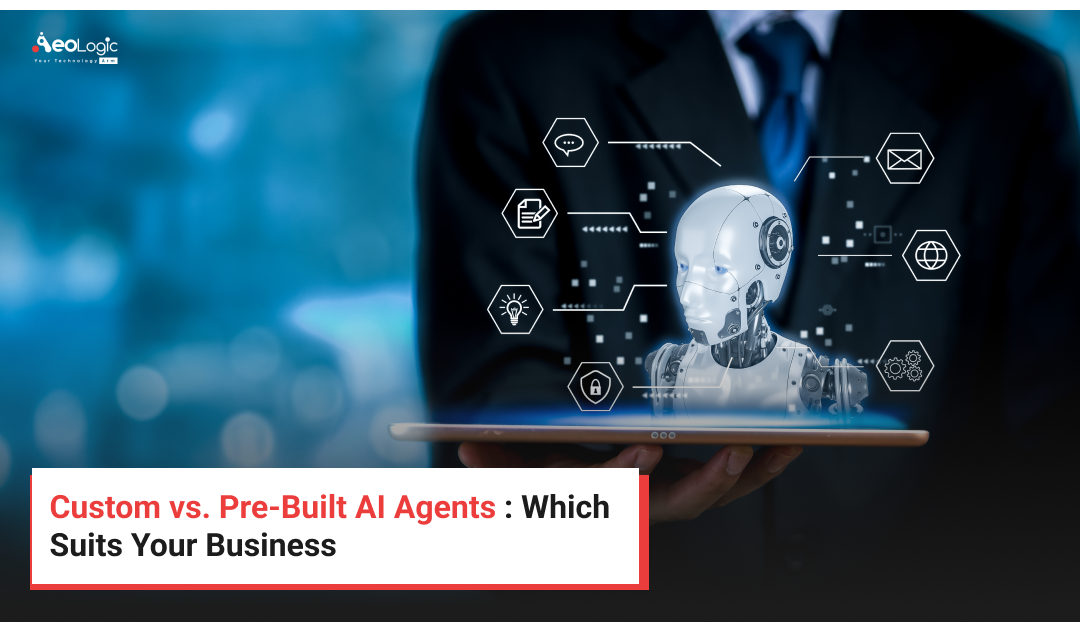
AI has gone from science fiction to a business application that can automate tasks, enhance customer experiences and enable data-informed decisions. One of the most recent innovations is the introduction of AI agents, which are revolutionizing the way businesses handle repetitive tasks, customer support, information handling, and operations. As more organizations adopt AI-powered solutions, one question consistently arises: Custom vs. Pre-Built AI Agents—which option is the right fit for your business?
It all depends on your organizations objectives, technology infrastructure, budget, need for scale, and long-term digital transformation plans.
This guide explores Custom vs. Pre-Built AI Agents, explaining their differences, advantages, limitations, and ideal use cases to help businesses make an informed investment decision.
Understanding AI Agents
AI agents are programs that can execute tasks, make decisions, and communicate with humans, albeit with limited human involvement. In contrast to traditional automation methods that rely on a rigid set of rules, AI agents possess the ability to comprehend the context, learn from exchanges, analyze data, and perform complicated workflows.
AI agents utilize modern technologies like NLP, machine learning, large language models, workflow automation, and enterprise integration. They can interact with the user, fetch data, create reports, automate business processes, and even coordinate with several different software.
Businesses across healthcare, finance, retail, logistics, manufacturing, education, and customer service are increasingly using AI agents to improve operational efficiency and reduce manual workloads.
What are Pre-Built AI Agents?
Pre-built AI agents are ready-to-use AI solutions developed for common business functions. Most of the times, these AI agents handle tasks like customer support, appointment scheduling, document summarization, drafting emails, lead qualification, HR support, and knowledge management. Organizations can deploy them quickly using cloud-based platforms and begin automating routine operations within days instead of months.
The architecture, workflows and integrations are pre-built, so businesses typically set them up, but don’t create a new solution.
Advantages of Pre-Built AI Agents
One of the quickest routes to AI adoption is to use pre-built AI agents. They can be set into use right away, without going through long development periods. This is especially appealing for startups and small businesses who are keen to try out AI but don’t want to risk implementation.
They also need reduced initial capital investment as the development expenses are distributed among several customers. The solution provider typically handles updates, maintenance and security upgrades, alleviating the burden on the internal IT team.
The other one is the ease of deployment. The majority of platforms have intuitive interfaces, enabling workflows to be set up without complex coding by non-technical teams.
Limitations of Pre-Built AI Agents
While they are easy to use, pre-built AI agents may not be as adaptable to companies with specific business needs. They are designed for general use cases, and might not completely match with specialized workflows, compliance, or industry-specific processes.
Pre-packaged features are generally not available. Businesses may have to change their processes to suit the software and not the other way around.
Compatibility with existing enterprise applications can also pose problems, particularly if using a proprietary database or a custom application.
What are Custom AI Agents?
The customization of AI agents is focused on an organization’s business processes, goals, and technology environment. Rather than coding, businesses develop AI agents that seamlessly fit their processes, data sources, compliance needs, and customer requirements.
The solutions are developed based on the analysis of operational issues, opportunities for automation and the design of smart work processes according to the needs of the business.
Custom AI agents can be connected to various ERP, CRM, inventory, HR, financial, IoT, knowledge base, and proprietary databases to deliver highly personalized automation experiences.
Advantages of Custom AI Agents
The top benefit of custom AI agents is their versatility. Without disrupting processes, organizations have the flexibility to tailor each and every part of the AI system to their business needs.
They also provide much greater accuracy as the AI is trained on business data, language, processes and business rules. This allows for improved decision-making and more appropriate responses.
Quality AI agents can be applied to more complex automation scenarios that aren’t well suited to generic solutions. They can collaborate across various departments, perform multiple-step business flows and make intelligent suggestions with internal data.
Custom AI agents can be scaled up as organizations grow and adapt to changing business needs, making them a strategic investment for the long term.
Limitations of Custom AI Agents
Developing custom AI agents requires greater investment in terms of time, expertise, and financial resources. AI businesses require seasoned AI developers, software architects, and domain specialists to guarantee its efficiency.
While maintenance offers more control, constant improvement, monitoring, security updates and optimization are still the responsibility of organizations.
 Custom vs. Pre-Built AI Agents: A Detailed Comparison
Development Time
However, pre-built AI agents may be deployed in days, as the solution may already be available. Businesses typically set up settings and link in necessary applications.
The development process for custom AI agents involves several stages, such as planning, requirement analysis, selecting the appropriate AI model, integrating the agent, testing, deployment, and optimization.
Cost
They are ideal for businesses that have a budget constraint or want to leverage AI for the first time.
Designing and developing custom AI agents can be more expensive and time-intensive, as it involves investing in the agent’s creation, rigorous testing, and deployment. They can create more long-term value, however, as they increase efficiency and minimize limitations on business operations.
Customization
One of the major contrasts between Custom vs. Pre-Built AI Agents is customization.
Pre-built solutions offer only limited configuration options, whereas custom AI agents can be fully tailored to support unique workflows, business rules, branding, user experiences, and enterprise processes.
Scalability
Business needs grow and get more complex as businesses grow.
The pre-built AI agents could eventually become less effective, leading to the need for organizations to use other software or move to custom options.
Integration Capabilities
Many companies are already utilizing various applications in their businesses such as CRM platforms, ERP applications, accounting software, inventory management software, cloud-based applications, and communication platforms.
Typical pre-built AI agents are available via common APIs with popular third-party apps.
Custom AI agents can integrate with virtually any enterprise software, proprietary platform, or internal database, providing significantly greater operational flexibility.
Security and Compliance
For regulated industries, data privacy and cybersecurity and data governance can be critical compliance areas.
Custom AI agents provide enhanced security configuration, access controls, encryption, data residency, and compliance regulations.
Pre-built AI agents operate under the company’s security policy, which may not meet some of the industry regulatory requirements.
Which Businesses Should Choose Pre-Built AI Agents?
For small businesses, startups, and organizations starting their AI initiative, pre-built AI agents are perfect.
Any enterprise wishing for a significant productivity boost without large development fees is able to use this service to achieve critical gains with the automation of customer support, internal documentation, appointment managing, email managing, or FAQ solutions.
For businesses with streamlined processes and fewer integration needs, pre-built AI solutions often meet their requirements.
Which Businesses Should Choose Custom AI Agents?
Large enterprises, rapidly growing organizations, and businesses with specialized workflows usually gain greater value from custom AI agents.
For organizations that are responsible for the most sensitive customer data, complicated operations, multiple enterprise systems, or industry-specific compliance standards, AI solutions tailored to their infrastructure are essential.
Custom AI development can be a valuable investment for businesses aiming to gain competitive edge through intelligent automation, predictive analytics, workflow orchestration, and sophisticated decision support systems.
Key Factors to Consider Before Making Your Decision
While cost is a key factor, there are other strategic considerations to weigh before deciding between custom and pre-built AI agents.
Organizations should assess business objectives, workflow complexity, expected return on investment, future scalability, integration requirements, security expectations, available technical expertise, and implementation timelines.
It’s also crucial to take into account the future trajectory of AI in the organization over the coming few years. Often, the more value that a solution provides long-term for digital transformation, the more valuable it is to the business.
Future of AI Agents in Business
AI agents are becoming more independent, independent, and intelligent. In the future, AI systems are not just reactive to user requests but are proactive in solving problems, recommending solutions, automating complex processes, and continuously learning.
AI is now making its way into multi-agent ecosystems, in which specific AI agents work together in various business departments, including sales, customer support, finance, HR, logistics and operations. These smart systems will help businesses increase productivity and minimize human intervention.
AI agents, whether customized or ready-to-use, will get better as AI technology evolves. But companies looking for unique AI solutions that align with their long-term goals will have to invest more heavily.
Conclusion
The Custom vs. Pre-Built AI Agents debate is not a comparison of the best solution for your business, but a choice of the solution best suited for your business. For businesses looking to rapidly automate without a lengthy development process, pre-built AI agents are a cost-effective solution that is easy to implement.
However, custom AI agents offer unparalleled flexibility, scalability, and enhanced integrations and intelligent capabilities designed to enable sustained success and complex business operations. They are costly, but can provide more competitive benefits and more long-term profit.
Businesses planning to integrate AI into their digital transformation strategy should carefully evaluate operational complexity, future expansion plans, security requirements, and desired outcomes before selecting the right AI agent solution. Partnering with an experienced AI development company like Aeologic Technologies can help businesses implement the right solution that aligns with their unique requirements and long-term objectives. Making the right choice today can significantly influence operational efficiency, customer satisfaction, and business growth in the years ahead.
FAQs
Q1. What is the difference between Custom vs. Pre-Built AI Agents?
The main difference is that pre-built AI agents are ready-made solutions designed for common business tasks, while custom AI agents are developed specifically to match an organization’s unique workflows, business goals, and system integrations. Custom AI agents offer greater flexibility and scalability, whereas pre-built AI agents provide faster deployment at a lower initial cost.
Q2. Are custom AI agents better than pre-built AI agents?
Custom AI agents are generally better for businesses with complex operations, industry-specific requirements, or the need for deep integration with existing systems. Pre-built AI agents are ideal for organizations that want to implement AI quickly for standard use cases without significant development investment.
Q3. Which businesses should choose pre-built AI agents?
Startups, small businesses, and organizations looking to automate common tasks such as customer support, scheduling, document management, or employee assistance can benefit from pre-built AI agents. They are easy to deploy and require minimal technical expertise.
Q4. How much does it cost to build a custom AI agent?
The cost of developing a custom AI agent depends on factors such as business requirements, integrations, AI capabilities, security needs, and project complexity. While custom solutions require a higher upfront investment than pre-built AI agents, they often provide better long-term value through improved efficiency and business-specific automation.
Q5. How do I decide between Custom vs. Pre-Built AI Agents for my business?
The right choice depends on your business objectives, budget, workflow complexity, scalability requirements, and integration needs. If you need a quick and cost-effective solution, pre-built AI agents are a suitable option. If your organization requires tailored automation, advanced functionality, and long-term scalability, investing in a custom AI agent is the better choice.