
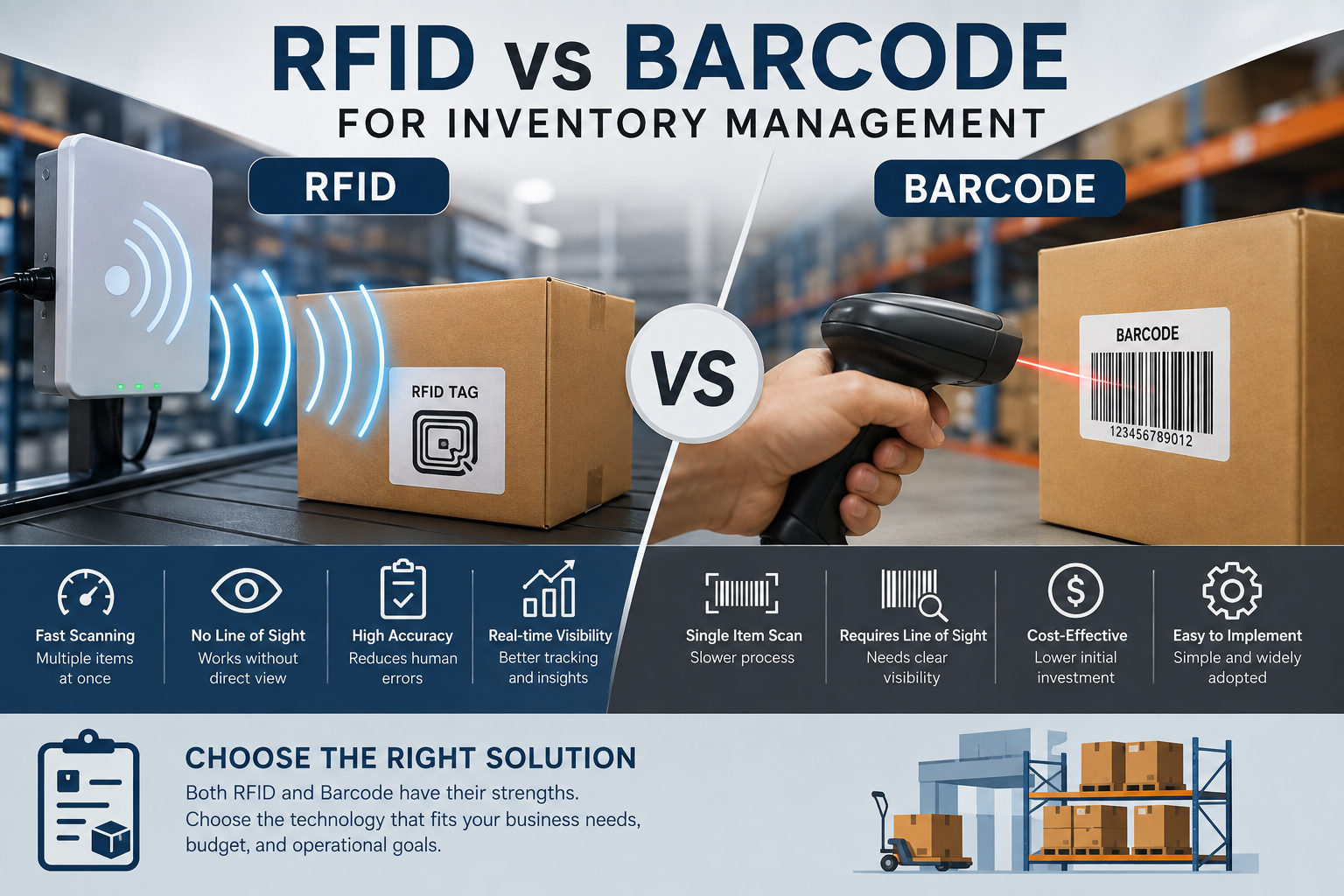
Managing inventory has become increasingly technology-focused as companies deal with bigger product inventories, quicker order turnaround, and increasingly complicated supply chains. The decision on an identification technology can have a direct influence on inventory accuracy, operational efficiency and time spent tracking products. This is primarily why the comparison of RFID vs Barcode for Inventory Management is becoming more crucial for businesses looking to optimize their inventory in 2026.
Barcodes have been around for years as a common way to identify inventory. They’re simple to put in place, inexpensive, and backed by nearly any inventory management system. With the need for more frequent inventory takings, more visibility and more automation, RFID is increasingly proving to be a better alternative to the traditional barcode system.
Understanding how these two technologies work, where they differ, and which one fits specific inventory requirements can help businesses make a more informed technology investment.
Understanding Barcode Inventory Management
Barcodes can be used to identify products, assets, packages or storage units via a printed or digitally generated code, known as barcode inventory management. The pattern on the label is scanned by a bar code scanner, and the identification data transmitted by the scanner is inputted to an inventory management program.
Traditional 1D Bar Codes use parallel lines and spaces to represent information, whereas 2D Bar Codes like QR Codes can fit more information into a smaller space. In the business world, barcode systems are widely used in logistics and distribution centers, manufacturing plants, retail outlets, and warehouses.
The most significant advantage of the barcode technology is its ease of use. A bar code is a relatively inexpensive label, scanners are readily available and employees can easily learn to use the equipment. Barcode systems can also be integrated into the existing inventory software, ERP platforms, warehouse management systems, and point-of-sale applications.
However, the typical method of scanning by bar code involves manually directing a worker or scanner to the bar code label for each one to scan. The scanner typically must be able to see the barcode, otherwise counting inventory is slower when a company is keeping thousands of items in stock.
Understanding RFID Inventory Management
The technique for tracking assets and products using radio frequency identification (RFID) is called RFID inventory management. The basic components of an RFID system are the RFID tags, the RFID readers, the RFID antennas, and the inventory management software.
The RFID tag consists of an electronic chip and antenna which can communicate with an RFID reader. The type of RFID system varies, and in some applications several tagged objects are detected at once, without the scanner having to see each individual tag.
This feature makes the RFID technology very useful for the warehouses, manufacturing facilities, healthcare organizations, retail stores, logistics organizations and others, where companies require real-time or near real-time visibility of their inventory.
RFID tags also can carry identification data which enables businesses to link a physical product with a digital record. Combined with inventory software, RFID can automatically keep inventory up to date when goods are received, stored, manufactured, shipped, and/or in other operational processes.
RFID vs Barcode for Inventory Management : Key Differences
The primary difference from RFID to bar code is the method used to capture inventory information. Barcodes are based on optical scanning and RFID is based on radio waves to identify tagged items.
The most common type of barcode system is one in which workers scan each item or package separately. This is suitable for a small amount of stock and when the products pass through a controlled scanning point. RFID can ID more than one tagged object within a reader’s range, making it better suited for where businesses are required to move through a lot of inventory in a short amount of time.
Line-of-sight requirements is another key difference. The majority of scanners require the printed code to be easily visible. Damage to the barcode, covering it, scanning it upside down, or if it is not easily accessible, may make scanning difficult. Most of the time, RFID does not need to be seen and does not depend on close range between the tag and the reader, although there may be environmental factors and placement of the tag that impacts performance.
RFID also offers a higher level of automation potential. RFID readers can be deployed around warehouse doors to automatically identify items passing through, as well as at conveyor belt systems, storage systems, or production lines. In contrast, most barcode systems require a human operator or scanner to initiate each scan. This makes RFID vs Barcode for Inventory Management an important consideration for businesses looking to reduce manual processes and improve inventory visibility.
Scanning Speed and Inventory Counting
One of the critical areas is inventory counting when comparing RFID and Barcode technology. With barcode stock count, the employee will have to scan the product one by one and record the location or quantity. This process can be time consuming if there are thousands or millions of items in the warehouse.
This can be greatly improved by RFID as multiple tags can be detected within the reading range of the reader. Depending on system design and warehouse environment, employees have the potential to perform inventory counts with less manual scanning.
This is especially important for companies that are doing regular cycle counts. RFID vs Barcode for Inventory Management can be an important consideration when choosing a faster and more efficient counting approach. Accelerated counting can lead to minimal disruptions to the operation and enable staff to allocate more time to higher-value activities at the warehouse.
However, RFID does not automatically make every inventory operation faster. System configuration, reader placement, tag orientation, interference, product materials, and warehouse layout can influence performance. Businesses need to design the RFID infrastructure according to their operational environment.
 Inventory Accuracy and Visibility
Another key issue in the RFID vs Barcode for Inventory Management debate is inventory accuracy. If employees scan items consistently at the appropriate locations, then the barcode systems can keep accurate inventory records. But the non-scan situation can lead to discrepancy between physical and system counts.
Using RFID to automatically track item movements can help to decrease the need for manual scanning. But with proper execution, the RFID system can give businesses more frequent inventory updates and a more accurate idea of where tagged items are at.
This is particularly advantageous for high-cost items, movable containers, work-in-progress materials and products that go through several stages of operation.
Cost Comparison Between RFID and Barcode
One of the major reasons why businesses are continuing to use barcodes is because of their cost. Barcode labels are cheap and simple barcode scanners are not very costly. Businesses can implement a barcode inventory system without having to invest in an extensive infrastructure.
RFID typically requires a larger initial investment because organizations may need RFID tags, fixed or handheld readers, antennas, middleware, software integration, and installation services. The total cost depends on the scale and complexity of the deployment.
A comparison looking just at the up-front technology costs, however, is not complete. Another factor businesses need to take into account is the labor expenses, the time it takes to count stock, potential stock discrepancies, asset loss, operational delays, and the value of increased visibility.
Barcode technology could still offer a great return on investment for smaller enterprises where inventory management is simple. RFID vs Barcode for Inventory Management becomes a more important consideration for larger organizations with extensive inventories and greater manual tracking needs, where RFID might prove more valuable in the long run.
RFID vs Barcode for Warehouse Operations
In the warehouses, businesses usually have to receive, store, locate, pick, pack and ship a huge amount of products on a daily basis. With the proper organization of scanning operations, barcode systems can assist in these operations very effectively.
For instance, warehouse staff can scan a product when receiving it, scan the storage area, and scan again when picking and shipping. This forms a digital history of the movement of inventory.
RFID can automate several of these interactions. Readers placed at specific points in the warehouse can read tags as the products are moving through them. Handheld RFID readers can also aid the workers to find products tagged or to conduct faster stock counting.
Thus, RFID can help in enhancing automation and visibility in large warehouses. Barcode technology is still viable where the number of products, the amount of labour and tracking complexity are not worth the investment in an RFID system.
RFID vs Barcode in Retail Inventory
Retail businesses are constantly grappling with issues of stock availability, misplaced items, shrinkage, and high inventory turnover. Barcode systems are still in use today for identifying products and for checkout purposes due to their low cost and uniformity. But, RFID vs Barcode for Inventory Management can offer retailers faster inventory counts, better item-level visibility and automation of store and warehouse operations.
Another benefit of a RFID technology is that it can add value to the products by allowing retailers to count the products faster and identify individual items. Employees can scan large groups of products without manually handling each item, which can improve shelf availability and reduce the time required for stock audits.
RFID can also assist the omnichannel retail function by enhancing the visibility on the store inventories. Effective stock accuracy can contribute to a more robust replenishment strategy, online order fulfillment and product availability.
RFID vs Barcode in Manufacturing
Manufacturing companies need to track raw materials, components, work-in-progress items, finished products, and sometimes reusable equipment. When products are passing through a defined checkpoint, barcode systems can offer accurate tracking.
RFID can provide more automation, by tracking the movement of the product through the production process. Manufacturers can associate RFID tags with production orders, components, tools, or finished products and use the collected data to improve traceability.
This can be especially valuable when products move frequently between workstations or when manual scanning creates delays. RFID vs Barcode for Inventory Management is an important consideration for businesses looking to improve inventory visibility, accuracy, and operational efficiency.
Durability and Environmental Considerations
Dirt, moisture, scratching, fading or physical damage can occur on the barcode label. If the printed code becomes unreadable, employees may need to manually enter information or replace the label.
The specialized radio frequency identification (RFID) tags can withstand certain levels of heat, moisture, chemicals, impact and outdoor exposure. This makes RFID ideal for use in industrial assets and re-usable equipment tracking in challenging conditions.
The correct technology still depends on the application. RFID tags are not universally resistant to every environmental condition, and businesses should select tags based on temperature, materials, operating conditions, and expected lifespan.
Which Technology Should Businesses Choose in 2026?
There is no universal winner in the RFID vs Barcode for Inventory Management comparison. The decision will depend on the volume of the inventory, the complexity of the operations, the necessity of tracking, budget and automation levels required by the business.
For those seeking a simple and budget-friendly identification method, barcode technology is still a viable choice for companies. It works well in smaller warehouses, retail settings, simple inventory management systems, and systems that do not require manual scanning to cause significant delays.
RFID becomes more appealing when businesses require a faster inventory count, automated identification, item level tracking, visibility and less manual involvement. Companies with high value items like in the health care sector, retail, or logistics, and large warehouses can benefit greatly from the RFID application.
Future of RFID and Barcode Inventory Management
In the future of inventory in 2026, the trend is towards automation, connected systems, and operational visibility in real time. A key reason for the potential of RFID vs Barcode for Inventory Management is the fact that it can capture item-level information to help automate inventory processes.
However, barcode technology will continue to be a viable solution due to its low cost, ease of use, universal nature and ability to fit into current enterprise systems. Improvements in 2D barcodes and mobile scanning will continue to make barcode-based inventory processes more capable.
The future is therefore unlikely to be about completely replacing barcodes with RFID. Instead, businesses will be picking the identification technology that is most suitable for each operational need.
Conclusion
The RFID vs Barcode for Inventory Management decision in 2026 should be based on business requirements rather than simply choosing the newer technology. Barcodes continue to offer affordability, simplicity, and reliable performance for many inventory operations, while RFID provides greater automation, faster identification, and improved visibility for more complex environments.
Businesses managing large inventories or frequent stock movements should evaluate the time spent on manual scanning, inventory counting, reconciliation, and asset tracking. If these activities create significant operational costs, RFID may offer measurable advantages. Aeologic Technologies helps businesses implement RFID-based inventory solutions to improve tracking, visibility, and operational efficiency. For organizations with simpler requirements and limited budgets, barcode technology can remain an efficient and practical solution.
Frequently Asked Questions
Q1. What is the difference between RFID and barcode inventory management?
RFID uses radio frequency technology to identify and track items, while barcode systems use optical scanning to read printed codes. RFID can identify multiple tagged items without direct line-of-sight, whereas barcodes generally require individual scanning.
Q2. Is RFID better than barcode for inventory management?
RFID can be better for businesses that manage large inventories and need faster counting, automated tracking, and improved inventory visibility. Barcodes remain a practical choice for businesses looking for a cost-effective and simple inventory management solution.
Q3. Which is more cost-effective, RFID or barcode?
Barcodes generally have a lower initial implementation cost because labels and scanners are inexpensive. RFID requires a higher upfront investment in tags, readers, software, and infrastructure, but it can provide long-term savings through automation and reduced manual inventory work.
Q4. Can RFID and barcode systems be used together?
Yes, businesses can use RFID and barcode systems together. A hybrid approach allows organizations to continue using barcodes for suitable processes while introducing RFID for applications that require automated identification, faster inventory counting, or item-level tracking.
Q5. Which technology should businesses choose for inventory management in 2026?
The right choice depends on inventory volume, operational complexity, budget, and tracking requirements. Barcodes are suitable for simpler and cost-sensitive operations, while RFID is a strong option for businesses requiring greater automation, real-time visibility, and faster inventory management.

I’m a Software Developer with 9 years of experience building scalable web and mobile applications. Currently focused on React.js and React Native, I specialize in creating high-performance, user-friendly interfaces that drive business outcomes.
My background spans cross-platform development using Flutter, and native Android development, giving me a strong understanding of the entire mobile ecosystem. I’ve contributed to products in EdTech, Healthcare, and Enterprise SaaS—helping scale apps to 100K+ users and improving performance, reliability, and user engagement.
I’m passionate about clean architecture, modular design, and seamless user experiences. Whether it’s setting up robust state management with Redux Toolkit, optimizing API integrations with GraphQL/REST, or automating workflows with CI/CD pipelines (GitHub Actions)—I focus on writing maintainable code and delivering value to both users and stakeholders.