Food spoilage quietly drains profit out of the supply chain every single day. A truck runs a few degrees too warm for an hour, a pallet sits too long on a loading dock, or a shipment arrives with no clear record of where it’s been — and perfectly good inventory ends up in the trash. A Perishable Food RFID Traceability System built on IoT sensors exists to close that gap. Instead of relying on paper logs and spot checks, it gives food businesses a continuous, verifiable record of where a product is, how it’s been handled, and whether it’s still safe to sell.
This guide breaks down how a Perishable Food RFID Traceability System actually works, why demand for it is accelerating across the food industry, and how a team can plan a rollout that actually sticks instead of collecting dust after the pilot phase.
What is a Perishable Food RFID Traceability System?
A Perishable Food RFID Traceability System is a food safety and logistics solution that combines RFID tags, IoT sensors, and cloud software to track perishable goods — such as produce, dairy, meat, and seafood — from farm to shelf. It automatically records location, temperature, humidity, and handling events, replacing manual logbooks with continuous, verifiable data.
Unlike a simple barcode sticker that only confirms a product existed at a scan point, RFID tags can be read in bulk, without line-of-sight, and often continuously. Add an IoT sensor layer — temperature probes, humidity sensors, shock detectors — and the system stops being a tracking tool and becomes a monitoring tool. It doesn’t just say where a pallet of chicken breasts is; it says whether that pallet has stayed within a safe temperature band the entire time it’s been in transit.
 Why Perishable Food Businesses Need Real-Time Traceability
Interest in a Perishable Food RFID Traceability System has grown quickly, and it isn’t a passing trend. A few forces are pushing adoption at the same time.
Rising Food Safety Regulations
Regulators in most major markets are moving toward faster, more granular traceability requirements for high-risk foods. Rules like the FDA’s food traceability requirements in the United States ask companies to keep detailed records — harvest date, lot codes, transformation events, and shipping data — and to produce them quickly when asked. Manual recordkeeping struggles to meet that bar. A digital system built around RFID and IoT sensors captures this data automatically as products move, so it’s already there when a regulator or auditor asks for it.
Consumer Demand for Transparency
Shoppers increasingly want to know where their food came from, not just what’s printed on the label. Retailers and brands that can answer “where did this come from and how was it handled” build more trust than those who can’t. A traceability system gives marketing and customer service teams real answers instead of guesses.
Reducing Spoilage and Shrinkage
Perishable inventory is unforgiving. A short cold chain break can turn a profitable shipment into a total write-off. Continuous monitoring catches temperature excursions early — sometimes in time to reroute or re-ice a shipment before the product is ruined, and always in time to understand exactly where the failure happened so it doesn’t repeat.
How a Perishable Food RFID Traceability System Works with IoT Sensors
A Perishable Food RFID Traceability System is really a stack of several technologies working together rather than one single device. Here’s how the pieces fit.
RFID Tags and Readers
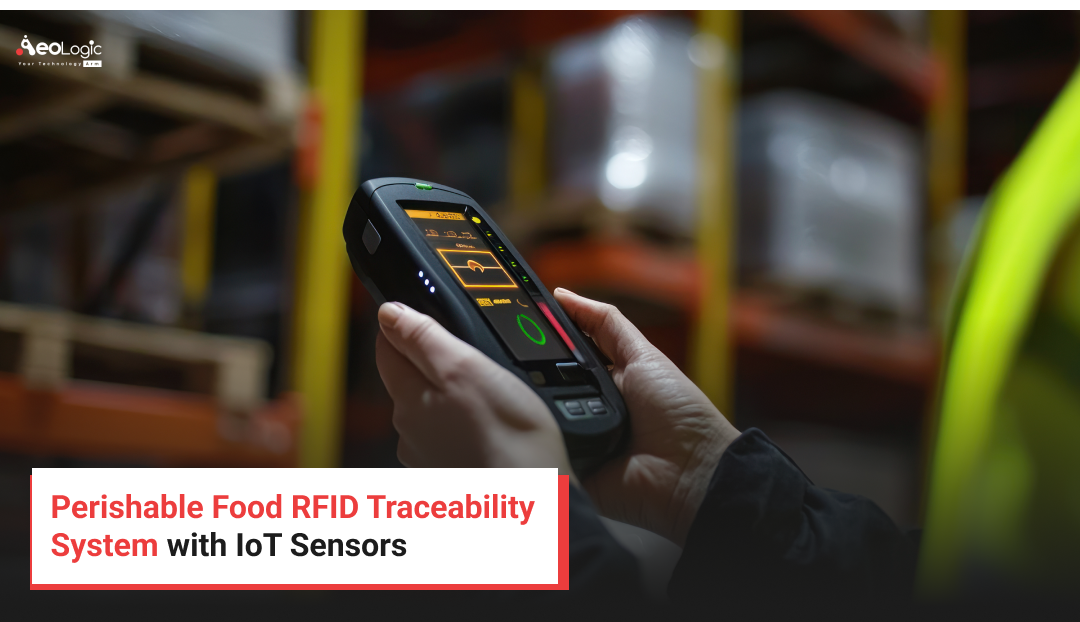
Each case, pallet, or individual item is tagged with a passive or active RFID chip carrying a unique identifier. Fixed readers at dock doors, conveyor lines, and storage racks — plus handheld readers for spot checks — scan these tags automatically as goods move through a facility, without needing a worker to scan each barcode by hand.
IoT Temperature, Humidity, and Shock Sensors
Battery-powered IoT sensors are placed inside trailers, containers, and cold storage units. They continuously measure temperature, humidity, and sometimes vibration or shock, and transmit readings over cellular, Wi-Fi, or low-power wide-area networks (LPWAN) at set intervals.
Edge Gateways and Cloud Dashboards
Gateways collect data from RFID readers and IoT sensors on-site, then relay it to a cloud platform. There, the data is matched to specific lots and shipments, checked against safety thresholds, and displayed on dashboards that supply chain, quality, and food safety teams can monitor in real time.
| Layer | What It Does | Example |
|---|---|---|
| RFID tags & readers | Identify and locate items automatically | Case-level RFID tags scanned at a dock door |
| IoT sensors | Monitor temperature, humidity, shock | A sensor inside a reefer trailer logging temperature every 5 minutes |
| Connectivity | Moves sensor and tag data to the cloud | Cellular, Wi-Fi, LPWAN (LoRaWAN, NB-IoT) |
| Cloud platform | Stores, analyzes, and visualizes data | Dashboard showing a shipment’s temperature history |
| Alerts & rules engine | Flags problems automatically | Notification when a pallet exceeds 40°F for over 15 minutes |
Automated Alerts
When a sensor reading crosses a safety threshold, the platform can automatically notify a quality manager, flag the affected lot, and log the event for compliance records — long before the shipment reaches its destination.
Key Benefits of an RFID Traceability System for Perishable Foods
- Fewer spoilage losses — early detection of temperature excursions means faster corrective action.
- Faster, narrower recalls — if a problem is found, teams can trace exactly which lots and locations are affected instead of pulling entire product lines.
- Easier regulatory compliance — traceability records are generated automatically and are audit-ready.
- Better cold chain visibility — everyone from the warehouse floor to the executive team can see shipment status in real time.
- Lower labor costs — bulk, no-line-of-sight RFID scanning replaces slow manual barcode scanning.
- Stronger customer and retailer trust — verifiable handling data supports quality claims and partner audits.
- More accurate inventory — automated tracking reduces the shrinkage and miscounts common with manual logs.
- Reduced theft and loss — tagged, tracked inventory is harder to divert or misplace without detection.
Perishable Food RFID Traceability System vs Traditional Barcode Tracking
| Feature | Barcode Tracking | Perishable Food RFID Traceability System |
|---|---|---|
| Scanning | One item at a time, line-of-sight required | Bulk scanning, no line-of-sight needed |
| Environmental monitoring | None — identification only | Built-in temperature, humidity, shock monitoring |
| Data capture | Manual scan at checkpoints | Continuous, automated capture |
| Recall speed | Slower — depends on manual records | Fast — pinpoints affected lots instantly |
| Labor requirement | Higher | Lower |
| Upfront cost | Lower | Higher, but often offset by reduced losses |
| Best fit | Low-risk, low-volume goods | High-value, high-risk perishable goods |
Core Components of an IoT-Enabled Perishable Food RFID Traceability System
| Component | Role |
|---|---|
| RFID tags (passive/active) | Unique item or pallet identification |
| Fixed & handheld RFID readers | Capture tag data at checkpoints |
| IoT environmental sensors | Monitor temperature, humidity, shock, light |
| Edge gateways | Aggregate and relay data from the facility or vehicle |
| Cloud traceability platform | Store, analyze, and visualize data across the chain |
| Rules/alerts engine | Trigger notifications when thresholds are breached |
| Reporting & compliance module | Generate audit-ready traceability records |
| Integration layer (ERP/WMS) | Sync traceability data with existing business systems |
Step-by-Step: How to Implement a Perishable Food RFID Traceability System
- Map the supply chain. Identify every point where a perishable product changes hands — farm, processor, warehouse, carrier, distribution center, retailer.
- Define risk-critical checkpoints. Decide where temperature and handling data matter most (loading docks, cold storage entry/exit, long-haul transit).
- Choose RFID tag type and read range. Match tag format (passive vs. active) to the product’s value, shelf life, and handling environment.
- Select IoT sensors for environmental data. Pick sensors rated for the relevant temperature range, battery life, and connectivity option.
- Deploy readers and gateways. Install fixed readers at key checkpoints and equip staff with handheld readers for spot audits.
- Integrate with existing systems. Connect the traceability platform to your ERP, warehouse management system (WMS), or quality management software.
- Set alert thresholds and escalation rules. Define what counts as a breach and who gets notified, and how fast.
- Pilot, then scale. Start with one facility or product line, validate accuracy and ROI, then roll out company-wide.
Real-World Use Cases and Industry Applications
Cold Storage Warehouses
Fixed RFID readers at rack and dock locations give warehouse managers a live map of inventory location and condition, reducing the time spent searching for stock and catching cold storage failures before they spread to an entire zone.
Food Distribution and Logistics Fleets
IoT sensors mounted inside refrigerated trailers continuously log temperature during transit, giving dispatch teams an early warning if a reefer unit starts failing mid-route.
Retail and Grocery Chains
RFID-tagged cases let store receiving teams verify shipment condition instantly, supporting faster stocking decisions and reducing the guesswork around “is this still good to put on the shelf.”
Restaurants and Food Service Operators
Larger food service operations use tagged deliveries to confirm cold chain integrity on arrival, which supports both food safety audits and supplier accountability.
Common Challenges When Deploying RFID + IoT Traceability
Rolling out a Perishable Food RFID Traceability System isn’t automatically smooth. Most of the friction falls into a few predictable categories.
| Challenge | Why It Happens | How to Fix It |
|---|---|---|
| High upfront hardware cost | Tags, readers, and sensors require capital investment | Start with a pilot on highest-risk product lines to prove ROI before scaling |
| Tag read accuracy near metal/liquid | RFID signals can be disrupted by dense liquids or metal surfacing | Use tag types and placements designed for wet or metal environments |
| Integration with legacy systems | Older ERP/WMS platforms may lack modern APIs | Use middleware or phased integration rather than a full rip-and-replace |
| Staff adoption resistance | Teams are used to manual processes | Involve frontline staff early and show how automation reduces their workload |
| Sensor battery life in cold storage | Cold temperatures reduce battery performance | Choose sensors rated for the specific temperature range and set realistic replacement schedules |
| Data overload | Continuous sensor data can overwhelm teams without the right alerts | Configure threshold-based alerts instead of requiring manual review of raw data |
Best Practices for a Successful Perishable Food RFID Traceability System Rollout
- Start with the highest-risk, highest-value product categories first.
- Set clear, realistic alert thresholds instead of flagging every minor fluctuation.
- Train frontline staff on both the “how” and the “why” of the new process.
- Integrate traceability data with existing quality and compliance workflows rather than running it as a separate silo.
- Review traceability data regularly, not just during an audit or a recall event.
- Choose hardware rated for your actual operating environment (cold storage, high humidity, outdoor loading docks).
- Treat the rollout as a phased program, not a single big-bang launch.
Conclusion
A Perishable Food RFID Traceability System with IoT sensors isn’t just a tracking upgrade — it’s a shift from guessing about product condition to knowing it, in real time, at every step of the supply chain. For food businesses facing tighter regulations, more demanding customers, and the constant financial pressure of spoilage and shrinkage, that shift matters. The businesses that get ahead of it are the ones treating traceability as core infrastructure rather than an afterthought bolted on after a recall scare.
If your team is evaluating where to start, begin small: select one high-risk product line, implement a pilot Perishable Food RFID Traceability System, and use the results to build a strong case for wider adoption. Aeologic Technologies can help you explore tailored RFID and IoT solutions for your supply chain, considering your product mix and operational requirements. Ready to improve food traceability, safety, and supply chain visibility?
Frequently Asked Questions
Q1. What is a Perishable Food RFID Traceability System used for?
It’s used to track perishable goods — like produce, meat, dairy, and seafood — throughout the supply chain while continuously monitoring temperature and handling conditions, helping businesses prevent spoilage, speed up recalls, and meet food safety recordkeeping requirements.
Q2. How accurate are RFID tags for tracking perishable food?
RFID accuracy is generally high, especially with tags designed for the specific environment (cold storage, high humidity, or near metal). Read accuracy depends on tag placement, reader positioning, and the materials surrounding the tagged product.
Q3. Can a Perishable Food RFID Traceability System help with recalls?
Yes. Because the system records exact lots, locations, and handling events, affected product can be identified and isolated quickly, narrowing a recall to specific batches instead of an entire product line.
Q4. What IoT sensors are used alongside RFID for food traceability?
Common sensors include temperature probes, humidity sensors, shock/vibration detectors, and sometimes light exposure sensors, depending on the product’s sensitivity and the risks in its specific supply chain.
Q5. How much does it cost to implement an RFID and IoT traceability system?
Costs vary widely based on tag type, sensor count, facility size, and software platform. Businesses typically start with a pilot on one product line or facility to estimate real-world cost and return before a full rollout.
Q6. Does a Perishable Food RFID Traceability System replace manual food safety checks?
No — it supplements them. Automated monitoring catches issues continuously and at scale, but trained staff still need to respond to alerts, perform spot checks, and make judgment calls the system can’t make on its own.
Q7. What industries benefit most from RFID-based food traceability?
Cold storage warehousing, food distribution and logistics, grocery retail, and food service operations handling high-risk perishables (meat, seafood, dairy, fresh produce) typically see the strongest benefits.
Q8. How does RFID traceability support compliance with food safety regulations?
It automatically captures the detailed records many regulations require — lot numbers, timestamps, locations, and handling conditions — making it faster to produce documentation during an inspection or audit.

Manoj Kumar is a seasoned Digital Marketing Manager and passionate Tech Blogger with deep expertise in SEO, AI trends, and emerging digital technologies. He writes about innovative solutions that drive growth and transformation across industry.
Featured on – YOURSTORY | TECHSLING | ELEARNINGINDUSTRY | DATASCIENCECENTRAL | TIMESOFINDIA | MEDIUM | DATAFLOQ