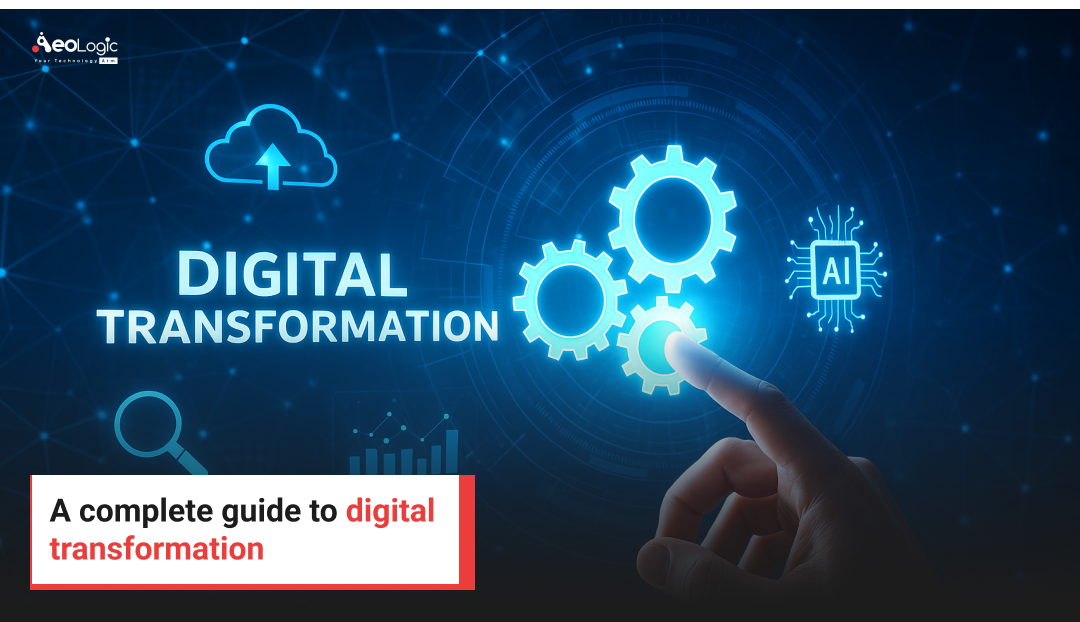
Digital transformation in 2026 is no longer limited to adopting new software, moving systems to the cloud, or automating a few manual tasks. To reimagine how they work, service customers, process data, and make decisions, businesses are now reconceiving their operations through the lens of artificial intelligence, cloud computing, automation, advanced analytics, cybersecurity and connected technologies. In a business world that continues to become more competitive and customer-centric, those that see digital transformation as a long-term business strategy are more likely to adapt and thrive.
The actual goal of digital transformation for business is to become more digital, not just that. The goal is to build a more interwoven, intelligent, flexible and efficient organization. In today’s world of business, digital technologies are transforming virtually every facet of business operations, from decision-making to workflow automation and real-time data analysis. As a result, companies looking for their next level of growth need to grasp the concept of digital transformation in 2026.
What is Digital Transformation?
Digital Transformation” is the strategic utilization of digital technologies to radically redesign business processes, customer journeys, organizational ways of working and decision-making. It is more than just about the technologies themselves as change needs to happen at the process, employee, business model and organizational level to be successful.
Cloud solutions, artificial intelligence, data analytics, automation and Internet of Things may be deployed, but only when they provide value to real business needs. In digital transformation, technology is aligned with business goals to enable organizations to function more efficiently and become quicker to adapt to fluctuating market demands.
How Digital Transformation has evolved
Much of the previous digital transformation efforts centered on replacing paper-based processes, enterprise software programs, or shifting applications from on-premises to cloud-based. Nowadays, the field is much wider.
Organizations are leveraging AI to interpret complicated information, automation to minimize the repetition, analysis to aid business choices and connected devices to offer real-time monitoring. More than just digitization, the focus is on smart systems that can continuously optimize business processes.
Why Digital Transformation in 2026 matters
The significance of digital transformation for 2026 lies in the rapidly evolving nature of technology, customer expectations, and competition. The traditional processes are not good enough when competitors are leveraging automation and intelligent processes to cut costs and enhance customer experience.
Digital transformation helps organizations to be more agile and responsive to these changes. A modern digital infrastructure can enable businesses to gain access to information in a faster time frame, to detect issues in operation at an earlier stage and give employees the tools to work more efficiently.
Changing Customer Expectations
The expectations of customers are higher than ever for quick responses, personalization, digital interactions and seamless service across platforms. If businesses don’t deliver on these expectations, they may see customers easily swayed to go elsewhere, to other businesses that are “digitally mature”.
Personalized marketing, digital customer service platforms, mobile apps, self-service systems and real-time communication are assisting organizations in making customer experiences more responsive. For Digital Transformation in 2026, these technologies are becoming essential for delivering faster, more connected, and customer-focused experiences.
Increasing Operational Complexity
As businesses expand, the processes and their data environment can become more complex. Information can be spread out through various applications, departments, databases, and cloud environments. Employees can waste considerable time looking for information and may have to manually move data between systems without adequate digital infrastructure.
Digital transformation helps connect these environments, allowing organizations to create more streamlined workflows and improve visibility across operations.
Key Technologies driving Digital Transformation in 2026
While technology is a key driver of transformation today, the most effective organisations don’t just jump on to every new technology out there. Rather, they look for technologies that are a direct help to their business objectives.
Artificial Intelligence and Generative AI
In 2026, AI will be one of the most crucial factors in digital transformation. AI is being leveraged in customer service, predictive analytics, fraud prevention, content creation, forecasting, document processing, recommendation engines, and decision-making.
Generative AI is reshaping the way employees engage with organizational knowledge, as well. Employees can leverage AI-powered systems to access information, summarize content, create reports, and aid daily tasks, instead of manually sifting through vast amounts of documents.
Another significant advancement is the increased adoption of AI agents. AI agents can execute workflows with minimal human involvement, engage with business applications and execute sequences of tasks. This can assist companies to go from basic automation to smarter functions.
Cloud Computing
Cloud infrastructure empowers organizations to leverage computing resources, applications, storage, and data services without relying solely on traditional physical infrastructure. This flexibility has become increasingly important as businesses modernize their operations and prepare for changing technology demands. In the context of Digital Transformation in 2026, cloud infrastructure provides the foundation for scalable, connected, and more agile business environments.
The transition to hybrid and multi-cloud approaches is growing in popularity for businesses in 2026, aiming to enhance flexibility, scalability, resilience, and workload optimization. Cloud platforms also facilitate the incorporation of AI, analytics, collaboration features and other contemporary applications. Cloud computing continues to provide the foundation for scalable digital operations.
Data Analytics and Business Intelligence
Data is now a key asset for any organisation. But big data does not necessarily yield business value. Systems are required that can transform raw data into meaningful insights for the benefit of organizations.
Business analytics and business intelligence solutions enable businesses to gain insights into customer behavior, operational performance, financial trends, supply chain conditions and other business metrics and indicators. Real-time dashboards and predictive analytics enable decision makers to shift from problem-solving to problem-prevention.
Automation and Intelligent Workflows
Another key factor in digital transformation in 2026 is automation. Intelligent automation uses AI, analytics and decision making abilities to automate tasks that are repetitive, but automated by a machine that knows what to do. Traditional automation is automation of the repetitive tasks, intelligent automation is automation plus capability of AI, analytics and decision making.
Automate repetitive tasks such as document processing, employee workflows, customer support, data entry, approvals, reporting, and more. This enables an employee to devote more time to strategic and creative duties.
Internet of Things
The Internet of Things is a technology that enables physical devices and assets to be linked to digital systems, allowing organizations to learn about, and analyze, information from the real world. Equipment monitoring from manufacturing companies, vehicle and shipment tracking by logistics companies and energy and environmental monitoring in facilities.
By integrating IoT information with analytics and AI, businesses can uncover trends, anticipate equipment failures, and optimize operations better.
 How Businesses can implement Digital Transformation
Digital Transformation in 2026 isn’t about choosing the right technology. The first step in improving is to grasp the goal and the rationale behind the change.
Start with Business Objectives
All transformational efforts need to have business objectives. They can involve operational efficiency gains, cost savings, enhanced customer experience, better decision making, increased security or new digital service offerings.
Once these goals are defined, an organisation can determine how the technology and processes required to meet these goals are achieved. This way, businesses will not waste money on technology that doesn’t make sense or have any return.
Assess existing Technology and Processes
When adding new technology systems to an existing environment, businesses need to assess the current technology landscape. Legacy applications, unconnected databases, manual processes, aging infrastructure and multiple systems can pose major challenges to transformation.
If a detailed assessment is done, the information provided can help determine systems to be modernized, integrated, replaced or retained. Furthermore, it’s a tool that enables organizations to grasp the potential for digital transformation.
Build a scalable Digital Architecture
The transformation is successful only if an architecture is established that can accommodate growth in the future. When designing the digital environment, businesses should take into account cloud infrastructure, APIs, data platforms, cybersecurity, application integration and interoperability.
A scalable architecture also makes it much easier to adopt new technologies as business needs evolve, rather than rebuilding the entire technology ecosystem each time, supporting Digital Transformation in 2026.
Prepare Employees for change
Technology can’t change an organization by itself. The skills, knowledge and confidence of employees to work with new systems and processes.
Training should be given to organisations as needed and the objective of transformation should be explained. If staff members are aware of how new technologies can help them to work more efficiently and with less stress, then the transition will be a lot less rocky.
Major Benefits of Digital Transformation in 2026
Digital transformation benefits span almost all areas of an organization. The major benefits are increased operational efficiency. Automated workflows and integrated systems eliminate repetitive tasks and eliminate needless delays.
Another benefit of digital transformation is that leaders are able to access accurate, relevant information in a timely manner, which aids in decisions. Organizations can rely more on real-time and predictive insights to know what’s happening and what’s likely to happen next, rather than relying on past reports.
Digital platforms can help businesses deliver swift support, tailored interactions, convenient services, and uniform experiences throughout various channels.
Transformation can also enhance business agility. Instead of attempting to modernize everything at once, organizations can prioritize projects based on business value, technical feasibility, and expected impact.
Challenges of Digital Transformation
While digital transformation has many advantages, there are potential hurdles to overcome during the actual process. One of the most prevalent challenges with legacy systems is that older applications can be difficult to integrate with modern technologies as businesses adopt Digital Transformation in 2026.
As organizations link more apps, devices and cloud environments, data security and privacy are becoming more significant. To safeguard sensitive data, business needs to put in place the right cybersecurity measures, access management, monitoring and governance.
Another challenge is resistance to change. Employees may be uncomfortable with new processes or concerned that automation will affect their roles. Clear communication, training, and employee involvement can help organizations manage this transition more effectively.
Budget limitations can also affect transformation initiatives. Instead of attempting to modernize everything at once, organizations can prioritize projects based on business value, technical feasibility, and expected impact.
The Future of Digital Transformation
The future of digital transformation will increasingly focus on intelligent, connected, and autonomous business operations. AI will become more deeply integrated into everyday workflows, while AI agents will support increasingly complex business activities.
Businesses will also place greater emphasis on real-time data, intelligent automation, cybersecurity, and responsible technology adoption. Digital platforms will need to become more flexible so organizations can quickly integrate emerging technologies without creating additional complexity.
From Digital Businesses to Intelligent Businesses
The next stage of transformation is moving beyond simply digitizing existing processes. Organizations are beginning to redesign processes around intelligence and automation from the beginning. This shift is making Digital Transformation in 2026 more focused on creating smarter operations, improving decision-making, and building flexible systems that can adapt to changing business needs.
Instead of asking how an existing manual process can be converted into a digital workflow, businesses can ask how AI, automation, data, and connected systems can create a fundamentally better process. This shift can lead to more efficient operations and new opportunities for innovation.
Conclusion
Digital transformation in 2026 represents a fundamental change in how businesses operate, compete, and create value. Artificial intelligence, cloud computing, automation, advanced analytics, IoT, and modern digital platforms are enabling organizations to build faster and more intelligent operations.