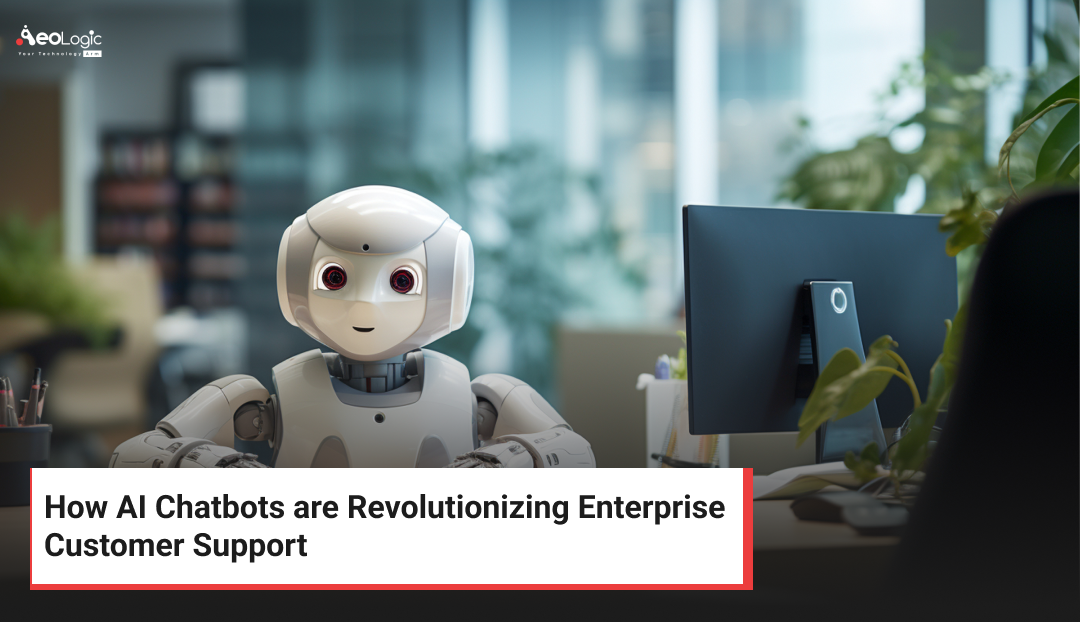
Enterprise customer support used to mean one thing: more headcount every time ticket volume grew. That math doesn’t work anymore. Customers expect an answer in minutes, not hours, across chat, email, voice, and social — all at once. AI chatbots for enterprise customer support have become the way large organizations close that gap without endlessly scaling their support teams.
This isn’t the clunky, keyword-matching chatbot of five years ago that could barely handle “reset my password.” Today’s enterprise-grade AI chatbots use large language models, retrieval-augmented generation, and deep integrations with CRM and ticketing systems to resolve complex, multi-step issues, hand off cleanly to human agents when needed, and learn from every interaction. For a growing number of Fortune 500 and mid-market companies, they’ve moved from “nice to have” to core infrastructure.
In this guide, we’ll break down exactly how AI chatbots for enterprise customer support work, where they deliver the most value, the real challenges teams run into, and how to roll one out without damaging the customer experience you’re trying to improve.
What are AI Chatbots for Enterprise Customer Support?
AI chatbots for enterprise customer support are software agents that use natural language processing (NLP) and machine learning to understand customer questions, retrieve relevant information from company knowledge bases and systems of record, and respond conversationally — without a human agent typing every reply.
Unlike basic rule-based bots that follow rigid decision trees (“Press 1 for billing”), enterprise AI chatbots are built on large language models (LLMs) that can:
- Understand intent even when a question is phrased oddly or combines multiple issues
- Pull live data from order management, billing, and account systems
- Maintain context across a multi-turn conversation
- Escalate to a human agent with full conversation history attached
- Operate across channels — web chat, mobile app, email, SMS, and voice — with a consistent brand voice
An enterprise AI chatbot is a conversational AI system, trained on company-specific data and integrated with core business systems, that independently resolves or triages customer support requests at scale, 24/7, while maintaining the accuracy and compliance standards large organizations require.
 Why Enterprises are Investing in AI Chatbots Now
A few forces are converging to push AI chatbots for enterprise customer support from experimental pilots into mainstream deployment.
Rising Customer Expectations
Customers increasingly expect instant responses regardless of time zone or ticket volume. A support team that only operates 9-to-5 in one region simply cannot meet that bar without some form of automation carrying the overnight and weekend load.
Support Volume Is Outpacing Headcount Budgets
As companies grow, support ticket volume tends to grow faster than support budgets. Hiring and training new agents is expensive and slow, and seasonal spikes (product launches, holiday shopping, service outages) make fixed headcount an inefficient way to handle variable demand.
Maturity of the Underlying AI
The large language models powering today’s chatbots are dramatically more capable than the NLP systems available even three years ago. They handle ambiguity, multi-intent questions, and nuanced tone far better, which makes enterprise-grade deployments realistic rather than purely aspirational.
Pressure to Reduce Cost-to-Serve
Finance and operations leaders are under constant pressure to reduce cost-per-ticket. Because an AI chatbot can resolve a large share of repetitive, low-complexity tickets automatically, enterprises can redirect human agents toward the complex, high-value conversations that actually need a person.
How AI Chatbots for Enterprise Customer Support Actually Work
Understanding the mechanics helps set realistic expectations for what a deployment can and can’t do out of the box.
- Intent recognition. The chatbot analyzes the customer’s message using NLP to determine what they’re actually asking for, even if it’s phrased informally or contains a typo.
- Knowledge retrieval. Using retrieval-augmented generation (RAG), the system searches internal knowledge bases, help center articles, and policy documents to find the most relevant, up-to-date information rather than relying only on what the model was originally trained on.
- System integration. For account-specific questions (“Where’s my order?” or “What’s my current plan?”), the chatbot calls APIs into CRM, billing, or order management systems to pull real data instead of guessing.
- Response generation. The model composes a natural-language answer, grounded in the retrieved information, matching the brand’s tone and compliance requirements.
- Confidence-based routing. If the system isn’t confident it can resolve the issue accurately — or the topic is flagged as sensitive (refunds, legal, security) — it escalates to a human agent with the full conversation context attached, so the customer never has to repeat themselves.
- Continuous learning. Teams review flagged conversations, correct errors, and feed that feedback back into the system, improving accuracy over time.
This pipeline is what separates a genuinely useful enterprise AI chatbot from a frustrating one. Skipping steps like system integration or confidence-based routing is the most common reason early chatbot deployments feel robotic or get stuck in unhelpful loops.
Key Benefits of AI Chatbots for Enterprise Customer Support
1. Round-the-Clock Availability
Enterprise customers span time zones, and downtime doesn’t wait for business hours. AI chatbots for enterprise customer support provide instant, consistent responses at 2 a.m. on a Sunday just as reliably as at 2 p.m. on a Tuesday, closing the coverage gaps that overnight or weekend staffing typically leaves open.
2. Faster First Response and Resolution Times
Instead of waiting in a queue, customers get an immediate answer to routine questions — password resets, order status, billing explanations, account changes. That speed directly improves customer satisfaction (CSAT) scores, which are closely tied to how quickly a customer feels heard.
3. Lower Cost-to-Serve
Because a single chatbot can field thousands of simultaneous conversations, enterprises reduce the number of agents needed for repetitive, low-complexity tickets. That doesn’t mean eliminating the support team — it means reallocating skilled agents toward complex, relationship-sensitive conversations where a human touch actually matters.
4. Consistency and Compliance
Human agents vary in tone, accuracy, and adherence to policy, especially under pressure. A well-configured AI chatbot applies the same approved answers, disclaimers, and escalation rules every time, which matters enormously in regulated industries like finance, healthcare, and insurance.
5. Scalability During Demand Spikes
Product launches, outages, and seasonal peaks can spike ticket volume 5–10x overnight. Human teams can’t scale that fast; an AI chatbot infrastructure can absorb the surge without a corresponding spike in burnout or missed SLAs.
6. Richer Customer Insight
Every chatbot conversation is a data point. Aggregated over thousands of interactions, that data reveals recurring pain points, product gaps, and emerging issues long before they’d surface through manual ticket review — insight product and support leadership can act on directly.
Real-World Use Cases for Enterprise AI Chatbots
| Use Case | What the Chatbot Handles | Typical Impact |
|---|---|---|
| Tier-1 ticket deflection | FAQs, password resets, order status, account changes | Reduces agent-handled ticket volume significantly |
| IT help desk support | Access requests, software troubleshooting, onboarding steps | Faster employee and customer issue resolution |
| Billing and account inquiries | Invoice explanations, plan changes, payment issues | Fewer billing-related escalations |
| Proactive outage communication | Automatic status updates during incidents | Reduced inbound ticket spikes during outages |
| Post-purchase support | Shipping updates, returns, warranty questions | Higher self-service resolution rate |
| Agent-assist / co-pilot | Suggests responses and pulls account data for live agents | Shorter average handle time |
| Multilingual support | Real-time translation and localized responses | Expanded global coverage without hiring multilingual staff |
Common Challenges With Enterprise AI Chatbot Adoption
AI chatbots for enterprise customer support deliver real value, but rollouts aren’t without friction. Being upfront about these challenges leads to better outcomes than treating the technology as a plug-and-play fix.
- Data quality and knowledge base gaps. A chatbot is only as accurate as the knowledge base and systems it draws from. Outdated help articles or missing documentation lead directly to wrong or incomplete answers.
- Integration complexity. Connecting a chatbot to legacy CRM, billing, and ticketing systems — especially in large enterprises with fragmented tech stacks — can take significantly longer than vendors initially estimate.
- Over-automation risk. Pushing every conversation through the bot, including sensitive or emotionally charged issues, damages trust. Clear escalation thresholds matter as much as the chatbot’s raw capability.
- Change management. Support agents may see chatbots as a threat rather than a tool. Framing the rollout around eliminating repetitive work — not eliminating jobs — and involving agents in tuning the bot’s responses improves adoption internally.
- Governance and compliance. Regulated industries need clear guardrails around what the chatbot can and cannot say, audit trails of conversations, and defined escalation paths for topics like refunds, cancellations, or legal disputes.
- Measuring the right metrics. Teams that only track deflection rate can inadvertently optimize for closing tickets fast rather than resolving them well. Resolution quality and customer satisfaction need equal weight.
Best Practices for Implementing AI Chatbots in Enterprise Support
- Start with a narrow, high-volume use case. Pick a well-defined category — order status or password resets, for example — prove the resolution quality, then expand scope. Trying to automate everything on day one is the most common cause of failed rollouts.
- Invest in your knowledge base before the chatbot. Clean, current, well-structured documentation is the single biggest driver of chatbot accuracy. No amount of model sophistication compensates for bad source content.
- Define clear escalation rules. Decide in advance which topics always route to a human (refunds above a certain amount, account cancellations, complaints, anything emotionally charged) and build those rules into the system from day one.
- Keep humans in the loop. Route a sample of chatbot conversations to agents for review regularly. Treat the chatbot as a system that improves through ongoing human feedback, not a set-it-and-forget-it tool.
- Measure resolution quality, not just deflection. Track CSAT on bot-handled conversations specifically, not only overall deflection rate, so you catch problems before they erode customer trust.
- Keep the handoff seamless. When a conversation escalates to a human, the full chat history and context should transfer automatically. Making a customer repeat themselves after being escalated is one of the fastest ways to damage CSAT.
- Pilot with internal teams first when possible. Testing against the IT help desk or internal employee support can surface integration and accuracy issues in a lower-stakes environment before customer-facing launch.
Conclusion
AI chatbots for enterprise customer support aren’t a passing trend — they’re becoming core infrastructure for any organization that needs to meet rising customer expectations without unsustainable headcount growth. Done well, they cut response times, lower cost-to-serve, and free human agents to focus on the conversations that genuinely need empathy and judgment. Done poorly — with thin knowledge bases, no escalation rules, or over-automation — they frustrate the very customers they’re meant to help.
The enterprises getting the most value from AI chatbots for enterprise customer support share a common pattern: they start narrow, invest in clean knowledge content, define clear human handoff points, and treat the chatbot as a continuously improving system rather than a one-time deployment. Aeologic Technologies helps businesses explore AI-driven solutions that streamline customer support, improve response times, and enhance service efficiency. If your support team is buried in repetitive tickets while complex cases wait in queue, that’s the clearest sign it’s time to evaluate where an AI chatbot fits into your support stack. Start with one high-volume use case, measure resolution quality as closely as deflection rate, and scale from there.
FAQs
Q1. What makes enterprise AI chatbots different from basic website chatbots?
Enterprise AI chatbots for customer support integrate deeply with CRM, billing, and ticketing systems, handle multi-turn and multi-intent conversations, and include governance features like audit trails and role-based escalation — capabilities basic rule-based website chatbots don’t offer.
Q2. Can AI chatbots handle complex, multi-step customer issues?
Yes, modern enterprise AI chatbots can manage multi-step conversations by maintaining context across turns and pulling live data from connected systems. Highly ambiguous, sensitive, or policy-exception cases are typically still routed to a human agent for final resolution.
Q3. Will AI chatbots replace human customer support agents?
Most enterprises use chatbots to handle repetitive, high-volume queries while redirecting human agents to complex, relationship-sensitive conversations, rather than eliminating support roles entirely. Many organizations report needing fewer net-new hires as ticket volume grows, rather than reducing existing headcount.
Q4. How do AI chatbots integrate with existing CRM and helpdesk tools?
Most enterprise AI chatbot platforms connect through APIs to common CRM, helpdesk, and ticketing systems, pulling account data in real time and logging conversation history back into those systems so agents have full context on handoff.
Q5. What industries benefit most from AI chatbots in customer support?
Industries with high support volume and well-structured, repeatable queries — like SaaS, telecom, financial services, retail, and travel — tend to see the fastest, clearest returns from AI chatbots for enterprise customer support.
Q6. How is data privacy handled with enterprise AI chatbots?
Enterprise-grade chatbot platforms typically offer data encryption, role-based access controls, configurable data retention policies, and compliance certifications relevant to the industry, though exact safeguards vary by vendor and should be verified during procurement.
Q7. What is the difference between rule-based and AI-powered chatbots?
Rule-based chatbots follow fixed decision trees and can only handle scripted paths, while AI-powered chatbots use natural language understanding to interpret varied phrasing, maintain conversational context, and generate responses grounded in real data rather than pre-written scripts.
Q8. How do you measure the success of an enterprise AI chatbot?
Key metrics include resolution rate, deflection rate, average handle time, CSAT on bot-handled conversations, escalation accuracy, and cost-per-ticket — with resolution quality and CSAT weighted as heavily as raw deflection volume.