
Filing an insurance claim has traditionally meant paperwork, phone holds, and waiting — sometimes for weeks — to hear back about a payout. That experience is changing fast. Insurers that once relied on manual intake and rules-based automation are now investing in Generative AI Services to rebuild the claims lifecycle from the ground up, and the results are hard to ignore: faster decisions, fewer errors, and policyholders who actually feel heard.
This shift isn’t hype. Carriers and third-party administrators are using Generative AI Services to read documents, summarize adjuster notes, detect fraud patterns, and even draft customer communications — all in a fraction of the time a human team would need. In this guide, we’ll break down exactly how GenAI is reshaping claims processing, where it delivers the most value, what risks to plan for, and how insurers can adopt Generative AI Services responsibly.
What is Generative AI in Insurance Claims Processing?
Generative AI in insurance claims processing refers to AI models — typically large language models (LLMs) and multimodal systems — that can read, summarize, generate, and reason over claims data such as policy documents, photos, medical reports, and customer messages. Unlike older rules-based automation, Generative AI Services can handle unstructured information and produce human-like outputs, such as draft settlement letters or claim summaries, with minimal manual input.
Generative AI Services combine natural language understanding, document intelligence, and pattern recognition to automate the judgment-heavy parts of claims handling that used to require a person.
 Why Insurance Companies are Turning to Generative AI Services
Rising Claim Volumes and Customer Expectations
Catastrophic weather events, rising vehicle repair costs, and a growing book of policies mean claims volumes keep climbing. At the same time, customers who are used to same-day delivery and instant banking apps expect claims to move just as fast. Traditional staffing models can’t scale at that pace — but Generative AI Services can absorb volume spikes without a drop in service quality.
Legacy Systems and Manual Bottlenecks
Many insurers still run on decades-old core systems that weren’t built for digital-first workflows. Adjusters spend hours re-keying data between systems, reading dense PDFs, and chasing missing documents. Generative AI Services sit on top of these legacy systems, extracting and structuring data so human staff aren’t stuck doing repetitive administrative work.
How Generative AI Services Work in the Claims Lifecycle
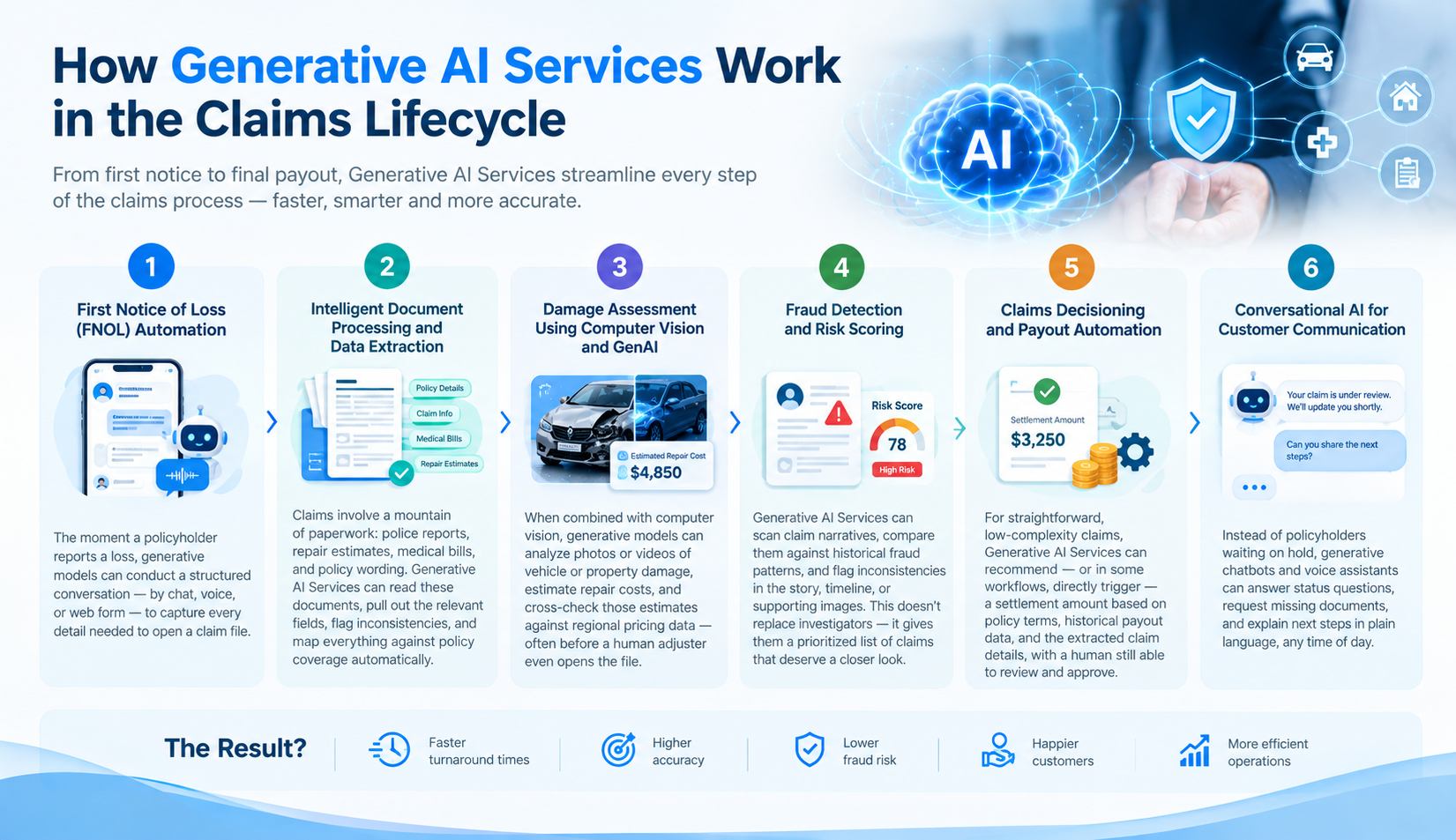
Here’s where Generative AI Services actually plug into the claims process, step by step.
1. First Notice of Loss (FNOL) Automation
The moment a policyholder reports a loss, generative models can conduct a structured conversation — by chat, voice, or web form — to capture every detail needed to open a claim file. This replaces static intake forms with a dynamic, AI-led interview that adapts based on the type of incident.
2. Intelligent Document Processing and Data Extraction
Claims involve a mountain of paperwork: police reports, repair estimates, medical bills, and policy wording. Generative AI Services can read these documents, pull out the relevant fields, flag inconsistencies, and map everything against policy coverage automatically, cutting document review time from hours to minutes.
3. Damage Assessment Using Computer Vision and GenAI
When combined with computer vision, generative models can analyze photos or videos of vehicle or property damage, estimate repair costs, and cross-check those estimates against regional pricing data — often before a human adjuster even opens the file.
4. Fraud Detection and Risk Scoring
Generative AI Services can scan claim narratives, compare them against historical fraud patterns, and flag inconsistencies in the story, timeline, or supporting images. This doesn’t replace investigators — it gives them a prioritized list of claims that deserve a closer look.
5. Claims Decisioning and Payout Automation
For straightforward, low-complexity claims, Generative AI Services can recommend — or in some workflows, directly trigger — a settlement amount based on policy terms, historical payout data, and the extracted claim details, with a human still able to review and approve.
6. Conversational AI for Customer Communication
Instead of policyholders waiting on hold, generative chatbots and voice assistants can answer status questions, request missing documents, and explain next steps in plain language, any time of day.
 Key Benefits of Generative AI Services in Claims Processing
| Benefit | What It Means for Insurers |
| Faster turnaround | Claims that took days can be resolved in hours for simple cases |
| Lower operating costs | Less manual data entry and document review per claim |
| Improved accuracy | Consistent application of policy rules reduces human error |
| Stronger fraud prevention | Pattern recognition surfaces anomalies earlier |
| Better customer experience | 24/7 updates and faster payouts improve satisfaction and retention |
| Adjuster capacity | Staff can focus on complex, high-value claims instead of paperwork |
Insurers that deploy Generative AI Services typically see the biggest early wins in document-heavy, high-volume claim types — auto glass, minor collision, and simple property claims — where the logic is repeatable and the data is largely unstructured text or images.
Real-World Use Cases of Generative AI Services in Insurance
- Auto insurers use generative vision models to assess collision damage from uploaded photos and generate preliminary repair estimates within minutes.
- Property and casualty carriers use document-intelligence tools built on Generative AI Services to process catastrophe claims faster after major weather events, when claim volume spikes dramatically.
- Health and travel insurers use generative summarization to condense long medical records or itineraries into claim-relevant summaries for faster adjudication.
- Claims contact centers deploy generative chatbots to triage first notice of loss conversations, freeing live agents for complex or emotionally sensitive calls.
- SIU (Special Investigations Units) use generative pattern-matching to flag claims with unusual narrative or documentation patterns for further review.
- Reinsurers and MGAs use Generative AI Services to summarize large portfolios of claims data when evaluating treaty performance or onboarding new books of business, cutting down weeks of manual analyst review.
These use cases share a common thread: wherever a claims workflow depends on reading, summarizing, or reasoning over messy, unstructured information, Generative AI Services tend to deliver measurable time savings without requiring a complete rebuild of the underlying systems.
How to Choose a Generative AI Services Provider for Claims Processing
Not all GenAI vendors are built for insurance. Before signing a contract, it helps to evaluate providers of Generative AI Services against criteria specific to claims operations:
- Domain-specific training data. Ask whether the provider’s models have been tuned on insurance documents, claim narratives, and industry terminology, rather than generic text.
- Integration options. Confirm the provider can connect to your existing policy administration and claims management systems through documented APIs, not just a standalone dashboard.
- Explainability and audit logs. Look for tools that show why a model made a recommendation, with a full audit trail for regulators and internal compliance review.
- Data residency and security certifications. Verify where claims data is processed and stored, and confirm the vendor holds relevant security certifications (such as SOC 2).
- Human-in-the-loop controls. Make sure the platform lets your team set thresholds for when a claim must be routed to a human adjuster.
- Proven track record in insurance. Ask for references or case studies from other carriers or MGAs that have deployed the vendor’s Generative AI Services in a live claims environment.
Choosing the right partner matters as much as the technology itself — a strong model with poor integration or weak governance will create more risk than value.
Measuring the ROI of Generative AI Services in Claims
Once Generative AI Services are live, insurers need a clear way to track whether the investment is paying off. Useful metrics to monitor include:
- Average claim cycle time — how long it takes from first notice of loss to final payout, broken down by claim type.
- Straight-through processing rate — the percentage of claims that move from intake to decision without manual intervention.
- Adjuster capacity freed up — hours saved per adjuster per week that can be redirected to complex or escalated claims.
- Fraud referral quality — the proportion of AI-flagged claims that investigators confirm as genuinely suspicious, rather than false positives.
- Customer satisfaction and retention — changes in claims-related satisfaction scores and policy renewal rates after rollout.
Tracking these metrics together, rather than looking at automation rate alone, gives a more honest picture of whether Generative AI Services are actually improving outcomes — not just moving work around.
Challenges and Risks of Implementing Generative AI Services
Adopting Generative AI Services isn’t without hurdles. Insurers planning a rollout should prepare for the following:
Data Privacy and Security
Claims data includes sensitive personal, medical, and financial information. Any Generative AI Services deployment needs strict data governance, encryption, and access controls to stay compliant with privacy regulations.
Model Bias and Explainability
Because claims decisions affect real payouts, insurers need to be able to explain why a model flagged a claim or recommended a settlement amount. Opaque “black box” outputs create regulatory and fairness risk, so explainability tooling is essential alongside any generative model.
Regulatory Compliance
Insurance is one of the most heavily regulated industries. State and national regulators are actively developing guidance on AI use in claims and underwriting, so Generative AI Services need to be deployed with compliance and legal teams involved from day one, not as an afterthought.
Legacy System Integration
Connecting modern generative models to decades-old policy administration or claims management systems can be technically complex and often requires middleware or API layers built specifically for that purpose.
Best Practices for Adopting Generative AI Services in Claims
- Start with a narrow, high-volume use case — such as document intake or FAQ chat — before expanding to complex decisioning.
- Keep a human in the loop for any claim decision above a defined complexity or dollar threshold.
- Invest in explainability tooling so adjusters and regulators can understand model outputs.
- Audit for bias regularly, especially across demographic and geographic claim patterns.
- Train staff to work alongside Generative AI Services rather than treating adoption as a replacement for adjusters.
- Measure outcomes, not just automation rate — track accuracy, customer satisfaction, and cycle time together.
Generative AI vs. Traditional Claims Automation (RPA)
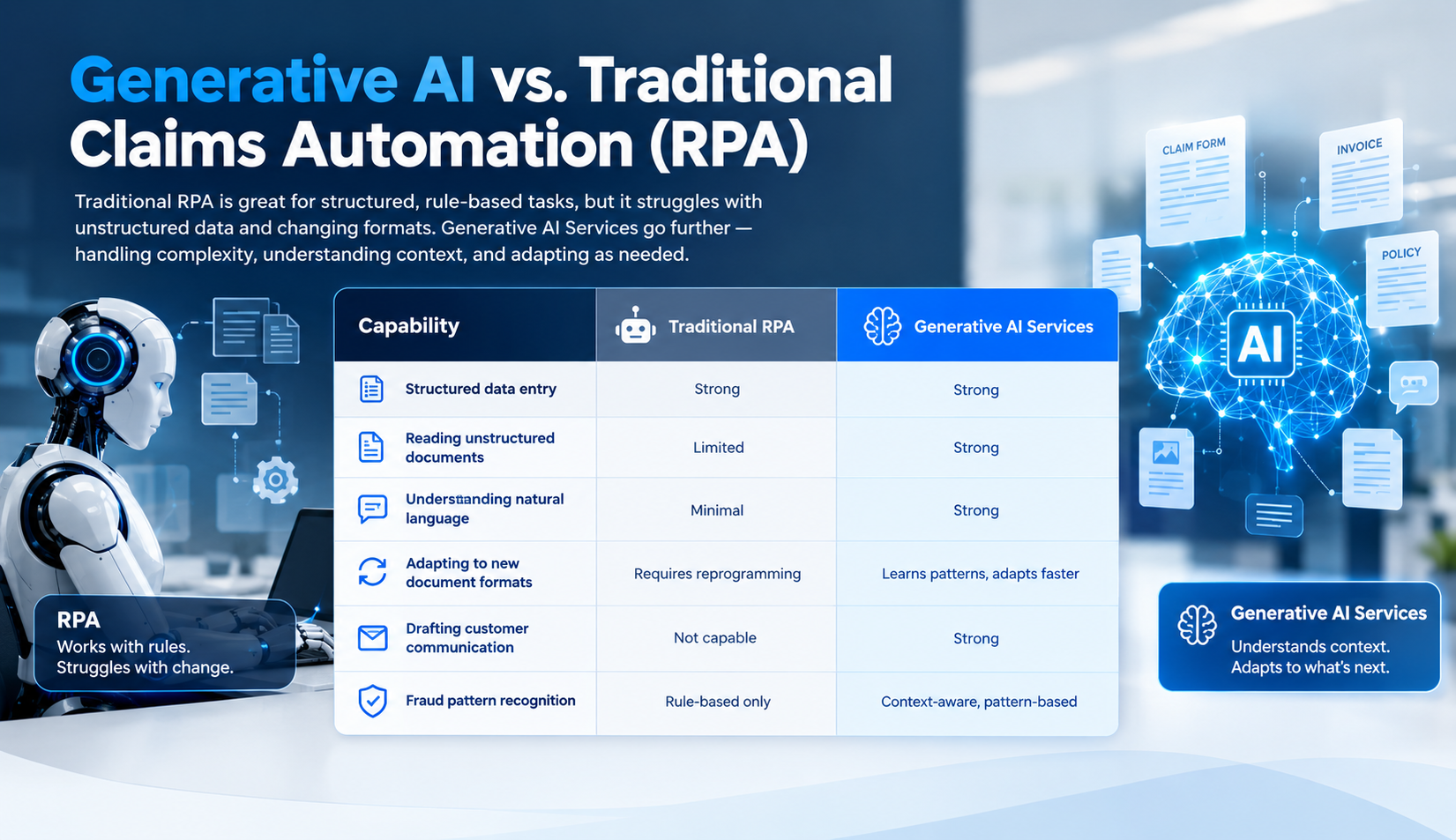
| Capability | Traditional RPA | Generative AI Services |
| Structured data entry | Strong | Strong |
| Reading unstructured documents | Limited | Strong |
| Understanding natural language | Minimal | Strong |
| Adapting to new document formats | Requires reprogramming | Learns patterns, adapts faster |
| Drafting customer communication | Not capable | Strong |
| Fraud pattern recognition | Rule-based only | Context-aware, pattern-based |
Traditional robotic process automation (RPA) is still useful for rigid, rule-based tasks, but it breaks down the moment a document format changes or a claim doesn’t fit a predefined template. Generative AI Services are built to handle exactly that kind of variability, which is why many insurers are layering GenAI on top of — or in place of — older RPA workflows.
 The Future of Generative AI Services in Insurance Claims
Expect the next wave of Generative AI Services to move from “assist” to “orchestrate” — coordinating document review, fraud checks, and customer updates as a single automated workflow rather than separate point tools. Multimodal models that combine text, image, and voice understanding will make end-to-end claims automation realistic for a much wider range of claim types, not just the simplest cases. Insurers that build strong data foundations and governance now will be best positioned to scale these capabilities as the technology matures.
Industry groups and regulators are also expected to publish clearer standards for AI use in claims decisioning over the next few years, which should make it easier for carriers to benchmark their Generative AI Services deployments against accepted best practices rather than building governance frameworks from scratch. Carriers that treat this as an evolving, long-term capability — rather than a one-time software purchase — are likely to see the most durable returns.
Conclusion
Generative AI Services are no longer an experimental side project for insurers — they’re becoming core infrastructure for claims processing. From the first notice of loss to final payout, GenAI is helping carriers move faster, cut costs, and catch fraud earlier, all while giving policyholders a smoother, more transparent experience. The insurers that invest now in responsible, well-governed Generative AI Solutions — with the right guardrails, human oversight, and change management — will be the ones best positioned to handle whatever comes next in claims volume and complexity.
Ready to explore what Generative AI Services could do for your claims operation? Aeologic Technologies can help you start with a single high-volume use case, measure the results, and scale from there.
Frequently Asked Questions
Q1. What are Generative AI Services in the context of insurance?
Generative AI Solutions refer to AI-powered tools — usually built on large language models — that read, summarize, and generate content from claims data, such as documents, images, and customer messages, to automate parts of the claims lifecycle.
Q2. Will Generative AI replace insurance claims adjusters?
No. Generative AI Solutions are designed to handle repetitive, document-heavy tasks, freeing adjusters to focus on complex claims, customer relationships, and decisions that require human judgment and empathy.
Q3. How accurate is AI in detecting insurance fraud?
Accuracy varies by implementation and data quality, but generative models paired with historical claims data can surface suspicious patterns far faster than manual review, acting as a prioritization tool rather than a final verdict.
Q4. What types of insurance claims benefit most from Generative AI?
High-volume, document-heavy claims — such as auto glass, minor collision, travel, and simple property claims — see the fastest and clearest benefits from Generative AI Solutions because the underlying data is repetitive and largely unstructured.
Q5. How long does it take to implement Generative AI Solutions in a claims department?
Timelines vary, but many insurers start with a narrow pilot, such as document intake automation, that can go live in a few months, with broader rollout happening over the following 12–18 months.
Q6. Are Generative AI Solutions compliant with insurance regulations?
They can be, when designed with explainability, audit trails, and human review built in. Insurers should involve legal and compliance teams from the start of any Generative AI Solutions deployment.
Q7. What’s the difference between Generative AI and traditional claims automation?
Traditional automation (RPA) handles structured, rule-based tasks, while Generative AI Solutions can interpret unstructured text, images, and natural language, making them far more adaptable to real-world claim variability.

I’m a Software Developer with 9 years of experience building scalable web and mobile applications. Currently focused on React.js and React Native, I specialize in creating high-performance, user-friendly interfaces that drive business outcomes.
My background spans cross-platform development using Flutter, and native Android development, giving me a strong understanding of the entire mobile ecosystem. I’ve contributed to products in EdTech, Healthcare, and Enterprise SaaS—helping scale apps to 100K+ users and improving performance, reliability, and user engagement.
I’m passionate about clean architecture, modular design, and seamless user experiences. Whether it’s setting up robust state management with Redux Toolkit, optimizing API integrations with GraphQL/REST, or automating workflows with CI/CD pipelines (GitHub Actions)—I focus on writing maintainable code and delivering value to both users and stakeholders.