
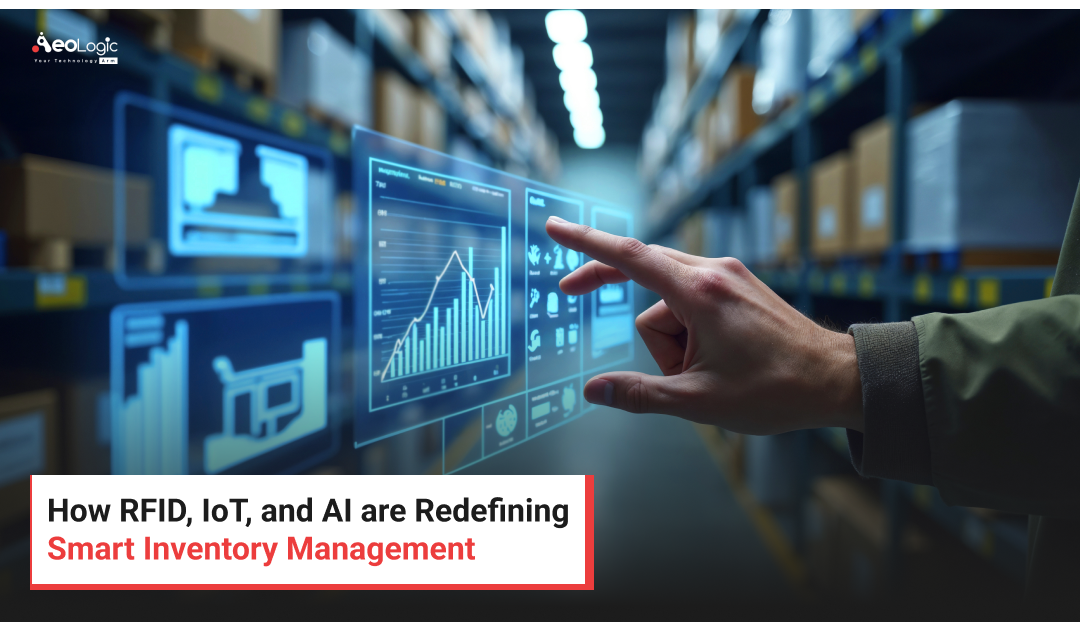
Walk into almost any warehouse in 2026 and you’ll notice something different from even five years ago: fewer people walking the aisles with clipboards, and a lot more sensors, scanners, and screens quietly doing the counting. That shift is smart inventory management in action — and it’s no longer a nice-to-have for large enterprises. Retailers, manufacturers, 3PLs, and even mid-sized e-commerce brands are adopting it because the old way of tracking stock, periodic manual counts backed by spreadsheets, simply can’t keep up with how fast orders move today.
Three technologies are doing most of the heavy lifting behind this change: RFID, IoT, and AI. Individually, each one solves a piece of the inventory puzzle. Together, they’re redefining what smart inventory management actually means, turning it from a back-office chore into a real-time, predictive system that touches everything from purchasing decisions to customer experience. This article breaks down how each technology contributes, what the combined approach looks like in practice, and how to start implementing it without blowing up your existing operations.
What is Smart Inventory Management?
Smart inventory management is the use of connected technology, primarily RFID tagging, IoT sensors, and AI-driven analytics, to track, monitor, and optimize stock levels automatically and in real time, rather than relying on manual counts or static spreadsheets.
Unlike traditional inventory control, which often depends on periodic audits and human data entry, smart inventory management works continuously. Items are tagged or scanned, sensors capture location and condition data, and software interprets that data to flag issues, predict demand, and trigger reorders before a shelf ever goes empty. The result is a system that tells you what you have, where it is, and what you’ll likely need next, all without someone manually checking a clipboard.
At its core, smart inventory management rests on three pillars:
- Identification — knowing exactly what an item is (RFID and barcodes handle this).
- Visibility — knowing where that item is and what condition it’s in (IoT sensors handle this).
- Intelligence — knowing what to do next based on patterns in the data (AI handles this).
 How RFID Powers Smart Inventory Management
Radio Frequency Identification (RFID) is one of the oldest building blocks of smart inventory management, but it’s far from outdated. An RFID tag stores a unique identifier that a reader can scan without needing a direct line of sight, unlike a barcode. That one difference changes everything about how inventory gets counted.
Instead of an employee scanning items one by one, an RFID reader can capture hundreds of tags in seconds as pallets move through a dock door or items pass a checkpoint. This is why so many smart inventory management systems use RFID as their data-capture layer:
- Bulk, hands-free scanning cuts stocktaking time from days to hours in many warehouses.
- Higher count accuracy — RFID-based counts routinely reach 95–99% accuracy compared to 65–75% for manual processes.
- Item-level tracking, not just case or pallet-level, so businesses know the exact location and status of individual SKUs.
- Reduced shrinkage from theft, misplacement, or administrative error, since items are harder to “lose” when every movement is logged.
Retailers like apparel chains use RFID extensively because it lets them reconcile online and in-store stock almost instantly, a backbone requirement for omnichannel fulfillment and a core use case within modern smart inventory management.
How IoT Strengthens Smart Inventory Management
If RFID answers “what is this item,” the Internet of Things (IoT) answers “where is it, and what’s happening to it right now.” IoT devices, smart shelves, weight sensors, temperature and humidity monitors, GPS trackers on vehicles and pallets, connect physical inventory to the internet, streaming data continuously instead of in periodic snapshots.
This constant stream of information is what makes smart inventory management genuinely real-time rather than just automated. A few concrete examples:
- Smart shelves with weight sensors detect when stock drops below a threshold and automatically trigger a replenishment alert.
- Cold-chain sensors track temperature and humidity for perishable or sensitive goods, flagging deviations before spoilage occurs.
- GPS and RFID-enabled tracking on trucks and containers gives in-transit visibility, so a retailer knows not just that stock exists, but when it will physically arrive.
- Connected forklifts and handheld scanners feed location and movement data straight into the inventory system without manual logging.
For businesses managing multiple warehouses or distribution centers, IoT is what makes centralized, real-time inventory visibility possible. Instead of calling a warehouse manager to ask “do we have this in stock,” a dashboard already has the answer, updated to the minute.
How AI Elevates Smart Inventory Management
RFID and IoT generate enormous volumes of data: every scan, every sensor reading, every movement. On their own, that data is just noise. Artificial intelligence is what turns it into decisions, and it’s the piece that separates basic automation from genuinely smart inventory management.
AI contributes in several concrete ways:
- Demand forecasting — machine learning models analyze historical sales, seasonality, promotions, and even external factors like weather or local events to predict future demand more accurately than static formulas.
- Automated reordering — AI can calculate optimal reorder points and quantities per SKU, per location, reducing both stockouts and overstock simultaneously.
- Anomaly detection — AI flags unusual patterns, like sudden inventory shrinkage, data mismatches between systems, or sensor readings outside expected ranges, that might otherwise go unnoticed until a full audit.
- Dynamic slotting — AI recommends optimal warehouse layouts and storage locations based on item velocity, picking frequency, and seasonal trends.
What makes this especially powerful in 2026 is that AI models are increasingly trained on multimodal inputs, combining RFID scan logs, IoT sensor streams, point-of-sale data, and even supplier lead-time history into a single predictive layer. That convergence is really the defining trait of modern smart inventory management: it’s not three separate tools bolted together, it’s one connected system where identification, visibility, and intelligence reinforce each other.
Benefits of Smart Inventory Management
The appeal of smart inventory management isn’t theoretical, it shows up directly in operating costs and customer satisfaction. Here’s what businesses typically see after adoption:
| Benefit | What Changes |
|---|---|
| Higher inventory accuracy | Real-time RFID/IoT data replaces periodic manual counts, often pushing accuracy above 95%. |
| Reduced stockouts and overstock | AI-driven forecasting aligns reorder quantities with actual demand patterns. |
| Lower labor costs | Automated scanning and counting reduce the hours spent on manual cycle counts. |
| Faster order fulfillment | Real-time visibility means staff spend less time searching for misplaced stock. |
| Better customer experience | Accurate online stock levels reduce canceled or backordered orders. |
| Reduced shrinkage and loss | Continuous tracking makes theft, damage, and misplacement easier to catch early. |
| Improved cash flow | Less capital tied up in excess inventory sitting unsold on shelves. |
Beyond the numbers, there’s a strategic benefit too: businesses running smart inventory management systems can make faster decisions, whether that’s launching a flash sale, rerouting stock between warehouses, or responding to a sudden demand spike, because they’re working from live data instead of a count that’s already a week old.
Common Challenges in Smart Inventory Management (and How to Solve Them)
Adopting smart inventory management isn’t without friction. Being upfront about the challenges makes the transition smoother.
- High upfront investment. RFID tags, IoT sensors, and software licenses add up, especially for item-level tagging. Solution: Start with a pilot in your highest-value or highest-shrinkage category before scaling company-wide.
- Integration with legacy systems. Many businesses still run older ERP or warehouse management systems that weren’t built for real-time data feeds. Solution: Look for middleware or API-based connectors rather than a full system replacement.
- Data overload. IoT sensors and RFID readers generate huge volumes of data, which can overwhelm teams without the right analytics layer. Solution: Prioritize AI-driven dashboards that surface exceptions and actions, not raw data dumps.
- Staff training and change management. Warehouse staff accustomed to manual processes may resist new scanning workflows. Solution: Involve frontline staff early and show how automation reduces their workload rather than replacing them.
- Tag and sensor reliability. RFID tags can fail near metal or liquids, and sensors require maintenance. Solution: Conduct a site survey before deployment to identify interference zones and plan tag placement accordingly.
Best Practices for Implementing Smart Inventory Management in 2026
- Start with a clear ROI case. Identify the specific pain point, shrinkage, stockouts, slow cycle counts, you’re solving before choosing technology.
- Pilot before you scale. Test RFID and IoT in one warehouse or product category to validate accuracy gains and refine processes.
- Choose interoperable platforms. Pick systems with open APIs so RFID, IoT, and AI tools can share data with your existing ERP or WMS.
- Prioritize data quality over data volume. Clean, well-structured data makes AI forecasting dramatically more accurate than simply collecting more of it.
- Build in human oversight. AI-generated reorder suggestions should still have a review step for unusual situations like supplier disruptions.
- Train staff on the “why,” not just the “how.” Teams that understand how smart inventory management reduces their manual workload adopt it faster.
- Revisit and retrain models regularly. Demand patterns shift, so AI forecasting models need periodic retraining with fresh data to stay accurate.
Future Trends Shaping Smart Inventory Management
Looking ahead, a few trends are likely to shape how smart inventory management evolves over the next few years:
- Autonomous mobile robots (AMRs) combined with RFID for self-navigating cycle counts, reducing the need for manual scanning altogether.
- Generative AI assistants that let warehouse managers ask plain-language questions (“which SKUs are at risk of stocking out this week?”) instead of building custom reports.
- Edge computing processing IoT sensor data on-site, reducing latency for time-sensitive alerts like cold-chain breaches.
- Blockchain-backed traceability layered on top of RFID data for industries with strict provenance requirements, like pharmaceuticals and food.
- Sustainability-focused inventory optimization, using AI to reduce overproduction and excess stock, cutting both cost and waste.
The common thread across all of these trends is convergence: RFID, IoT, and AI aren’t separate upgrades anymore, they’re becoming one integrated layer that businesses treat as standard infrastructure, not an experimental add-on.
Conclusion
RFID, IoT, and AI have moved smart inventory management from a back-office efficiency project to a core part of how competitive businesses operate. RFID gives you fast, accurate identification. IoT gives you continuous visibility into location and condition. AI turns that stream of data into forecasts, automated reorders, and early warnings that prevent costly mistakes. Together, they let businesses replace guesswork with real-time, data-backed decisions, cutting stockouts, reducing waste, and freeing staff to focus on higher-value work.
The businesses that will come out ahead in 2026 and beyond aren’t necessarily the ones with the biggest inventory, but the ones with the clearest visibility into it. If your current process still depends on periodic manual counts and gut-feel reordering, there’s never been a better time to adopt smart inventory management. With the right technology partner, such as Aeologic Technologies, businesses can explore RFID, IoT, and AI-powered solutions to improve inventory visibility, automate tracking, and make more informed decisions.
FAQs
Q1. What is the difference between traditional inventory management and smart inventory management?
Traditional inventory management relies on periodic manual counts and static spreadsheets, while smart inventory management uses RFID, IoT sensors, and AI to track stock continuously and in real time, catching discrepancies and demand shifts as they happen rather than during the next scheduled audit.
Q2. How much does it cost to implement smart inventory management?
Costs vary widely based on scale, RFID tags can cost a few cents to a few dollars each, and IoT sensor deployments range from a few thousand to six figures for large warehouses. Most businesses start with a pilot in one category or location to control costs before a full rollout.
Q3. Can small and medium-sized businesses use smart inventory management?
Yes. Cloud-based inventory platforms with built-in IoT and AI features have made smart inventory management accessible without large upfront infrastructure, letting smaller businesses start with a handful of sensors or a limited RFID pilot.
Q4. Does smart inventory management replace warehouse staff?
No, it shifts their role. Staff spend less time on manual counting and searching for misplaced stock, and more time on tasks like exception handling, quality control, and process improvement that automation can’t fully replace.
Q5. How does smart inventory management reduce stockouts?
AI models analyze historical sales, seasonality, and real-time stock levels from RFID and IoT data to predict demand accurately, triggering reorders before shelves run empty rather than after a stockout already happened.
Q6. What industries benefit most from smart inventory management?
Retail, manufacturing, logistics, healthcare, and food and beverage see some of the largest gains, especially businesses with high SKU counts, perishable goods, or strict compliance and traceability requirements.
Q7. Is RFID necessary for smart inventory management, or can IoT and AI work alone?
RFID isn’t strictly required, barcode scanning can still feed IoT and AI systems, but RFID significantly speeds up data capture and improves item-level accuracy, making it the preferred identification layer in most modern setups.

I’m a Software Developer with 9 years of experience building scalable web and mobile applications. Currently focused on React.js and React Native, I specialize in creating high-performance, user-friendly interfaces that drive business outcomes.
My background spans cross-platform development using Flutter, and native Android development, giving me a strong understanding of the entire mobile ecosystem. I’ve contributed to products in EdTech, Healthcare, and Enterprise SaaS—helping scale apps to 100K+ users and improving performance, reliability, and user engagement.
I’m passionate about clean architecture, modular design, and seamless user experiences. Whether it’s setting up robust state management with Redux Toolkit, optimizing API integrations with GraphQL/REST, or automating workflows with CI/CD pipelines (GitHub Actions)—I focus on writing maintainable code and delivering value to both users and stakeholders.