In today’s rapidly evolving digital economy, Enterprise Automation has become a critical priority for organizations aiming to improve efficiency, reduce operational costs, and scale intelligently. Mid-market businesses have a special problem: they need automation tools that are as powerful as those of large businesses, but without the high costs, long implementation times, and complicated processes.
Picking the right partner can have a big effect on the results. This is where businesses often look at choices like Aeologic, Accenture, and TCS. Each one has its own strengths, weaknesses, and value propositions. This blog gives a full comparison to help people who are making decisions find the best partner based on their budget, automation goals, and need for scalability.
What is Enterprise Automation?
Enterprise automation is the use of cutting-edge technologies like AI, machine learning, RPA, and workflow systems to automate complicated business processes across departments. It goes beyond simple task automation to focus on connecting systems, making better decisions, and making digital transformation happen from start to finish.
For mid-sized businesses, automation isn’t just about being more efficient; it’s also about staying competitive, giving customers better experiences, and allowing for faster growth without raising operational costs.
Why Enterprise Automation Matters for Mid-Market Businesses
Mid-sized businesses often have to work with limited resources, but they are under more and more pressure to compete with bigger companies. Automation helps close this gap by making operations smarter without the need for big investments in infrastructure.
Aeologic Technologies positions itself as a specialized automation partner focused on delivering tailored solutions for mid-market and growing enterprises. Unlike large consulting firms, Aeologic emphasizes flexibility, speed, and customization.
Their approach revolves around understanding specific business challenges and designing solutions that integrate seamlessly with existing systems. They leverage technologies like AI agents, IoT, RFID, and workflow automation platforms to create highly targeted solutions.
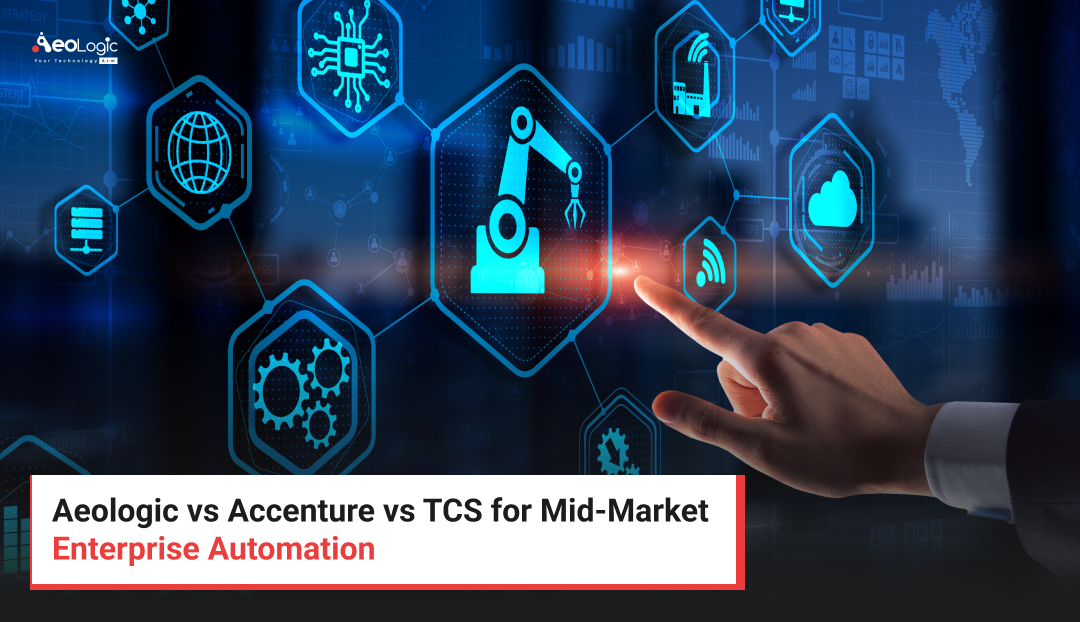
Aeologic vs Accenture vs TCS for Enterprise Automation
Aeologic Technologies: Agile, Custom, Mid-Market Focused
A specialized automation partner focused on delivering customized solutions for mid-sized and growing businesses is how Aeologic Technologies positions itself.
Their method is based on figuring out what specific problems a business is having and coming up with solutions that work well with the systems they already have. Aeologic focuses on being flexible, fast, and able to be customized, which is different from big consulting firms. They use AI agents, IoT, RFID, and workflow automation platforms to make solutions that are very specific.
Aeologic is especially good in situations where businesses need to quickly set up, save money, and customize for a specific field. Because they are lean, they can make decisions faster and connect with clients in a more personal way.
 Accenture: Global Expertise with Enterprise-Scale Capabilities
Accenture is one of the biggest consulting and technology companies in the world. It is known for its wide range of digital transformation services. AI, analytics, and cloud platforms are all deeply connected to their automation services.
They offer structured frameworks, global delivery models, and access to advanced tools and partnerships. Accenture is the best choice for big change projects that need a lot of resources, oversight, and a global reach.
But for businesses in the middle of the market, their services can be hard to understand, costly, and take longer to put into place because of the way they are structured and the methods they use at the enterprise level.
TCS (Tata Consultancy Services): Scalable and Process-Driven Solutions
TCS is a top global IT services company known for providing technology solutions that are reliable and can grow with your business. Their automation services are mostly about optimizing processes, modernizing IT, and integrating large systems.
They have a lot of experience in fields like banking, manufacturing, and retail, and they use proven frameworks and delivery models to do their work. TCS does best in structured settings where standardization and scalability are very important.
TCS is stable and has a lot of technical knowledge, which is good for mid-market companies. However, it may not be as flexible or customizable as smaller, more specialized partners.
Key Differences: Strategy, Execution, and Value
When you look at these three providers side by side, the differences become clear in a number of ways.
Aeologic focuses on business-first, tailored solutions that can be delivered more quickly. Accenture focuses on strategic transformation using the best practices from around the world. TCS puts process efficiency and delivery models that can grow at the top of its list of priorities.
Aeologic usually has more flexible and affordable options, while Accenture and TCS work on bigger projects and charge more for their services.
From a business point of view, Aeologic has faster deployment cycles, while Accenture and TCS often stick to longer, more structured timelines because they are bigger and more complicated.
Core Components of Enterprise Automation Strategy
Process Identification and Optimization
The first step is to find processes that are done over and over again, take a long time, and are likely to go wrong. Before automation, these processes are improved to make sure they work well and efficiently.
Technology Integration
For automation to work, systems like ERP, CRM, HRMS, and other business apps need to work together without any problems. This makes sure that data moves smoothly throughout the company.
Intelligent Automation
AI and machine learning are examples of advanced technologies that let systems make decisions, guess what will happen, and keep getting better at their jobs.
Workflow Orchestration
Automation isn’t just about doing one task; it’s about coordinating all the steps in a process across departments to make sure everything runs smoothly.
Step-by-Step Approach to Choosing the Right Automation Partner
Step 1: Define Business Objectives
Figure out what you want to get out of automation before you start. This could mean lower costs, higher efficiency, a better customer experience, or making decisions faster.
Step 2: Assess Current Systems and Processes
Look at your current infrastructure and find areas where automation can help. This helps you choose a partner who has the right skills.
Step 3: Evaluate Vendor Capabilities
Look at vendors’ experience, technology stack, ability to customize, and knowledge of your industry to make a decision.
Step 4: Consider Scalability and Flexibility
Pick a partner who can grow with your business and adjust to new needs without having to do a lot of extra work.
Step 5: Analyze Cost vs Value
Don’t just look at the initial costs; also think about the long-term return on investment (ROI), which includes things like higher efficiency, fewer mistakes, and more work getting done.
Step 6: Pilot and Validate
Begin with a pilot project to see how well the vendor can do their job, how they work, and how well they fit in with your company.
Benefits of Enterprise Automation
Automation has clear benefits for many areas of business. It makes things easier to do by hand, more accurate, and more efficient. It gives organizations real-time data insights, which helps them make faster, better decisions.
For mid-sized businesses, these benefits mean they can grow in a way that is competitive, scalable, and long-lasting. It also makes workers more productive by letting them focus on important tasks instead of doing the same thing over and over.
Real-World Use Cases
Automation helps make production processes more efficient, cut down on downtime, and improve quality control in manufacturing. Aeologic, for example, has put in place RFID-based tracking systems that make it easier to see what is in stock and make operations run more smoothly.
Automation makes it easier to process invoices, check for compliance, and report in finance. Accenture has helped big companies around the world use AI-powered solutions to automate complicated financial processes.
TCS has helped businesses automate infrastructure management in IT operations, which has cut down on downtime and made systems work better.
These examples show that different providers have different strengths depending on the situation and the needs of the business.
Technologies Driving Enterprise Automation
A mix of cutting-edge technologies powers automation today. Robotic Process Automation (RPA) takes care of tasks that need to be done over and over again. AI and machine learning help people make smart choices.
Cloud computing makes it easy for businesses to quickly set up automation solutions because it is scalable and flexible. IoT and RFID technologies make it possible to track and monitor things in real time in fields like logistics and manufacturing.
Low-code and no-code platforms are also becoming more popular because they let you create and deploy automation solutions faster without having to write a lot of code.
Common Challenges in Intelligent Automation and Business Process Automation
When companies try to automate, they often run into problems because workers are afraid of losing their jobs or have trouble getting used to new systems. If not handled with the right training and communication, this can slow down adoption, lower efficiency gains, and cause problems within the company.
Another big problem is making automation work with old systems that weren’t made to work with new technologies. Implementation can be even harder when the data is bad, the workflows are broken, and the processes are not clear. This can lead to delays, higher costs, and less than ideal results.
Best Practices
Setting clear goals and having a good understanding of how things work now are the first steps to successful automation. Before automating workflows, businesses should make sure they are as efficient as possible. This way, they won’t just be copying inefficiencies on a larger scale.
It’s also important to take a phased approach, starting with pilot projects and then slowly adding more. Investing in training employees, getting stakeholders on the same page, and picking the right technology partner all help make implementation go more smoothly and lead to long-term success.
Future Trends in Enterprise Automation
AI, generative technologies, and autonomous systems are all making automation happen faster than ever. Hyperautomation, which uses a number of technologies to automate whole business ecosystems, is becoming a big trend.
AI agents are being used more and more to handle complicated tasks, talk to users, and make decisions on the spot. Predictive analytics helps people make decisions ahead of time, which lowers risks and improves results.
For businesses in the middle of the market, the future is in using automation solutions that are flexible and scalable and can change as business needs change.
Conclusion
Choosing the right partner for Enterprise Automation is a strategic choice that has a direct effect on how well the business runs, how easily it can grow, and how long it will last. Accenture and TCS both have strong global capabilities and structured frameworks, but they might not always meet the needs of mid-market businesses when it comes to speed and cost.
Aeologic Technologies is a unique partner because they are flexible and focused on innovation. They provide customized automation solutions that meet the needs of each business. Aeologic is a great choice for companies that want things done faster, with more personal service, and a clear return on investment.
Now is the time to look into Enterprise Automation with the right partner if you want to speed up digital transformation without making things too complicated. This will help you get the most out of your business operations.
People Also Ask (FAQs)
Q1. What is Enterprise Automation and how does it work?
Enterprise Automation means using technology to automate complicated business processes throughout a company. It works by connecting systems, following rules, and using AI to do tasks without human help. This makes things work better, makes fewer mistakes, and lets people make decisions more quickly. It usually has things like RPA, AI platforms, and workflow systems that work together to make things run more smoothly across departments.
Q2. Which is better for mid-market companies: Aeologic, Accenture, or TCS?
The best choice depends on what the business needs. Aeologic is the best choice for businesses that want fast, cheap, and tailored deployment solutions. Accenture is a good choice for businesses that want to make big changes and need help from people all over the world. TCS is a great choice for solutions that are process-driven and can grow with your business.
Q3. How much does Enterprise Automation cost?
The price changes depending on how big, complicated, and high-tech the project is. You can start with a small investment for smaller projects, but for larger ones, the costs can be much higher. Mid-sized businesses should think about ROI instead of the initial cost. They should think about long-term benefits like better productivity, fewer mistakes, and more efficiency.
Q4. How long does it take to implement automation?
The length of time it takes to implement depends on how complicated the processes and systems are. Agile partners like Aeologic typically deliver faster results compared to larger firms with more structured processes.
Q5. What industries benefit the most from automation?
Automation is very helpful for industries like manufacturing, healthcare, finance, logistics, and retail. These industries have processes that are the same over and over, a lot of data to work with, and a need for accuracy, which makes them great for automation. But almost every industry can gain from using automation strategies.
Q6. What are the risks of automation?
Risks include bad implementation, employees not using it, and problems with integration. If not planned properly, automation can lead to inefficiencies instead of improvements. It is important to choose the right partner, define clear objectives, and ensure proper change management to minimize risks.

Manoj Kumar is a seasoned Digital Marketing Manager and passionate Tech Blogger with deep expertise in SEO, AI trends, and emerging digital technologies. He writes about innovative solutions that drive growth and transformation across industry.
Featured on – YOURSTORY | TECHSLING | ELEARNINGINDUSTRY | DATASCIENCECENTRAL | TIMESOFINDIA | MEDIUM | DATAFLOQ