Ask ten people in your organization what “AI automation” means, and you may get ten different answers. For some, it means a chatbot that answers customer questions. For others, it is a script that moves data from one spreadsheet to another. But a new category is changing that conversation entirely. It is one that operations, IT, and business leaders need to understand: Agentic AI for Enterprise Automation.
Unlike automation tools of the last decade, agentic AI does not simply follow a fixed script. It can also respond to a single prompt. Instead, it can reason through a goal and break it into smaller steps. It can make decisions along the way and use software tools independently. It can also adjust its approach when something does not go as planned.
In this guide, we’ll break down what agentic AI actually is, how it’s different from the automation and generative AI tools you already know, where it’s already delivering value inside real businesses, and what to watch out for before you roll it out. Whether you’re an operations leader trying to cut manual work, an IT director evaluating vendors, or simply curious about where enterprise technology is headed, this article will give you a grounded, practical understanding of Agentic AI for Enterprise Automation — without the hype.
What is Agentic AI?
Agentic AI refers to artificial intelligence systems that can autonomously plan, make decisions, and take multiple actions toward a goal. These systems are often called AI agents. They can use tools, software, and business data with limited human intervention.
Instead of responding to one instruction, an agentic AI system can work toward a broader objective. It can divide that objective into smaller tasks. It can then decide which tools or APIs to use. After completing each step, it can evaluate the result and adjust its approach when necessary.
That is the core idea behind Agentic AI for Enterprise Automation. It gives business processes a kind of digital “driver” instead of a static set of instructions.
 How Agentic AI Differs From Traditional Automation and Generative AI
It’s easy to lump agentic AI in with other buzzwords, but it solves a genuinely different problem than the tools that came before it.
Agentic AI vs. Robotic Process Automation (RPA)
Traditional RPA is rule-based. It automates repetitive, predictable tasks — clicking buttons, copying fields, moving files — exactly the way a human programmed it to. It’s reliable, but brittle: change the layout of a webpage or the format of an invoice, and the bot breaks.
Agentic AI, by contrast, can interpret unstructured information, reason about context, and decide how to handle a scenario it wasn’t explicitly programmed for. Where RPA executes a fixed script, agentic AI pursues a goal and figures out its own path to get there. That’s a meaningful upgrade for any organization that has hit the ceiling of what rule-based bots can handle.
Agentic AI vs. Generative AI and Chatbots
Generative AI tools like chatbots and copilots are reactive. You give them a prompt, they give you an output — text, an image, a summary — and the interaction ends there. They’re excellent at producing content but don’t typically take independent action in other systems.
Agentic AI builds on top of generative AI’s reasoning ability but adds autonomy and “tool use.” An agentic system doesn’t just draft an email reply — it can read the incoming message, check a CRM for account history, decide on the right next step, send the reply, update the record, and flag the deal for a human only if something looks unusual. That loop of perceive, decide, act, and verify is what separates a true AI agent from a conversational assistant.
How Does Agentic AI Work?
Underneath the term, most agentic AI systems share a similar architecture, built around four core capabilities:
- Perception – The agent gathers information from its environment: emails, databases, APIs, documents, or user input.
- Reasoning and planning – A large language model (or a specialized reasoning engine) breaks the goal into a sequence of smaller steps and decides the order in which to tackle them.
- Tool use and action – The agent calls external tools — a CRM, an ERP system, a search engine, a code interpreter — to actually carry out each step, rather than just describing what should happen.
- Memory and feedback – The agent tracks what it has already done, evaluates whether the outcome matches the goal, and adjusts its plan if a step fails or new information appears.
Many enterprise deployments also add a fifth layer: human-in-the-loop checkpoints, where the agent pauses for approval before taking a high-stakes or irreversible action, like issuing a refund above a certain amount or sending an external legal document. This governance layer is often what separates a safe, production-ready deployment of Agentic AI for Enterprise Automation from an experimental proof of concept.
Why Agentic AI for Enterprise Automation Matters Now
Three trends are converging to make this the right moment for enterprises to pay attention:
- Large language models got good enough to reason, not just generate. Multi-step planning and tool use are now reliable enough for real business workflows, not just demos.
- The labor equation changed. Many enterprises are managing hiring freezes, tight budgets, and growing backlogs of manual, repetitive work — exactly the kind of work agentic systems are built to absorb.
- Integration got easier. Standardized ways for AI models to connect to business software (APIs, connectors, and emerging protocols) mean agents can now plug into existing systems instead of requiring a ground-up rebuild.
Together, these shifts are why analysts and enterprise technology leaders increasingly describe agentic AI not as a future trend but as the current frontier of operational efficiency — and why Agentic AI for Enterprise Automation is quickly becoming a standing line item in digital transformation roadmaps.
Key Benefits of Agentic AI for Enterprise Automation
When implemented thoughtfully, agentic AI offers advantages that go well beyond simple time savings:
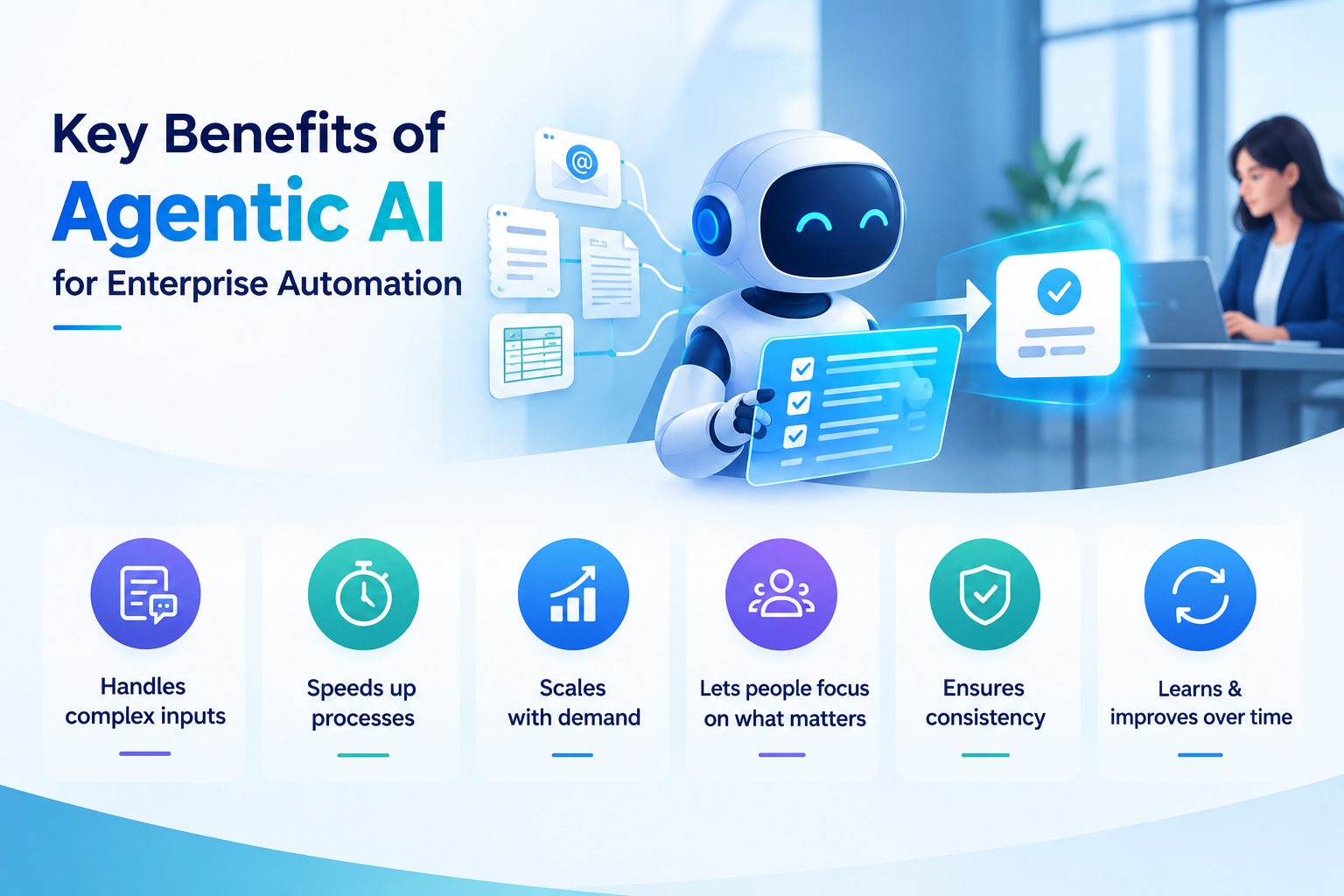
- Handles unstructured, judgment-based work. Unlike rule-based bots, agents can process messy inputs — a vague customer email, a scanned invoice, a half-filled form — and still make a reasonable decision.
- Reduces end-to-end cycle time. Because an agent can chain multiple steps together without waiting on a human for each handoff, entire processes can finish in minutes instead of days.
- Scales without a linear increase in headcount. A single agentic system can handle a spike in support tickets, invoices, or requests without the lead time required to hire and train staff.
- Frees skilled employees for higher-value work. Routine triage, data entry, and first-pass analysis move to the agent, while people focus on judgment calls, relationship management, and strategy.
- Improves consistency. A well-designed agent applies the same logic and compliance checks every time, reducing the human-error variability that comes with manual processes.
- Creates a feedback loop for continuous improvement. Because agentic systems log their reasoning and actions, enterprises gain visibility into where processes break down — insight that’s harder to get from a purely manual workflow.
 Real-World Use Cases of Agentic AI in the Enterprise
Agentic AI for Enterprise Automation isn’t a single tool — it’s a pattern that applies across almost every department. Here’s where it’s already showing up.
Finance and Accounting
Agents can read incoming invoices, match them against purchase orders, flag discrepancies, and route only the exceptions to a human for review — collapsing a multi-day accounts payable cycle into hours. In FP&A, agents can pull data from multiple systems, build draft variance reports, and surface anomalies before a monthly close.
Customer Support
Instead of a chatbot that can only answer FAQs, an agentic support system can look up an order, check a refund policy, process an eligible return, update the customer record, and escalate only the ambiguous cases to a human agent — closing routine tickets end-to-end.
IT Operations
Agents can monitor system alerts, diagnose the likely root cause of an incident, attempt a standard remediation (like restarting a service or clearing a cache), and open a detailed ticket for engineers only when the issue needs human judgment.
Supply Chain and Procurement
An agent can track inventory levels, compare vendor pricing and lead times, draft purchase orders when stock runs low, and adjust forecasts as new sales data comes in — reducing the manual monitoring that procurement teams typically do by hand.
HR and Talent
Agentic systems can screen resumes against role requirements, schedule interviews across multiple calendars, answer candidate questions about the process, and draft onboarding checklists tailored to a new hire’s role and department.
| Department | Traditional Approach | Agentic AI for Enterprise Automation |
|---|---|---|
| Finance | Manual invoice matching | Agent matches, flags exceptions, routes only outliers |
| Customer Support | Scripted chatbot FAQs | Agent resolves tickets end-to-end, escalates edge cases |
| IT Operations | Human triages every alert | Agent diagnoses and remediates common issues automatically |
| Procurement | Manual stock monitoring | Agent tracks inventory and drafts purchase orders |
| HR | Manual resume screening | Agent screens, schedules, and answers candidate FAQs |
Challenges and Risks of Implementing Agentic AI for Enterprise Automation
No honest discussion of this technology is complete without the trade-offs. Enterprises considering Agentic AI for Enterprise Automation should plan for:
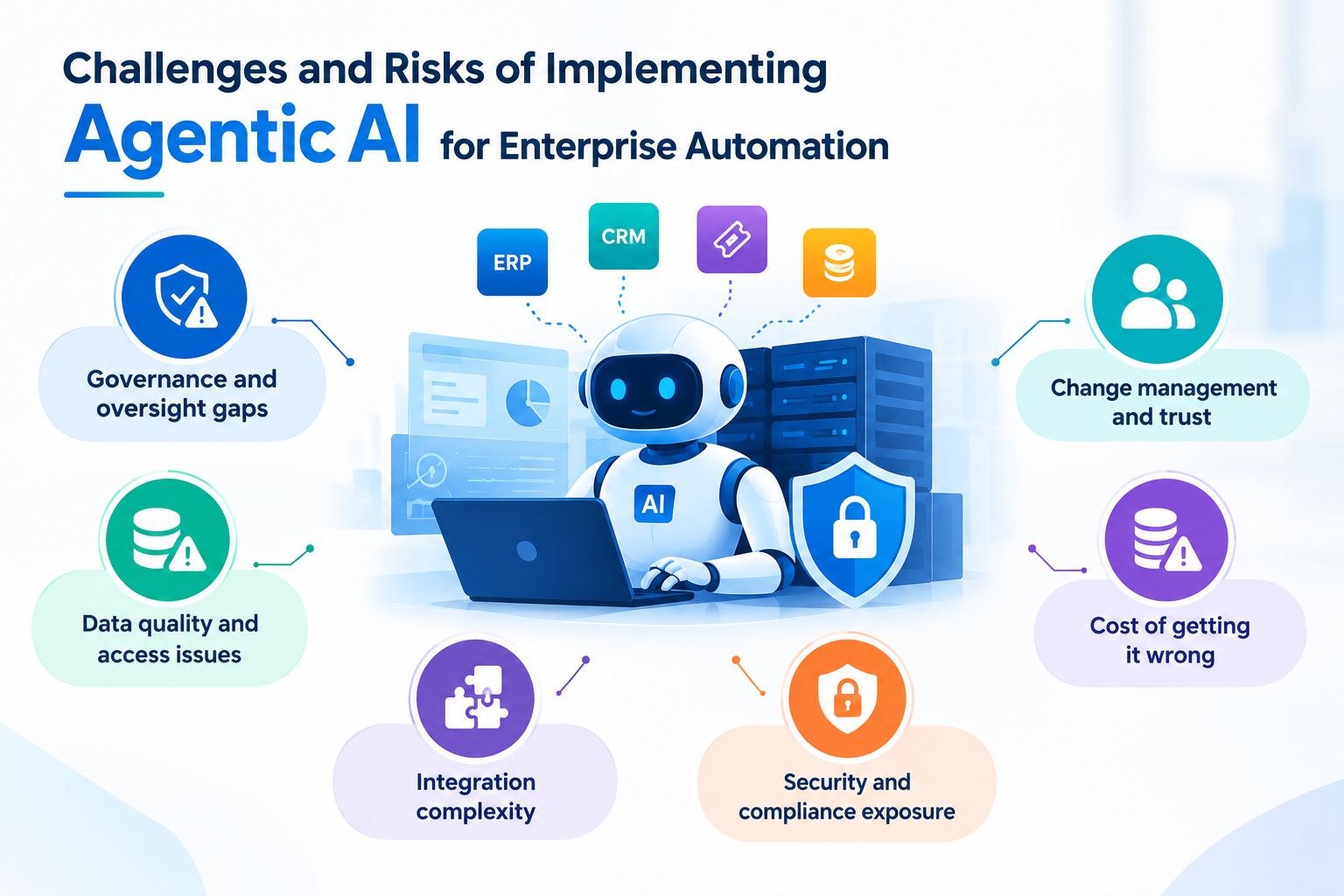
- Governance and oversight gaps. Giving an AI system the ability to take action — not just generate text — raises the stakes if it makes a wrong call. Clear approval thresholds and audit trails are essential.
- Data quality and access issues. An agent is only as good as the systems it can see. Fragmented or poorly documented data sources will limit what any agent can reliably do.
- Integration complexity. Connecting an agent securely to core enterprise systems (ERP, CRM, ticketing, financial platforms) takes real engineering work, not just a plug-and-play setup.
- Security and compliance exposure. An autonomous agent with system access is a new kind of attack surface and a new compliance consideration, particularly in regulated industries like finance and healthcare.
- Change management and trust. Employees need to understand what the agent can and can’t do, and leadership needs realistic expectations about where human review is still required.
- Cost of getting it wrong. A poorly scoped agent that takes the wrong action autonomously can create more rework than it saves, which is why most successful deployments start narrow and expand gradually.
 Best Practices for Adopting Agentic AI for Enterprise Automation
Organizations that get the most value tend to follow a similar playbook:
- Start with a single, well-bounded process. Pick a workflow with clear rules and measurable outcomes — like invoice matching or first-line support triage — before expanding to more ambiguous work.
- Define clear escalation rules. Decide upfront which decisions the agent can make independently and which ones require human sign-off.
- Build in observability. Make sure every action an agent takes is logged, explainable, and auditable — this is non-negotiable for regulated industries and good practice everywhere else.
- Involve the people doing the work today. The employees currently handling a process usually know its edge cases better than anyone; their input prevents costly blind spots.
- Measure before and after. Establish a baseline for cycle time, error rate, and cost before deployment so you can prove (or disprove) impact with real numbers.
- Treat it as an ongoing program, not a one-time project. Agentic systems improve with tuning and feedback — budget for iteration, not just initial setup.
The Future of Agentic AI for Enterprise Automation
Most industry watchers expect the next few years to bring tighter integration between agentic systems and everyday enterprise software, more standardized protocols for agents to safely communicate with each other, and increasingly sophisticated multi-agent setups — where several specialized agents coordinate on a larger process, each handling a piece of the puzzle. As trust and governance frameworks mature, expect the scope of what organizations are comfortable automating to expand steadily, moving Agentic AI for Enterprise Automation from a pilot-stage experiment into a standard layer of how enterprise operations run.
 Key Takeaways
- Agentic AI goes beyond chatbots and RPA by planning, deciding, and acting toward a goal with minimal human input.
- Agentic AI for Enterprise Automation is already delivering measurable value in finance, support, IT, procurement, and HR.
- The biggest risks are governance, data quality, and integration complexity — not the underlying AI capability itself.
- Successful adoption starts narrow, with clear escalation rules and strong observability, then expands over time.
Conclusion
Agentic AI for Enterprise Automation marks a real shift in what businesses can hand off to software — not just repetitive clicks, but genuine multi-step work that used to require a person’s judgment. From finance and customer support to IT operations and HR, enterprises are already using agentic systems to compress cycle times, absorb routine decision-making, and free their teams for higher-value work.
The technology isn’t a magic fix, and it isn’t risk-free: governance, data quality, and integration still require real planning. But for organizations willing to start with a single well-scoped process, build in clear oversight, and iterate from there, Agentic AI for Enterprise Automation offers one of the clearest paths to measurable operational gains available today. Aeologic Technologies helps organizations approach this transformation with practical, business-focused AI automation strategies.
Frequently Asked Questions (FAQs)
Q1. What is agentic AI in simple terms?
Agentic AI is artificial intelligence that can plan, decide, and take multi-step actions on its own to reach a goal, rather than just answering a single prompt. It perceives information, reasons about the best next step, uses software tools to act, and checks whether the outcome matches the goal — adjusting its approach if it doesn’t.
Q2. How is Agentic AI for Enterprise Automation different from RPA?
RPA follows fixed, pre-programmed rules and breaks when a process changes. Agentic AI for Enterprise Automation can interpret unstructured information, make context-aware decisions, and handle variations in a process without being explicitly reprogrammed for every scenario.
Q3. Is agentic AI the same as a chatbot?
No. A chatbot responds to prompts with text. Agentic AI goes further by taking real actions in other systems — updating records, sending approved communications, or completing transactions — as part of pursuing a broader goal.
Q4. What industries benefit most from Agentic AI for Enterprise Automation?
Finance, customer support, IT operations, supply chain, and HR see some of the fastest returns, since these departments handle high volumes of repetitive, rules-adjacent work that still requires some judgment — exactly where agentic AI performs best.
Q5. Is agentic AI safe for enterprise use?
It can be, with the right safeguards: clear escalation rules, human approval for high-stakes actions, detailed audit logs, and strong data access controls. Enterprises that skip governance are the ones most likely to run into trouble.
Q6. How much does it cost to implement agentic AI?
Costs vary widely based on scope, the number of systems an agent needs to integrate with, and whether you build in-house or use a vendor platform. Most organizations start with a single, narrow use case to control cost and prove ROI before expanding.
Q7. Will agentic AI replace jobs?
It will change many jobs more than eliminate them outright. Agentic AI tends to absorb repetitive, lower-judgment tasks, freeing employees to focus on relationship management, exceptions, and strategic work — though workforce planning should account for real shifts in required skills.
Q8. What’s the difference between agentic AI and multi-agent systems?
Agentic AI describes the general capability of an AI system to act autonomously toward a goal. A multi-agent system is a specific architecture where several specialized agents coordinate — each handling part of a larger process — to complete work no single agent could manage alone.