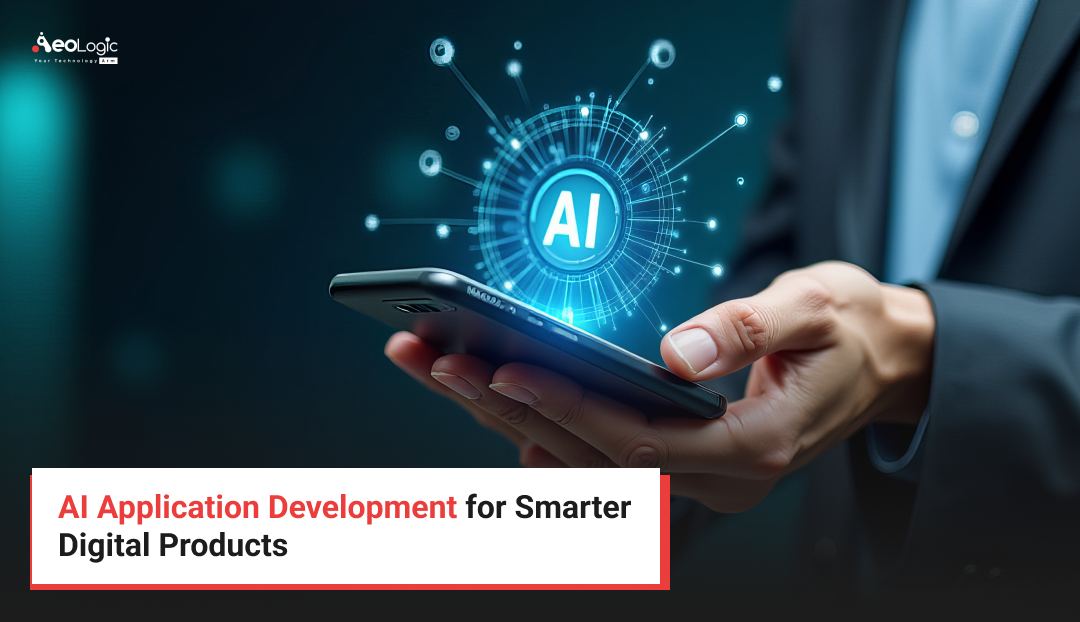
The functionality of digital products is no longer the only criterion used to evaluate them. Users frequently lack awareness of the intricate systems operating in the background and expect intelligence, personalisation, speed, and adaptability. AI application development is now a key component of contemporary digital transformation due to this change in expectations.
Artificial intelligence is changing the way software products are created, developed, and used. Examples include intelligent chatbots, fraud detection systems, adaptive mobile apps, and predictive recommendations on eCommerce platforms. Companies that previously relied on applications with static logic are now making significant investments in AI-powered systems that can learn, adapt, and make decisions instantly.
What is AI Application Development?
The process of creating, developing, implementing, and maintaining software applications that make use of artificial intelligence technologies like machine learning, natural language processing, computer vision, and predictive analytics is known as AI application development.
AI-driven applications, in contrast to traditional ones that adhere to predetermined guidelines, can:
- Gain knowledge from data
- Boost performance over time
- Adjust to fresh inputs
- Make choices based on probability
- Provide individualised user experiences
Software engineering, data science, and AI modelling are the fundamental components of AI-based software development. In addition to writing code, developers also manage data pipelines, train models, assess predictions, and continuously improve system behaviour.
A conventional recommendation engine, for instance, might show the same products to each user. Built through AI-based software development, a recommendation system driven by AI examines browsing habits, preferences, past purchases, and even real-time data.
 Why AI Application Development is Important in the Modern World
Due to multiple simultaneous global changes, the significance of AI application development has increased dramatically.
Intelligent experiences are now expected by digital users. Consumers want seamless cross-platform interactions, quicker responses, and pertinent recommendations. However, in order to remain competitive, businesses require automation, efficiency, and data-driven decision-making.
By converting unprocessed data into useful intelligence, AI-based software development helps close this gap.
In the current setting:
- Data volumes are enormous and continuously increasing.
- Making decisions by hand is laborious and prone to mistakes.
- Static apps are unable to satisfy changing user demands.
- Experience is becoming a more important factor in competition than just features.
Organisations can transition from reactive operations to proactive and predictive strategies with the help of AI-powered applications. Whether it’s forecasting demand, detecting anomalies, or personalizing content, AI-driven systems provide insights that were previously impossible at scale.
Additionally, companies can automate complicated procedures without compromising precision or quality thanks to AI-based software development. This is particularly crucial in sectors where customer trust and revenue are directly impacted by speed and accuracy.
Benefits of Developing AI Applications
AI-based software development adds value to a digital product in a number of ways. Its advantages extend well beyond automation.
Improved Decision-Making
Real-time analysis of massive datasets by AI apps reveals patterns and trends that people might miss. Better forecasting, more effective strategies, and well-informed decisions result from this.
AI-powered analytics tools, for instance, can forecast customer attrition, optimise pricing, or spot operational inefficiencies before they become expensive issues.
Improved User Experience
Personalisation is one of the biggest benefits of AI-powered application development. Applications are able to modify recommendations, content, and interfaces.
This results in:
- Increased involvement
- Enhanced retention
- A rise in client satisfaction
Instead of being viewed as anonymous visitors, users feel understood.
Automation and Operational Efficiency
By automating time-consuming and repetitive tasks, AI-driven applications lessen manual workloads. AI increases productivity while lowering errors in everything from automated customer service to intelligent document processing.
Teams are able to concentrate on higher-value tasks rather than repetitive tasks as a result.
Scalability Without Relative Expenses
More personnel, infrastructure, and resources are frequently needed for traditional scaling. Scalability is more sustainable when AI-powered systems can manage rising demand with little additional cost.
An AI chatbot, for instance, can manage thousands of customer interactions at once without the need for extra human agents.
Constant Improvement Over Time
AI programs get better as they process more data, in contrast to static software. Performance steadily improves with appropriate monitoring and retraining.
How Companies Develop AI Applications
AI-powered application development is not just for big businesses or experimental projects. It is being used by companies of all sizes to solve real-world issues and obtain a competitive edge.
Knowledgeable Customer Service
Artificial intelligence (AI)-driven chatbots and virtual assistants manage routine questions, offer prompt answers, and refer complicated problems to human agents when necessary. These systems gain accuracy over time by learning from interactions.
Forecasting and Predictive Analytics
Businesses use AI-driven apps to predict demand, sales, inventory requirements, and consumer behaviour. This enhances planning accuracy, minimises waste, and streamlines supply chains.
Risk management and fraud detection
AI programs in eCommerce and finance examine transaction patterns to spot irregularities and stop fraud in real time. These systems adjust to novel fraud strategies as they emerge.
Automation of Processes
Workflow automation tools driven by AI greatly reduce processing times by streamlining business processes like document classification, invoice processing, and approval workflows.
Product Suggestions and Customization
Recommendation engines that increase engagement and revenue by making relevant product or content recommendations are made possible by AI-powered application development for everything from streaming platforms to online marketplaces.
Industry Use Cases of AI Application Development
Instead of being a specialized technology, AI-powered application development is now a cross-industry capability.
Medical care
Medical imaging analysis, patient risk prediction, virtual health assistants, and customized treatment recommendations are all aided by AI-powered applications. These systems increase operational effectiveness and diagnostic precision.
E-commerce and retail
AI applications are used by retailers for inventory optimization, dynamic pricing, demand forecasting, and personalized shopping experiences. AI-driven insights enable companies to react swiftly to shifts in the market.
Banking and Finance
Algorithmic trading, robo-advisory services, fraud detection, and credit scoring are all supported by AI applications. AI is used by financial institutions to enhance customer satisfaction, security, and compliance.
Production
AI is used in smart manufacturing applications to forecast equipment failures, optimize production schedules, and track quality control in real time.
Education
Personalized learning paths and better educational outcomes are made possible by AI-powered learning platforms that modify content according to student performance.
Technologies Used in AI Application Development
Advanced technologies, development approaches, and data-driven workflows are all essential to AI-powered application development. Instead of viewing AI as a mystery, businesses can make well-informed decisions by comprehending these elements.
Models for Machine Learning
The majority of AI applications are built on machine learning. To find trends and forecast outcomes, models are trained on past data. Depending on the use case, developers could make use of:
- Supervised learning for prediction and classification
- Finding patterns through unsupervised learning
- For decision-making systems, reinforcement learning
Natural Language Interpretation
Applications can comprehend, interpret, and produce human language thanks to NLP. Chatbots, voice assistants, sentiment analysis tools, and document processing systems all make extensive use of it.
Vision in Computers
AI programs can examine pictures and videos thanks to computer vision. Use cases for this technology include surveillance systems, medical imaging, facial recognition, and quality inspection.
Pipelines and Data Engineering
Data quality is critical to the development of successful AI applications. Data pipelines gather, purify, process, and supply AI models with data. Poor data leads to poor outcomes, regardless of model sophistication.
Infrastructure for Cloud and MLOps
In order to enable scalable training, inference, and monitoring, modern AI applications are frequently implemented in cloud environments. Models are versioned, tested, deployed, and retrained effectively thanks to MLOps procedures.
Challenges in AI Application Development
Despite its potential, AI-powered application development has practical issues that businesses need to carefully consider.
Problems with Data Quality and Availability
AI models need a lot of high-quality data. Unreliable results may arise from incomplete, biased, or inconsistent data.
Solution:
Investing in preprocessing pipelines, data governance, and ongoing data validation procedures.
Model Prejudice and Ethical Issues
Unintentionally reinforcing bias in training data can result in unfair or discriminatory outcomes for AI applications.
Solution:
Apply ethical AI frameworks throughout development, use a variety of datasets, and carry out bias audits.
Integration with Current Systems
Integrating AI applications with legacy software and workflows is a challenge for many organizations.
Solution:
To guarantee more seamless integration, use microservices, APIs, and modular architectures.
Scalability and Performance Issues
While AI models may perform well in testing, real-world traffic and data loads can cause them to falter.
Solution:
Make use of stress testing, cloud-native infrastructure, and ongoing performance tracking.
Gaps in Skills and Talent
A combination of data science, engineering, and domain knowledge is needed for AI-driven systems.
Solution:
Use hybrid development models, work with seasoned AI development partners, or upskill internal teams.
The Best Methods for Developing Successful AI Applications
Businesses that are successful with AI don’t rush into experimentation; instead, they take methodical, structured approaches.
Identify a clear business problem first
AI shouldn’t exist for its own sake, but rather to address a particular issue. Prior to selecting technologies, establish quantifiable goals.
Prioritize Data Strategy
Model development frequently takes less time than data preparation. Data that is well-governed, labeled, and clean is essential.
Create Transparent and Explainable Models
Particularly in regulated industries, stakeholders must comprehend how AI applications make decisions.
Continue to Test, Monitor, and Iterate
AI applications require ongoing monitoring to ensure accuracy, relevance, and fairness as conditions change.
Design for Human-AI Cooperation
Instead of completely replacing human decision-making, the most successful AI applications complement it.
Future Trends of AI Application Development
The field of AI application development is developing quickly, and a number of trends are influencing its future.
Applications Driven by Generative AI
Applications using generative models are revolutionizing design, content production, and software development itself.
AI-Driven Product Development
AI applications are moving closer to users through edge computing, enabling faster decisions with lower latency.
Real-Time Intelligence and Edge AI
Through edge computing, AI applications are getting closer to users, allowing for quicker decisions with reduced latency.
Control and Conscientious AI
Governments and industries are introducing frameworks to ensure ethical, transparent, and secure AI usage.
AI Platforms with Low and No Code
By enabling non-technical teams to create intelligent applications with little coding, these platforms will democratise AI-driven systems.
Conclusion
AI application development is now a fundamental skill for creating more intelligent and flexible digital products, rather than a new trend. Businesses can achieve new efficiencies, provide outstanding user experiences, and make better decisions at scale by carefully embracing AI.
But technology is not the only factor that determines success. Strong execution procedures, ethical considerations, high-quality data, and a clear strategy are all essential. In an increasingly sophisticated digital economy, companies that approach AI-driven systems with a long-term perspective will be in the best position to innovate and compete.
Businesses like Aeologic Technologies show how firms can turn concepts into intelligent, scalable applications that have a real-world impact by fusing AI expertise with real-world business knowledge.
Frequently Asked Questions
Q1. What is AI Application Development in simple terms?
AI Application Development is the process of building software applications that can learn from data, make intelligent decisions, and improve over time.
Q2. What distinguishes AI software development from conventional software development?
While AI applications adapt and change based on data and learning models, traditional software adheres to set rules.
Q3. Is AI software development necessary for small businesses?
Indeed, AI-powered solutions can help small businesses compete with larger companies, automate tasks, and enhance customer satisfaction.
Q4. Which sectors gain the most from the development of AI applications?
The industries that stand to gain the most are healthcare, finance, retail, manufacturing, education, and logistics.
Q5. Is it costly to develop AI applications?
AI development is now more accessible than ever thanks to cloud infrastructure and scalable tools, though costs vary.
Q6. How much time does it take to develop an AI application?
Timelines can range from a few weeks to several months, depending on complexity, data accessibility, and integration requirements.
Q7. What abilities are necessary for developing AI applications?
Data science, machine learning, software engineering, cloud infrastructure, and domain knowledge are important competencies.