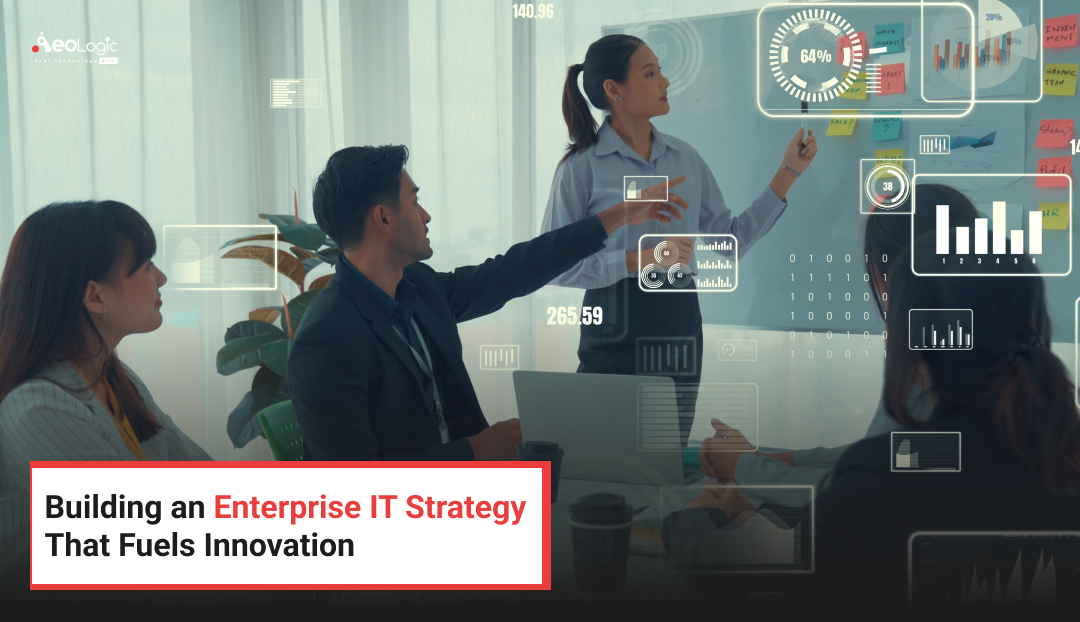
Every organization, regardless of industry, depends significantly on technology to function, expand, and maintain its competitiveness in today’s hyperconnected and digitally driven world. However, success cannot be achieved solely through technology. A well-thought-out enterprise IT strategy that drives innovation, aligns business objectives with technological capabilities, and gets the company ready for quick change is what really makes top businesses stand out.
An enterprise IT strategy is now a strategic engine that propels transformation, operational excellence, and long-term competitiveness rather than merely a road map for managing IT assets. Companies that don’t modify their IT strategy run the risk of falling behind, becoming irrelevant in the market, or experiencing avoidable operational inefficiencies.
The True Significance of an Enterprise IT Strategy
A comprehensive, forward-thinking plan that outlines how technology will support an organization’s overarching business objectives, vision, and operational requirements is called an enterprise IT strategy. It is a strategic framework for how technology enables a business to innovate and grow, and it goes far beyond simply choosing software, updating hardware, or maintaining networks.
An effective enterprise IT strategy includes:
- Coordinating IT projects with corporate goals
- Establishing technology governance and standardized procedures
-
Optimizing IT investments
- Making sure you’re ready for digital
- Encouraging decision-making based on data
- Facilitating sustained creativity and adaptability
It acts as the foundation for digital transformation, operational modernization, cybersecurity resilience, and customer experience enhancement.
Enterprise IT Strategy’s Increasing Significance in the Modern World
Businesses have been forced to reconsider how they use technology due to the rapid growth of AI, automation, cloud computing, data analytics, and cybersecurity risks. An enterprise IT strategy is essential in this setting for a number of reasons:
Technology advances more quickly than companies can adjust on their own
Ineffective operations, redundant tools, and disjointed systems are the results of organizations lacking a clear IT blueprint.
Customer expectations that prioritize digital
Consumers anticipate smooth online interactions, tailored experiences, quick service, and round-the-clock assistance. Businesses can meet and surpass these expectations with a solid IT strategy.
Increased threats to cybersecurity
Consequently, businesses need a plan that guarantees security, compliance, and resilience because cyberattacks are becoming more frequent and sophisticated.
Distributed teams and remote work
A strategic approach guarantees infrastructure that facilitates hybrid workplaces, secure access, and collaboration tools.
Increasing competition from digitally advanced companies
Businesses that don’t modernize run the risk of losing market share to rivals who innovate more quickly.
To put it briefly, the value of an enterprise IT strategy is found in its capacity to support businesses in remaining flexible, economical, future-ready, and customer-focused.
 Important Advantages of Putting in Place a Robust Enterprise IT Strategy
There are many significant advantages to a well-thought-out enterprise IT strategy:
Enhanced Efficiency in Operations
Through automation, centralized systems, and optimized workflows, a unified IT framework reduces duplication, simplifies procedures, and boosts productivity.
Improved Coordination of Technology and Business
IT is no longer isolated. A solid plan guarantees that each technology investment directly advances business objectives and yields a quantifiable return on investment.
Increased Compliance and Cybersecurity
A proactive approach improves data protection, lowers risks, and guarantees compliance in light of growing cyberattacks and regulatory requirements.
Encouraging Innovation
Experimenting with new technologies like AI, IoT, cloud-native architectures, RPA, and blockchain is made easier in a future-ready IT environment.
Optimization of Costs
Businesses can reduce costs while increasing performance by getting rid of out-of-date systems, combining tools, and utilizing affordable cloud platforms.
Improved Decision-Making
Businesses that are data-driven outperform their rivals. High-quality data management, analytics integration, and immediate insights are guaranteed by a sound IT strategy.
Long-Term Growth and Scalability
Businesses can scale operations, enter new markets, and quickly adjust to change with the help of a flexible IT blueprint.
How Enterprise IT Strategy Operates (and How Companies Use It)
An effective enterprise IT strategy usually takes a methodical approach:
Evaluation and Audit
Organizations start by assessing their existing infrastructure, procedures, systems, skills, and gaps.
Setting Vision and Goals
IT teams work together with leadership to comprehend business objectives, including innovation, growth, efficiency, and customer experience.
Development of Technology Roadmaps
This involves choosing:
- Platforms for technology
- Plans for implementing cloud computing
- Possibilities for automation
- Frameworks for security
- Methods of data management
- Plans for application modernization
Integration and Execution
Once the roadmap is defined, enterprises implement the required technologies, integrate systems, and modernize existing processes.
Optimization and Governance
The tech strategy is kept current, safe, and performance-focused through ongoing monitoring.
Iteration and Innovation
To future-proof operations, businesses embrace cutting-edge technologies like AI, machine learning, edge computing, and IoT.
Businesses like Aeologic Technologies assist businesses with modernization, implementation, consulting, and ongoing innovation support, making sure the IT strategy changes to reflect market trends.
Applications of Enterprise IT Strategy in Industry
A strategic IT blueprint is useful in a variety of industries:
Manufacturing
- Implementation of smart factories
- IoT-powered activities
- Predictive upkeep
- Automation of robotics
Medical care
- Electronic medical records
- Infrastructure for telemedicine
- AI diagnostics
- Compliance and data security
Retail
- Experiences across multiple channels
- Tailored suggestions
- Digitalization of the supply chain
- Automation of inventory
Finance and Banking
- Online banking systems
- Systems for detecting fraud
- Blockchain-based solutions
- Adherence to regulations
Logistics
- Fleet monitoring
- Route optimization and automation
- Systems for managing warehouses
Real Estate
- Intelligent construction solutions
- Platforms for property management
- AI-driven appraisal
- Virtual tours of properties
An enterprise IT strategy serves as the foundation for modernization and competitive advantage in each of these sectors.
Technologies and Approaches Used in Enterprise IT Strategy
Today’s IT strategies are shaped by a number of contemporary technologies and approaches:
Cloud Computing
Allows for easier infrastructure management, lower costs, scalability, and flexibility.
Machine Learning and Artificial Intelligence
Drives advanced customer experiences, data intelligence, automation, and predictive analytics.
RPA, or robotic process automation
Helps increase workflow efficiency, decrease human error, and automate repetitive tasks.
Architecture for Cybersecurity
Advanced threat detection, access controls, encryption standards, and zero-trust frameworks.
Agile Methodologies and DevOps
Promotes operational effectiveness, quick innovation, and continuous delivery.
Edge Computing and IoT
Propels smart device integrations, predictive capabilities, and real-time monitoring.
Business Intelligence and Data Analytics
Makes operational optimization and strategic decision-making possible.
Frameworks for Enterprise Architecture
IT governance and planning are standardized using TOGAF, ITIL, and COBIT.
To optimize value and spur innovation, businesses like Aeologic Technologies apply these technologies using an integrated, business-first methodology.
Challenges in Developing an Enterprise IT Strategy (and Workable Solutions)
Although crucial, creating an enterprise IT strategy is not without its difficulties. The following are the most typical challenges and how businesses get past them:
Challenge 1: Disjointed Legacy Systems
Innovation is slowed down and integration is made more difficult by legacy tools.
Solution: Implement a phased modernization strategy that includes microservices architecture, API integrations, and cloud application migration.
Challenge 2: Financial Limitations
Businesses frequently overspend on obsolete or unnecessary technologies.
Solution:
Conduct IT cost optimization assessments and prioritize high-impact investments aligned with business outcomes.
Challenge 3: Dangers to Cybersecurity
Attacks are becoming more frequent, so proactive security measures are needed instead of reactive ones.
Solution:
Use AI-enabled security tools, zero-trust models, and ongoing monitoring.
Challenge 4: Opposition to Change
Workers may have trouble using new tools or be afraid of automation.
Solution:
Establish employee training, change management initiatives, and phased rollouts.
Challenge 5: Deficits in Skills
New skills are needed for advanced technologies.
Solution:
Collaborate with IT consulting companies like Aeologic Technologies, hire specialized personnel, or upskill teams.
Challenge 6: Data Silos
As a result, efficiency and visibility are decreased when data is confined to distinct systems.
Solution:
Use centralized data lakes, unified dashboards, and integrated analytics tools.
Top Techniques for an Effective Enterprise IT Plan
Therefore, businesses should adhere to these tried-and-true best practices in order to develop a strong, innovative IT strategy:
Put Business Alignment Above Technology Adoption
Every IT choice must be in line with a business objective, whether it be cost effectiveness, growth, innovation, or customer experience.
Adopt an Architecture Fit for the Future
To promote long-term agility, make use of modular systems, scalable cloud platforms, and adaptable infrastructure.
Pay Attention to User Experience
In addition, technology should simplify workflows for customers and employees rather than make them more complicated.
Assure Sturdy Governance
For standardized procedures, security enforcement, and compliance management, use frameworks such as ITIL or TOGAF.
Make Data-Driven Decisions Possible
Invest in real-time reporting tools, AI-driven insights, analytics, and dashboards.
Seek Ongoing Innovation
Try out new technologies like edge computing, IoT automation, and generative AI on a regular basis.
Collaborate With Skilled Technology Providers
Furthermore, collaborating with professionals such as Aeologic Technologies enhances innovation, lowers risks, and speeds up implementation.
Future Developments Affecting Enterprise IT Strategy
Enterprise IT strategy will be dynamic and driven by innovation in the future. The top trends changing the landscape are as follows:
AI-Powered Businesses
Businesses will use generative AI, automation models, and AI agents to improve decision-making, customer service, and productivity.
The New Standard: Cloud-Native Architecture
Enterprise IT frameworks will be dominated by hybrid and multi-cloud ecosystems.
Integration of Quantum Computing
Early adopters will use quantum capabilities to solve complicated problems and process data in real time.
Excessive automation
End-to-end business processes will be automated through the use of AI, RPA, machine learning, and low-code platforms.
Mesh Architectures for Cybersecurity
Security will develop into distributed, dynamic frameworks that can adjust to intricate digital ecosystems.
Intelligence on the Edge
By bringing real-time processing closer to the user, edge computing and smart devices will lower latency and increase responsiveness.
IT Infrastructure for Sustainability
Energy-efficient technologies and green computing will become crucial for business compliance and brand reputation.
Conclusion
One of the most crucial things an organization can do to stay competitive, flexible, and prepared for the future is to develop a strong, innovative enterprise IT strategy. In an increasingly fast-paced digital environment, it supports scalable growth, facilitates better business decisions, and lays the groundwork for digital transformation.
The proper IT strategy turns technology from a cost center into a strategic driver of success, from boosting cybersecurity and cutting expenses to enabling automation and enhancing customer experiences.
Businesses that adopt cutting-edge technology, adhere to best practices, and collaborate with reputable specialists like Aeologic Technologies put themselves at the forefront of innovation and position themselves to be leaders in their fields for many years to come.
FAQs
Q1. What is an IT strategy for an enterprise?
It is a long-term plan that synchronizes an organization’s operations, technology investments, and digital transformation projects with its business goals.
Q2. What makes an IT strategy crucial for businesses?
It promotes business expansion while guaranteeing effectiveness, creativity, cybersecurity, and scalability.
Q3. How is innovation enhanced by an IT strategy?
It establishes an organized setting that facilitates the adoption of cutting-edge technologies like automation, cloud-native systems, and artificial intelligence.
Q4. Which sectors stand to gain the most from an enterprise IT strategy?
Real estate, manufacturing, banking, healthcare, retail, and logistics all see substantial increases in value.
Q5. An enterprise IT strategy is created by whom?
To develop and carry out a strategic plan, IT directors, CIOs, consultants, and technology partners like Aeologic Technologies work together.
Q6. How frequently should IT strategies be revised?
Ideally, it should be updated every year; however, it must also be reviewed every three months to account for rapid changes in the market and technology.
Q7. How does cloud computing fit into an IT strategy?
Moreover, cloud platforms are crucial to contemporary IT frameworks because they offer scalability, security, flexibility, and cost effectiveness.

Manoj Kumar is a seasoned Digital Marketing Manager and passionate Tech Blogger with deep expertise in SEO, AI trends, and emerging digital technologies. He writes about innovative solutions that drive growth and transformation across industry.
Featured on – YOURSTORY | TECHSLING | ELEARNINGINDUSTRY | DATASCIENCECENTRAL | TIMESOFINDIA | MEDIUM | DATAFLOQ