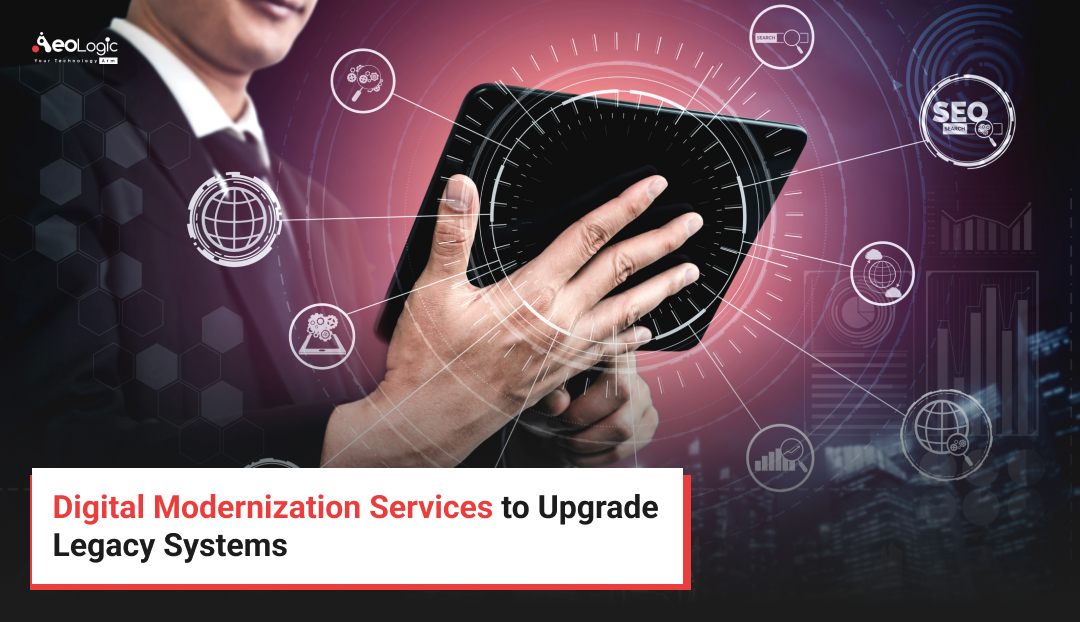
Legacy systems have quietly powered companies in a variety of industries for decades. These technologies were once cutting edge, ranging from internal databases and warehouse management systems to core banking platforms and ERP software. However, they now find it difficult to satisfy the contemporary needs for integration, speed, and scalability. In order to help businesses stay competitive in a world that is becoming more and more digital-first, digital modernisation services have emerged as a strategic way to upgrade these outdated systems without interfering with core operations.
Businesses are under more and more pressure to provide scalable operations, real-time insights, seamless digital experiences, and faster services. Consumers want customisation, authorities want transparency, and the competition is moving at a digital pace.
What are Digital Modernisation Services?
The term “digital modernisation services” describes an organised method for utilising contemporary digital technologies to upgrade, transform, or re-engineer legacy systems. The objective is to maintain critical business logic while improving performance, scalability, security, and user experience.
Digital modernisation emphasises gradual, intelligent change as opposed to a complete system replacement, which can be expensive and dangerous. It enables businesses to continue operating while modernising at their own speed.
Why Legacy Systems Are Difficult
Legacy systems frequently have:
- Antiquated designs that are incompatible with contemporary instruments
- High infrastructure and maintenance costs
- Restricted scalability
- Vulnerabilities in security
- Unsatisfactory user experience
- Absence of real-time data visibility
By implementing contemporary architectures, cloud platforms, APIs, automation, and sophisticated analytics, digital modernisation services tackle these problems.
Digital Transformation vs. Modernisation
Despite their frequent interchangeability, modernisation and transformation have distinct functions.
- The goal of digital modernisation is to improve current systems.
- Complete business models are reimagined by digital transformation.
Why Today’s Digital Modernisation Services Are Important
The Transition to a Digital-First Enterprise
Businesses today function in an economy that prioritises digital technology. Technology is the foundation of everything, including internal operations, supply chains, e-commerce, and customer service. Legacy systems that are slow to change turn into liabilities.
By assisting companies in matching technology to contemporary operational requirements, digital modernisation services promote quicker innovation and improved decision-making.
Increasing Expectations of Customers
Consumers anticipate smooth digital interactions across channels and devices. Delays, data silos, and inconsistent experiences are frequently caused by legacy systems. Systems that have been updated allow:
- Quicker reaction times
- Individualised communications
- Experiences across multiple channels
Pressures on Security and Compliance
Older systems are challenging to patch and frequently lack contemporary security controls. Modernisation is necessary to safeguard sensitive data as cyber threats increase and compliance regulations tighten.
Growing IT Expenses
It is costly to maintain antiquated systems. Operational costs are raised by specialised knowledge, outdated infrastructure, and frequent downtime. By switching to scalable and automated platforms, digital modernisation services lower long-term costs.
 Key Benefits of Digital Modernization Services
Enhanced Efficiency in Operations
Redundancy is decreased, manual processes are eliminated, and workflows are streamlined by modernised systems. Faster execution and fewer errors are the results of automation and integration.
Increased Flexibility and Scalability
Businesses can scale operations in response to demand thanks to cloud-native and modular architectures. Growth, seasonal peaks, and market expansion all depend on this adaptability.
Improved Access to and Understanding of Data
Advanced analytics and real-time data access are made possible by modern systems. Decision-makers are able to act more confidently and quickly.
Enhanced Safety and Dependability
Updated security frameworks, encryption, identity management, and disaster recovery capabilities are all brought about by modernisation.
Quicker Innovation
Businesses can add new features, services, and integrations without interfering with core operations by decoupling systems and enabling APIs.
How Companies Utilise Services for Digital Modernisation
Updating Essential Business Applications
In order to ensure immediate operational impact, improved performance, and increased system reliability, organisations frequently begin by modernising critical applications like ERP, CRM, HR systems, or inventory platforms.
Changing to Cloud Infrastructure
In order to lower infrastructure costs, improve scalability, increase flexibility, and facilitate the quicker deployment of new services, legacy systems are moved from on-premise servers to cloud platforms.
Dissecting Monolithic Structures
Large, tightly coupled systems are broken into microservices, making applications easier to update, maintain, scale independently, and deploy without disrupting entire systems.
Facilitating Interoperability and Integration
By facilitating smooth communication between legacy systems and new apps, outside partners, and digital platforms, modern APIs enhance data flow and operational effectiveness.
Enhancing the User Experience
Industry Use Cases of Digital Modernisation Services
Manufacturing and Industrial Businesses
To enable real-time production monitoring, predictive maintenance, increased operational efficiency, and more intelligent logistics planning across facilities, manufacturers update their outdated MES, ERP, and supply chain systems.
E-commerce and retail
In order to facilitate smooth omnichannel commerce, retailers update their POS systems, customer data platforms, and inventory management systems.
Medical care
In order to improve care delivery, guarantee regulatory compliance, strengthen data security, and facilitate improved system interoperability, healthcare organizations update patient records, billing systems, and scheduling platforms.
Financial Services and Banking
To enhance operational agility, bolster security, support digital channels, and satisfy changing regulatory compliance requirements, banks update their core banking systems, risk management platforms, and customer portals.
Supply Chain and Logistics
Key Technologies Used in Digital Modernization Services
Cloud Computing
Scalable infrastructure, increased system availability, better disaster recovery, and cost effectiveness are all offered by cloud platforms. Lift-and-shift, re-platforming, and complete cloud-native redesign techniques are examples of contemporary migration strategies.
Architecture of Microservices
Applications are divided into smaller, independent services. This architecture allows for quicker updates without affecting the system as a whole and increases agility and resilience.
Integration Layers and APIs
Data consistency and seamless platform interoperability are ensured by APIs and integration layers, which facilitate communication between legacy systems, contemporary applications, outside partners, and third-party tools.
Modernization of Data
Legacy databases are upgraded, restructured, or migrated to modern data platforms, enabling advanced analytics, real-time reporting, improved data governance, and AI-driven business insights.
DevOps and Automation
DevOps techniques and automation tools speed up deployment cycles, lower manual error rates, foster teamwork, and improve overall system dependability and operational effectiveness.
Intelligent Systems and AI
Challenges and Solutions of Digital Modernization
Legacy Systems Complexity
Many legacy systems lack documentation and were built using outdated technologies.
Solution: Prioritize modernization in stages and carry out comprehensive system assessments.
Danger of Business Interruption
Modernization projects can impact ongoing operations if not managed carefully.
Solution: Make use of robust testing techniques, incremental rollouts, and parallel systems.
Gaps in Skills
Internal teams might not have the new skills needed for modern technologies.
Solution: Invest in training and collaborate with seasoned providers of legacy system modernization.
Risks of Data Migration
During migration, data security and integrity are crucial.
Solution: Make use of frameworks for structured data migration that include backup and validation techniques.
Best Practices for Successful Digital Modernization
Align Modernization with Corporate Objectives
In order to ensure that modernization efforts yield quantifiable and strategic value, technology upgrades should directly support core business objectives such as revenue growth, operational efficiency, improved customer experience, and long-term scalability.
Start with Systems with High Impact
Modernizing systems that cause the most operational bottlenecks, present security risks, or have a major impact on customer satisfaction and business performance should be the first priority for organizations.
Take a Phased Approach
By enabling organizations to implement changes gradually, validate results early, minimize disruptions, and deliver business value faster at each phase, incremental modernization lowers overall risk.
Make security a top priority right away
Security must be embedded into every stage of the modernization process, including design, development, deployment, and maintenance, to protect data, systems, and regulatory compliance.
Continue to Measure and Optimize
Upcoming Future Developments in Services for Digital Modernization
Everything is Cloud-Native
In order to increase scalability, flexibility, cost effectiveness, and facilitate quicker innovation cycles, organizations will increasingly create systems especially for cloud environments.
AI-Powered Modernization
AI-powered tools will automate code refactoring, testing, system optimization, and issue detection, significantly reducing modernization time and human effort.
Platforms with Low and No Code
By facilitating quicker application development, lowering reliance on developers, and empowering business users, these platforms will quicken modernization efforts.
Composable Businesses
In order to swiftly adapt to shifting market demands, businesses will implement modular, interoperable systems that are simple to reassemble or replace.
IT with a Sustainability Focus
In order to promote long-term environmental sustainability, digital modernization will give priority to energy-efficient technologies, optimized resource usage, and smaller infrastructure footprints.
Conclusion
Legacy systems should not define the limits of modern business. In an era where speed, data, and digital experiences determine success, outdated technology becomes a strategic risk. Digital Modernization Services provide a practical and powerful way to bridge the gap between legacy infrastructure and future-ready innovation.
Organizations can lower costs, increase resilience, unlock data-driven insights, and accelerate growth by intelligently modernizing systems rather than replacing them mindlessly. The benefits are long-lasting and transformative, but the journey calls for knowledge, preparation, and a clear vision.
Businesses seeking to strategically and responsibly modernize frequently collaborate with seasoned suppliers like Aeologic Technologies, who are knowledgeable about both contemporary digital ecosystems and legacy complexity.
Frequently Asked Questions
Q1. What are Digital Modernization Services?
Digital Modernization Services help businesses upgrade legacy systems using modern technologies to improve performance, scalability, and security.
Q2. Is updating a system preferable to replacing it?
While maintaining current business logic and data, modernisation is frequently less expensive and risky than complete replacement.
Q3. What is the duration of digital modernisation?
Phased approaches minimise operational disruption for businesses and deliver value early; timelines vary based on system complexity.
Q4. Is it possible to modernise legacy systems without causing any downtime?
Yes, with proper planning, parallel systems, incremental rollouts, and thorough testing, downtime can be minimized or avoided.
Q5. Does modernisation require moving to the cloud?
Cloud platforms provide substantial benefits for scalability, cost effectiveness, flexibility, and long-term system resilience, though not always.
Q6. In what ways does modernisation enhance security?
Updated security protocols, encryption, compliance controls, ongoing monitoring, and quicker threat response are all supported by modern systems.
Q7. Who ought to spend money on services for digital modernisation?