Globally, governments are facing increasing pressure to manage tight budgets and intricate regulatory frameworks while providing services that are quicker, more transparent, and focused on the needs of the people. Public sector organisations are being forced to reconsider how they function and serve the public as a result of growing public expectations, growing data volumes, and the need for real-time decision-making.
At the core of this shift is Digital Transformation in Government, which leverages advanced technologies like artificial intelligence (AI) and automation to modernize legacy systems, streamline processes, and improve service delivery. This change is no longer optional for public sector workers, IT executives, and legislators; rather, it is strategically required to create robust, future-ready governance.
What Is Digital Transformation in Government Through AI and Automation?
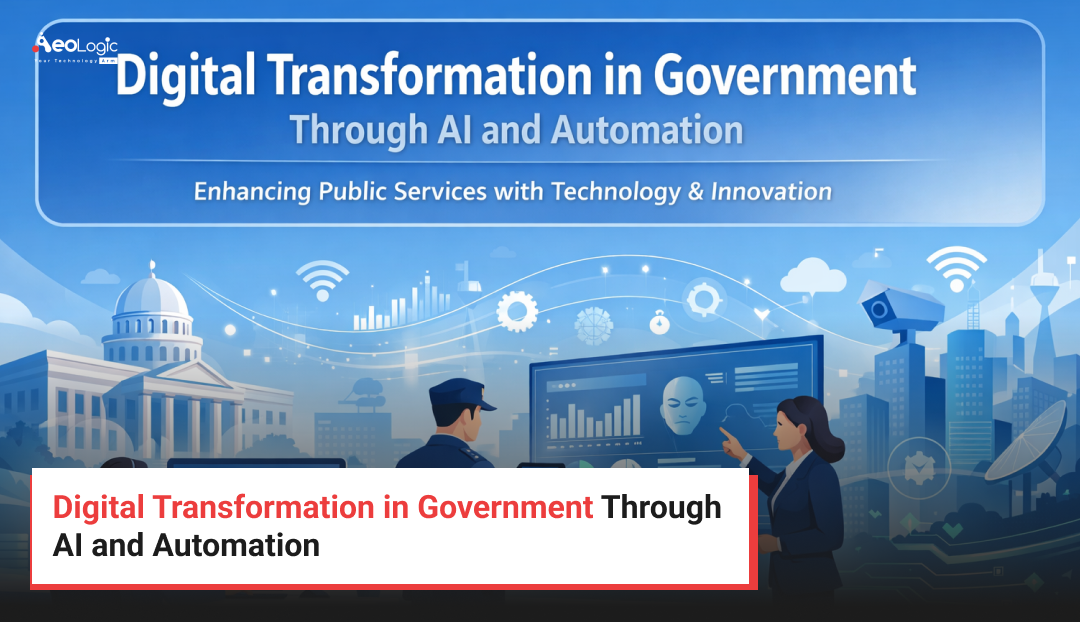
The methodical use of digital technologies to revamp internal operations, public services, and citizen engagement models is known as digital transformation in government. This shift goes beyond digitisation and makes intelligent, data-driven governance possible when it is driven by automation and artificial intelligence.
While automation minimises manual labour, errors, and processing time, artificial intelligence (AI) assists governments in analysing massive datasets, forecasting results, and customising services. When combined, they make it possible for public institutions to function more effectively, make better choices, and provide reliable, superior services on a large scale.
Why Government digital modernization Matters Today
Increasing Citizen Trust and Public Service Delivery
Consumers today demand the same degree of convenience from public services as they do from private businesses. Digital portals, automated processes, and AI-powered chatbots greatly speed up service response times and increase accessibility.
Key impacts include:
- Quicker service responses and approvals
- Delays in the bureaucracy have decreased.
- Increased accountability and transparency
Driving Operational Efficiency and Cost Optimization
Paper-based, manual procedures are costly and prone to mistakes. While upholding compliance and governance standards, automation and AI-driven insights assist governments in maximising resource utilisation and cutting operating expenses.
 Core Elements of Digital Transformation in Government Through AI and Automation
Intelligent Process Automation
Governments can automate repetitive tasks like data entry, document verification, and compliance checks by combining robotic process automation (RPA) with artificial intelligence (AI). Human resources can now focus on high-value, policy-driven tasks.
Data-Driven Decision Making
Analytics platforms driven by AI convert unprocessed data into useful insights. Predictive analytics can be used by governments to improve policy outcomes, identify fraud, and forecast demand.
Digital Platforms Focused on Citizens
Citizens can access a variety of services via a single interface thanks to unified digital platforms and mobile applications, which increase satisfaction and engagement while lowering administrative costs.
Secure and Scalable Digital Infrastructure
The foundation of sustainable digital initiatives is made up of cloud computing, cybersecurity frameworks, and interoperable systems, which guarantee data protection, scalability, and resilience.
Step-by-Step Strategy for Implementing AI and Automation in Government
Step 1: Evaluate Your Digital Readiness and Maturity
To find gaps and transformational opportunities, governments must assess workforce skills, data quality, and current systems.
Step 2: Define Clear Use Cases and Objectives
Give top priority to high-impact fields where AI and automation can produce quantifiable benefits, such as revenue management, public service delivery, or compliance monitoring.
Step 3: Build a Strong Data Foundation
AI-driven projects require data that is secure, standardised, and dependable. Early attention should be given to data governance and interoperability.
Step 4: Pilot, Scale, and Optimize
While continuously improving performance, start with pilot projects, track results, and expand successful initiatives across departments.
Key Benefits of AI-Driven Government Transformation
- Improved accuracy and speed of service
- Lower operating expenses and fewer human errors
- Enhanced openness and adherence to regulations
- Data-driven policymaking
- Improved citizen trust and experience
One of the most important advantages of Digital Transformation in Government is its ability to create faster, more responsive, and data-driven public services.
Real-World Use Cases and Applications
AI-Powered Citizen Support
In order to decrease call center traffic and speed up response times, governments are using AI chatbots to answer common questions about taxes, licenses, and benefits.
Automated Document Processing
Automation tools use AI-based OCR and validation engines to extract and validate data from documents, processing applications, permits, and claims more quickly.
Predictive Governance Models
AI models enable proactive planning and resource allocation by forecasting healthcare demand, energy consumption, and traffic congestion.
Technologies and Tools Powering Digital Transformation in Government
- Platforms for machine learning and artificial intelligence
- Tools for Robotic Process Automation (RPA)
- Infrastructure for cloud and hybrid clouds
- Solutions for business intelligence and data analytics
- Systems for identity management and cybersecurity
Key Challenges Governments Commonly Face
Infrastructure Restrictions and Legacy Systems
Many government agencies continue to use antiquated, compartmentalised systems that aren’t made to work with contemporary automation or artificial intelligence platforms. This slows down transformation projects, raises implementation costs, and causes interoperability problems.
Data Quality, Privacy, and Security Concerns
Accurate, standardised, and well-governed data is essential to AI systems. The efficacy of AI-driven solutions in the public sector is frequently constrained by inconsistent data formats, subpar data, and stringent data privacy laws.
Skill Gaps and Organizational Resistance
Adoption may be hampered by government employees’ lack of digital skills, AI knowledge, and change readiness. Another common obstacle is resistance to automation brought on by worries about job security or lack of familiarity with new technologies.
Regulatory and Compliance Complexity
Government agencies are subject to stringent legal and regulatory requirements. The implementation of AI models becomes even more complex when it comes to maintaining their explainability, ethics, and compliance with data protection regulations.
Best Practices for Successful Government Transformation
Following a phased, use-case-driven approach ensures that Digital Transformation in Government delivers measurable improvements in efficiency, transparency, and citizen satisfaction while minimizing operational risks.
Adopt a Use-Case-Driven and Phased Strategy
Governments should begin with well-defined, high-impact use cases rather than implementing extensive rollouts. Prior to scaling, pilot programs aid in risk management, internal confidence building, and outcome validation.
Establish Strong Data Governance Frameworks
AI systems are dependable, transparent, and legally compliant when standardised data policies, security controls, and access management are put in place.
Make Workforce Enablement and Change Management Investments
To promote adoption and reduce resistance, it is essential to upskill staff, encourage cross-functional cooperation, and explain the advantages of automation and artificial intelligence.
Ensure Ethical and Responsible AI Usage
To preserve public confidence and accountability, governments should place a high priority on explainable AI models, bias mitigation, and open decision-making procedures.
Future Trends in Government AI and Automation
Emerging innovations such as hyperautomation, generative AI, and predictive analytics will further accelerate Digital Transformation in Government, enabling more proactive, intelligent, and citizen-centric governance models.
Rise of Hyperautomation in Public Services
Governments are combining AI, RPA, process mining, and analytics to achieve hyperautomation, which goes beyond simple task automation. This makes it possible to automate complicated processes from start to finish, including benefits administration, purchasing, and regulatory approvals.
Proactive and Predictive Governance Frameworks
Predictive analytics powered by AI will be more important in identifying risks, anticipating citizen needs, and allocating public resources as efficiently as possible. Governments will increasingly adopt proactive governance models in place of reactive service delivery.
Generative AI for Policy and Administrative Support
With human oversight, generative AI is becoming a potent tool for creating policy documents, evaluating public input, summarizing laws, and helping government employees retrieve information.
Integrated Digital Government Ecosystems
Interoperability between departments and agencies will be a key component of future government platforms. Service experiences will be smooth and focused on the needs of the public thanks to shared data platforms and unified digital identities.
Stronger Focus on AI Ethics and Regulation
Governments will take the lead in establishing international standards for algorithmic accountability, data sovereignty, ethical AI, and transparency as the use of AI grows, striking a balance between innovation and public confidence.
Conclusion
Digital Transformation in Government is reshaping how public institutions operate, deliver services, and engage with citizens. Governments can create effective, transparent, and citizen-focused ecosystems that satisfy contemporary standards by strategically implementing automation and artificial intelligence.
To successfully navigate large-scale public sector change, partnering with experts in digital transformation consulting can help governments design, implement, and scale AI- and automation-driven initiatives with confidence.
People Also Ask (FAQs)
Q1. What is digital transformation in government?
AI-driven public sector transformation involves using digital technologies to modernize public services, internal processes, and governance models. It focuses on using automated and data-driven systems to increase efficiency, transparency, and the citizen experience.
Q2. How does AI support Government digital modernization?
By facilitating intelligent automation, predictive analytics, and customized citizen services, artificial intelligence (AI) aids in the transformation of government. It facilitates the processing of big datasets, the identification of patterns, and the automation of difficult decision-making processes.
Q3. What are the main benefits of Government digital modernization?
The main benefits include faster service delivery, reduced operational costs, improved transparency, better policy outcomes, and enhanced citizen satisfaction through consistent and accessible services.
Q4. What challenges do governments face during digital transformation?
Legacy infrastructure, data security issues, workforce skill gaps, regulatory compliance, and organizational change resistance are typical problems.
Q5. How can governments start their digital transformation journey?
Prior to scaling, governments should first evaluate their digital preparedness, find high-impact use cases, establish a solid data foundation, and carry out pilot projects.
Q6. Is AI-driven public sector transformation secure?
Digital transformation projects can be extremely safe and resilient if they are carried out with robust cybersecurity frameworks, data governance guidelines, and compliance standards.

Manoj Kumar is a seasoned Digital Marketing Manager and passionate Tech Blogger with deep expertise in SEO, AI trends, and emerging digital technologies. He writes about innovative solutions that drive growth and transformation across industry.
Featured on – YOURSTORY | TECHSLING | ELEARNINGINDUSTRY | DATASCIENCECENTRAL | TIMESOFINDIA | MEDIUM | DATAFLOQ