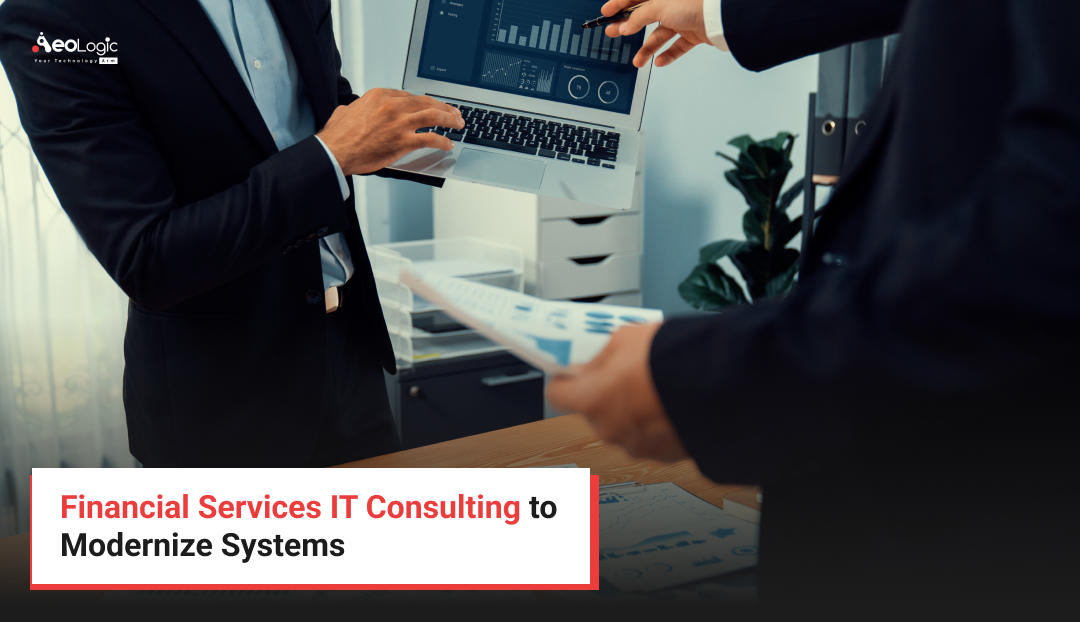
Long-term success in the financial services sector is determined by speed, security, and digital intelligence at this crucial juncture. The complexity of regulations, real-time transactions, and growing customer expectations have made it difficult for traditional systems that once supported banks, insurers, and investment firms to keep up. Due to this change, financial services IT consulting is now a crucial force behind modernisation, assisting organisations in rethinking their technological underpinnings in order to stay competitive in an increasingly digital economy.
Strategic IT guidance is more important than ever as financial organisations manage data silos, cyber security threats, legacy infrastructure, and compliance demands. By coordinating technology with business objectives, increasing operational effectiveness, and facilitating large-scale innovation, financial services IT consulting closes the gap between antiquated systems and platforms prepared for the future. Rather than simply upgrading tools, it empowers financial institutions to transform how they operate, serve customers, and manage risk in a rapidly evolving global landscape.
What is Financial Services IT Consulting?
Comprehending the Fundamental Idea
Financial institutions can design, optimise, and modernise their IT ecosystems with the aid of specialised advisory and implementation services known as financial services IT consulting. These consulting services match technology strategies to customer expectations, legal requirements, and business objectives.
Financial IT modernization has a strong foundation in domain expertise, in contrast to general IT consulting. The intricacies of banking systems, insurance platforms, payment networks, capital markets infrastructure, and compliance-driven settings are all understood by consultants. Their function extends beyond technical improvements; they lead companies through digital transformation with the least amount of risk and the greatest possible impact.
The Center’s Modernisation
Financial IT modernization is primarily concerned with updating systems that are frequently decades old. This entails strengthening cybersecurity frameworks, moving to cloud environments, integrating digital channels, replacing monolithic core banking platforms, and improving data analytics.
Modernisation guarantees that technology will no longer be a barrier to business but rather an enabler.
 Why Today’s Financial Services IT Consulting Is Essential?
Growing Expectations from Customers
Consumers of today demand smooth, instantaneous, and customised financial experiences. Digital wallets, instant payments, mobile banking, and AI-powered assistance are now required. This degree of flexibility and responsiveness is difficult for legacy systems to provide.
Financial IT modernization assists businesses in updating their digital architecture to satisfy contemporary client needs without sacrificing dependability or security.
Compliance Complexity and Regulatory Pressure
Financial institutions are subject to stringent regulatory supervision. Data privacy, risk reporting, auditability, and fraud prevention are examples of compliance requirements that are always changing. Older systems frequently aren’t flexible enough to quickly adjust to new rules.
Organisations can update compliance frameworks while preserving control and transparency with the help of financial IT modernization specialists.
Fintech and Digital-First Players’ Competition
Fintech firms are using cloud-native platforms, agile development approaches, and data-driven insights to challenge established financial services. For established institutions to remain competitive, they must quickly modernise.
Financial services By utilising their current scale and trust, traditional players can adopt fintech-like agility through IT consulting.
Benefits of IT Consulting for Financial Services
Increased Effectiveness of Operations
Workflows are streamlined, redundant tasks are eliminated, and manual processes are reduced by modern IT systems. Consultants identify inefficiencies and design optimized architectures that lower operational costs and improve productivity.
Enhanced Performance and Scalability of the System
Workloads at financial institutions vary, particularly during periods of high transaction volume. Scalability is provided by updated systems created with technology consulting for finance, guaranteeing steady performance under changing demands.
Improved Risk Management and Security
Financial services are increasingly concerned about cyber threats. Sensitive financial data is protected by IT consulting’s introduction of cutting-edge security architectures, real-time monitoring, and proactive risk mitigation techniques.
Quicker Time-to-Market
New products and services can be launched more quickly thanks to modern development frameworks, APIs, and microservices. IT consulting for financial services enables organisations to innovate swiftly without sacrificing stability.
How Financial Services IT Consulting Operates
Phase of Assessment and Discovery
A thorough evaluation of the current infrastructure, systems, procedures, and problems is the first step in consulting. This stage finds the gaps between present and future capabilities.
Development of a Strategy and Roadmap
Consultants create a modernisation roadmap based on assessment results. Initiatives are prioritised, deadlines are established, expenses are estimated, and technology investments are matched with business objectives.
Integration and Implementation
Financial services Internal teams and IT consulting teams collaborate to put solutions into action. This includes data integration, cloud migration, system upgrades, and application modernization—often in stages to reduce disruption.
Optimisation and Ongoing Enhancement
Modernisation is a continuous process. In order to guarantee that systems adapt to shifting business requirements, consultants offer ongoing optimisation, performance monitoring, and support.
Financial Services IT Consulting’s Industry Applications
Lending and Banking Organisations
To update their core banking systems, digital channels, payment platforms, and loan management solutions, banks depend on IT consulting. Improved risk assessment, quicker approvals, and increased customer engagement are all made possible by modernisation.
Insurance Companies
Technology consulting for finance is used by insurance companies to update customer portals, underwriting systems, policy administration, and claims processing. Efficiency and customer satisfaction are greatly increased by automation and data analytics.
Capital Markets and Investment
IT consulting supports regulatory reporting, trading platforms, risk analytics, and portfolio management systems in the capital markets. Contemporary systems offer better decision-making and real-time insights.
Digital Financial Services and Fintech
Fintech companies use technology consulting for finance to maintain innovation speed while securely scaling platforms, integrating with banking ecosystems, and ensuring regulatory compliance.
Financial Services Driven by Technologies Modernization of IT
Cloud Computing
Scalability, cost effectiveness, and quick innovation are made possible by cloud platforms. IT consulting for financial services guarantees cloud adoption that is safe and compliant for financial workloads.
Business Intelligence and Data Analytics
Institutions are able to learn more about customer behavior, risk exposure, and operational performance thanks to advanced analytics.
Microservices Architecture and APIs
The main objectives of technology consulting for finance projects—smooth integration, quicker updates, and increased flexibility—are made possible by modular architectures.
Financial Services Difficulties Modernization of IT
Complexity of Legacy Systems
It is challenging to replace the deeply ingrained legacy systems that many financial institutions rely on. These systems frequently lack contemporary security controls, flexible integration, and documentation.
Integration Problems and Data Silos
Disparate systems create fragmented data environments, limiting visibility and decision-making. Financial technology consulting uses integration frameworks and unified data strategies to address this.
Risks related to regulations and security
Modernization must protect sensitive financial data while adhering to stringent regulations. One of the most difficult tasks for organizations is striking a balance between innovation and compliance.
Skill Gaps and Change Management
New skill sets and cultural shifts are necessary for technology modernization. Resistance to change and lack of internal expertise can slow transformation efforts.
Financial Services IT Consulting Provides Solutions
Methods of Phased Modernization
To lower risk and guarantee business continuity, consultants advise phased modernization rather than replacing everything at once.
Models of Hybrid Architecture
Hybrid environments combine legacy systems with modern platforms, allowing gradual transformation while preserving critical operations.
Robust Frameworks for Governance and Compliance
Consulting services ensure regulatory alignment by integrating governance, security, and compliance into each stage of modernization.
Enabling Change and Upskilling
Financial services To guarantee successful adoption, IT consulting offers training courses, documentation, and change management techniques.
The Best Ways to Modernize IT Successfully
Connect Technology to Business Goals
Modernization should always support strategic business goals, not just technical upgrades.
Give the customer experience top priority
Customer-centric design guarantees that technology investments provide end users with real benefits.
Adopt Security-by-Design Concepts
Architecture must incorporate security from the start rather than adding it later.
Utilize Data as a Strategic Resource
Risk management, personalization, and decision-making are all improved by data-driven insights.
Financial Services’ Future Trends IT Advice
Automation and Intelligence Powered by AI
Predictive analytics, customer service, and fraud detection will all see an increase in the use of artificial intelligence.
Modular Systems and Composable Banking
Future systems will be built using modular components that can be easily updated or replaced.
Increased Attention to Sustainability and ESG
IT consulting will increasingly support sustainability reporting, energy-efficient infrastructure, and ethical technology practices.
Enhanced Cooperation Between Fintechs and Banks
Modern IT architectures will enable deeper partnerships and ecosystem-driven innovation.
Conclusion
In a digital-first economy, financial institutions can no longer afford to rely on antiquated systems. Financial Services IT Consulting offers the technical know-how, industry insight, and strategic guidance required to update systems, boost resilience, and spur innovation.
Organizations can achieve long-term success by embracing modernization through professional consulting and gaining customer-centric capabilities, security, and agility. The right consulting partner makes transformation feasible and long-lasting, whether it is strengthening compliance frameworks, implementing cloud technologies, or updating legacy platforms.
Aeologic Technologies, a reputable partner that offers future-ready IT consulting solutions specifically designed for the financial services sector, can help organizations modernize their financial systems with confidence.
Frequently Asked Questions
Q1. What is Financial Services IT Consulting?
Financial services IT consulting helps financial institutions modernize, optimize, and secure their technology systems while aligning IT strategies with business and regulatory goals.
Q2. Why do financial institutions need to modernise their IT?
In a rapidly changing digital landscape, modernisation fosters innovation, resilience, cost optimisation, and competitive differentiation while enhancing efficiency, security, scalability, customer experience, and compliance.
Q3. In what ways does IT consulting for financial services lower risk?
Through testing, compliance alignment, documentation, and organised change management, consultants employ phased upgrades, robust governance, and security-by-design techniques to reduce operational and regulatory risks.
Q4. Is it possible to update legacy systems without completely replacing them?
Yes, by safely integrating new technologies with current systems, hybrid and phased approaches enable institutions to modernise gradually without interfering with essential operations.
Q5. Which technologies are commonly used in financial IT consulting?
Cloud computing, data analytics, APIs, microservices, automation, and cybersecurity solutions are widely used along with AI, DevOps tools, identity management, and integration platforms.
Q6. What is the duration of IT modernisation?
The complexity, scope, and regulatory requirements of the system all affect timelines. Realistic, phased roadmaps that are in line with business priorities and resources can be created with the aid of consulting.
Q7. Who ought to make an investment in IT consulting for financial services?