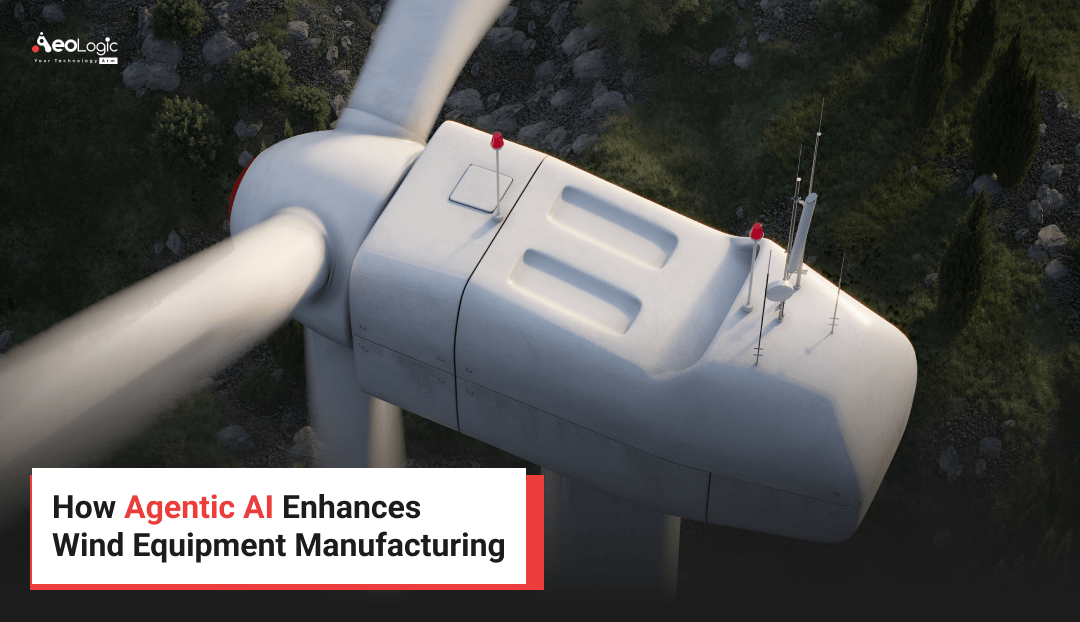
The planet is rapidly pushing toward a cleaner energy future, and wind power is emerging as a key component of that transition, quite literally towering above the rest. In 2023, according to the World Wind Energy Association, the global wind energy capacity increased to 1047 gigawatts, which is enough to supply energy to millions of homes and dramatically reduce carbon emissions. However, building the giant turbines that generate this clean energy is not simple. Wind equipment manufacturing is faced with considerable challenges: creating 100-meter-long blades, coordinating a global supply chain, rising manufacturing costs, complex engineering designs, and a demand for decarbonized supply chain input and transportation associated with creating and deploying turbines. Most importantly, AI introduces a new way for manufacturers to build wind turbine production AI that will lead the green revolution.
Agentic AI is not a standard AI. It is a system with agency—think of it as a factory manager that not only analyzes data but also makes decisions and takes actions to meet defined objectives. In the context of wind turbine manufacturing, agentic AI will help with design, assembly, and construction processes in order to be a greener manufacturing of wind turbines. This blog explains how agentic AI is revolutionizing wind equipment manufacturing, exploring its applications, benefits, challenges, and what lies ahead. Buckle up—we are about to see how “wind turbine production ai” and “agentic ai agency” are powering a cleaner, more efficient future.
What is agentic AI, and why is it important for wind turbines-
Picture a factory where equipment does not just follow a pre-programmed series of steps, but is able to independently adjust for any issues, such as delays, defects, or modifications to design. This is the basic idea behind agentic AI. It is a series of analytical systems working with data that will operate independently to attain a goal. Traditional AI systems may have the ability to predict a defect but will only state that there is a defect. Agentic AI would be able to not only identify the defective component, but also reroute the production line or redesign the blade in order to get the most optimized performance. This “agentic ai agency” is a true game-changer for industries such as wind turbine manufacturing, where quality and efficiency mean everything. Wind turbines are truly an engineering marvel, with blades, nacelles, and towers each requiring a careful design and production process.
The manufacture of with many thousands of variables—material characteristics, aerodynamic properties, supply chain logistics, and endless coordination and deadlines to meet the global energy requirements—is incredibly complex. Agentic AI thrives in these complexities, it is capable of combining information from millions of system sensors and making split-second decisions to maintain productivity on the factory floor. The agent’s autonomy on the factory floor addressed the previous industry production pain points: cost, quality, and scalability, while demonstrating production sequencing, availability, and priority control of component assembly. For example, the ai agent may sense that the blade assembly was slightly slower than anticipated and reallocated available resources to minimize assembly bottlenecks—our agent may even disclose it using wind turbine production ai
Key Characteristics of Agentic AI
Agentic AI systems are built around several important capabilities:
Autonomous Decision-Making
The AI can independently analyze situations and make decisions without waiting for human intervention.
Goal-Oriented Planning
Agentic AI works toward defined business objectives such as reducing waste, improving efficiency, or minimizing downtime.
Continuous Learning
The system continuously learns from production data, sensor feedback, operational patterns, and environmental conditions.
Real-Time Adaptation
The AI can instantly adjust manufacturing processes or workflows when disruptions occur.
Multi-Agent Collaboration
Different AI agents can collaborate across departments such as design, logistics, production, and maintenance.
 Agentic AI Explainer: How It Works in Manufacturing
To better understand agentic AI in wind turbine production, imagine a smart manufacturing ecosystem where machines, sensors, software systems, robots, and AI agents continuously communicate with each other.
The Core Components of Agentic AI Systems
Sensors and IoT Devices
Factories use thousands of sensors to collect real-time data such as:
- Temperature
- Pressure
- Vibration
- Material quality
- Machine speed
- Energy usage
- Environmental conditions
Machine Learning Models
AI models analyze this data to identify patterns, predict issues, and optimize processes.
Digital Twins
A digital twin is a virtual simulation of a physical object or process. Manufacturers use digital twins to simulate turbine performance, blade aerodynamics, and production workflows.
Autonomous AI Agents
These agents make decisions and execute actions based on predefined goals.
Robotics and Automation Systems
Robots physically perform manufacturing tasks under AI supervision.
Example of Agentic AI Workflow
Suppose a sensor detects abnormal vibration in a blade assembly machine.
A traditional AI system may simply alert the operator.
An agentic AI system can:
- Analyze vibration data
- Compare patterns with historical failures
- Predict potential equipment damage
- Reduce machine load automatically
- Reschedule production tasks
- Order replacement parts
- Notify maintenance teams
- Update digital twin simulations
This autonomous execution dramatically improves efficiency and reliability.
How Agentic AI Changes the Game for Wind Turbine Manufacturing
Agentic AI will influence every aspect of wind turbine manufacturing from concept to production. Here are five examples of how it is currently making a change.
Predictive Maintenance for Wind Farms
Agentic AI is not limited to factory operations. It also plays a critical role after turbines are deployed in wind farms.
Predictive maintenance has become one of the most valuable applications of wind turbine production AI.
The Problem With Traditional Maintenance
Traditional maintenance models are usually:
- Reactive
- Time-based
- Expensive
- Inefficient
Repairs often happen after failures occur.
Unexpected turbine failures can lead to:
- High repair costs
- Energy production losses
- Safety risks
- Long operational downtime
How Predictive Maintenance Works
Agentic AI continuously monitors turbine performance using data from:
- Vibration sensors
- Temperature sensors
- Oil analysis systems
- Power output measurements
- Weather data
- Rotor speed analytics
The AI identifies patterns indicating potential failures.
Example Use Case
Suppose a turbine gearbox begins showing unusual vibration patterns.
The AI system can:
- Detect abnormal behavior
- Predict remaining equipment life
- Schedule maintenance proactively
- Order replacement components
- Coordinate technician deployment
- Minimize turbine downtime
Benefits of Predictive Maintenance
- Reduced unplanned outages
- Lower maintenance costs
- Extended turbine lifespan
- Improved energy production
- Better asset utilization
- Enhanced operational safety
Large wind farm operators now use predictive AI systems to monitor hundreds of turbines simultaneously.
This transforms wind farms into highly intelligent renewable energy ecosystems.
Design Efficiency for Turbine Components
Designing a wind turbine blade, like creating a wing for a massive bird, requires an understanding of strength, weight, and wind shape. Agentic AI gives engineers the ability to test thousands of designs in a period of a few days instead of months. Take a UK-based start-up, EvoPhase, for example. They created over 2000 potential blade designs specifically for urban wind conditions using AI. Agentic AI enabled EvoPhase to do so by employing genetic algorithms and digital twins (a digital version of a physical object that creates behavioral simulations and interactions with the object’s environment). With this technology, agentic AI produced uniquely shaped blades that represent the best combination to generate the most efficient wind turbine output. This is the best illustration of wind turbine production ai.
Automation of the Manufacturing Process-
Imagine a manufacturing plant with robots on assembly lines working in concert, all under the stewardship of an artificial intelligence that acts as an experienced factory foreman. Agentic AI can observe production lines in real time, modifying workflows as required to avoid disruptions. If a machine slows down, for instance, the AI may be able to change the tasks assigned to that piece of equipment or speed up the flow of another production line, in order to keep the final product successfully completing the assembly operation of manufacturing. Moreover, production downtime can be one of the biggest (time) wasters and also has the potential to literally cost manufacturers millions dollars. When your robotic systems work collaboratively with agentic AI you get greater accuracy every time you are assembling complex mechanical components, such as nacelles, even in large quantities, while reducing the time and cost of accuracy.
Quality Control and Defect Detection
There is no room for error when manufacturing wind turbines, where even a small defect can result in a costly, catastrophic, and often preventable failure. In this regard, agentic AI is second to none when it comes to reviewing sensor feeds from the quality control and assurance systems. The AI can review timestamp events, as well as visual data to identify defects, such as cracks or inconsistencies in the materials that are used in production, with incredible accuracy.
For example, Chinese manufacturers have rolled out AI vision systems that can find defects in blade assemblies with 95% accuracy, far exceeding human inspectors. If a defect has been identified, not only can the AI notify the human operators, but the AI can also modify the manufacturing parameters quickly, on the fly, to ensure that defects of the same nature do not disrupt production again. This immediate problem solving is called “agentic ai agency” and is by far the most distinguishing and significant feature our agentic AI system can provide.
Supply Chain and Resource Management
The wind turbine manufacturing industry is managed through a global supply chain that draws materials such as carbon fiber and steel from multiple continents. Agentic AI navigates through this complex puzzle by anticipating delays, finding alternate shipment sources (when needed) to ensure factories stay appropriately stocked. For example, General Electric’s tool began with AI-driven logistics that were team and overall objective-centric, with a goal of achieving 10% less costs, by predicting global savings of $2.6 billion by 2030. By forecasting demand, and reinforcing inventory control with raw materials stand by, agentic AI allows that inventory to be received “just in time” to limit excess, waste, and ultimately costs, consistent with traditional “wind turbine production AI
Sustainability Improvements
Sustainability is much more than a trendy slogan in wind energy; sustainability is a requirement. Agentic AI utilizes technology to help manufacturers, and every and any agent, be more intelligent with material utilization, and lower waste. It could for instance help predict how much resin will be needed to make a blade while reducing the excess, waste and emissions. Agentic AI is a much more direct route for production output linkage & alignment to environmentally sustainable practices. The win-win aspect provides renewable energy (solution) development, without degrading our planet. Anchoring sustainability is part of agentic ai, therefore presenting with legitimate and systematic means of addressing renewable energy challenges.
India’s Renewable Energy Manufacturing Growth and the PLI Scheme
India is rapidly emerging as a global renewable energy manufacturing hub.
The Indian government has launched several initiatives to strengthen domestic clean energy production capabilities.
One of the most important programs is the Production Linked Incentive (PLI) scheme.
What Is the PLI Scheme?
The Production Linked Incentive scheme is a government initiative designed to encourage domestic manufacturing in strategic industries.
The scheme provides financial incentives to companies that increase local production capacity.
Renewable Energy and the PLI Scheme
India’s renewable energy sector benefits significantly from PLI support.
The government aims to:
- Reduce dependence on imports
- Expand clean energy manufacturing
- Strengthen supply chains
- Create jobs
- Accelerate energy transition goals
Why Agentic AI Matters for India?
India’s wind energy ambitions require:
- Large-scale manufacturing
- High production efficiency
- Advanced quality control
- Faster deployment
- Lower production costs
Agentic AI can help Indian manufacturers achieve these goals.
Meeting the Challenges of Agentic AI-
While agentic AI holds great promise, there are challenges to be addressed in the implementation stage. This, for instance, is true for implementing it in wind turbine manufacturing, considering the fact that agentic AI is not a plug-and-play solution, and different challenges will need to be overcome.
A major challenge is data integration. Factories produce a lot of data, and this is often messy, as sensors can vary in format or data can be incomplete, features are required to provide agentic AI clear data on which to act, and in turn clean data requires data pipelines to triage and relay. Another challenge is model interpretability. Engineers need to trust that the AI is making the right decisions, but if there aren’t explicable models — they often feel like black boxes.
Cybersecurity is another challenge.
As factories become more interconnected, IoT phenomena will always leave AI systems exposed to hacks. The only solution is strict encryption and then layering intrusion detection, etc. The second constraint relates to costs – practically all agentic AIs require much investment in hardware, software, and also training before they can be of value. Even if the long term ROI is an obvious question of if/when for small manufacturers, they may never see investment as more than an accelerator for business. The third concern is many factories operate legacy operating systems or older equipment, which they may struggle to connect AI with. It is also still true that for many factories, modernization will be an iterative integration not an installation of a whole AI system directly into the factory.
Real-World Success Stories-
Agentic AI has already shown its potential in wind turbine manufacturing. Let’s take a look at a few of the companies paving that path. General Electric (GE) Renewable Energy, has already helped streamline its supply chain with AI, achieving up to a 10% reduction in logistics costs. GE expects its extensive use of predictive analytics and digital twins to yield as much as $1.7 billion to $2.6 billion globally by 2030. This illustrated the use of “agentic ai agency” to optimize complexity in operation. Chinese manufacturers already are utilizing small AI vision systems to inspect turbine blades while the blades are being constructed and produced with 95% accuracy in crack and ice accumulation recognition so as not to stop production lines.
Each example features the advanced specificity of “wind turbine production ai.” EvoPhase, a startup out of the UK, used agentic AI to generate thousands of designs for their urban wind conditions in Birmingham on the turbine blades. In less than a week, they were able to create alternative blade designs that translated to faster development and better performing turbines. In a different setting, Sandia National Laboratories used AI to optimize rotor performance by predicting data-driven wakes that will eventually yield improved efficiency in wind turbines. Together, these examples showcase why agentic AI is delivering results today, not tomorrow.
Future prospects for agentic-
in wind production are very good and positive advances in how wind turbines are designed and manufactured are bound to emerge. We are seeing the emergence of multi-agent systems whereby multiple AI agents work together to run an entire factory. We see a recognition that manufacturing, design, and logistics must be evaluated together as a single addition.
Physics-informed AI will utilize physics to include physics within the machine learning process whereby the turbine designs are assured to be data informed as well as scientifically valid.
Conclusion: Fueling a Cleaner Tomorrow
Agentic AI is changing the way that wind-based equipment will be manufactured, faster, cheaper, greener. From the design of high-performance blades to identifying defective equipment with uncanny precision, “agentic ai agency” represents a key component of “wind turbine production ai,” and is changing the future of turbine manufacture. The takeaways are evident: lower costs, better turbans, and a smaller environmental footprint. Will manufacturers face obstacles such as data sanitation, quality, and security? Absolutely, however they can be taken care of with a little strategic planning.
Businesses that embrace agentic AI today will lead the future of renewable energy manufacturing tomorrow. As wind energy continues to play a greater role in powering the world, intelligent AI-driven systems will become the engine behind faster, smarter, and more sustainable turbine production. At Aeologic Technologies, we are committed to helping industries accelerate this transformation through advanced AI, automation, IoT, and smart manufacturing solutions. The future belongs to wind turbines that are stronger, cleaner, more efficient, and intelligently powered by the capabilities of agentic AI.
FAQs

Project Lead with 9+ years of experience in Web Technologies and AI. Expert in leading end-to-end development of scalable, AI-driven solutions. Driving innovation through smart architecture, agile execution, and team leadership.