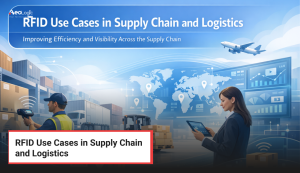

Businesses can no longer rely on conventional manual methods to track assets, manage inventory, and maintain operational accuracy in the fast-paced digital world of today. Increased operating costs and decreased productivity are frequently caused by delays, misplaced items, human error, and a lack of real-time visibility. The RFID Tagging System and other contemporary automation technologies come into play here.
For real-time tracking and control in a variety of sectors, including manufacturing, retail, logistics, healthcare, and more, RFID has emerged as a game-changing technology. It is far more efficient than traditional barcode systems because it can instantly identify, monitor, and track objects without human intervention or line-of-sight. RFID technology has become a crucial component of digital transformation as businesses aim for increased speed, efficiency, and transparency.
Comprehending the RFID Tagging System
An RFID tagging system is an automated identification technology that tracks and manages people, property, inventory, and equipment in real time using radio frequency signals. There are three primary parts to it:
- RFID tags are tiny electronic devices that are affixed to objects and contain unique identification information.
- RFID readers are gadgets that wirelessly gather information from tags.
- RFID Software/Database: The backend system that stores, processes, and analyses all tracking data.
RFID tags operate wirelessly, in contrast to conventional barcodes, which need a direct line of sight to scan. They can be read in batches, through objects, and over long distances. This improves accuracy, gets rid of manual labour, and gives companies total control over their assets.
Several frequencies are supported by contemporary RFID tagging systems, including:
- Low Frequency (LF): utilised for access control and livestock tracking
- High Frequency (HF/NFC): perfect for contactless payments and library systems
- Ultra-High Frequency (UHF): ideal for long-range, high-volume asset and inventory tracking
When combined, these systems create an intelligent ecosystem that aids businesses in achieving operational accuracy and real-time visibility.
The Significance of RFID Tagging Systems in the Modern World
Businesses now operate differently due to the need for quicker delivery, error-free operations, optimised supply chains, and full traceability. Global trade necessitates transparency, regulators demand compliance, and customers expect prompt service.
An effective way to address these issues is through the RFID Tagging System, which offers:
- Quick data gathering
- Automated monitoring
- Decreased reliance on humans
- Increased accuracy and speed
- Making decisions in real time
The following are some of the main causes of RFID’s current necessity:
Increasing Automation Requirements
Workflows that are reliable and effective are made possible by automation. RFID is essential because it records operational data without the need for human intervention.
Growth in Omnichannel and E-Commerce
Retailers require accurate inventory visibility throughout stores, warehouses, and delivery routes. Up to 99% accuracy is guaranteed by RFID.
Smart Manufacturing and Industry 4.0
RFID is used by factories to control finished goods, machine parts, raw materials, and quality assurance.
Modernisation of Healthcare
RFID is used by hospitals to monitor staff activities, medication, equipment, and patient movement in order to provide better care.
Reinventing Logistics and Supply Chains
RFID facilitates real-time asset traceability from last-mile delivery to shipment accuracy.
Digital Transformation of Enterprises
RFID solutions are used by organisations collaborating with firms such as Aeologic Technologies to modernise processes and create intelligent, data-driven ecosystems.
To put it briefly, RFID technology is now required for companies that wish to remain agile, competitive, and customer-focused.
 Important Advantages of RFID Tagging System Implementation
Numerous operational, financial, and strategic benefits come from a properly implemented RFID tagging system. Here’s a closer look:
Tracking and Visibility in Real Time
RFID offers real-time asset movement, location, and status updates. Companies can achieve complete operational transparency and do away with uncertainty.
Increased Production and Efficiency
Batch scanning greatly reduces manual labour and speeds up workflows by detecting hundreds of items in a matter of seconds.
Up to 99% accuracy
RFID reduces human error, which is frequently linked to barcode scanning and manual entry.
Lower Expenses
Operational costs are directly decreased by fewer losses, reduced downtime, improved asset utilisation, and simplified procedures.
Increased Safety
RFID tags aid in preventing theft, misplacement, and unauthorised asset movement. When equipment leaves specific zones, alerts may be set off.
Improved Making of Decisions
Forecasting, inventory planning, and process optimisation are all improved by real-time data.
Enhanced Client Experience
Retailers, logistics firms, and service providers can reduce delays, enhance service quality, and complete orders more quickly.
Scalability
Adding more tags, zones, or integrating with other IoT and automation systems are all simple ways for RFID systems to expand with your business.
The Operation of RFID Tagging Systems in Commercial Settings
Businesses can use RFID more wisely if they understand how it truly operates. This is a condensed explanation:
Marking the Item
An RFID label is attached to each item, asset, pallet, part, and piece of equipment. A unique ID and any other necessary information are stored on this tag.
Strategically Positioning RFID Readers
Readers are placed at strategic locations like:
- Gates for entry and exit
- Shelves in warehouses
- Doors for industries
- Lines of assembly
- Hospital departments
- Floors in stores
- Monitoring zones
RFID tags are automatically detected by these readers.
Wireless Data Capture
RFID tags transmit their ID in response to radio waves from the reader. After that, the reader transmits this information to a centralised software platform.
Real-Time Data Processing
The program monitors motion and instantly updates data, including:
- Location of the item
- Time stamp
- Current Situation
- Amount
- History of usage
Setting Up Automation and Alerts
Companies can automate things like:
- Alerts about low stock
- Unauthorised movement alerts
- Automated invoicing
- Dashboards in real time
- Reconciling inventory
- Preventive upkeep
Reporting and Analytics
Supervisors are able to see:
- Health of inventory
- Trends in asset usage
- Performance-related insights
- Bottlenecks in operations
- Reports on compliance
Aeologic Technologies creates unique RFID dashboards that align with business objectives and industry demands.
RFID Tagging System Applications in Industry
There are many uses for RFID technology. Here are some ways that various industries profit:
Manufacturing
- Monitor raw materials from procurement to manufacturing
- Keep an eye on the assembly line’s components
- Oversee work-in-progress (WIP)
- Automate quality assurance
- Make production schedules more efficient.
RFID is a crucial component of Industry 4.0 in smart factories.
Supply Chain & Logistics
- Tracking shipments in real time
- Warehouse management that is automated
- Quicker counting of stocks
- Route optimization
- Error-free delivery and receipt
Stock discrepancies, misrouting, and shipment delays are all decreased by RFID.
Retail
- Inventory tracking at the store level
- Quicker restocking
- Visibility of shelves
- Preventing loss and preventing theft
- Intelligent checkout methods
Because RFID improves inventory accuracy, retailers using it report higher sales.
Medical care
- Tracking the location of equipment
- Identifying patients and monitoring their movements
- Management of medications
- Avoiding confusion
- Increasing the speed of emergency response
RFID facilitates safer and more effective patient care.
Automobile Sector
- Keep track of components on assembly lines.
- Verify the authenticity of the component
- Oversee the logistics of completed vehicles
- Avoid losing equipment
RFID is a key component of automotive manufacturing.
Education & Libraries
- Quick book returns and checkout
- Management of assets
- Student monitoring (controlled and optional)
- Automation of inventory
Libraries greatly cut down on operating time.
RFID Tagging System Technologies and Procedures
A contemporary RFID tagging system may incorporate several cutting-edge technologies. Among them are:
RFID UHF
Large asset volumes and long-range scanning are the most common uses.
Passive and Active Tags
- Passive tags are inexpensive, driven by readers, and utilized for inventory
- Battery-operated, long-range active tags for machinery or cars
Integration of IoT
IoT sensors are frequently integrated with RFID systems to track environmental factors like humidity and temperature.
Analytics and AI
AI facilitates better planning, trend prediction, and anomaly detection.
Platforms in the Cloud
Centralized dashboards, multi-location tracking, and remote monitoring are all supported by cloud solutions.
Integration of ERP and APIs
RFID systems are simple to integrate with systems like:
- SAP
- Oracle
- Dynamics by Microsoft
- ERP systems that are specifically designed
RFID + IoT + Cloud-based integrated systems for enterprise-scale operations are Aeologic Technologies’ areas of expertise.
Implementing RFID Systems: Obstacles and Solutions
Despite RFID’s strength, companies may encounter some difficulties. Many of these can be resolved with careful preparation and professional execution.
Challenges:
- High initial outlay of funds
- Problems with tag readability in liquid or metal environments
- Physical barriers causing interference
- Connectivity to legacy systems
- Mismanagement or an excess of data
Solutions:
- Use robust or metal-compatible RFID tags.
- Before deploying, test the environment.
- Optimize the frequency and placement of readers
- Select RFID software platforms that are scalable.
- Use analytics and data filtering tools.
- Collaborate with seasoned partners such as Aeologic Technologies
Implementing RFID becomes easy and very advantageous with the correct strategy.
The Best Ways to Use an RFID Tagging System
Businesses should adhere to these best practices in order to maximize the benefits of RFID:
- Establish a specific business goal first.
- Choose the appropriate RFID readers and tags.
- Make a map of your operational processes.
- Prior to full deployment, conduct a pilot test.
- Provide employees with appropriate training.
- Make sure your records are clean and accurate.
- Connect to analytics and ERP systems
- Continue to keep an eye on and improve the system
Businesses that take these actions see long-term success and a quicker return on investment.
RFID Tagging Systems’ Future Trends
The RFID Tagging System continues to develop into a more sophisticated, networked, and high-performing technology as global industries move faster toward automation, artificial intelligence, and IoT-driven ecosystems. Future developments that will revolutionize real-time tracking and control include the following:
IoT and Smart Sensor Integration
An intelligent layer of connectivity will be created by the increasing integration of RFID with IoT ecosystems. Beyond location tracking, businesses will learn more about environmental conditions, real-time usage, and predictive patterns. IoT and RFID allow:
- Monitoring humidity and temperature for food and pharmaceutical supply chains
- Predictive maintenance notifications for equipment
- Automated evaluation of asset performance
Passive data is transformed into potent, useful intelligence by this combination.
Predictive Analytics Powered by AI
By examining patterns that are difficult for humans to recognize, artificial intelligence will improve RFID systems. AI-powered RFID ecosystems can:
- Forecast stockouts
- Make warehouse layouts more efficient.
- Be prepared for equipment failure
- Suggest cycles of replenishment
- Find irregularities in the movements of assets
As a result, RFID becomes a decision-making engine rather than just a tracking tool.
Blockchain-Based Traceability
RFID data will have tamper-proof transparency thanks to blockchain. Blockchain can be used by sectors including manufacturing, luxury goods, pharmaceuticals, and food supply chains to confirm:
- Authenticity of the product
- Compliance with suppliers
- History of the item
- Monitoring conditions
- Sourcing ethically
RFID gives businesses end-to-end trust and traceability by feeding real-time data into blockchain networks.
Adoption of Advanced UHF and RAIN RFID
For high-volume tracking, RAIN RFID technology is quickly emerging as the new industry standard. It permits:
- Quicker rates of reading
- Greater scanning distances
- Improved performance against collisions
- Reduced tag prices
UHF developments will be crucial for industries that deal with large inventories, such as retail, logistics, and automotive.
Automated Checkouts and Smart Retail
RFID is being used by retailers to create seamless shopping experiences. Among the trends are:
- Self-checkout via RFID
- Automated restocking
- Intelligent shelves
- Systems for preventing theft
- Cross-category item-level tagging
RFID will improve inventory accuracy and drastically reduce wait times.
Eco-Friendly and Sustainable RFID Tags
Manufacturers are developing RFID tags with an emphasis on sustainability worldwide by utilising:
- Antennas made of paper
- Recyclable materials
- Chips that use less energy
Green RFID technology is less expensive for widespread use and has a smaller environmental impact.
One of the most revolutionary technologies for real-time tracking and control, RFID is undoubtedly moving towards smarter, faster, and more automated ecosystems.
Conclusion
The RFID Tagging System is a key innovation for real-time tracking, process optimisation, and operational transparency in a world driven by speed, automation, and data intelligence. RFID enables businesses to operate more efficiently, cut down on errors, eliminate delays, and make confident decisions in a variety of settings, including manufacturing floors, warehouses, retail establishments, hospitals, airports, and construction sites.
RFID becomes much more than just an identification tool when combined with IoT, AI, cloud computing, and data analytics technologies; it becomes the foundation of intelligent enterprise automation.
As a pioneer in smart automation and digital transformation, Aeologic Technologies continues to assist businesses in integrating cutting-edge RFID systems customised to meet their particular operational requirements. RFID provides a potent route to increased productivity and long-term growth, whether your goals are to modernise your supply chain, streamline your warehouse, automate manufacturing procedures, or improve retail operations.
FAQs
Q1. What is a system for RFID tagging?
An RFID tagging system is a wireless tracking and identification technology that uses radio frequency signals to instantly and automatically identify people, objects, or assets. It consists of software, readers, and tags that cooperate to provide precise and immediate visibility.
Q2. What distinguishes barcoding from RFID?
RFID does not require a direct line of sight, in contrast to barcodes. It is far more effective for large-scale operations because it enables bulk scanning, operates over greater distances, has greater accuracy, and supports automated data collection.
Q3. Which sectors gain the most from RFID technology?
The industries that benefit most from real-time tracking and process automation are manufacturing, retail, healthcare, logistics, aviation, construction, automotive, and libraries.
Q4. Is it possible for RFID to function in liquid and metal environments?
Yes, but in order to guarantee optimal performance, specific RFID tags made for metal surfaces or high-moisture areas are needed. Aeologic Technologies provides solutions that are tailored to these difficult conditions.
Q5. Is it safe to track valuable assets using RFID?
To protect data, RFID systems support access control, authentication, and encryption. They also aid in lowering asset theft and unauthorised transfers.
Q6. What is the cost of putting an RFID system into place?
Tag type, volume, reader infrastructure, software platform, and integration requirements all affect costs. However, because of improved accuracy, efficiency, and asset visibility, businesses typically see a rapid return on investment.
Q7. Does RFID facilitate ERP system integration?
Of course. To guarantee end-to-end automation and real-time data synchronisation, RFID platforms can easily interface with ERP systems like SAP, Oracle, Microsoft Dynamics, and custom enterprise software.

Manoj Kumar is a seasoned Digital Marketing Manager and passionate Tech Blogger with deep expertise in SEO, AI trends, and emerging digital technologies. He writes about innovative solutions that drive growth and transformation across industry.
Featured on – YOURSTORY | TECHSLING | ELEARNINGINDUSTRY | DATASCIENCECENTRAL | TIMESOFINDIA | MEDIUM | DATAFLOQ