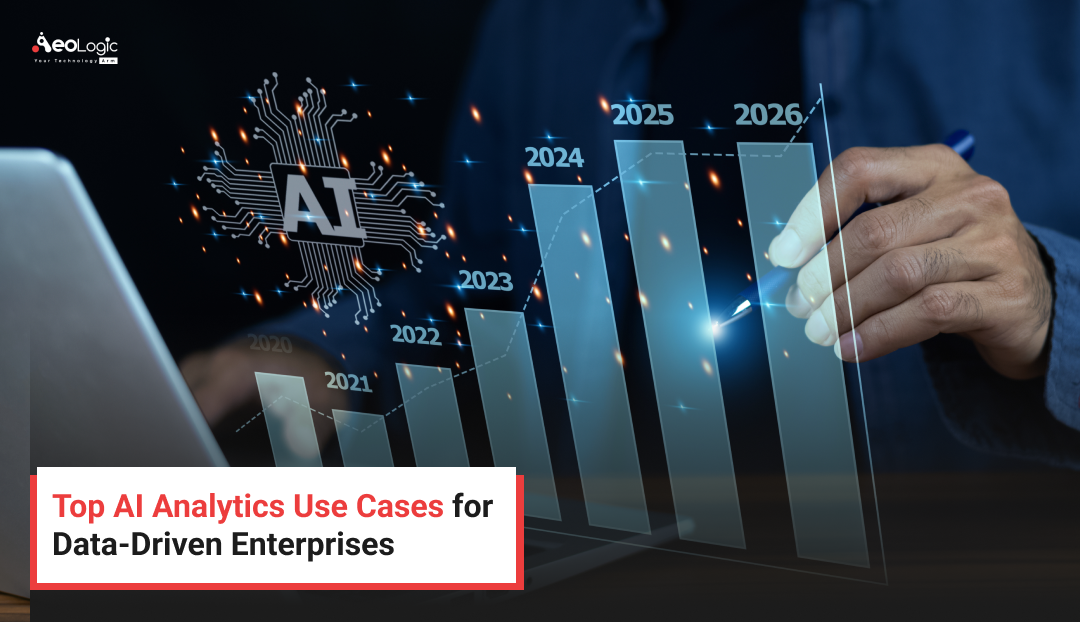
The digital economy is changing quickly and businesses are producing more data than ever. All customer interactions and transactions, supply chain movements, website clicks, operational workflows and even connected devices add to the growing body of information. Gathering data may be easier, but transforming it into meaningful business intelligence is a big challenge. That’s where Top AI Analytics Use Cases are transforming enterprises’ operations, competition, and growth.
AI and analytics can help companies analyze huge quantities of data in real time and uncover patterns that are not apparent with traditional systems. Rather than just relying on past reports, businesses can now anticipate what will happen in the future, proactively identify risks, automate decision-making, and optimize operational performance. In 2026, organizations are transitioning to intelligent ecosystems, and AI analytics plays a crucial role in digital transformation and sustainability.
From manufacturing to healthcare, logistics to retail, finance to telecommunications, businesses are increasingly turning to AI-driven analytical solutions to enhance efficiency and make informed decisions. By grasping its real-world uses, businesses can leverage this AI analytics to boost productivity, enhance user experience, and drive improved profitability.
What Is AI Analytics and Why Is It Transforming Enterprise Decision-Making?
AI analytics refers to the use of artificial intelligence technologies such as machine learning, deep learning, predictive modeling, and natural language processing to analyze data automatically and generate actionable insights. Traditional analytics generally focuses on understanding historical events. The traditional analytics is more about comprehending past events. AI analytics goes beyond this, finding concealed connections, anticipating future results, and suggesting optimum actions.
In real business scenarios, AI analytics serves as a smarter layer on top of enterprise data systems, making the Top AI Analytics Use Cases even more crucial for organizations aiming to make quicker and smarter decisions. AI continuously analyzes information and gives recommendations in real time, instead of waiting for analysts to manually analyze reports. By providing faster response to market changes, customer requirements, and operational challenges, and enhancing overall agility and competitiveness, this capability benefits businesses.
The speed of decision making is becoming a competitive edge, as business becomes increasingly data-driven. Companies who can convert raw information into intelligence more quickly tend to be more efficient, innovative and satisfy their customers more.
Why Enterprises Are Increasingly Investing in AI Analytics
While AI analytics is a new technology, its rise is not just about that. It is heavily dependent on the complexity of businesses. The days of traditional reporting are over as enterprises are now taking place in several channels, regions and digital platforms.
The need for predictive insights over retrospective analysis is why it’s more important than ever for modern enterprises to understand Top AI Analytics Use Cases. In this context, AI analytics emerges as a powerful solution to transform uncertainty into informed decision-making, help organizations become more accurate in forecasting, optimize their operations, and achieve enhanced competitive advantage.
Other factors are also significant to consider, such as operational pressure. All of these objectives – cost optimization, productivity enhancement, personalization, and risk management – must be achieved all in one. AI analytical systems enable companies to achieve these goals, with minimal manual effort.
Top AI Analytics Use Cases Driving Enterprise Growth in 2026
Industries are leveraging AI analytics for real-world applications with measurable impact. More and more enterprises are adopting smart systems which enhance forecasting, automate monitoring processes and optimize operation efficiency.
One of the most significant applications is predictive forecasting. The traditional forecasting methods can be difficult to adapt to fast changing market conditions. Historical information, external factors, and new trends are continuously fed into the AI model to produce more precise forecasts.
For example, a retailer can embrace predictive forecasting and alter inventory supplies ahead of shortages. Producers can forecast manufacturing needs in response to consumer trends. Financial institutions can make better investment risk predictions.
Better forecasting can help businesses minimize uncertainty and increase forecasting accuracy.
Customer Intelligence and Personalized Experiences
In the digital age, customer expectations keep on going up. By providing a more personalized experience, consumers are more likely to be engaged and interested in the products or services offered. Personalized experiences, by catering to the consumers’ behaviour, preferences and buying history, are increasingly preferred. AI analytics enables companies to comprehend their customers on a deeper level.
Understanding their browsing habits, engagement levels, transaction histories, and interactions allows businesses to tailor their experiences, leading to increased engagement and customer retention. One of the Top AI Analytics Use Cases is the recommendation system in digital commerce and streaming platforms, where artificial intelligence understands customer preferences and provides personalized recommendations on the fly. The AI-powered personalization features enable businesses to boost their conversion and retention rates, and improve customer experience on digital platforms.
With personalization, organizations can achieve better customer retention, satisfaction, and revenue opportunities. Using intelligent customer analytics, engagement moves from general to personalized communication. With intelligent customer analytics, engagement becomes more personal than ever.
Predictive Maintenance and Industrial Optimization
Equipment failures are still one of the main challenges in the manufacturing and industrial industry. Downtime reduces productivity, costs and impact the supply chain.
Through AI analytics, continuous monitoring of equipment performance data can be used to predict maintenance, thereby enabling predictive maintenance. These sensor data, vibration characteristics, operating temperature and previous maintenance history are analysed to look for early warning signs of failure.
Organizations no longer have to undertake maintenance at pre-designed intervals, but only when it is needed. This not only helps to save on maintenance expenses but also extends the lifespan of equipment and enhances its reliability.
Predictive maintenance is emerging as a key aspect of smart manufacturing environments and Industry 4.0.Predictive maintenance is gaining importance in smart manufacturing environments and Industry 4.0.
 Top AI Analytics Use Cases in Supply Chain and Logistics Transformation
Economic uncertainty, geopolitical issues, climate change and fluctuations in consumer demand have made global value chains increasingly susceptible to disruptions. For enterprises, it is important to have increased visibility in their procurement, inventory, transportation and distribution processes.
With AI analytics, businesses can predict disruptions and fine-tune supply chain operations. Intelligent systems are used to identify shipment patterns, vendor performance, warehouse activity and movement of inventory, and forecast potential bottlenecks before they become an issue.
AI-powered logistics intelligence can enhance delivery efficiency and minimize operational risks in companies. Forecasting benefits also help to optimize inventories and reduce costs.
AI analytics remains crucial in creating resilient supply chains amid the increasingly connected supply chain landscape.
Fraud Detection and Financial Risk Management
With the rise in digital transactions across the globe, financial fraud has become more sophisticated. In the past, it was difficult to get unusual activity noticed quickly with traditional monitoring.
AI analytics can help identify fraud by detecting patterns of activity that are considered unusual. Intelligent systems continuously compare new activities against historical behavior to identify potential risks in real time.
AI is being adopted by banks to detect fraudulent activity and by insurance companies to investigate inconsistencies in claims. Banks are leveraging AI to track suspicious transactions, and insurance companies are using it to investigate inconsistencies within their claims. Predictive models work well at identifying payment fraud on e-commerce platforms.
Rapid fraud detection reduces financial losses and enhances customer trust and performance in compliance.
Enterprise Workforce Analytics and Human Resource Intelligence
One of the Top AI Analytics Use Cases is to enhance workforce productivity, employees’ engagement and retention strategies; human capital still stands as one of the most important assets in the organizations. In the hybrid/digital workplace, managing talent is becoming more complex, and it has become more important to gain greater insights into employee behavior, performance trends, and workforce needs for the future.
By utilizing AI analytics, HR teams can uncover trends in employee engagement, forecast potential employee attrition, and make informed hiring decisions. Organizations gain deeper understanding of workforce patterns that influence productivity and long-term retention.
Recruitment processes are also greatly helped. AI systems process candidate information more effectively and enable businesses to pinpoint skill deficits based on their future business requirements.
How Enterprises Can Successfully Implement AI Analytics
It’s not just about implementing technology. Organizations should have a plan to get measurable results.
The first step is to define problems that need to be solved in the business. Businesses should establish their goal to be more accurate with their forecasting, lower operating expenses, improve customer retention or boost productivity.
The following step is upon the readiness of the data. Data quality is a critical component of AI systems. Incomplete or inconsistent information diminishes the accuracy of predictions and also the overall level of performance.
In addition, organizations need to build scalable infrastructure to handle increasing numbers of analytical workloads. Flexibility and integration are increasingly being offered in cloud-based environments and will be essential for enterprise AI adoption.
Finally, there needs to be ongoing monitoring. AI models get better with learning, so businesses should periodically test them and adjust analytical models accordingly.
Challenges Enterprises Face While Adopting AI Analytics
While the advantages of AI analytics are significant, there are also some challenges to consider when implementing it. No matter how sophisticated the algorithm, it can’t produce accurate results when the information is faulty.
The adoption of Top AI Analytics Use Cases is also complicated by integration complexity, particularly when enterprises try to roll out these use cases in systems that were built for previous generations of systems, and were not designed to accommodate modern AI infrastructure. Organizations are still stuck with legacy technologies, which pose integration, scalability, and smooth deployment of advanced AI solutions challenges.
Another challenge involves skills shortages. Many organizations have difficulties locating professionals with the expertise to lead an analytical ecosystem that relies on AI.
As regulations continue to change, issues of transparency, bias and privacy remain an influence on enterprise adoption.
The solutions to these barriers will take a long-term investment, governance, and planning approach.
Future Trends in Top AI Analytics Use Cases Shaping Enterprises Beyond 2026
AI analytics is forecast to become more autonomous in the future, that is, a decision intelligence that exists without human intervention. Rather than just suggesting action, systems can begin to take action automatically with a set of business rules.
Explainable AI is also a trend that is becoming more prevalent. In regulated industries, organizations want to know how algorithms arrive at their results and are more transparent about it.
As a result, generative AI and analytics are revolutionizing business intelligence. Conversational interface systems with the ability to provide real-time insight may see enterprises soon interacting with them.
Expect to see edge analytics, federated learning and AI-powered digital twins continue to grow, as the enterprises seek the next level of distributed intelligence at speed.
The development of intelligent analytics is set to keep reshaping business processes and competition across the world of business.
Conclusion
AI analytics is no longer a new idea exclusive to technology giants. It has emerged as a real business skill that can shape business decisions, efficient operations, customer interactions, and company expansion. In the end, with intelligent analytics frameworks, organizations are well-poised to react quickly to market shifts and establish sustainable competitive edges.
Understanding Top AI Analytics Use Cases allows enterprises to identify opportunities where predictive intelligence can create measurable value. As AI capabilities continue evolving, businesses investing early in analytics maturity will likely achieve stronger resilience and innovation outcomes.
Companies seeking to accelerate AI adoption and build scalable enterprise solutions can explore advanced digital transformation strategies with Aeologic Technologies, helping organizations integrate intelligent technologies into real-world business operations.
Frequently Asked Questions
Q1. What industries benefit most from AI analytics?
Industries including manufacturing, healthcare, logistics, retail, banking, telecommunications, and energy benefit significantly from AI analytics because they generate large volumes of operational and customer data. AI enables these sectors to improve forecasting, automate monitoring, optimize resources, and reduce risks.
Q2. Are AI analytics solutions suitable for small and medium businesses?
Yes. Cloud platforms and scalable AI tools have made advanced analytics accessible for organizations beyond large enterprises. Smaller businesses increasingly adopt AI to improve efficiency, customer engagement, and operational planning.
Q3. How long does enterprise AI analytics implementation take?
Implementation timelines vary depending on infrastructure complexity, business goals, and data readiness. Some projects require several months, while large-scale enterprise transformations may extend longer.
Q4. Why are Top AI Analytics Use Cases important for modern enterprises?
Top AI Analytics Use Cases help organizations move beyond traditional reporting toward predictive and intelligent decision-making. Enterprises gain faster insights, improved efficiency, reduced risks, and stronger competitive positioning.
Q5. What is the biggest challenge in adopting AI analytics?
Poor data quality remains one of the largest barriers. Organizations must establish governance processes and ensure accurate, accessible datasets before deploying AI models.