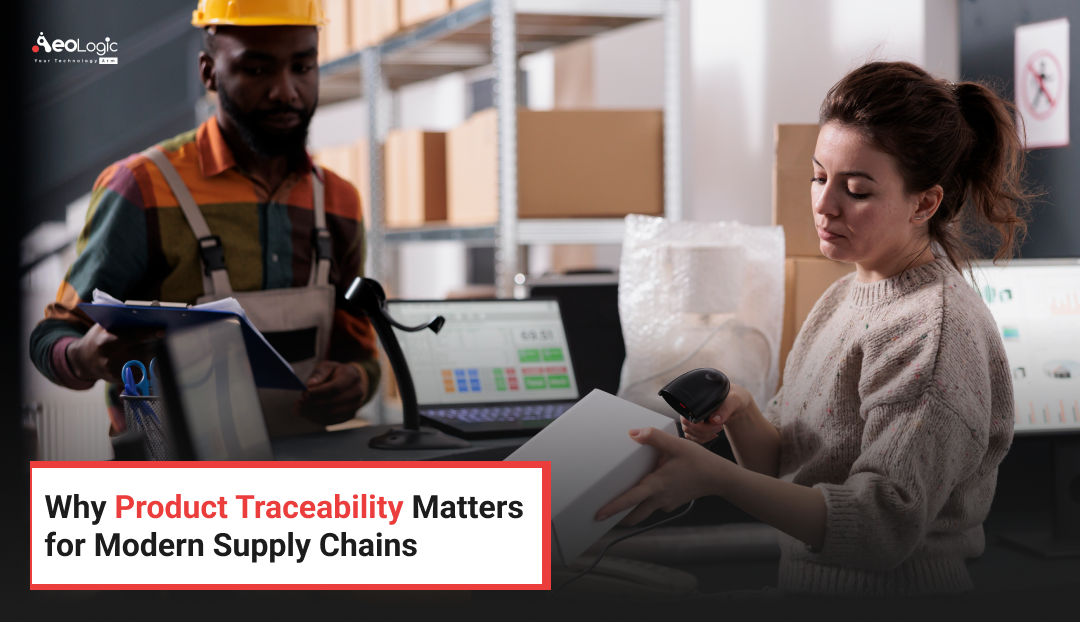
Businesses are under growing pressure to increase transparency, improve quality, and provide outstanding customer experiences in every industry, from food and pharmaceuticals to electronics and logistics. In this context, Product Traceability has quickly developed from a “good-to-have” feature to one of the most important pillars of international supply chain management. The goal is now to create a full digital footprint of a product’s journey, including its origin, movement, transformation, and final delivery, rather than just tracking goods from point A to point B.
Product traceability is essential for lowering risk, facilitating real-time visibility, and promoting operational excellence as businesses work to meet customer expectations, legal requirements, and international competition. Prominent digital transformation firms like Aeologic Technologies have been at the forefront of deploying cutting-edge traceability solutions driven by blockchain, RFID, IoT, AI, and intelligent automation—assisting businesses in accurately and confidently transforming their supply chain ecosystems.
Comprehending Product Traceability
Product traceability is essentially the capacity to monitor a product’s movement, history, location, and condition over the course of its lifecycle. This covers the procurement of raw materials, production, storage, shipping, distribution, retail, and even post-purchase operations.
Product traceability provides answers to important queries like:
- Where did this product come from?
- Which components or raw materials were utilized?
- At every stage, who was in charge of it?
- How was it handled, moved, or kept?
- Does it follow the rules and is it genuine?
- What is its current location and status?
Traceability has two main dimensions:
• Backward traceability: Tracking a product back to its source or earlier stages
• Forward traceability: Tracking a product as it travels toward end users
A full 360-degree view of products from source to shelf is ensured by the integration of both in modern supply chains.
The Significance of Product Traceability in Contemporary Supply Chains
Modern supply chains have become far more complex than ever before. As globalization expands, supplier networks grow, regulations tighten, and customer expectations rise, businesses must operate with greater accuracy and transparency. This is where product traceability becomes indispensable. It not only strengthens supply chain reliability but also supports long-term growth and resilience.
Here’s why it’s more crucial than ever:
A greater demand for transparency and consumer awareness
Consumers want to know if the goods they use are genuine, safe, and sourced ethically. For verification, labels like “organic,” “sustainably produced,” or “cruelty-free” need to be traceable. Brands that can substantiate their claims are trusted by modern consumers.
Tighter Regulations and Global Compliance
Pharmaceuticals, food, medical devices, aerospace, and chemicals are among the industries that are subject to stringent regulations that necessitate careful material and process tracking. Penalties, recalls, or legal action result from noncompliance.
Growing Risks of Fraud and Counterfeiting
Every year, billions of dollars are lost due to counterfeit goods. Traceability aids in product authentication and keeps counterfeit goods out of the market, which is especially important for luxury goods, electronics, pharmaceuticals, and auto parts.
Supply Chain Interruptions and Risk Reduction
Furthermore, product traceability enhances supply chain efficiency by offering real-time visibility into product movement. As a result, businesses can reduce delays, prevent losses, eliminate manual errors, maintain healthier inventory levels, and improve communication across every supply chain partner.
Quicker and More Precise Product Recalls
Without traceability, recalls become costly and chaotic. With proper tracking, companies can pinpoint exactly which batches are affected and remove them swiftly.
Increased Productivity and Cost Reductions
Production scheduling, inventory management, logistics effectiveness, and supply chain performance are all enhanced by real-time insights.
Product traceability is a strategic tool that helps companies modernize operations, cut waste, improve efficiency, and foster customer trust, according to digital transformation partners like Aeologic Technologies.
 Principal Advantages of Product Traceability
Throughout the whole supply chain, product traceability provides both strategic and operational benefits. Among the most significant advantages are:
Improved Control and Visibility
Businesses can track events at every stage thanks to traceability, which offers total visibility into product movement. This facilitates prompt, well-informed decision-making.
Enhanced Safety and Quality of Products
Businesses can guarantee constant product quality and safety by monitoring raw materials, production procedures, and environmental factors like temperature and humidity.
Decreased Shrinkage, Waste, and Losses
Real-time inventory monitoring greatly reduces shrinkage, theft, and unaccounted losses.
Enhanced Inventory Control
Businesses can minimize overstocking and stockouts by maintaining ideal stock levels with precise tracking.
Increased Consumer Loyalty and Brand Trust
Transparency is valued by customers. Brand credibility and trust are increased when companies showcase full product journeys.
Simplified Compliance and Recalls
Traceability systems assist companies in fulfilling legal obligations and carrying out focused recalls with the least amount of disruption to business operations.
Enhanced Efficiency of the Supply Chain
End-to-end insights facilitate the identification of inefficiencies, the removal of bottlenecks, and the enhancement of coordination.
Encouragement of ESG reporting and sustainability
Data from traceability is needed for ESG compliance, carbon footprint analysis, ethical sourcing reports, and sustainability claims.
The Operation of Product Traceability
Data collection at multiple touchpoints and storage in a centralized or distributed system for real-time access are essential components of product traceability. Usually, the procedure entails:
Data Gathering
Data is gathered from:
- Unprocessed materials
- Details of the supplier
- Lot and batch numbers
- Timestamps for production
- Inspections of quality
- Labeling and packaging
- Transportation and logistics
- Handling of warehouses
- Delivery to customers
Information is gathered using technologies like blockchain, RFID, barcodes, QR codes, and Internet of Things sensors.
Integration and Storage of Data
Blockchain networks, cloud platforms, and centralized ERP systems are used to store collected data. Smooth data flow is ensured by integrating systems like enterprise resource planning (ERP), warehouse management systems (WMS), and manufacturing execution systems (MES).
End-to-end visibility and data analysis
To track product movement, spot trends, spot anomalies, and streamline operations, businesses use analytics dashboards and real-time monitoring tools.
Data Exchange and Cooperation
Suppliers, manufacturers, distributors, logistics partners, and retailers must work together to achieve traceability. Platforms for secure data sharing guarantee reliable communication.
Using automation, AI, and IoT-led solutions, digital transformation firms like Aeologic Technologies assist businesses in implementing complete traceability architectures, from data capture to analytics.
Applications of Product Traceability in Industry
Product traceability benefits many different industries. Among the most significant use cases are:
Food and Drinks
Food safety, freshness, contamination control, and adherence to FDA FSMA and FSSAI regulations are all guaranteed by traceability. Additionally, it aids in monitoring cold chain integrity, expiration dates, and sourcing.
Medicines and Healthcare
Guarantees the authenticity of drugs, stops fake medications, keeps an eye on storage conditions, and assists with regulatory compliance for track-and-trace and serialization.
Manufacturing and Industrial Products
Tracking components, keeping an eye on work-in-progress procedures, and upholding quality control throughout production are all made easier with traceability.
E-commerce and retail
Retailers use traceability to enhance last-mile delivery tracking, guarantee product authenticity, and optimize inventory.
Automobile
Component traceability is crucial to OEMs’ warranty management, recall effectiveness, and safety compliance.
Electronic devices
Monitors parts, manufacturing procedures, and test findings to guarantee high-quality, flawless products.
Logistics & Transportation
Route optimization, real-time product condition monitoring, and shipment visibility are all improved by traceability.
Fashion & Textiles
Used more often to track sustainability, verify ethical sourcing, and stop the production of fake luxury goods.
In the majority of these industries, Aeologic Technologies assists businesses in implementing intelligent, scalable, and highly accurate traceability ecosystems.
Methods and Technologies Driving Product Traceability
Automation, digitization, and intelligent technologies work together to power modern product traceability. Among the important facilitators are:
Radio Frequency Identification, or RFID
Without the need for manual scanning, RFID tags automatically record product movement and status. Perfect for inventory control, asset tracking, and warehouse automation.
QR codes and barcodes
Widely used and reasonably priced for identifying materials, products, and batches.
Internet of Things Sensors
Keep an eye on environmental factors that are important for the cold chain and sensitive goods, such as temperature, humidity, shock, and location.
Blockchain technology
Ensures data transparency among supply chain partners and offers unchangeable, tamper-proof records for authenticity verification.
Machine Learning and AI
Uses traceability data to forecast risks, enhance quality control, and produce insights.
Cloud Computing
Permits remote access over international networks, real-time monitoring, and scalable data storage.
ERP, MES, and WMS Systems
For automation and coordination, incorporate traceability data into business processes.
These technologies are combined by digital transformation specialists like Aeologic Technologies to create reliable, future-ready traceability systems that are customized to meet industry-specific needs.
Implementing Product Traceability: Obstacles and Solutions
Product traceability is crucial, but many businesses find it difficult to put it into practice. Typical difficulties consist of:
Lack of Integration and Data Silos
Maintaining a cohesive view is challenging when systems are disconnected.
Solution: All data points are unified through cloud integration and API-based architecture.
High Starting Expenses
Investing in technology may seem costly.
Solution: Phased, scalable deployments lower expenses and risk.
Unreliable Data Quality
Errors are frequently caused by manual inputs.
Solution: Manual handling is reduced by automation (RFID, IoT, barcode scanning).
Complicated Networks of Suppliers
Hundreds of suppliers are involved in global supply chains.
Solution: Centralized platforms and blockchain make multi-party cooperation easier.
Employee Opposition to Change
Internal opposition may arise when switching from manual to digital systems.
Solution: User-friendly tools, organized onboarding, and training guarantee adoption.
Complexity of Regulation
The standards for compliance vary by nation.
Solution: Automated compliance tools and digital documentation make regulatory management easier.
Aeologic Technologies uses cutting-edge, adaptable, and compliance-focused digital transformation frameworks to address these issues.
Best Practices for Implementing Product Traceability Successfully
Businesses should adhere to these tried-and-true best practices to optimize the advantages of product traceability:
- Use a phased implementation approach.
- Standardize procedures, data formats, and labeling.
- For smooth visibility, integrate all supply chain systems.
- Reduce human error by using automation
- Select scalable technologies so they can expand with your company.
- Make sure that regulations are followed from the start.
- Educate staff members and supply chain partners.
- For real-time insights, use analytics and dashboards.
- Work closely with specialists in digital transformation like Aeologic Technologies.
- Audit and improve traceability processes on a regular basis.
Future Patterns Influencing Product Traceability’s Development
Intelligent technologies, data-driven decision-making, and a strong emphasis on transparency will shape the future of product traceability as global supply chains continue to grow and become more interconnected.
Intelligent Supply Chains and Hyper-Automation
In order to create highly interconnected supply chain ecosystems, businesses are embracing hyper-automation by fusing AI, machine learning, IoT, and advanced analytics. In order to provide real-time insights into product quality, location, and compliance, product traceability will become more automated and require less human intervention.
Blockchain for Transparency and Trust
Blockchain technology is quickly becoming the norm for businesses that require unchangeable, unchangeable product histories. Blockchain-enabled traceability will aid in confirming the legitimacy of food, medicine, electronics, and luxury goods as consumer trust and regulatory compliance become more crucial.
Predictive Traceability with Digital Twins
Businesses will be able to model the complete supply chain thanks to digital twins, which are virtual copies of real goods and procedures. This technology helps organizations anticipate disruptions, detect risks sooner, and optimize product flow long before any challenges emerge.
IoT-Powered Condition Monitoring
Additionally, IoT sensors will continue to transform traceability by monitoring temperature, humidity, shock, pressure, and movement in real time. This level of visibility is especially crucial for sensitive products such as electronics, chemicals, pharmaceuticals, and perishable foods.
Transparency in Ethical Sourcing and Sustainability
Companies across the world are under pressure to follow ethical practices, reduce carbon emissions, and meet ESG reporting standards. Product traceability will play a critical role in documenting sustainable sourcing, energy usage, waste management, and carbon footprint at each stage of a product’s journey.
Predictive Insights Driven by AI
Massive amounts of traceability data will be analyzed by AI, which will forecast demand, identify anomalies, predict delays, and suggest remedial measures.
Unified International Standards for Traceability
Global traceability standards like GS1 will keep growing as industries demand greater dependability and transparency. Standardization will lessen data silos between international partners and facilitate cross-border movement.
Including Smart Packaging
Customers will be able to confirm the authenticity of products by simply scanning their mobile phones thanks to smart packaging technologies like NFC tags, RFID labels, and sensor-enabled packaging.
These cutting-edge, next-generation technologies are already being used by digital transformation firms like Aeologic Technologies to assist businesses in making the shift to smarter, more robust supply chains.
Conclusion
Product traceability is now a fundamental capability for every contemporary supply chain in today’s cutthroat and rapidly evolving market. It helps companies to improve the quality of their products, streamline operations, cut waste, improve regulatory compliance, reduce the risk of counterfeiting, and gain unparalleled customer trust.
By adopting a robust traceability system, your business becomes better equipped to meet rising expectations for transparency, safety, and ethical responsibility.
Businesses can access cutting-edge RFID solutions, IoT-powered tracking systems, blockchain frameworks, automated workflows, and AI-driven insights that modernize the entire supply chain ecosystem by working with digital transformation partners like Aeologic Technologies. Businesses that embrace product traceability now and leverage it as a competitive advantage will own the future of supply chain excellence.
FAQs
Q1. Describe product traceability and explain its significance.
The ability to follow a product’s path through the supply chain is known as product traceability. It promotes regulatory compliance, guarantees transparency, enhances product quality, and aids in keeping dangerous or counterfeit goods off the market.
Q2. Which sectors gain the most from product traceability?
Because these sectors operate under strict safety, quality, and authenticity requirements, industries such as food and beverage, pharmaceuticals, healthcare, electronics, manufacturing, automotive, logistics, and retail gain immense value from implementing product traceability.
Q3. How does product traceability increase the effectiveness of the supply chain?
Product traceability also elevates overall supply chain performance by providing real-time visibility into product movement. As a result, businesses can reduce delays, avoid losses, eliminate manual errors, maintain balanced inventory levels, and strengthen communication among supply chain partners.
Q4. Which technologies are frequently employed in product traceability?
RFID, barcodes, QR codes, IoT sensors, blockchain, artificial intelligence, cloud platforms, ERP systems, and automated tracking systems are examples of technologies.
Q5. Can traceability systems be implemented by small and mid-sized businesses?
Indeed. Businesses of all sizes can install affordable, adaptable traceability systems without making significant infrastructure investments thanks to the modular and scalable solutions provided by firms like Aeologic Technologies.
Q6. What are the main obstacles to putting traceability into practice?
Data silos, a lack of integration, inconsistent data quality, employee resistance, complicated regulations, and high initial costs are common problems. Automation, training, and phased digital transformation techniques can address these.
Q7. How is sustainability aided by traceability?
Verifiable information regarding waste management, energy use, carbon emissions, and sourcing methods is provided by traceability. It enables companies to fulfill ESG reporting requirements and support their sustainability claims.

Manoj Kumar is a seasoned Digital Marketing Manager and passionate Tech Blogger with deep expertise in SEO, AI trends, and emerging digital technologies. He writes about innovative solutions that drive growth and transformation across industry.
Featured on – YOURSTORY | TECHSLING | ELEARNINGINDUSTRY | DATASCIENCECENTRAL | TIMESOFINDIA | MEDIUM | DATAFLOQ