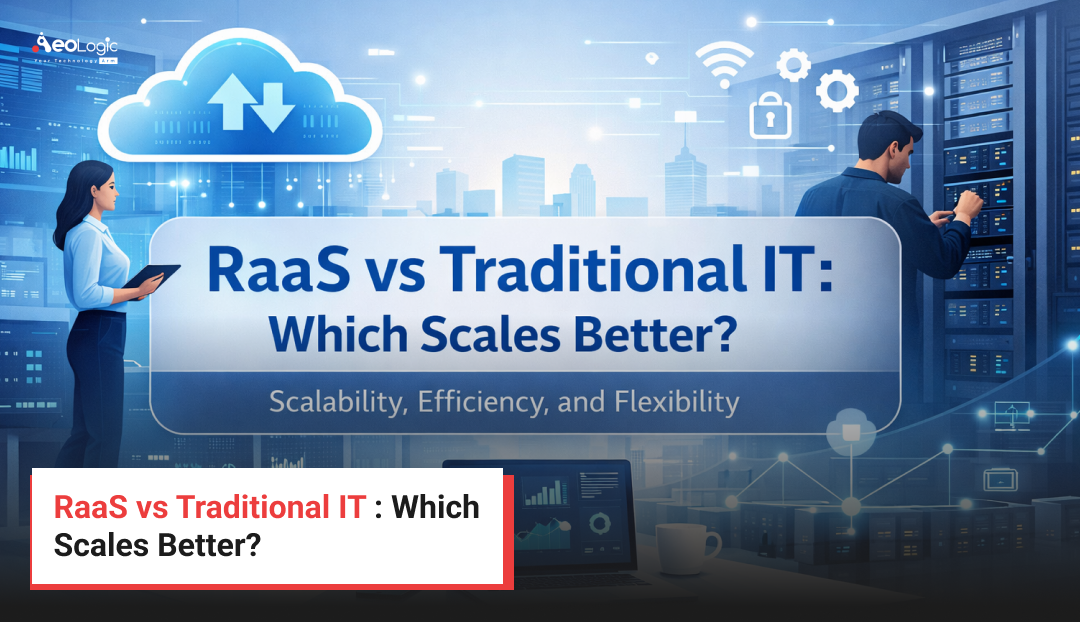
In today’s rapidly evolving digital landscape, businesses are under constant pressure to scale operations efficiently while maintaining flexibility and cost control. The debate around RaaS vs Traditional IT has become increasingly relevant as organizations seek infrastructure models that align with modern demands such as agility, remote operations, and real-time scalability. Whether you’re a growing startup or a large enterprise, choosing the right IT model can directly impact your operational efficiency, innovation speed, and long-term growth.
As cloud computing, automation, and service-based architectures continue to reshape enterprise ecosystems, companies are rethinking legacy IT setups. The comparison between Robot-as-a-Service (RaaS) and traditional IT infrastructure is not just a technical discussion—it’s a strategic business decision. This article explores both approaches in depth, helping decision-makers understand which model scales better in real-world scenarios.
What is RaaS (Robot-as-a-Service)?
Robot-as-a-Service, or RaaS, is a cloud-based service model that lets businesses rent robotic process automation (RPA), physical robots, or intelligent automation systems on a monthly or yearly basis. Companies can get automation capabilities as a service instead of spending a lot of money on hardware and software up front.
RaaS combines cloud computing, the Internet of Things (IoT), artificial intelligence (AI), and automation into one way to deliver services. Companies can set up, keep an eye on, and grow robotic operations from afar without having to own the infrastructure that supports them. RaaS is especially appealing to industries like manufacturing, logistics, healthcare, and retail.
Traditional IT systems need to be set up, maintained, and upgraded by hand. RaaS platforms, on the other hand, are run by service providers. This cuts down on operational costs by a lot and speeds up deployment cycles.
What is Traditional IT Infrastructure?
Traditional IT is the old way of doing things, where companies build, own, and run their own IT systems. This includes things like servers, networking hardware, storage systems, software licenses, and data centers that are located on the premises.
In this model, businesses are in charge of buying, installing, maintaining, upgrading, and securing their own systems. Traditional IT gives you full control over systems and data, but it usually costs a lot of money, takes a long time to set up, and doesn’t allow for much growth.
This method has been the backbone of enterprise IT for a long time. But as digital transformation speeds up, its flaws are becoming clearer, especially in environments that are always changing and growing quickly.
Why the RaaS vs Traditional IT Debate Matters?
The debate about RaaS vs. Traditional IT is important because scalability is now a must-have for survival in competitive markets. Businesses must adapt quickly to changing demands, customer expectations, and technological advancements.
Companies that depend on rigid infrastructure often have a hard time growing quickly. Service-based models like RaaS, on the other hand, are flexible and let businesses add or remove resources as needed.
This comparison is very important for industries that are going through digital transformation, where automation, data analytics, and remote operations are very important. Picking the wrong model can cause problems, cost more, and lose out on chances.
 Core Differences Between RaaS and Traditional IT
Scalability Approach
RaaS is made to be able to grow. In the RaaS vs Traditional IT comparison, cloud-based platforms let businesses quickly add or remove robotic capacity. This flexibility ensures that organizations only pay for what they actually use, making scaling more efficient and cost-effective.
In contrast, traditional IT needs a lot of planning and money to grow. When you expand your infrastructure, you often have to buy new hardware, set up systems, and find space for them, which can slow down growth plans.
Cost Structure
RaaS works on an operational expenditure (OpEx) model, which means that businesses pay a monthly fee. This gets rid of the need for big up-front investments and makes it easier to manage cash flow.
Traditional IT uses a capital expenditure (CapEx) model, which means that a lot of money must be spent up front on hardware and software. The total cost of ownership goes up even more because of the costs of ongoing maintenance and upgrades.
Deployment Speed
You can set up RaaS solutions quickly, usually in a few days or weeks. Service providers take care of the setup, integration, and configuration.
It can take months to set up traditional IT systems because of the time it takes to buy, install, and test them. This delay could make projects that need to be done quickly harder.
Maintenance and Upgrades
With RaaS, the provider takes care of updates and maintenance. Businesses can always use the newest features and technologies.
In traditional IT, internal teams must handle maintenance, which can be time-consuming and resource-intensive. Upgrades often require downtime and additional investment.
RaaS vs Traditional IT: Which Scales Better in Real Scenarios?
When comparing RaaS to traditional IT, scalability is the most important thing to look at. RaaS is clearly better in situations where growth, flexibility, and new ideas are needed quickly.
For instance, an online store that has a lot of business during certain times of the year can quickly scale up its robotic warehouse operations with RaaS. On the other hand, a traditional IT setup would need to spend money on infrastructure that might not be used much during slow times.
In the same way, healthcare organizations can use RaaS to automate the processing of patient data and diagnostics without having to buy expensive equipment. Traditional IT would need its own infrastructure, which would make it hard to scale.
However, traditional IT may still be a good choice for businesses with steady workloads and strict rules that require full control over data and systems.
Key Components of RaaS Ecosystem
Cloud Infrastructure
In the context of RaaS vs Traditional IT, physical robots or software bots that perform tasks such as data processing, manufacturing, and logistics operations form the core of the RaaS model.
Robotics and Automation
Physical robots or software bots that do things like process data, make things, and run logistics are at the heart of RaaS.
AI and Machine Learning
Intelligent automation makes it easier to make decisions by letting systems learn and get better over time.
IoT Integration
Connected devices make it possible to monitor and collect data in real time, which makes things more efficient and open.
Step-by-Step Strategy for Transitioning in RaaS vs Traditional IT Environments
Step 1: Assess Current Infrastructure
Organizations should look at their current IT systems and find any problems, slowdowns, or limits on how many people they can handle. This helps figure out if moving to RaaS is possible.
Step 2: Define Business Objectives
Make your goals clear, like lowering costs, making things work better, or getting things up and running faster. This makes sure that business strategy and technology are in sync.
Step 3: Identify Automation Opportunities
Look at tasks that could be made easier by automation, like data processing, supply chain operations, and tasks that are done over and over.
Step 4: Choose the Right RaaS Provider
It’s very important to choose a trustworthy service provider. You should think about things like security, scalability, and the ability to integrate.
Step 5: Implement and Integrate
Slowly roll out RaaS solutions, making sure they work well with the systems you already have. Pilot projects can help lower risks.
Step 6: Monitor and Optimize
To get the most out of your investment, keep an eye on performance metrics and improve processes.
Benefits of RaaS Over Traditional IT
RaaS vs Traditional IT highlights how RaaS gives businesses the most freedom possible, letting them grow without having to spend a lot of money. Outsourcing maintenance and upgrades to service providers makes operations less complicated. Companies can focus on their main business instead of having to worry about their IT infrastructure.
Another big benefit is that new ideas come up faster. Companies can try out and put into use new solutions quickly thanks to advanced technologies like AI and automation. RaaS also makes systems more resilient by letting them work from anywhere and recover from disasters.
Real-World Use Cases
RaaS makes smart factories possible in manufacturing, where robots do assembly, quality control, and packaging with great accuracy and consistency. Companies can easily change the size of their production lines based on changes in demand without having to buy new machines. This makes the process more efficient, cuts down on downtime, and speeds up the overall production cycle.
RaaS-powered automation makes warehouse operations much better in logistics by making picking, sorting, and keeping track of inventory easier. This cuts down on mistakes made by people and speeds up delivery times. Retail stores also use RaaS to manage their inventory, predict demand, and automate customer service. This makes things run more smoothly and improves the customer experience.
Healthcare organizations use RaaS to manage patient data, make diagnoses, and even do robotic-assisted surgeries with better accuracy. This not only makes treatment more accurate, but it also lowers costs and the amount of work that needs to be done by hand. Additionally, RaaS supports telemedicine and remote monitoring, enabling better patient care and faster decision-making.
Technologies and Tools Involved in RaaS vs Traditional IT
Cloud platforms, IoT devices, AI frameworks, and robotic process automation tools are just some of the technologies that work together in RaaS ecosystems. AWS, Microsoft Azure, and Google Cloud are all well-known platforms that make it possible to offer scalable services.
Automation tools like UiPath, Automation Anywhere, and Blue Prism are very important for businesses to be able to use RaaS solutions properly. These platforms make it easy to design, deploy, and manage software bots that can automate repetitive, rule-based tasks in many business areas.
Challenges and Limitations of RaaS vs Traditional IT Models
RaaS has some problems, even though it has some benefits. When companies depend on third-party providers to handle sensitive data and operations, worries about data security and privacy become very important. Ensuring compliance with industry regulations, maintaining data integrity, and establishing strong access controls are essential to mitigate potential risks.
For businesses with deeply embedded traditional infrastructure, integration with legacy systems can also be hard and take a long time—this is a common challenge highlighted in RaaS vs Traditional IT comparisons. Problems with compatibility, moving data, and the need for custom settings may make implementation take longer. If you don’t plan ahead and have the right technical skills, trying to integrate different systems can cause problems for your business.
Employees who are used to traditional systems and workflows may not want to change, which can be a problem for organizations. When you switch to RaaS, you usually need to learn new skills, take new training courses, and change the way you think. If you don’t have good change management plans and clear communication, employees may be hesitant, which could slow down adoption and hurt overall success.
RaaS vs Traditional IT : Best Practices for Successful Implementation
Businesses should use a clear and strategic approach to implementing RaaS that is in line with their long-term goals in order to get the most out of it. This means carefully choosing trustworthy and experienced service providers, setting up strong data security and compliance systems, and spending money on training programs for employees to make sure that technology is adopted smoothly, that operations run smoothly, and that people are less resistant to change.
It’s also important to start with small pilot projects to test performance, find gaps, and lower risks before full deployment. By gradually scaling operations, companies can adapt well while still keeping control. Continuous monitoring, performance analysis, and optimization of processes are essential to ensure sustained efficiency, improved ROI, and long-term business success.
Future Trends: The Evolution of RaaS and IT Infrastructure
Artificial intelligence, edge computing, and 5G connectivity are all advancing rapidly, and they will significantly influence the future of RaaS vs Traditional IT. These technologies will enable faster data processing, real-time decision-making, and highly responsive automation. As a result, RaaS solutions are expected to become more intelligent, autonomous, scalable, and widely accessible across diverse industries and use cases.
As businesses continue accelerating their digital transformation journeys, traditional IT models are likely to face gradual decline due to their limited flexibility and scalability. Organizations will increasingly adopt hybrid approaches that combine on-premise infrastructure with RaaS capabilities, allowing them to maintain control while leveraging the agility, efficiency, and innovation offered by service-based IT environments.
Conclusion
The comparison of RaaS vs Traditional IT ultimately comes down to scalability, flexibility, and business objectives. Traditional IT gives you control and stability, but it can’t keep up with the needs of today’s digital ecosystems. RaaS, on the other hand, offers a flexible, affordable, and innovative way to meet the needs of modern businesses.
For organizations looking to future-proof their operations, adopting RaaS or a hybrid model can unlock new opportunities for growth and efficiency. Companies like Aeologic Technologies are already helping enterprises transition toward smarter, scalable IT solutions that drive real business value.
If your organization is planning to scale efficiently and stay competitive in a digital-first world, now is the time to evaluate your infrastructure strategy and explore the potential of RaaS.
People Also Ask (FAQs)
Q1. What is the main difference between RaaS vs Traditional IT?
The main difference is who owns it and how big it can get. RaaS offers automation and robotics as a service, so businesses can add resources as needed without having to own the infrastructure. Companies that use traditional IT have to buy, manage, and maintain their own systems, which makes it harder and more expensive to scale. Traditional IT puts more emphasis on control and customization, while RaaS puts more emphasis on flexibility and operational efficiency.
Q2. Is RaaS more cost-effective than traditional IT?
RaaS is usually cheaper because it doesn’t require big upfront costs and instead charges customers on a subscription basis. Businesses only pay for the resources they use, which cuts down on waste and makes their money go further. Traditional IT requires a lot of money to set up and keep running, which can make the total cost of ownership go up over time.
Q3. Can small businesses benefit from RaaS?
Yes, RaaS can help small businesses a lot. It gives you access to cutting-edge technologies like AI and automation without needing to spend a lot of money. This helps small businesses compete with bigger ones by making them more efficient and able to grow. RaaS also makes it easier to use and manage because it doesn’t require as much IT knowledge in-house.
Q4. What industries benefit the most from RaaS?
RaaS is very helpful for industries like manufacturing, logistics, healthcare, retail, and finance. These fields depend a lot on automation, data processing, and being able to grow. RaaS helps them run their businesses better, cut costs, and give better service.
Q5. Is traditional IT becoming obsolete?
Traditional IT isn’t completely dead, but its role is changing. It is still useful for some situations that need full control and compliance, but many businesses are moving toward service-based models like RaaS. More and more people are using hybrid approaches that combine the best parts of both models.
Q6. How secure is RaaS compared to traditional IT?
Most RaaS providers use strong security measures like encryption, access controls, and regular updates. But companies need to make sure that their providers follow the rules and standards set by the industry. Traditional IT gives you more control over security, but it takes a lot of resources to keep it running.
Q7. Which is better for long-term scalability: RaaS and traditional IT comparison?
When evaluating long-term scalability, RaaS and traditional IT comparison clearly favors RaaS due to its flexibility, cost efficiency, and ability to adapt to changing business needs. Traditional IT may still be suitable for stable environments, but RaaS provides a more dynamic and future-ready approach.