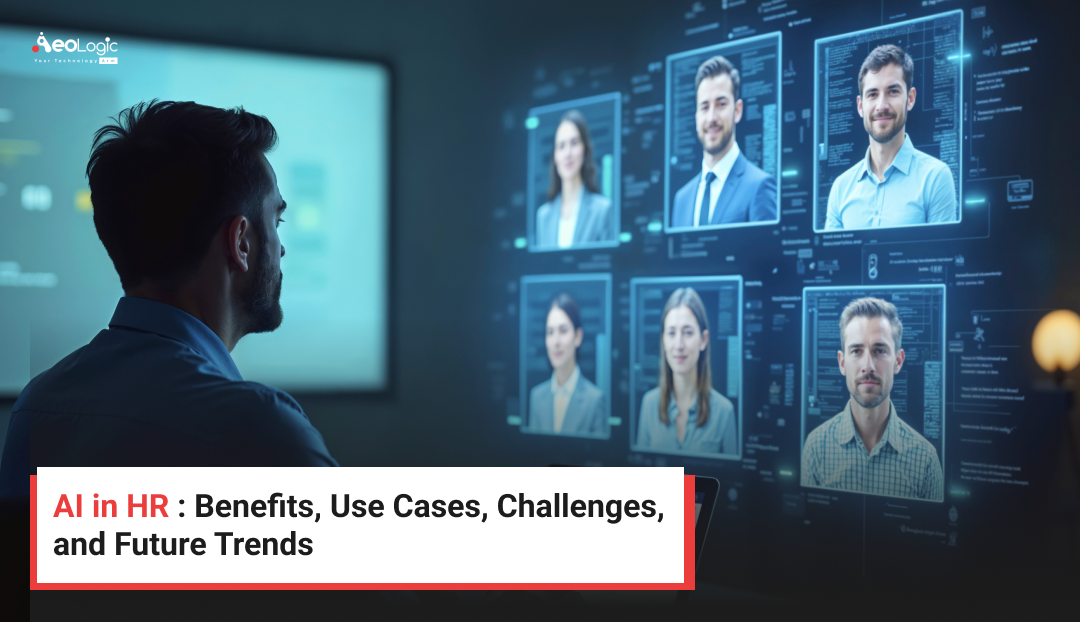
HR has always been fundamental for all successful organizations. HR teams are essential in supporting business growth, from attracting the best talent and onboarding new hires to managing performance and ensuring employee satisfaction. But as businesses grow and working environments change, it can be difficult for HR departments to meet the growing demands of the workplace with traditional HR methods. This is where AI in HR is making a significant impact.
AI is reshaping HR practices by streamlining repetitive tasks, optimizing hiring processes, providing personalized employee experiences, and facilitating data-driven decision-making. Instead of taking the place of human HR staff, AI can help HR professionals shift their attention to strategic activities that drive innovation, employee engagement, and overall organizational success. HR is getting more agile, proactive and adaptable to the changing business needs with the growth of AI technologies.
Understanding AI in HR
AI in HR involves the application of Artificial Intelligence technologies like machine learning, natural language processing (NLP), predictive analytics, and intelligent automation, to improve HR operations. These technologies leverage a lot of data regarding employees and organization to automate workflows, detect trends, create insights and make better decisions.
In contrast to traditional HR management systems that mainly have information about employees and manage administrative duties, AI HR platforms constantly refine their recommendations based on data patterns and trends.
Modern AI solutions can understand resumes, analyze interview responses, recommend training programs, answer employee questions through virtual assistants, and even forecast future hiring requirements based on business objectives.
Why AI is Becoming Essential in Human Resource Management?
The role of the HR department has come a long way in the last ten years. Organizations today are seeking HR professionals to play a strategic role in enhancing employee engagement, enabling business growth, creating high-performing teams, and dealing with the ever-evolving and complex administrative requirements.
By automating repetitive tasks and offering valuable insights, Artificial Intelligence empowers HR teams to fulfill these objectives more effectively. HR can focus more time on developing their people, building culture, diversity programs, and workforce planning, rather than spending hours reviewing resumes or answering the same questions about employees.
AI also enables faster and more objective decision-making by analyzing data that would otherwise be difficult for humans to process efficiently. As remote work, hybrid workplaces, and global hiring continue to grow, AI has become an indispensable technology for managing distributed workforces effectively.
Key Benefits of AI in HR
Improved Recruitment Efficiency
One of the most significant advantages AI brings to the recruitment landscape is its ability to streamline the resume screening and matching process, automate scheduling interviews, and generate initial email responses to applicants.AI can greatly speed up the recruitment process by automating resume screening, matching candidates, scheduling interviews, and sending initial emails to applicants. This saves time on repetitive tasks, and accelerates the process for recruiters to find the best candidates. This means that organizations can accelerate their hiring process and enhance the candidate experience.
Enhanced Employee Experience
AI in HR solutions provides a personalized journey for employees all the way from hiring to leaving. AI can provide employees with access to the information and resources they need, from bespoke onboarding initiatives and learning recommendations to real-time assistance with virtual HR assistants. This enhances engagement, satisfaction and retention.
Better Decision-Making with Data Analytics
AI can work with extensive workforce data to identify trends, gaps, forecast attrition and aid in strategy. Such data-driven insights help HR leaders make informed decisions on recruitment, performance management, workforce planning, and employee development.
Increased Productivity Through Automation
AI can be used to automate many standard HR tasks, like attendance tracking, payroll assistance, leave handling, document verification, and addressing frequent employee inquiries. This frees up HR professionals to concentrate on initiatives that are more strategic and directly impact business growth and organizational success.
 Major Use Cases of AI in HR
From recruitment to retention and beyond, AI is revolutionizing the HR process, making it quicker, wiser, and more efficient.
AI-Powered Recruitment and Talent Acquisition
One of the most common use cases of AI in the HR world is recruitment. The intelligent recruitment platforms automatically filter thousands of resumes, shortlist the suitable candidates based on the pre-defined qualification criteria, rank the resumes based on the suitability and suggest the most suitable for the job openings.
AI can also support HR professionals in analyzing job descriptions, pinpointing skill deficits, offering suggestions for more efficient hiring criteria, and boosting the precision of matching candidates. The Chatbots interact with the applicants all the way through the hiring process, answer frequently asked questions, gather preliminary information and automatically schedule interviews for the applicants.
This can help to save time in hiring and enhance the overall candidate experience.
Resume Screening and Candidate Assessment
Applying manual screening to your resume can take hours and hours, particularly when you’re looking to hire on a large scale. With the help of Natural Language Processing, AI-driven systems can process resumes and provide insights about qualifications, certifications, technical skills, work experience, and industry expertise.
This enables HR teams to focus their attention on the most promising candidates.
Employee Onboarding
AI streamlines onboarding by providing guidance through documentation, policy training, compliance, IT setup and company orientation.
Virtual HR assistants are able to respond to the most commonly asked questions on leave policies, payroll, benefits, workplace procedures, and workplace guidelines, etc. Onboarding is tailored for new staff, boosting productivity and engagement.
Learning and Employee Development
In today’s fast changing work environment, the ability to learn on the job is a must. AI-powered learning management systems recommend personalized training programs based on employee roles, career aspirations, skill gaps, and performance metrics.
With their smart algorithms, these platforms keep an eye on the learning trajectory of employees and adapt their suggestions to their performance, enabling companies to nurture highly qualified staff equipped to meet future business demands.
Performance Management
The traditional annual performance review is not always effective in giving feedback. With AI, you can continuously monitor productivity and performance, review the results of projects, track collaboration, and assess employee projects and achievements.
Employee Engagement and Retention
It’s less easy than ever to keep valuable workers in today’s business environment. AI analyzes employee feedback, survey responses, engagement scores, communication patterns, absenteeism, and performance trends to identify early signs of dissatisfaction.
Workforce Planning
To plan strategically for workforce, it is necessary to accurately predict future talent needs. With this knowledge, organizations can make better workforce decisions and ensure enough staff to cover upcoming projects and expansions.
HR Chatbots and Virtual Assistants
HR Chatbots with AI capabilities offer instant support to employees, no matter the time or day. They answer questions related to leave balances, company policies, payroll information, benefits, training schedules, and internal processes without requiring HR intervention.
This will improve staff experience and greatly lessen administration loads.
Challenges of Implementing AI in HR
While AI presents numerous benefits, there are also several challenges to consider when implementing AI to ensure its responsible use.
One of the critical issues is data privacy. HR systems hold sensitive employee data and robust cybersecurity protocols and adherence to data protection laws are crucial. Organizations are responsible for ensuring the secure collection, storage and processing of employee data.
Bias in AI algorithms presents another challenge. If training datasets contain historical hiring biases, AI systems may unintentionally replicate unfair recruitment practices. Frequent auditing of AI models is essential to promote fairness, transparency, and equal opportunities.
Data quality is also crucial for successful implementation of AI. Employee buy-in is also a crucial aspect. It’s important to communicate clearly to organizations that AI is meant to complement and assist HR professionals, not replace them.
Best Practices for Successfully Adopting AI in HR
The first step in automating and making intelligent decisions in HR should be to identify HR processes that will gain the most from automation. Practicing this, it is possible to get the most out of your investment and reduce the risk in implementing your project.
Before implementing AI models, it is important to use high-quality, unbiased data. Occasional monitoring and auditing ensures fairness, compliance and continuous improvement.
HR teams need proper training to comprehend the workings of AI systems and effectively understand AI-generated suggestions. Human oversight remains essential, particularly for hiring, promotions, employee relations, and performance management decisions.
Future Trends of AI in HR
Looking ahead, AI’s role within HR is poised to be defined by increasingly intelligent, personalized and predictive technologies.
Predictive workforce analytics will become even more sophisticated, enabling organizations to forecast future skill requirements, identify leadership potential, anticipate employee attrition, and optimize workforce planning with greater precision.
Conversational AI assistants will evolve into comprehensive digital HR partners capable of handling complex employee requests, providing personalized career guidance, and supporting managers with workforce insights.
Conclusion
Artificial Intelligence is fundamentally reshaping the future of human resource management. From recruitment and onboarding to employee engagement, workforce planning, learning, and performance management, AI in HR enables organizations to operate more efficiently while delivering better experiences for employees and HR professionals alike.
As AI continues to evolve, HR will become increasingly strategic, predictive, and employee-centric. Businesses that embrace this transformation today will gain a competitive advantage in building resilient, future-ready workforces capable of thriving in an ever-changing digital landscape. By partnering with experienced AI solution providers such as AeoLogic Technologies, organizations can implement intelligent HR solutions that streamline operations, enhance employee experiences, and support long-term business growth.
Frequently Asked Questions (FAQs)
Q1. What is AI in HR?
AI in HR refers to the use of Artificial Intelligence technologies such as machine learning, natural language processing (NLP), and predictive analytics to automate HR processes, improve recruitment, enhance employee engagement, and support data-driven decision-making.
Q2. What are the main benefits of AI in HR?
The primary benefits of AI in HR include faster recruitment, automated administrative tasks, improved candidate screening, personalized employee learning, predictive workforce analytics, better employee engagement, reduced operational costs, and more informed HR decision-making.
Q3. How is AI used in recruitment?
AI streamlines recruitment by screening resumes, matching candidates to job requirements, scheduling interviews, answering applicant queries through chatbots, and helping recruiters identify the most suitable candidates more quickly and accurately.
Q4. Can AI replace HR professionals?
No, AI is not intended to replace HR professionals. Instead, it automates repetitive and time-consuming tasks, allowing HR teams to focus on strategic responsibilities such as employee development, workforce planning, leadership, and organizational culture.
Q5. What are the biggest challenges of implementing AI in HR?
Some of the biggest challenges include data privacy concerns, algorithmic bias, integration with existing HR systems, maintaining high-quality data, ensuring regulatory compliance, and gaining employee trust in AI-driven processes.