
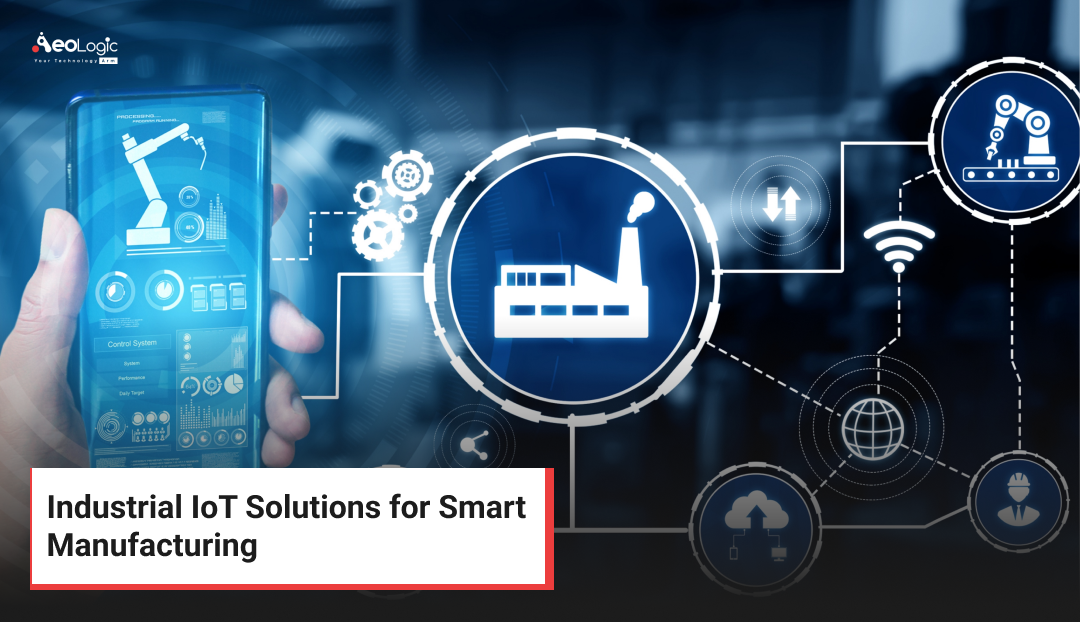
A cracked bearing that fails at 2 a.m. on a Saturday can cost a plant more in lost output than a year of sensor subscriptions. That single fact explains why so many manufacturers are now investing in Industrial IoT solutions for smart manufacturing instead of waiting for the next breakdown. Rather than reacting to problems after they happen, factories equipped with connected sensors, edge gateways, and analytics platforms can see trouble coming and act before it costs them a shift.
This guide walks through what Industrial IoT solutions for smart manufacturing actually are, how they work, what they cost to get wrong, and how a plant can realistically roll them out without turning operations upside down. Whether you run a single production line or oversee a multi-site manufacturing network, the ideas here are meant to be practical rather than theoretical.
What are Industrial IoT Solutions for Smart Manufacturing?
Industrial IoT solutions for smart manufacturing are the combination of connected sensors, networking infrastructure, edge computing, and software analytics that let machines, production lines, and entire facilities share real-time data and act on it. Instead of a technician walking the floor with a clipboard, sensors on a motor, pump, or conveyor stream vibration, temperature, and pressure readings continuously to a central platform.
Industrial IoT solutions for smart manufacturing turn physical equipment into a source of live data, and that data gets turned into decisions, often automatically. A spike in motor temperature can trigger a maintenance ticket before the motor ever stops running. A dip in throughput on one line can be compared instantly against five others to spot which machine is the bottleneck.
The term “IIoT” (Industrial Internet of Things) is often used interchangeably with Industrial IoT solutions for smart manufacturing, though IIoT technically refers to the underlying technology stack, while smart manufacturing describes the broader operational philosophy of using that data to run a factory more intelligently.
 Why Manufacturers Need Industrial IoT Solutions for Smart Manufacturing Today
Three forces are pushing manufacturers toward Industrial IoT solutions for smart manufacturing at the same time: tightening margins, skilled-labor shortages, and customers who expect shorter lead times with zero quality slip-ups.
The Cost of Standing Still
Unplanned downtime remains one of the largest hidden costs in manufacturing. Every hour a line sits idle because of an unexpected failure is an hour of labor, energy, and overhead spent producing nothing. Traditional maintenance schedules — fixing or replacing parts on a calendar rather than based on actual condition — tend to either replace healthy components too early or run failing ones too long.
The Labor Reality
Experienced maintenance technicians and process engineers are retiring faster than plants can replace them. Connected sensors and dashboards help newer staff make informed decisions without decades of tribal knowledge, because the data itself flags what needs attention.
The Customer Pressure
Buyers increasingly expect manufacturers to prove consistent quality and traceability, sometimes down to the individual batch or part. Industrial IoT solutions for smart manufacturing make that kind of traceability possible without adding manual inspection steps at every stage.
Core Components of Industrial IoT Solutions for Smart Manufacturing
A working deployment is built from several layers, each doing a distinct job. Skipping or underinvesting in any one layer is usually where projects stall.
1. Sensors and Smart Devices
Temperature, vibration, pressure, humidity, current, and acoustic sensors attach to existing equipment or come built into newer machines. These are the eyes and ears of the system.
2. Connectivity Layer
Data has to travel from the factory floor to a place it can be analyzed. Options include industrial Wi-Fi, wired Ethernet, private 5G, and low-power wide-area networks, chosen based on how much data needs to move and how far it has to travel.
3. Edge Computing
Not every piece of data needs to travel to the cloud. Edge devices process data locally, on or near the machine, so time-sensitive decisions — like shutting down a press before a jam damages tooling — happen in milliseconds rather than waiting on a round trip to a remote server.
4. Cloud or On-Premises Platform
This is where historical data is stored, machine learning models run, and dashboards are generated. Many manufacturers choose a hybrid approach: edge for instant decisions, cloud for long-term trend analysis.
5. Analytics and Visualization Software
Raw sensor data means little without context. Analytics software turns streams of numbers into alerts, predictive maintenance scores, and visual dashboards that plant managers can actually use during a morning shift meeting.
Key Benefits of Industrial IoT Solutions for Smart Manufacturing
The appeal of Industrial IoT solutions for smart manufacturing comes down to a handful of measurable outcomes:
- Reduced unplanned downtime — Predictive maintenance flags failing components days or weeks before they fail, instead of after.
- Lower maintenance costs — Parts are replaced based on actual condition, not a fixed calendar, cutting unnecessary part swaps.
- Improved product quality — Real-time monitoring catches process drift before it produces a batch of defective parts.
- Better energy efficiency — Connected equipment reveals exactly where energy is wasted, from idling machines to inefficient HVAC cycles.
- Faster root-cause analysis — When something does go wrong, historical sensor data shortens the investigation from days to hours.
- Improved worker safety — Sensors can detect unsafe conditions, like gas leaks or excessive machine vibration, before they become incidents.
- Supply chain visibility — Connected inventory and asset tracking reduce the guesswork in planning and procurement.
Industrial IoT Solutions for Smart Manufacturing: Common Use Cases
The table below summarizes where manufacturers are seeing the clearest return from Industrial IoT solutions for smart manufacturing.
| Use Case | What It Does | Typical Impact |
|---|---|---|
| Predictive maintenance | Monitors vibration, temperature, and current to predict equipment failure | Fewer unplanned stops, lower repair costs |
| Real-time production monitoring | Tracks output, cycle time, and downtime across lines | Faster bottleneck identification |
| Quality control automation | Uses sensors and vision systems to catch defects inline | Reduced scrap and rework |
| Energy monitoring | Tracks power consumption by machine or zone | Lower utility costs |
| Asset and inventory tracking | Uses RFID or IoT tags to locate tools, materials, and WIP | Less time searching for parts |
| Digital twin simulation | Mirrors a physical line virtually to test changes before implementing them | Lower-risk process changes |
| Worker safety monitoring | Detects hazardous conditions or unsafe behavior in real time | Fewer workplace incidents |
Challenges in Implementing Industrial IoT Solutions for Smart Manufacturing
No rollout is without friction. The most common obstacles manufacturers run into include:
Legacy equipment compatibility. Many factories run machines that are decades old with no native connectivity. Retrofitting with external sensors is usually possible but requires careful planning around mounting, wiring, and power.
Data overload. Connecting hundreds of sensors produces an enormous volume of data. Without a clear plan for which metrics actually drive decisions, teams can end up with dashboards nobody looks at.
Cybersecurity exposure. Connecting operational technology (OT) to IT networks introduces new attack surfaces. A compromised sensor network can, in the worst case, affect physical equipment, not just data.
Organizational resistance. Floor staff who have run a line a certain way for years may be skeptical of new dashboards and alerts, especially if early false positives erode trust in the system.
Upfront cost and unclear ROI timelines. Smaller manufacturers sometimes hesitate because the payback period isn’t obvious before deployment, even though total cost of ownership often favors IoT over reactive maintenance within a year or two.
Best Practices for Deploying Industrial IoT Solutions for Smart Manufacturing
- Start with one high-value line or asset. A focused pilot proves value quickly and builds internal confidence before a facility-wide rollout.
- Pick metrics tied to a business outcome. Track measures that map directly to cost, quality, or uptime — not just metrics that are easy to collect.
- Involve floor operators early. The people running the equipment daily often know which failure patterns matter most, and their buy-in determines whether alerts actually get acted on.
- Build in cybersecurity from day one. Segment OT networks from IT networks, and require authentication on every connected device.
- Plan for scale from the start. A pilot architecture that can’t extend to additional lines or sites means rebuilding the system later.
- Set a realistic timeline. Most manufacturers see measurable ROI within 12–18 months of a focused Industrial IoT solutions for smart manufacturing deployment, though complex retrofits can take longer.
The Future of Industrial IoT Solutions for Smart Manufacturing
Several trends are shaping where Industrial IoT solutions for smart manufacturing are headed next. Edge AI is making it possible to run sophisticated anomaly-detection models directly on factory-floor hardware, reducing reliance on constant cloud connectivity. Digital twins are becoming more accessible to mid-sized manufacturers, not just large enterprises, as platforms simplify the setup process. And generative AI is starting to show up inside maintenance workflows, summarizing sensor trends in plain language for technicians who aren’t data specialists.
The common thread across all of these developments is that Industrial IoT solutions for smart manufacturing are moving from monitoring toward autonomous decision-making, where routine adjustments happen without a human in the loop, while people stay focused on the exceptions that actually need judgment.
How to Choose the Right Industrial IoT Solutions for Smart Manufacturing Partner
When evaluating vendors or integrators, a few questions tend to separate a good fit from a costly mismatch:
- Does the platform support the specific equipment and protocols already on your floor (OPC-UA, Modbus, MQTT, and similar standards)?
- Can the system scale from a single pilot line to the whole facility without a complete re-architecture?
- What does onboarding and training actually look like for floor staff, not just IT?
- How is data secured in transit and at rest, and who owns the data once it’s collected?
- What is the typical implementation timeline, and what does ongoing support cost after go-live?
A vendor who can answer these clearly, with specifics rather than marketing language, is usually a safer long-term partner for Industrial IoT solutions for smart manufacturing than one who focuses only on the sale.
Conclusion
Industrial IoT solutions for smart manufacturing are no longer an experimental add-on — they’re becoming a baseline expectation for manufacturers that want to control costs, protect quality, and keep equipment running reliably. The path there doesn’t have to start big: a single pilot line, a handful of well-chosen metrics, and a vendor who understands your existing equipment can get real results within a year. For manufacturers still relying on reactive maintenance and manual tracking, the gap between their operations and competitors running Industrial IoT solutions for smart manufacturing is only going to widen.
The best time to evaluate an Industrial IoT pilot is before the next unplanned breakdown, not after it. Aeologic Technologies to explore how Industrial IoT solutions can help your business reduce downtime, improve operational efficiency, and enable smarter manufacturing.
Detailed FAQ Section
Q1. How much do Industrial IoT solutions for smart manufacturing cost to implement?
Costs vary widely based on facility size and legacy equipment, typically ranging from a focused single-line pilot to a multi-site enterprise rollout. Most manufacturers start with a smaller pilot to validate ROI before committing to a facility-wide budget, which keeps initial costs more predictable.
Q2. Can Industrial IoT solutions work with old, non-connected machines?
Yes. Retrofit sensors can be externally mounted on legacy equipment to capture vibration, temperature, or current data without replacing the machine itself. This is one of the most common entry points for manufacturers with older production lines.
Q3. How long does it take to see ROI from smart manufacturing IoT?
Many manufacturers report measurable returns, such as reduced downtime or lower maintenance costs, within 12 to 18 months of a focused deployment. Timelines depend on how quickly staff adopt the new alerts and how complex the retrofit is.
Q4. Is Industrial IoT secure enough for factory operations?
Security depends heavily on implementation. Segmenting operational technology networks from IT networks, requiring device authentication, and working with vendors who follow recognized industrial security standards all reduce risk significantly.
Q5. What industries benefit most from Industrial IoT solutions for smart manufacturing?
Automotive, electronics, food and beverage, pharmaceuticals, and heavy equipment manufacturing see some of the clearest gains, largely because unplanned downtime or quality failures in these industries carry especially high costs.
Q6. Do small and mid-sized manufacturers need IIoT, or just large enterprises?
Mid-sized manufacturers increasingly adopt IIoT because modern platforms have lowered the cost of entry. A single-line pilot is often affordable enough for smaller operations to test before scaling further.
Q7. What skills does a team need to manage an IoT-connected factory?
Basic data literacy and familiarity with dashboards are usually enough for floor staff, while a smaller technical team manages the underlying platform, network, and integrations. Most vendors provide training as part of onboarding.
Q8. How does predictive maintenance differ from preventive maintenance?
Preventive maintenance follows a fixed schedule regardless of equipment condition, while predictive maintenance uses real-time sensor data to service equipment only when signs of wear actually appear. This avoids both premature part replacement and unexpected failures.

With a strong foundation in software and a growing expertise in AI, I specialize in building smart, scalable solutions that drive digital transformation