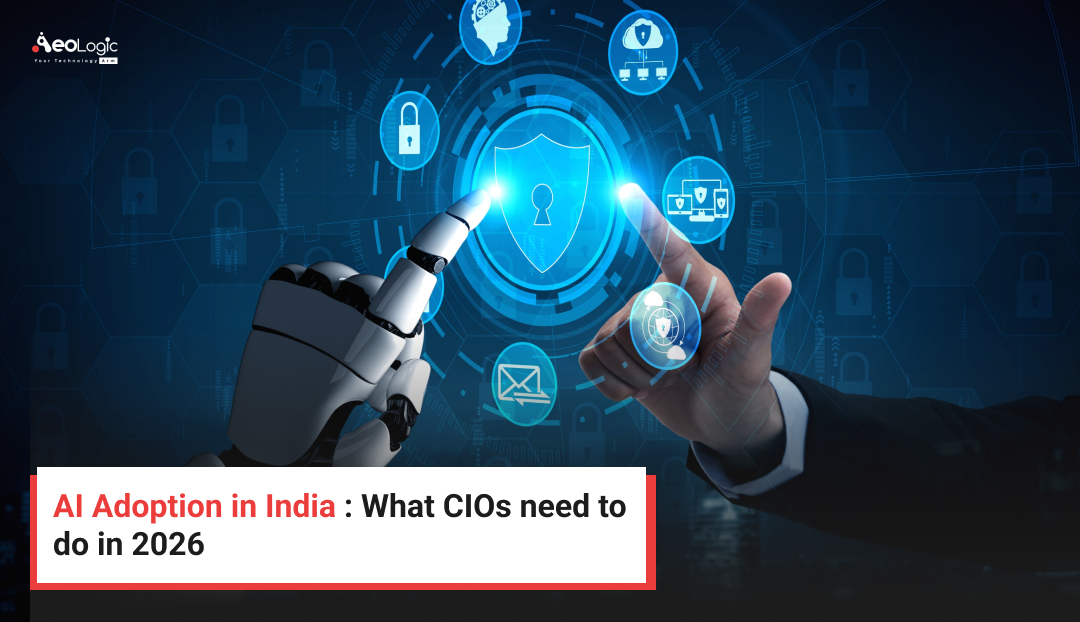
AI is not just about experimentation anymore; it’s a transformative era as organizations in various industries start integrating intelligent technologies into their core business operations. To stay competitive in the rapidly changing digital economy, Indian companies are placing a growing emphasis on AI-powered automation, predictive analytics, generative AI, intelligent customer experiences, and data-driven decision-making. AI Adoption in India is accelerating due to government initiatives supporting digital transformation, improved cloud infrastructure, expanding AI talent, and growing enterprise investments in digital innovation. This progress is paving the way for companies to better apply artificial intelligence and maximize its long-term benefits to their operations and strategy.
However, moving towards the successful adoption of AI goes beyond just installing cutting-edge technology. The role of Chief Information Officers (CIOs) is now to spearhead the enterprise-wide AI strategy for aligning it with business goals, enhancing governance, responsible use, and driving measurable business results. But as the year 2026 nears, CIOs will have to reimagine their IT approach and create AI capable organizations.
This article explores the key priorities CIOs should focus on to drive successful AI adoption in India and prepare their organizations for the next generation of intelligent business transformation.
Why AI Adoption in India is Accelerating?
Today, India has emerged as one of the fastest-growing AI markets in the world. Many companies are pushing hard to deploy AI solutions for various purposes such as enhancing efficiency and generating business advantages not only in the manufacturing industry but also in banking, healthcare, retail, logistics, telecommunications, education, and government sectors.
AI’s implementation has become much more streamlined with the help of cloud computing, cheap computing power, open-source AI frameworks, and vast quantities of enterprise data. Meanwhile, there has been a rise in the number of customers who expect a tailored digital experience, which has prompted companies to invest in intelligent technologies to enhance service delivery and efficiency.
Furthermore, the extensive adoption of enterprise-grade AI solutions has also facilitated small, medium, and large companies to try out machine learning, computer vision, natural language processing, and generative artificial intelligence without developing everything themselves. As these technologies evolve, AI is transitioning from an innovation project to a must-have business function.
The Evolving Role of CIOs in the AI Era
Over the past few years, CIOs have taken on more responsibility in the last several years. Technology leaders are no longer just in charge of maintaining IT infrastructure, but also integral to the development of business strategy and digital innovation.
By 2026, CIOs will be judged on ROI rather than hype, when they’re deciding whether or not to invest in AI. They need to develop AI strategies that also incorporate factors such as security, compliance, governance, and organizational preparedness.
Building a Business-First AI Strategy
Aligning AI initiatives with Business Objectives
The No.1 reason why AI projects fail is that technology implementation is not aligned with the business objectives. The first step to effective AI implementation is to understand the business problems that can be addressed and benefited by using AI solutions and where the impact can be felt.
Instead of jumping on the bandwagon of the use of AI due to its peers adopting it, CIOs should use AI to address operational inefficiencies, boost customer interaction, streamline supply chains, cut operating expenses, and aid in decision-making.
Prioritizing high-impact use cases
There are many use cases where AI can be implemented but not all of them have the same value. CIOs need to look at the projects that can offer specific business benefits with a reasonable time frame.
Intelligent customer support, fraud detection, predictive maintenance, inventory optimization, financial forecasting, employee productivity, document processing and workflow automation are all potential high-impact areas.
Early wins foster confidence within the organization and gain executive buy-in for future bigger AI initiatives.
Strengthening enterprise data foundations
Data quality determines AI success
AI Adoption in India is heavily dependent on the strength of the data foundations, and accurate, complete, and well-managed data are essential for artificial intelligence systems to thrive. When data is shoddy, predictions are faulty, results can be skewed and business decisions are not consistent.
To scale AI projects, CIOs should develop enterprise-wide data governance policies, which would ensure the standardization of data collection, storage, validation and access.
Breaking down data silos
Businesses still have siloed systems in various departments. These separate data repositories hinder the making of holistic insights by AI.
When combined with other components like ERP systems, CRM platforms, operational databases, IoT devices, and cloud applications, AI models can provide more precise and meaningful insights.
 Preparing IT infrastructure for Enterprise AI
Modernizing cloud and hybrid environments
AI workloads, particularly in the enterprise, demand scalable compute resources that are powerful enough to manage vast amounts of data and sophisticated machine learning models.
A large number of organizations are turning to hybrid clouds to strike a balance between flexibility, performance and compliance with regulatory rules and regulations.
With modern infrastructure, organizations can deploy AI applications quickly and cost-effectively while keeping their infrastructure operation resilient.
Supporting Real-Time AI processing
The business landscape is becoming increasingly data-driven and the need for timely insights rather than reporting has become the need of the hour. The CIO should ensure the use of architectures that can handle streaming information from sensors, customer interactions, financial transactions and connected devices.
In the real time, AI can identify anomalies as they happen, trigger automated responses, and enhance decision-making processes in mission-critical situations.
Investing in responsible AI Governance
Creating ethical AI frameworks
With AI systems increasingly shaping business decisions, the importance of responsible AI governance is growing. Fairness, transparency, accountability, and explainability are crucial aspects of the AI lifecycle that organizations need to ensure.
CIOs must put in place governance that defines policies for model development, validation, deployment, monitoring, and continuous improvement.
Responsible AI practices minimize the legal risks and boost trust with customers, employees, regulators and business partners.
Managing Regulatory Compliance
As India’s digital landscape continues to change, it is essential that organizations handle sensitive data with care and ensure transparency in automated decision-making.
Effective governance policies contribute to meeting the privacy standards, safeguarding customer information, and minimizing risks within operational workflows linked to AI implementation.
Developing AI skills across the organization
Building AI-Ready teams
Technology alone cannot drive successful AI Adoption in India. There is a growing need for organizations to hire AI specialists who can create, manage, and implement AI solutions effectively. By prioritizing AI skills, ongoing education, and interdisciplinary cooperation, companies can harness the full potential of intelligent technologies, fostering sustained innovation and growth.
CIOs need to allocate resources for ongoing education and upskilling to promote AI literacy across the technical and business teams. With an understanding of AI capabilities, employees can recognize opportunities, and work more efficiently with data specialists.
Encouraging cross-functional collaboration
AI projects require collaboration between IT, business operations, finance, legal, cybersecurity, customer service, and executive leadership.
Cross-functional teams ensure that AI solutions solve meaningful business problems and comply with operational, regulatory and technical requirements.
This joint effort greatly enhances the likelihood of project success and fosters rapid enterprise-wide AI adoption.
Strengthening Cybersecurity for AI Systems
As AI Adoption in India brings new challenges to the cybersecurity landscape, conventional security frameworks might not cover all aspects. Machine learning models, training datasets, APIs, and automated workflows create additional attack surfaces that require continuous monitoring.
The protection of AI infrastructure is critical to ensuring business continuity and protecting valuable enterprise data.
Measuring AI success beyond technology metrics
Technical performance metrics like model accuracy are the sole focus of many organizations when assessing AI projects. These metrics are still relevant, but there are others that CIOs should track as well, such as business results like revenue growth, operational efficiency, cost savings, customer satisfaction, employee productivity, and process improvements.
Performance measurement, grounded in the business, enables executives to grasp the actual value of AI investments and to make informed decisions on future expansion plans.
Organizations can also leverage continuous monitoring to discover opportunities for optimization as AI systems grow over time.
Scaling AI across the enterprise
Following successful pilot projects, CIOs need to create a strategy to scale up AI across several departments and business functions.
Standard development workflows are needed to support enterprise-wide scaling, AI models that can be reused, centralized management, automated deployment processes, ongoing monitoring, and strong infrastructure management.
Organizations that successfully scale AI create intelligent ecosystems where multiple business processes continuously learn, improve, and generate new operational efficiencies.
Emerging AI trends CIOs should watch in 2026
The next phase of AI Adoption in India will be shaped by rapid advancements in generative AI, autonomous AI agents, multimodal AI, edge intelligence, AI-powered cybersecurity, digital twins, intelligent automation, and industry-specific AI platforms.
Organizations are also expected to integrate AI more deeply into enterprise software, enabling employees to interact with intelligent assistants directly within business applications.
As AI capabilities become more accessible, competitive advantage will increasingly depend on how effectively organizations combine technology, governance, skilled talent, and strategic leadership.
The Road ahead for Indian Enterprises
India is poised to become one of the world’s most AI-powered economies. Widespread AI transformation is supported by the growth of digital infrastructure, the booming of start-up ecosystems, governmental initiatives, and enterprise investments.
The question of whether to use AI is now one that CIOs are tackling as they figure out how to do so in a responsible, secure and strategic way. Those that create robust data foundations, upgrade their systems, hire capable talent, create good governance and then match their AI projects to business objectives will be on a better footing for ongoing growth in the coming years.
The enterprises that succeed in 2026 will view artificial intelligence not simply as a technology initiative but as a long-term business capability that drives innovation, resilience, and competitive differentiation across every aspect of their operations.
Conclusion
Now, AI Adoption in India is moving from niche projects to a company-wide revolution. CIOs will be key to defining how AI can provide meaningful business value as organizations continue to adopt intelligent technologies. Balancing innovation with governance, investing in good data, building scale-able infrastructure, enhancing cybersecurity and cultivating AI-ready talent will all be critical to success.
In this context, Indian businesses have the opportunity to leverage the strategic and business-oriented potential of AI and create resilient and future-proof organizations for success in the future digital economy of 2026 and beyond. Aeologic Technologies is contributing to this shift by offering scalable AI solutions that meet the growing demands of enterprises.
Frequently Asked Questions (FAQs)
Q1. What is AI Adoption in India?
AI Adoption in India refers to the increasing use of artificial intelligence technologies by businesses, government organizations, and enterprises to automate processes, improve decision-making, enhance customer experiences, and drive digital transformation across various industries.
Q2. Why should CIOs prioritize AI adoption in 2026?
CIOs should prioritize AI adoption in 2026 because AI has become a key driver of business innovation, operational efficiency, and competitive advantage. A well-planned AI strategy helps organizations improve productivity, reduce costs, strengthen cybersecurity, and make data-driven decisions.
Q3. What are the biggest challenges of AI Implementation in India?
Some of the most common challenges include poor data quality, limited AI expertise, integration with legacy systems, cybersecurity concerns, regulatory compliance, and ensuring responsible AI governance. Addressing these challenges is essential for successful enterprise AI implementation.
Q4. Which industries are leading AI Implementation in India?
Industries such as banking and financial services, healthcare, manufacturing, retail, logistics, telecommunications, education, and government are leading AI Implementation in India by using AI for automation, predictive analytics, customer engagement, fraud detection, and operational optimization.
Q5. How can organizations prepare for successful AI Implementation in India?
Organizations can prepare by building a strong data foundation, modernizing IT infrastructure, investing in AI talent, establishing governance frameworks, strengthening cybersecurity, and aligning AI initiatives with long-term business objectives. These steps help ensure sustainable and scalable AI adoption.

With a strong foundation in software and a growing expertise in AI, I specialize in building smart, scalable solutions that drive digital transformation