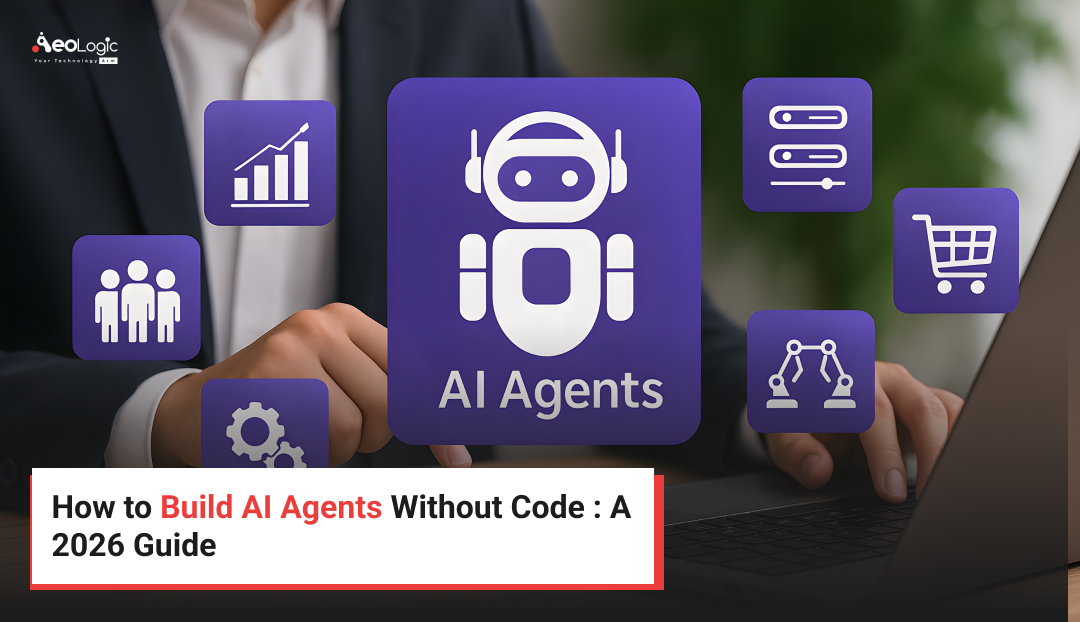
AI is not just about chatbots and automation; it’s about transforming the entire customer experience. In 2026, businesses of every size are looking for practical ways to automate repetitive tasks. They also want to improve customer experiences and increase productivity without investing heavily in software development. One of the biggest reasons behind this shift is the growing popularity of no-code AI platforms that make it possible to Build AI Agents without writing a single line of code.
But it was only a few years ago that the creation of an AI agent was a matter of days for experienced developers, machine learning engineers, and technology budgets. This is no longer true today. Modern no-code platforms make AI development accessible. Business users, marketers, HR teams, operations managers, customer support teams, and entrepreneurs can build intelligent AI agents using visual interfaces and drag-and-drop workflows.
This guide explains everything you need to know about how to Build AI Agents without code in 2026, including the technologies involved, the step-by-step process, business benefits, common use cases, challenges, best practices, and future trends.
What are AI Agents?
AI agents are intelligent software systems that can autonomously understand information, make decisions, interact with users, and autonomously accomplish specific objectives.
Unlike traditional chatbots, AI agents understand context and remember previous conversations. They can access multiple data sources, perform actions, and improve their responses through continuous feedback.
Every modern AI agent is equipped with multiple capabilities: Large Language Models (LLMs), natural language processing, workflow automation, APIs, enterprise knowledge bases, and more.
For example, when a customer asks about an order, the AI agent retrieves information from the ERP system. It checks shipment details, provides delivery updates, recommends related products, and can even initiate a return request.
Why Businesses Want to Build AI Agents in 2026
Companies in all sectors are continually searching for ways to be more efficient and to keep costs down. It’s costly to hire more staff to perform repetitive tasks, and traditional software automation is often inflexible.
AI agents fill this void, functioning as smart digital workers that can manage repetitive tasks anytime, anywhere.
Businesses are choosing to Build AI Agents because they automate customer interactions and streamline workflows. They also improve decision-making, reduce manual effort, and deliver consistent service.
This transformation is now made possible by the emergence of enterprise-grade no-code AI platforms, even for businesses with limited technical knowledge.
How No-Code AI Development Has Changed the Industry?
From Developers to Business Users
The most significant shift in the adoption of AI is the fact that software engineers no longer have to build intelligent systems.
Today’s no-code solutions allow users to use visual builders to create workflows, upload documents, and link business applications, while setting the behavior of AI with ease and using simple interfaces.
Users need not write hundreds of lines of code, but only specify objectives, link data sources, and set actions.
This dramatically reduces development time while making AI accessible to non-technical teams.
Faster Deployment Cycles
Traditional AI development projects often required several months before deployment.
Today, organizations can Build AI Agents within days or even hours depending on the complexity of the project.
This rapid deployment allows businesses to test new ideas quickly, gather user feedback, and improve AI performance continuously.
Lower Development Costs
The cost of employing AI developers, buying infrastructure, and keeping AI machine learning models is high.
No-code platforms eliminate much of this complexity by providing pre-built components, managed infrastructure, and ready-to-use AI models.
This makes it possible for organizations to adopt AI solutions at a much lesser cost than the traditional methods.
How AI Agents Work
Understanding User Intent
The key to any interaction with AI is to understand what the user is trying to accomplish.
AI agents leverage sophisticated NLP and LLM capabilities to interpret, understand intent, identify key entities, and comprehend context in questions and conversations.
This helps you to interact in natural and meaningful ways.
Accessing Business Knowledge
Not all AI agents these days have general internet knowledge.
They can link to internal documents, company policies, CRM, ERP systems, product catalog, support documentation, databases, and cloud storage.
This helps them to give precise, company-specific answers.
Decision-Making
After collecting information, the AI agent analyzes the options and makes a decision on what action to take.
It can either provide a response to a question, open a support ticket, update customer records, generate reports, or trigger automated processes in the business.
Learning Through Feedback
While most enterprise AI agents won’t self-train, they will continuously learn, refine, and enhance over time via feedback from administrators, prompt refinement, updated knowledge bases, and workflow optimizations.
This iterative improvement helps increase response accuracy over time.
 Step-by-Step Process to Build AI Agents Without Code
Define the Business Objective
Every successful AI project begins with a clearly defined objective.
Organizations should not try to automate everything, but take on one business challenge at a time.
An AI agent can be developed to enhance customer support, streamline employee induction, handle HR inquiries, support sales teams, invoice processing, and managing internal documentation.
A clear objective facilitates development and enhances measurable business results.
Identify the Target Users
Knowing the audience allows you to set the tone of the conversation, sources of AI knowledge, permissions and complexity of the workflow.
The skills of customer-facing agents are different from those of employee assistants inside the company.
Similarly, the reporting features for AI agents serving executives should be different from the ones for customer service agents.
Collect Relevant Data
The information available to an AI agent is crucial to the quality of the agent.
Businesses need to have documents like FAQs, how to guides, product information, manuals, knowledge articles, training materials, support records and policy documents.
Maintaining accurate and current information is a huge advantage to enhance AI performance.
Choose the Right No-Code Platform
One of the most critical decisions in attempting to Build AI Agents is selecting the right platform.
Organizations should evaluate usability, integrations, security, scalability, pricing, collaboration features, analytics, workflow automation, and enterprise support before selecting a platform.
The ideal platform should integrate seamlessly with existing business systems while supporting future growth.
Design Conversational Flows
AI-based conversations are fluid, yet user experience can be enhanced by specifying possible conversation sequences.
Some of the common questions to consider include exception handling, escalation, fall-backs, and workflows needed to complete tasks.
Good conversation flows enable AI agents to respond in a consistent manner throughout various scenarios.
Connect Business Applications
The true value of AI agents comes from their ability to interact with business applications.
No-code platforms can be integrated with CRM, email, calendar, payment gateway, cloud storage, database, project management, communication, and customer support applications.
These integrations enable AI agents to be more than just conversation services—they can become smart workflow automation tools.
Configure Automation
Automation allows AI agents to provide value-added customer service, rather than just answering questions.
AI can be set up to automatically create tickets, update records, schedule meetings, send emails, create reports, process forms, or start approval workflows in a business.
This helps to minimize the amount of manual work needed and also makes it more efficient.
Test Before Deployment
Before the introduction of any AI solution, comprehensive testing is crucial.
Organizations should evaluate response accuracy and workflow execution. They should also test knowledge retrieval, integrations, user experience, security controls, and error handling.
Validation of actual business cases provides insights of gaps prior to deployment.
Monitor and Improve
The work is just starting after you’ve deployed your AI agent.
Continuous optimization ensures long-term success.
Essential Features Every No-Code AI Platform Should Provide
Natural Language Understanding
It’s important for a modern AI agent to grasp conversational language rather than depend on keyword matching. With advanced language understanding, interactions become more natural and user frustration is minimized.
Knowledge Base Integration
It should be able to store documents, websites, databases, PDFs, spreadsheets, cloud storage, and internal repository of knowledge. Having business information that is reliable is crucial for giving accurate answers.
Workflow Automation
AI should do so much more than just be a conversation box. Workflow automation allows agents to execute business processes automatically.
API Connectivity
Enterprise systems don’t typically work in isolation. The integration of AI agents with other applications can facilitate end-to-end process automation in various departments.
Security and Access Control
For organizations that process sensitive data, robust authentication, permission control, encryption, audit logs, compliance capabilities are critical. Security is also an important concern, as it is with enterprise-class solutions.
Analytics Dashboard
By tracking the activity, response quality, and workflow completion rates, conversation trends, and automation performance, organizations can continually refine and enhance the effectiveness of the AI.
Business Benefits of Building AI Agents Without Code
Businesses that begin to implement no code AI development benefits in many processes.
Development cycles are significantly shortened as business users can develop and update AI agents without waiting for engineering resources. As repetitive manual tasks are automated, employees can focus on higher-value operational tasks, reducing costs.
AI agents are always on-call, regardless of business hours, leading to enhanced customer service. For sales teams, the lead qualification process is accelerated and automated follow-ups are streamlined, while HR teams ease employee onboarding and internal support.
Knowledge management also is enhanced. Employees no longer have to wade through several documents to find accurate answers to their queries; they can get the answers they need, instantly, from AI-powered assistants that have access to the organization’s knowledge base.
Perhaps the greatest advantage is scalability. Once organizations successfully Build AI Agents, they can expand automation across multiple departments without rebuilding their technology stack from scratch.
Industries Using No-Code AI Agents
Healthcare
AI agents help healthcare organizations manage patient scheduling, answer common questions, streamline administrative tasks, and deliver verified medical data to patients while easing workload for frontline agents.
Retail and E-commerce
AI agents are used in retail for personalized customer suggestions, finding products, tracking orders, handling returns, engaging with customers and managing loyalty programs.
Banking and Financial Services
Insurers utilize AI agents for customer support, document verification, loan qualification, fraud prevention, and digital sign-up due to regulatory compliance. Financial institutions use AI agents to manage customer queries, gather documents, provide loan eligibility information, and increase customer awareness of fraud, all while ensuring regulatory adherence.
Manufacturing
AI-powered assistants are used in the manufacturing sector to assist maintenance personnel, to document equipment, to automate production reporting, and to make inventory more visible and efficient in its use.
Human Resources
From onboarding to training, HR departments use AI agents to respond to employee inquiries, clarify policies, handle leave applications, and offer guidance on various aspects of their work.
Education
AI agents enhance and streamline various aspects of the educational system, including admissions, student support, learning materials, course guidance, and administrative tasks.
Common Challenges When Building AI Agents
No-code development ensures that AI is more accessible, but implementation will still need some planning. Knowledge bases that are not well-designed or maintained can result in incorrect answers, which is why it’s crucial to have a well-structured and up-to-date knowledge base. The integration with the legacy systems can also be a challenge, as many of them may not provide modern APIs or a unified set of data structures.
Another common issue is unrealistic expectations. While AI agents can be very capable, they work best when they are designed to address a specific business challenge instead of replacing all human interactions. Organizations should also develop governance policies to safeguard that AI-driven responses stay secure, compliant, and in accordance with company policies.
It’s equally crucial to educate workers and train them to work with AI. When teams are aware of the strengths and weaknesses of intelligent automation, and can identify when human judgement is necessary, adoption rates benefit.
Best Practices to Build AI Agents Successfully
The most successful AI projects start with a clear business goal and grow step-by-step as they achieve measurable results. With a specific use case, organizations can test performance, collect feedback from users and improve the workflows before rolling it out in other departments.
Another key practice is to ensure the accuracy of knowledge sources. If the data AI agents use is outdated or inaccurate, it will lead to unreliable responses. Monitoring of documents, policies and business information ensures that response quality is sustained.
User experience is another factor that should be taken into consideration; designing a conversation with a user that is natural, transparent and easy to follow. Analytics and monitoring, along with constant improvements to interactions, help keep AI agents valuable as your business requirements change.
Last but not least, security, compliance and data protection must be built in at every stage of development. Trust between employees and customers, and long-term adoption, is created through strong governance frameworks.
The Future of No-Code AI Agents in 2026 and Beyond
The potential applications of AI agents go far beyond just automating tasks. With the enhancements in reasoning powers, multimodal AI, and autonomous workflows, agents will be better equipped to manage more complex tasks in various industries. AI systems will assist businesses in collaborating with employees, managing multiple software applications, and making decisions based on context with minimal supervision.
As no-code platforms continue to mature, creating intelligent digital assistants will become as common as building a website is today. Organizations that begin experimenting now will be better positioned to adapt to changing customer expectations, improve operational efficiency, and gain a competitive advantage in an AI-driven economy.
Conclusion
Learning how to Build AI Agents without code is becoming an essential capability for organizations seeking to improve productivity, reduce operational costs, and deliver better customer experiences. No-code platforms have removed many of the traditional barriers associated with AI development, allowing business users to create intelligent assistants without extensive programming knowledge.
By defining clear objectives, selecting the right platform, integrating reliable business data, and continuously refining performance, organizations can deploy AI agents that deliver measurable value across customer service, sales, HR, operations, healthcare, finance, manufacturing, and many other industries. Organizations looking to accelerate their AI journey can also partner with experienced technology providers such as Aeologic Technologies to design, implement, and scale no-code AI solutions tailored to their unique business needs.
Frequently Asked Questions
Q1. Is coding required to build AI agents?
No. Modern no-code AI platforms provide visual interfaces, pre-built workflows, and drag-and-drop tools that allow users to create AI agents without programming experience.
Q2. Which businesses benefit the most from AI agents?
Organizations in healthcare, retail, manufacturing, finance, education, logistics, customer support, and professional services can all benefit by automating repetitive tasks and improving customer interactions.
Q3. Can no-code AI agents integrate with existing business software?
Yes. Most enterprise platforms support integrations with CRM systems, ERP solutions, cloud storage, databases, communication tools, calendars, and other business applications through APIs and built-in connectors.
Q4. Are no-code AI agents secure for enterprise use?
Enterprise-grade no-code platforms typically include encryption, authentication, role-based access control, audit logs, and compliance features to help protect sensitive business information.
Q5. What is the first step to build AI agents successfully?
The first step is identifying a specific business problem that can be improved through automation. A clear objective helps ensure the AI agent delivers measurable value and supports long-term scalability.

Project Lead with 9+ years of experience in Web Technologies and AI. Expert in leading end-to-end development of scalable, AI-driven solutions. Driving innovation through smart architecture, agile execution, and team leadership.