Walk into almost any modern distribution center today and you’ll notice something: the aisles are quieter, the forklifts move with a strange kind of confidence, and somewhere in a back office, a dashboard is quietly predicting a delay before it even happens. That shift didn’t come from a single piece of software. It came from AI and IoT in warehouse management working as a single system instead of two separate technologies bolted together.
This is exactly the gap that AI and IoT in warehouse management fills. IoT devices — sensors, RFID tags, connected scanners, GPS trackers — generate a constant stream of real-world data: where a pallet is, how cold a cooler actually is, how fast a conveyor belt is running, whether a forklift battery is about to die. On its own, that data is just noise. Artificial intelligence is what turns it into decisions: reordering stock before a shelf goes empty, rerouting a robot around a blocked aisle, flagging a machine for maintenance three weeks before it fails.
In this guide, we’ll break down exactly how AI and IoT in warehouse management works in practice, the specific technologies involved, real benefits and honest challenges, and the steps a warehouse operator can take to start adopting it without turning the whole operation upside down.
What is AI and IoT in Warehouse Management?
AI and IoT in warehouse management refers to the combined use of Internet of Things (IoT) devices — sensors, tags, cameras, and connected machinery — with artificial intelligence systems that analyze the data those devices collect and act on it automatically or near-automatically. The IoT layer captures what’s happening on the warehouse floor in real time; the AI layer interprets that data, spots patterns, predicts problems, and triggers actions such as reordering inventory, rerouting robots, or alerting a technician.
Think of it as two halves of a nervous system. IoT devices are the senses — constantly gathering signals about temperature, location, movement, and inventory levels. AI is the brain — processing those signals, learning from historical patterns, and deciding what to do next. Neither half is especially powerful alone. An IoT sensor that reports a freezer’s temperature every ten seconds is useless if nobody — or nothing — is watching for a dangerous trend. An AI model with no real-time data to analyze is just guessing.
Why These Two Technologies Work Better Together
IoT without AI produces mountains of data that nobody has time to review manually. AI without IoT has no fresh, ground-truth information to learn from — it’s stuck working off outdated spreadsheets and end-of-day reports. Put them together, and you get a warehouse that can sense a problem and respond to it in the same minute, not the same week.
This is also why AI and IoT in warehouse management has become a standard phrase in supply chain technology circles rather than two separate buzzwords. The value isn’t in either technology individually — it’s in the loop they create together: sense, analyze, act, learn, repeat.
How IoT Sensors Are Transforming Warehouse Operations
IoT is the foundation. Before AI can optimize anything, the warehouse needs a reliable stream of real-time data. Here’s where that data typically comes from.
Real-Time Inventory Tracking
RFID tags, barcode scanners, and smart shelving systems track inventory as it moves, rather than relying on periodic manual counts. Instead of discovering a stockout during a weekly audit, a warehouse management system (WMS) connected to IoT sensors knows the moment a SKU drops below a safe threshold. This is one of the most immediate, practical applications of AI and IoT in warehouse management — and often the first one companies implement, because the return on investment is easy to measure.
Environmental and Condition Monitoring
For warehouses handling perishables, pharmaceuticals, or sensitive electronics, IoT sensors track temperature, humidity, and vibration continuously. If a cold-storage unit starts drifting out of range, the system can alert staff — or, in more advanced setups, automatically adjust climate controls — long before the goods are compromised.
Asset and Equipment Tracking
GPS and Bluetooth-based trackers monitor the location and condition of forklifts, pallet jacks, and reusable containers. This reduces time spent searching for equipment and gives managers visibility into utilization rates, which matters a great deal when deciding whether to buy more equipment or better schedule the equipment already on the floor.
Worker Safety and Wearables
Connected wearables can detect unsafe lifting patterns, proximity to moving machinery, or prolonged inactivity that might indicate an injury. This is a quieter but increasingly important part of AI and IoT in warehouse management, since safety incidents are costly both financially and operationally.
The Role of AI in Modern Warehouse Logistics
If IoT is the sensory layer, AI is where the actual optimization happens. Here’s what artificial intelligence contributes once the data is flowing.
 Predictive Analytics and Demand Forecasting
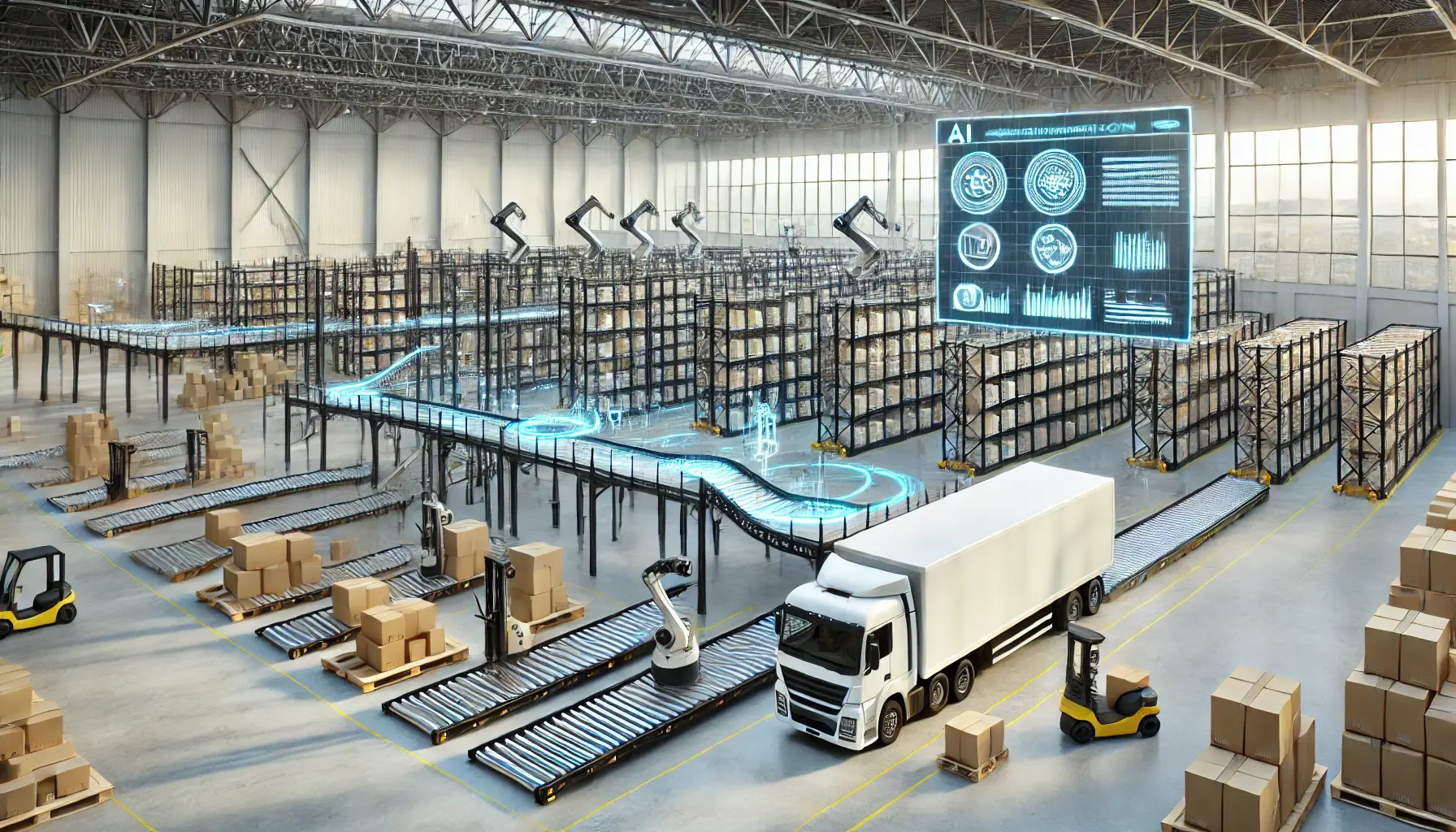
AI models analyze historical order data, seasonal patterns, and even external signals like weather or local events to forecast demand more accurately than manual planning ever could. Better forecasts mean fewer stockouts, less overstock, and warehouse layouts that put fast-moving items within easy reach.
Computer Vision for Quality Control
Cameras paired with computer vision models can inspect packages for damage, verify that the right items are being picked, and catch labeling errors — all faster and more consistently than a human doing visual spot-checks on a fast-moving line.
AI-Powered Robotics and Automation
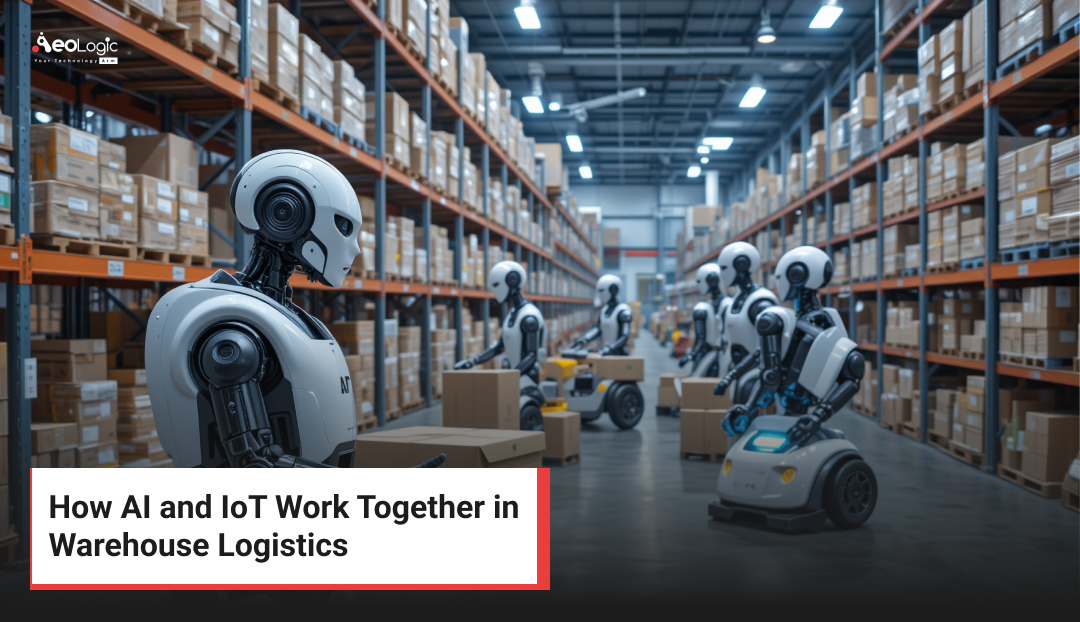
Autonomous mobile robots (AMRs) and automated guided vehicles (AGVs) use AI to navigate warehouse floors, avoid obstacles, and adjust routes in real time based on IoT sensor input about congestion or blocked paths. This is one of the most visible expressions of AI and IoT in warehouse management: a robot that “sees” the floor through connected sensors and “decides” its path using machine learning.
Intelligent Route and Layout Optimization
AI algorithms can recommend better warehouse layouts based on actual picking patterns rather than guesswork, and can optimize picker routes on the fly to reduce walking distance and fulfillment time — a discipline sometimes called slotting optimization.
Predictive Maintenance
By analyzing vibration, temperature, and usage data from IoT sensors on conveyor belts, forklifts, and automated systems, AI can predict equipment failures before they happen. This shifts maintenance from a reactive, break-fix model to a scheduled, preventive one — one of the clearest financial arguments for adopting AI and IoT in warehouse management at scale.
Key Benefits of AI and IoT in Warehouse Management
| Benefit | What It Looks Like in Practice |
| Improved inventory accuracy | Real-time stock visibility reduces overstock and stockouts |
| Lower operating costs | Predictive maintenance and optimized routing cut waste |
| Faster order fulfillment | AI-optimized picking paths and robotics reduce cycle time |
| Better labor allocation | Managers see real bottlenecks instead of guessing |
| Reduced equipment downtime | Sensors flag issues before they cause a full stoppage |
| Improved safety | Wearables and monitoring reduce workplace incidents |
| Stronger demand forecasting | AI models adjust to seasonal and market shifts automatically |
Beyond the individual line items, there’s a compounding effect. Each of these improvements feeds the others — better inventory accuracy improves forecasting, which improves layout decisions, which improves picking speed. This is why warehouses that adopt AI and IoT in warehouse management thoughtfully tend to see gains accelerate over time rather than plateau.
Common Use Cases in the Real World
- Automated replenishment: Shelf-level sensors trigger reorders automatically when stock dips below a set threshold, without waiting for a human to notice.
- Dynamic slotting: AI reorganizes which products sit in the most accessible locations based on real, current demand rather than a layout set once and never revisited.
- Cold chain compliance: Continuous IoT temperature logging paired with AI anomaly detection helps food and pharmaceutical warehouses stay compliant and catch problems early.
- Robotic picking and sorting: AMRs handle repetitive picking and transport tasks, freeing human workers for tasks that require judgment.
- Predictive fleet maintenance: Sensor data on forklifts and conveyors feeds AI models that schedule maintenance before breakdowns occur.
Challenges of Implementing AI and IoT in Warehouse Management
It’s worth being honest here — this isn’t a plug-and-play upgrade, and any credible guide to AI and IoT in warehouse management should say so clearly.
High Initial Investment
Sensors, connected equipment, robotics, and the software to tie it all together require meaningful upfront spending. Smaller operations often need to phase adoption rather than implementing everything at once.
Data Integration Complexity
Warehouses frequently run a patchwork of legacy systems — older WMS platforms, spreadsheets, disconnected scanners. Getting all of that talking to a unified AI system can take longer, and cost more, than the sensor hardware itself.
Cybersecurity Risks
Every connected device is a potential entry point for attackers. A warehouse relying heavily on IoT needs a serious security posture: network segmentation, regular firmware updates, and monitoring for unusual device behavior.
Workforce Training and Change Management
New systems change how people work. Staff need training not just on new tools, but on trusting and interpreting AI-driven recommendations, which is often the harder part of the transition.
Data Quality Issues
AI is only as good as the data it learns from. Poorly calibrated sensors or inconsistent tagging practices can quietly undermine even a well-designed system.
Best Practices for Adopting AI and IoT in Warehouse Management
- Start with a clear, narrow use case. Inventory tracking or predictive maintenance are common starting points because the ROI is easy to measure.
- Audit your existing systems first. Understand what your current WMS, ERP, and equipment can and can’t connect to before buying new hardware.
- Prioritize data quality over data quantity. A smaller number of well-calibrated sensors beats a warehouse full of unreliable ones.
- Build in cybersecurity from day one, not as an afterthought once devices are already deployed.
- Involve floor staff early. The people who will use the system daily often spot practical issues that planners miss.
- Scale in phases. Prove value in one zone or process before expanding warehouse-wide.
- Choose interoperable platforms. Favor systems with open APIs so future IoT devices and AI tools can be added without a full rebuild.
 Traditional Warehousing vs. AI and IoT-Enabled Warehousing
| Aspect | Traditional Warehouse | AI and IoT in Warehouse Management |
| Inventory counts | Periodic manual audits | Continuous real-time tracking |
| Maintenance | Reactive (fix after failure) | Predictive (fix before failure) |
| Demand planning | Historical averages, manual review | AI-driven forecasting with live data |
| Picking routes | Fixed or experience-based | Dynamically optimized |
| Equipment visibility | Manual logs, frequent search time | GPS/Bluetooth tracking in real time |
| Decision speed | Hours to days | Seconds to minutes |
How Much Does AI and IoT in Warehouse Management Cost?
Direct answer: Costs vary widely based on scale — a single-zone pilot using basic RFID tracking and cloud-based analytics can start in the low tens of thousands of dollars, while a full warehouse-wide rollout with robotics, computer vision, and custom AI models can run into the millions. Most operators see a positive return within 12 to 24 months when they start with a focused use case rather than a full-scale deployment.
The smartest way to think about cost isn’t “what does the technology cost” but “what is the cost of not having it.” Stockouts lose sales. Reactive maintenance costs more than scheduled maintenance, both in repair bills and in the downtime around them. Manual forecasting errors lead to overstock that ties up cash and warehouse space that could be used more productively. When operators weigh AI and IoT in warehouse management against the ongoing cost of manual, reactive processes, the investment case usually becomes clear fairly quickly — which is part of why adoption has moved from early-adopter territory to a mainstream operational decision.
A phased rollout also spreads the cost. A typical path looks like:
- Pilot phase (1–3 months): Deploy sensors and analytics in one zone or process, such as inbound receiving or a single product category.
- Validation phase (3–6 months): Measure results against baseline metrics — inventory accuracy, downtime, fulfillment speed — and refine the AI models with real operational data.
- Expansion phase (6–18 months): Roll the proven system out to additional zones, product lines, or facilities, adding robotics or computer vision where the ROI supports it.
Key Takeaways
- AI and IoT in warehouse management combines connected sensors (the data layer) with artificial intelligence (the decision layer) to create warehouses that sense problems and respond in real time.
- The most common starting points are real-time inventory tracking and predictive maintenance, both with measurable, fast payback.
- Benefits compound over time: better data leads to better forecasting, which leads to better layout and staffing decisions.
- The biggest barriers aren’t the technology itself — they’re integration complexity, cybersecurity, and change management.
- Successful adoption is phased, not all-at-once: start narrow, prove value, then expand.
Conclusion
AI and IoT in warehouse management isn’t a futuristic concept anymore — it’s the operating model that competitive warehouses are already running on. IoT devices give a warehouse the ability to sense what’s happening in real time; AI gives it the ability to act on that information intelligently, whether that means rerouting a robot, reordering a pallet of stock, or flagging a conveyor belt for maintenance before it grinds to a halt.
The warehouses that get the most value aren’t necessarily the ones with the most sensors or the flashiest robots — they’re the ones that start with a clear problem, build a solid data foundation, and expand deliberately from there. Aeologic Technologies helps businesses build smarter warehouse operations by combining connected IoT infrastructure with AI-driven insights and automation. If your operation is still running on manual counts and reactive maintenance, the gap between you and competitors already using AI and IoT in warehouse management will only widen.
Ready to modernize your warehouse operations? Start by auditing where your biggest blind spots are today — inventory accuracy, equipment downtime, or fulfillment speed — and build your AI and IoT roadmap from there.
FAQs
Q1. What’s the difference between IoT and AI in a warehouse?
IoT refers to the connected devices — sensors, tags, cameras — that collect real-time data from the warehouse floor. AI refers to the software that analyzes that data and makes decisions or predictions. In practice, AI and IoT in warehouse management work together: IoT supplies the data, and AI turns it into action.
Q2. Do small warehouses benefit from AI and IoT in warehouse management, or is it only for large operations?
Smaller warehouses can benefit too, especially by starting with low-cost, high-impact applications like RFID inventory tracking or basic predictive maintenance sensors. A phased approach lets smaller operators capture value without the large upfront investment a full robotics rollout would require.
Q3. What IoT devices are most commonly used in warehouses?
Common devices include RFID tags and readers, barcode scanners, GPS and Bluetooth asset trackers, environmental sensors for temperature and humidity, vibration sensors on machinery, and connected wearables for worker safety monitoring.
Q4. Is AI and IoT in warehouse management safe from cyberattacks?
No connected system is completely risk-free, but a well-designed deployment includes network segmentation, regular firmware updates, encrypted data transmission, and continuous monitoring for unusual device behavior. Security should be planned from the start, not added after devices are deployed.
Q5. How long does it take to implement AI and IoT in warehouse management?
A focused pilot in a single zone can be running within one to three months. A full warehouse-wide rollout, including integration with existing systems and staff training, typically takes six to eighteen months depending on scale and complexity.
Q6. Can AI and IoT in warehouse management work with an existing warehouse management system (WMS)?
In most cases, yes. Modern IoT platforms and AI tools are commonly built with APIs designed to integrate with existing WMS and ERP software, though older legacy systems may require middleware or a phased upgrade path.
Q7. What skills do warehouse staff need to work with AI and IoT systems?
Staff generally don’t need to become data scientists. They need training on interpreting system alerts and recommendations, basic troubleshooting for connected devices, and understanding when to trust automated decisions versus when to intervene manually.

I’m a Software Developer with 9 years of experience building scalable web and mobile applications. Currently focused on React.js and React Native, I specialize in creating high-performance, user-friendly interfaces that drive business outcomes.
My background spans cross-platform development using Flutter, and native Android development, giving me a strong understanding of the entire mobile ecosystem. I’ve contributed to products in EdTech, Healthcare, and Enterprise SaaS—helping scale apps to 100K+ users and improving performance, reliability, and user engagement.
I’m passionate about clean architecture, modular design, and seamless user experiences. Whether it’s setting up robust state management with Redux Toolkit, optimizing API integrations with GraphQL/REST, or automating workflows with CI/CD pipelines (GitHub Actions)—I focus on writing maintainable code and delivering value to both users and stakeholders.