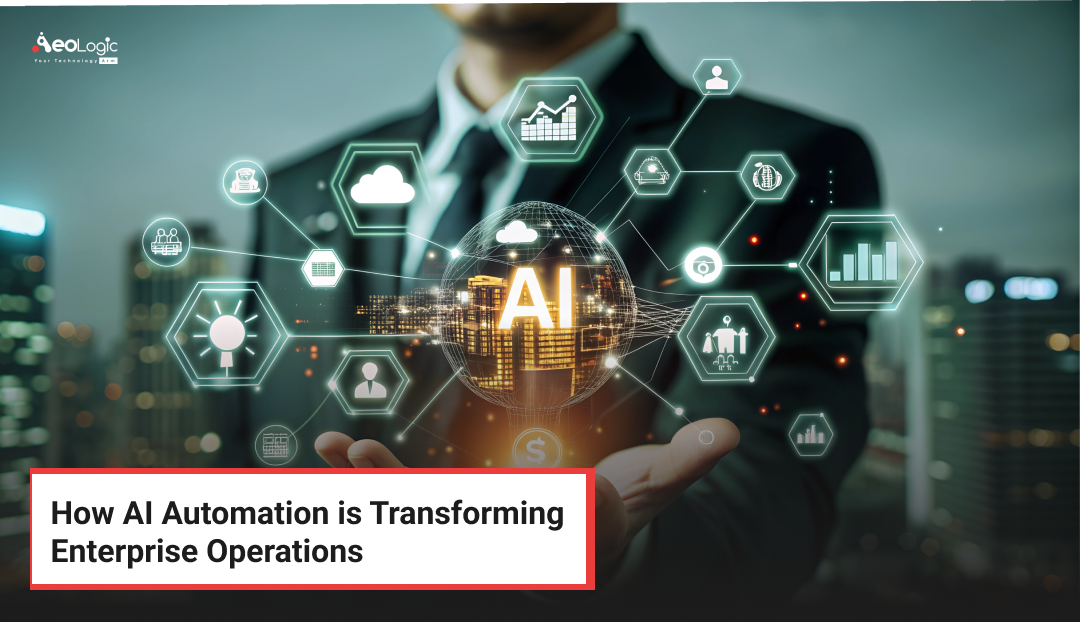
In 2026, enterprises are no longer experimenting with artificial intelligence—they are scaling it across their core processes. AI Automation in Enterprise Operations has become a strategic necessity rather than a technological upgrade. Organizations across industries are leveraging intelligent automation to streamline workflows, enhance decision-making, and reduce operational inefficiencies at scale.
As businesses face increasing pressure to deliver faster, operate leaner, and adapt to dynamic market demands, AI-driven automation provides a powerful solution. From supply chain optimization to customer experience transformation, enterprises are embedding AI into their operational DNA. This shift is not just about automation; it is about reimagining how enterprises function in a data-driven, intelligent ecosystem.
What is AI Automation in Enterprise Operations?
AI automation in enterprise operations refers to the integration of artificial intelligence technologies such as machine learning, natural language processing, and predictive analytics into business processes to automate tasks, improve efficiency, and enable intelligent decision-making.
Unlike traditional automation, which follows predefined rules, AI-driven systems learn from data, adapt to changing scenarios, and make informed decisions without constant human intervention. This makes enterprise operations more agile, scalable, and resilient in complex environments.
Enterprises use AI automation to handle both structured and unstructured processes, ranging from back-office functions like finance and HR to customer-facing operations such as support and engagement. The ability to continuously learn and optimize processes gives organizations a competitive edge in an increasingly digital-first economy.
Why AI Automation in Enterprise Operations Matters for Modern Businesses
The growing complexity of enterprise ecosystems demands smarter and faster decision-making. AI automation plays a critical role in addressing these challenges by enabling organizations to operate with greater precision and efficiency.
Modern enterprises generate massive volumes of data every second. Without intelligent systems, extracting meaningful insights from this data becomes nearly impossible. AI automation bridges this gap by analyzing patterns, predicting outcomes, and automating responses in real time.
Another significant factor is cost optimization. Enterprises are under constant pressure to reduce operational expenses while maintaining high performance. AI-driven automation reduces manual effort, minimizes errors, and improves resource utilization, resulting in measurable cost savings.
Additionally, customer expectations have evolved dramatically. Businesses must deliver personalized, seamless, and fast experiences across all touchpoints. AI automation enables enterprises to meet these expectations by providing real-time insights and automated responses tailored to individual customer needs.
Ultimately, the importance of AI automation lies in its ability to transform operations from reactive to proactive, enabling businesses to anticipate challenges and seize opportunities before competitors.
Core Components of AI-Driven Enterprise Automation
Enterprise AI automation is built on several foundational components that work together to deliver intelligent outcomes.
The first key component is data infrastructure. High-quality, structured, and accessible data is essential for training AI models and driving accurate insights. Enterprises must invest in robust data management systems to ensure reliability and scalability.
The second component is machine learning models. These models analyze historical and real-time data to identify patterns, make predictions, and continuously improve performance. They form the backbone of intelligent automation systems.
Another critical element is process orchestration. This involves integrating AI capabilities into existing workflows and ensuring seamless coordination across departments and systems. Effective orchestration enables end-to-end automation without disrupting business continuity.
Natural language processing is also a vital component, especially for customer-facing operations. It allows systems to understand and respond to human language, enabling chatbots, virtual assistants, and automated support systems.
Finally, governance and compliance frameworks ensure that AI systems operate ethically, securely, and in alignment with regulatory requirements. As enterprises scale automation, maintaining transparency and accountability becomes increasingly important.
 Key Strategies to Implement AI Automation Successfully
Enterprises cannot simply adopt AI technologies without a clear strategy. Successful implementation requires a structured approach that aligns with business goals and operational priorities.
Step 1: Identify High-Impact Use Cases
Organizations should begin by identifying processes that are repetitive, data-intensive, and prone to errors. These areas offer the highest potential for automation and immediate ROI.
Step 2: Build a Strong Data Foundation
Reliable data is the backbone of AI systems. Enterprises must ensure data quality, consistency, and accessibility across all departments to enable effective automation.
Step 3: Choose the Right Technologies
Selecting appropriate AI tools and platforms is crucial. Enterprises should evaluate solutions based on scalability, integration capabilities, and alignment with their operational needs.
Step 4: Integrate with Existing Systems
AI automation should complement existing workflows rather than replace them entirely. Seamless integration ensures minimal disruption and maximizes efficiency.
Step 5: Train and Upskill Workforce
Employees must be equipped with the skills to work alongside AI systems. Training programs and change management initiatives play a key role in successful adoption.
Step 6: Monitor, Optimize, and Scale
Continuous monitoring and optimization are essential for maintaining performance. Enterprises should regularly evaluate outcomes and scale successful implementations across the organization.
Benefits of AI Automation in Enterprise Operations
AI automation offers a wide range of benefits that directly impact enterprise performance and growth.
It significantly improves operational efficiency by automating repetitive tasks and reducing manual intervention. This allows employees to focus on strategic and value-driven activities.
Decision-making becomes faster and more accurate as AI systems analyze large datasets and provide actionable insights in real time.
Cost reduction is another major advantage. By minimizing errors and optimizing resource utilization, enterprises can achieve substantial savings across operations.
Customer experience is enhanced through personalized interactions and faster response times. AI systems can anticipate customer needs and deliver tailored solutions.
Scalability is also a key benefit. AI-driven automation allows enterprises to handle increased workloads without proportionally increasing resources.
Finally, it fosters innovation by enabling organizations to experiment with new business models and technologies without significant risk.
Real-World Use Cases and Applications
AI automation is transforming enterprise operations across various industries, delivering measurable outcomes and driving innovation.
In the manufacturing sector, companies use AI to predict equipment failures and optimize production schedules. Predictive maintenance reduces downtime and improves overall efficiency.
In the banking and financial services industry, AI automation streamlines processes such as fraud detection, loan approvals, and customer onboarding. Intelligent systems analyze transaction patterns to identify anomalies and prevent fraud in real time.
Healthcare organizations leverage AI to automate administrative tasks, analyze patient data, and improve diagnostic accuracy. This leads to better patient outcomes and more efficient healthcare delivery.
Retail enterprises use AI-driven automation to manage inventory, forecast demand, and personalize customer experiences. By analyzing consumer behavior, businesses can optimize pricing and marketing strategies.
In logistics and supply chain management, AI systems enhance route optimization, demand forecasting, and warehouse operations, ensuring faster and more reliable deliveries.
Technologies Powering AI Automation
Several advanced technologies enable AI automation in enterprise environments, each contributing to different aspects of operational transformation.
Machine learning algorithms form the core of AI systems, enabling predictive analytics and continuous improvement.
Robotic process automation integrates with AI to automate rule-based tasks while adding intelligence to decision-making processes.
Cloud computing provides the scalability and flexibility required to deploy AI solutions across large enterprise ecosystems.
Edge computing enhances real-time decision-making by processing data closer to the source, reducing latency and improving performance.
Advanced analytics platforms enable organizations to derive insights from complex datasets, supporting data-driven strategies and operations.
Challenges and Common Mistakes
Despite its benefits, implementing AI automation comes with challenges that enterprises must address carefully.
One common issue is poor data quality. Inaccurate or incomplete data can lead to unreliable outcomes and reduced effectiveness of AI systems.
Another challenge is resistance to change within the organization. Employees may be hesitant to adopt new technologies, making change management essential.
Integration complexities can also pose significant hurdles. Ensuring compatibility between AI systems and existing infrastructure requires careful planning and execution.
Security and privacy concerns are critical, especially when dealing with sensitive data. Enterprises must implement robust security measures to protect their systems and comply with regulations.
Over-automation is another mistake organizations should avoid. Not all processes require automation, and excessive reliance on AI can lead to inefficiencies and loss of human oversight.
Best Practices for Enterprise Success
To maximize the value of AI automation, enterprises should follow best practices that ensure sustainable and scalable implementation.
Organizations should adopt a phased approach, starting with pilot projects and gradually expanding to larger deployments.
Collaboration between business and technology teams is essential for aligning AI initiatives with organizational goals.
Continuous learning and improvement should be embedded into the process, enabling systems to evolve and adapt over time.
Transparency and ethical considerations must be prioritized to build trust among stakeholders and ensure responsible use of AI technologies.
Enterprises should also focus on measuring performance through key metrics, allowing them to track progress and identify areas for improvement.
Future Trends Shaping AI Automation in Enterprise Operations
The future of enterprise automation is being shaped by several emerging trends that will redefine how businesses operate.
Hyperautomation is gaining momentum, combining AI, machine learning, and process automation to create fully automated enterprise ecosystems.
Generative AI is enabling new capabilities, such as automated content creation, code generation, and advanced data analysis.
Autonomous systems are becoming more prevalent, allowing enterprises to operate with minimal human intervention in certain areas.
The integration of AI with Internet of Things devices is driving smarter operations, particularly in manufacturing and logistics.
Ethical AI and governance frameworks are also becoming more important as organizations strive to ensure transparency and accountability in their AI initiatives.
Conclusion
AI-driven transformation is no longer optional for enterprises aiming to stay competitive in 2026. AI Automation in Enterprise Operations is redefining how organizations function by enabling smarter processes, faster decision-making, and scalable growth.
Enterprises that embrace this transformation strategically will unlock new levels of efficiency and innovation. By investing in the right technologies, building strong data foundations, and fostering a culture of continuous improvement, businesses can fully realize the potential of AI automation.
If your organization is looking to implement intelligent automation solutions and transform operations at scale, partnering with experts like Aeologic Technologies can help you navigate this journey with confidence and achieve measurable business outcomes.
People Also Ask (FAQs)
Q1. What is AI automation in enterprise operations?
AI Automation in Enterprise Operations refers to the use of artificial intelligence technologies to automate business processes, improve efficiency, and enable intelligent decision-making. It goes beyond traditional automation by incorporating learning capabilities, allowing systems to adapt and improve over time. Enterprises use it to streamline workflows, reduce costs, and enhance overall productivity. By integrating AI into operations, businesses can transform how they manage resources, interact with customers, and respond to market changes.
Q2. How does AI automation improve business efficiency?
AI automation improves efficiency by eliminating repetitive tasks, reducing human errors, and accelerating process execution. It enables real-time data analysis, allowing organizations to make faster and more informed decisions. By automating workflows, enterprises can optimize resource utilization and focus on strategic initiatives. This results in increased productivity, reduced operational costs, and improved overall performance.
Q3. What industries benefit the most from AI automation?
Industries such as manufacturing, healthcare, finance, retail, and logistics benefit significantly from AI automation. In manufacturing, it enhances production efficiency and predictive maintenance. In healthcare, it improves patient care and administrative processes. Financial institutions use it for fraud detection and risk management, while retailers leverage it for personalized experiences and inventory optimization. Logistics companies benefit from improved supply chain efficiency and route optimization.
Q4. What are the challenges of implementing AI automation?
Implementing AI automation involves challenges such as data quality issues, integration complexities, and resistance to change. Enterprises must ensure that their data is accurate and accessible for effective AI implementation. Integration with existing systems can be complex and requires careful planning. Additionally, organizations must address employee concerns and provide training to ensure successful adoption of AI technologies.
Q5. Is AI automation expensive for enterprises?
The initial investment in AI automation can be significant, but the long-term benefits often outweigh the costs. Enterprises can achieve substantial savings through improved efficiency, reduced errors, and optimized resource utilization. Cloud-based solutions and scalable platforms also make AI more accessible and cost-effective for organizations of all sizes.
Q6. How will AI automation evolve in the future?
AI automation is expected to evolve with advancements in technologies such as generative AI, hyperautomation, and autonomous systems. These innovations will enable more sophisticated and intelligent operations, allowing enterprises to achieve higher levels of efficiency and innovation. The focus will also shift towards ethical AI and governance to ensure responsible use of technology.

I’m a Software Developer with 9 years of experience building scalable web and mobile applications. Currently focused on React.js and React Native, I specialize in creating high-performance, user-friendly interfaces that drive business outcomes.
My background spans cross-platform development using Flutter, and native Android development, giving me a strong understanding of the entire mobile ecosystem. I’ve contributed to products in EdTech, Healthcare, and Enterprise SaaS—helping scale apps to 100K+ users and improving performance, reliability, and user engagement.
I’m passionate about clean architecture, modular design, and seamless user experiences. Whether it’s setting up robust state management with Redux Toolkit, optimizing API integrations with GraphQL/REST, or automating workflows with CI/CD pipelines (GitHub Actions)—I focus on writing maintainable code and delivering value to both users and stakeholders.